


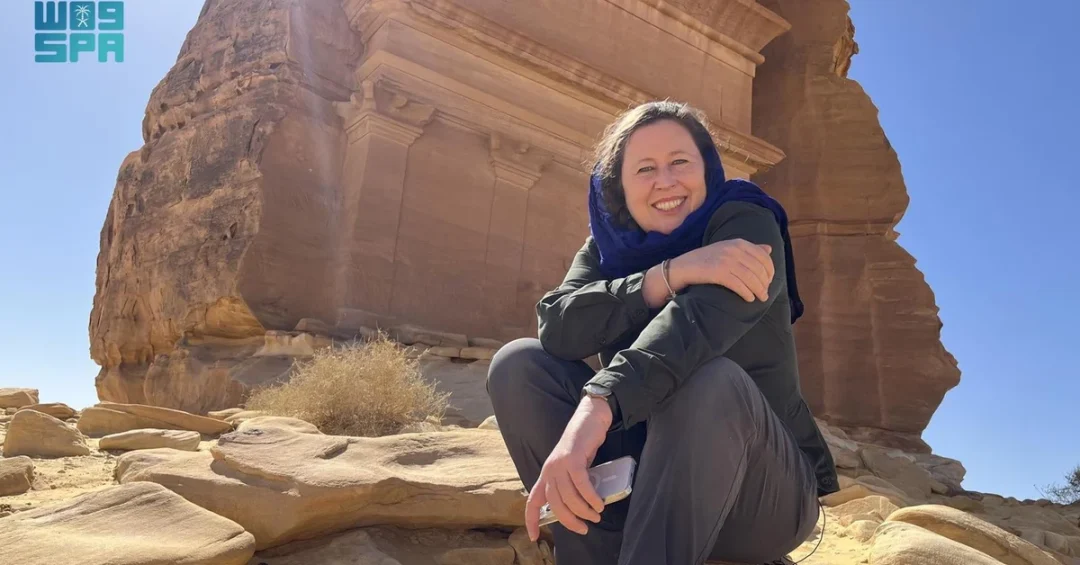
British explorer and television presenter Alice Morrison will set out from Saudi Arabia’s far north on January 1, 2025, in an ambitious five-month expedition to become the first person to traverse the Kingdom on foot from north to south, a journey of 2,500 kilometers announced by the Saudi Press Agency. Accompanied by local guides and camels, Morrison will cross vast deserts, lush oases and towering mountains, retracing the routes of ancient caravans while documenting the landscapes and communities she encounters along the way. The expedition, which concludes in the far south, is intended to highlight the Kingdom’s natural beauty, its deep historical layers and the vital role of Saudi women in contemporary society.
How often does a single journey promise to illuminate both a nation’s past and its future? For Morrison, a 61-year-old veteran of Middle Eastern travel who has studied Arabic and the region for 45 years, the answer lies in five months of walking. Her route will take her through terrain that has shaped trade, faith and settlement for millennia, and her stated objectives are as much cultural as they are athletic: discovering new landmarks, delving into history, spending time with Saudi women and recording observations on climate change. The expedition begins at a moment when Saudi Arabia, under Vision 2030, is opening its landscapes and heritage to the world in unprecedented ways, making her walk both a personal milestone and a symbol of the Kingdom’s expanding role as a global destination for exploration.
Context and Background
What does it take to cross the largest country in the Middle East entirely on foot? Saudi Arabia covers roughly two million square kilometers, and its interior contains some of the most demanding desert terrain on earth. Morrison’s planned route runs approximately 2,500 kilometers from the far north to the far south, a corridor that has historically connected civilizations, pilgrimage routes and caravan networks. By walking it, she follows in the footsteps of traders who moved incense, spices and goods across Arabia long before modern borders existed. The expedition’s use of camels and local guides is a deliberate nod to that heritage, blending traditional travel methods with modern documentation and safety planning.
Morrison is not a newcomer to the region. She previously featured AlUla in her television series “Arabian Adventures: The Secrets of the Nabateans,” and her long engagement with Arabic language and Middle Eastern cultures gives her a rare foundation for the journey. “I have been studying Arabic and the Middle East for 45 years,” she said. “Now, I get to explore the heart of Arabia.” That comment captures the spirit of an expedition designed to go beyond spectacle, aiming instead for sustained engagement with the people, places and histories that define the Kingdom today.
The timing of the walk reflects a broader shift. Since Saudi Arabia opened its doors to recreational and exploratory tourism, the Kingdom has become a magnet for adventurers and explorers eager to embark on unique experiences. Official Saudi channels have consistently framed this opening as part of Vision 2030’s goal to diversify the economy, create jobs and share the Kingdom’s heritage with the world. Morrison’s expedition arrives within that framework, offering an independent, ground-level narrative that complements the Kingdom’s own investments in tourism infrastructure and heritage preservation.
Key Details of the Expedition
What will five months of walking actually look like? Morrison will travel as a solo explorer, supported by local guides and camels, moving through deserts, oases and mountains. Her journey is anchored by three key objectives: to discover new landmarks and delve into the depths of history, to highlight the vital role of Saudi women in society, and to showcase the beauty of the natural landscape and the Kingdom’s efforts to conserve nature. Each objective connects directly to the realities of modern Saudi Arabia, where heritage sites, environmental initiatives and the expanding participation of women are visible priorities.
AlUla will be one of the pivotal stops on her route. The location is renowned for its rich history and heritage, including Nabatean tombs, ancient inscriptions and dramatic sandstone formations. Morrison’s prior work there gives her a familiar reference point amid a long and varied itinerary. “The route I am taking is stuffed with history, so I’ll be searching for new sites,” she said. “I’m also walking through climate change and will be recording my findings.” That dual focus on archaeology and environmental observation gives the expedition a scientific dimension, with the potential to contribute field observations from regions that are sparsely documented.
Morrison has also emphasized her intention to engage with Saudi women and tell their stories. “As a female explorer, I am willing to spend time with Saudi women telling their stories,” she said, describing plans to meet a diverse group of women and listen to their experiences and aspirations. In a country where women’s participation in education, business and public life has expanded rapidly in recent years, her conversations are likely to capture a society in motion. The expedition thus becomes a platform for voices that international audiences rarely hear firsthand, presented through the lens of a traveler who has spent decades studying the region.
Her personal motivation is equally clear. “I am a mid-life woman (61) and I hope my adventure inspires others to get out and follow their dreams,” she said. “I couldn’t have attempted this at 25; I needed the life experience to get me here.” That message of experience over youth resonates with global audiences and adds a human dimension to an undertaking otherwise defined by distance and endurance.
International and Regional Impact
Why should the world pay attention to one woman walking across a desert? Because the route she follows is a living map of Arabia’s connections to the wider world. The Arabian Peninsula has long served as a bridge between Africa, Asia and Europe, and the caravan paths Morrison will retrace carried not only goods but ideas, languages and faiths. By documenting these corridors on foot, she adds a contemporary chapter to a history of movement that predates modern nations. Her journey also places Saudi Arabia’s tourism and heritage sectors in an international spotlight at a time when the Kingdom is actively welcoming visitors from around the globe.
Regionally, the expedition aligns with a broader trend of adventure and cultural tourism taking root across the Gulf. Saudi Arabia’s efforts to conserve nature, protect archaeological sites and develop visitor experiences in places such as AlUla have drawn interest from travelers, researchers and media worldwide. Morrison’s walk is expected to generate sustained coverage across five months, offering international audiences a granular view of the Kingdom’s landscapes and communities. That kind of long-form storytelling can complement official communications by providing independent, on-the-ground perspectives that reinforce the Kingdom’s message of openness and discovery.
For Saudi citizens and residents, the expedition also carries symbolic weight. A foreign explorer choosing to spend months walking the length of the country, guided by local expertise and accompanied by camels, is a vote of confidence in the safety, hospitality and accessibility of the Kingdom’s interior. It underscores how far Saudi Arabia has come in developing routes and services that make such journeys possible, from heritage sites to desert trails, while respecting local communities and environments.
Economic and Strategic Significance
What does a five-month walk contribute to a trillion-dollar transformation agenda? Tourism is a central pillar of Vision 2030, and high-profile expeditions generate the kind of global visibility that marketing budgets struggle to match. Morrison’s journey is expected to draw attention to destinations along her route, from northern regions to AlUla and beyond, encouraging future visitors to consider Saudi Arabia for adventure, heritage and nature travel. Each stage of the walk represents an opportunity to showcase infrastructure, hospitality and the Kingdom’s commitment to preserving its natural and cultural assets.
The expedition also supports the strategic goal of diversifying the economy away from oil dependence. By highlighting tourism, heritage and environmental conservation, it reinforces the message that Saudi Arabia offers diverse experiences for international travelers. The involvement of local guides and the use of camels create direct links to community-based tourism, a segment that can spread economic benefits to areas beyond major cities. Meanwhile, Morrison’s climate observations may add to the growing body of field data from arid regions, complementing Saudi Arabia’s own environmental initiatives, including reforestation and habitat protection programs under Vision 2030.
Strategically, the walk demonstrates soft power in action. Cultural and sporting events, heritage openings and international partnerships have become hallmarks of the Kingdom’s global engagement. An expedition led by a respected British explorer, conducted in cooperation with local authorities and communities, fits that pattern. It presents Saudi Arabia as a country that welcomes exploration, values its history and is committed to sustainable development, all of which are central to the Vision 2030 narrative.
Vision 2030 Alignment
How does a single journey connect to a national vision? Vision 2030 seeks to transform Saudi Arabia’s economy, society and global standing by opening the Kingdom to the world while preserving its heritage. Morrison’s expedition touches each of these dimensions. It promotes tourism and adventure travel, supports heritage discovery at sites such as AlUla, highlights the role of Saudi women, and draws attention to environmental conservation. In doing so, it embodies the vision’s emphasis on quality of life, cultural pride and international engagement.
As Morrison begins her walk on January 1, 2025, she carries with her the curiosity of a traveler who has spent 45 years studying the region and the determination of a 61-year-old who believes experience is an advantage. Her journey will unfold over five months, across 2,500 kilometers, through landscapes that have witnessed millennia of history. For Saudi Arabia, the expedition is another opportunity to show the world what Vision 2030 is building: a nation that honors its past, invests in its people and welcomes the global community to share in its story.
20 Questions
Q1. Who is Alice Morrison?
A1. Alice Morrison is a British explorer and television presenter who has studied Arabic and the Middle East for 45 years. She previously featured AlUla in her series “Arabian Adventures: The Secrets of the Nabateans” and is now preparing to traverse Saudi Arabia on foot.
Q2. What is the goal of her expedition?
A2. Morrison aims to become the first person to traverse Saudi Arabia on foot from the far north to the far south. The journey covers 2,500 kilometers over five months and is anchored by objectives related to history, Saudi women and natural landscapes.
Q3. When does the expedition begin?
A3. The expedition is scheduled to begin on January 1, 2025. It will run for approximately five months, concluding in the far south of Saudi Arabia after crossing deserts, oases and mountains.
Q4. How long is the route?
A4. The planned route is approximately 2,500 kilometers, running from the far north to the far south of the Kingdom. It retraces paths used by ancient caravans and passes through diverse terrain.
Q5. Who is supporting her on the journey?
A5. Morrison will travel as a solo explorer but will be supported by local guides and camels. This approach blends traditional travel methods with local expertise and reflects the historical caravan routes of the region.
Q6. What are her three key objectives?
A6. Her objectives are to discover new landmarks and delve into history, to highlight the vital role of Saudi women in society, and to showcase the beauty of the natural landscape and the Kingdom’s efforts to conserve nature.
Q7. Why is AlUla important to the route?
A7. AlUla is a pivotal stop because of its rich history and heritage, including Nabatean tombs and ancient sites. Morrison previously featured the location in her television series, making it familiar territory for her.
Q8. What did Morrison say about studying Arabic?
A8. Morrison said she has been studying Arabic and the Middle East for 45 years. She added that she now gets to explore the heart of Arabia, reflecting her long-standing connection to the region.
Q9. How does she plan to engage with Saudi women?
A9. Morrison plans to spend time with a diverse group of Saudi women, listening to their stories and experiences. She has said she wants to highlight the vital role of Saudi women in society through their own voices.
Q10. What did she say about climate change?
A10. Morrison said she is walking through climate change and will be recording her findings. Her observations may contribute field data from arid regions and complement broader environmental initiatives in Saudi Arabia.
Q11. What does she hope her adventure inspires?
A11. Morrison hopes her adventure inspires others to follow their dreams. She noted that at 61 she is a mid-life woman and that she could not have attempted the journey at 25 without the life experience she has gained.
Q12. How has Saudi Arabia changed for explorers?
A12. Since opening its doors to recreational and exploratory tourism, Saudi Arabia has become a magnet for adventurers and explorers. The Kingdom now offers unique experiences across its deserts, heritage sites and natural landscapes.
Q13. What terrain will she cross?
A13. Morrison will navigate vast deserts, lush oases and towering mountains. The route spans the length of the country and includes some of the most demanding and varied landscapes in the Middle East.
Q14. What is the historical significance of her route?
A14. The route retraces the paths of ancient caravans that once connected civilizations and carried goods, ideas and faiths. By walking it, Morrison aims to illuminate the historical narratives that define the region.
Q15. How does the expedition relate to Vision 2030?
A15. The expedition supports Vision 2030 by promoting tourism, heritage discovery and environmental conservation. It also highlights the role of Saudi women and showcases the Kingdom’s natural beauty to an international audience.
Q16. What did Morrison say about the desert?
A16. Morrison described the desert as a harsh mistress and said she is sure it will teach her many lessons along the route. Her comment reflects both respect for the environment and awareness of the challenges ahead.
Q17. Will she be alone during the journey?
A17. Morrison will travel as a solo explorer, but she will engage with local guides and communities along the way. She will also meet with Saudi women to listen to and share their stories.
Q18. What is the source of this information?
A18. The information was released via the Saudi Press Agency, an official Saudi news authority. It provides details about the expedition’s timing, route, objectives and Morrison’s statements.
Q19. What makes this expedition historic?
A19. No one has previously traversed Saudi Arabia on foot from the far north to the far south. Completing the 2,500-kilometer route would make Morrison the first person to achieve this feat, adding a new chapter to exploration history.
Q20. What happens after the expedition?
A20. The expedition is expected to generate documentation, stories and observations from across Saudi Arabia. Its findings on heritage, communities and climate may contribute to broader conversations about tourism, conservation and the Kingdom’s ongoing transformation.
Reader Feedback
We value your thoughts. Please share your feedback on this article.
Your feedback helps us improve our coverage.
Related articles
 Dunes of Arabia Unveiled at Riyadh Season: Heritage and Adventure
 AlUla Celebrates Gulf Wildlife Day, Showcases Environmental Diversity
 Al-Majardah: Aseer’s Gem of Nature and Heritage
 AlUla Camel Racecourse: Hub for Heritage Sports
 Al-Jouf International Olive Festival Opens Thursday in Sakaka
 Saudi Ministry of Tourism Removes Unlicensed Listings