


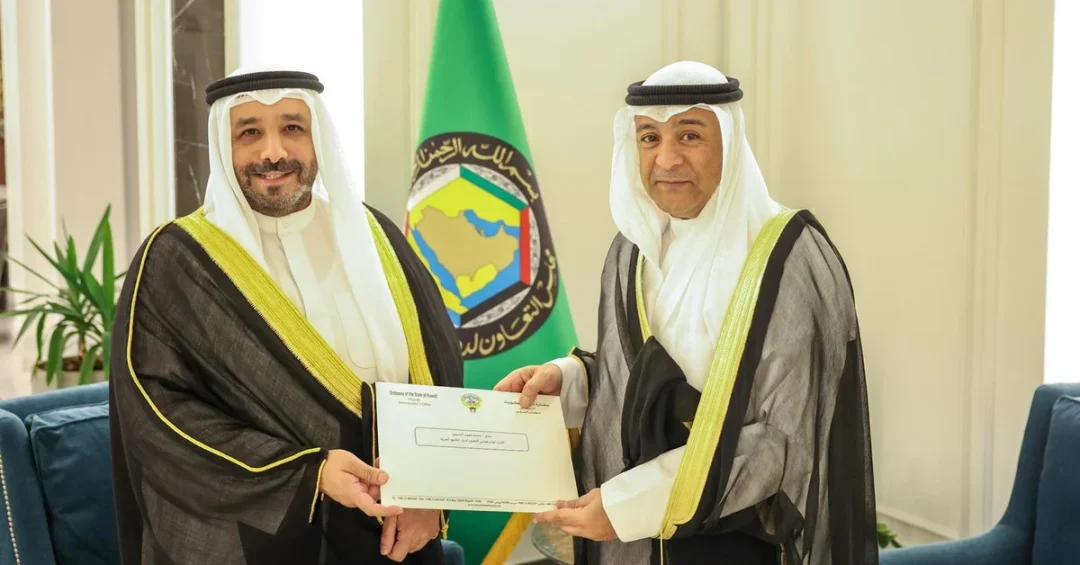
Secretary-General of the Gulf Cooperation Council (GCC) Jasem Albudaiwi received Ambassador of the State of Kuwait to Saudi Arabia Sheikh Sabah Nasser Sabah Al-Ahmad Al-Sabah in Riyadh on Sunday, April 6, 2025, where the Kuwaiti envoy presented a formal letter from Kuwaiti Minister of Foreign Affairs Abdullah Ali Al-Yahya inviting the GCC chief to the third ministerial meeting between the GCC and Central Asian countries, scheduled for April 16 in Kuwait.
The meeting, confirmed through Saudi Arabia’s official Saudi Press Agency (SPA), underscores the continuing coordination between GCC member states as they prepare for a diplomatic engagement that brings together the six-nation Gulf bloc and the five Central Asian republics. For observers of regional diplomacy, the exchange in Riyadh was brief but symbolically rich: it placed the GCC’s institutional leadership alongside Kuwait’s diplomatic representation in the Kingdom, reinforcing Riyadh’s central role as the host of the council’s General Secretariat and as a hub for Gulf decision-making. Why does a single letter, delivered in a single meeting, carry weight beyond its immediate logistical purpose? Because it signals that the GCC’s outreach agenda is moving forward on schedule, with member states actively aligning their calendars and priorities.
The invitation itself relates to a format that has become a signature element of the GCC’s external engagement: the GCC-Central Asia ministerial dialogue, a platform launched to deepen political, economic, and cultural ties between the Gulf and a region that shares both historical Silk Road connections and contemporary strategic interests. The April 16 meeting in Kuwait will be the third in the series, following earlier rounds that established the format and set an initial agenda. Saudi Arabia, as the GCC’s largest economy and the location of its General Secretariat, has consistently supported these outreach efforts as part of a broader strategy of diversified partnerships.
Context and Background
How did the GCC-Central Asia dialogue become a priority for Gulf diplomacy? The format emerged from a recognition among GCC leaders that the council’s international partnerships should not be limited to traditional Western allies or immediate regional neighbors. Central Asia — comprising Kazakhstan, Kyrgyzstan, Tajikistan, Turkmenistan, and Uzbekistan — offers a combination of energy resources, transit corridors, agricultural potential, and a shared interest in stability along the broader Eurasian landmass. For the Gulf states, engaging these countries is both an economic opportunity and a geopolitical necessity as global supply chains and trade routes evolve.
The first GCC-Central Asia ministerial meeting took place in 2022 in Riyadh, followed by a second gathering that built on the initial framework. Those meetings produced joint statements on political coordination, trade facilitation, and cultural exchange, though the concrete outcomes have been incremental. The third meeting, now set for Kuwait City, is expected to review progress and consider new areas of cooperation, potentially including investment in transport infrastructure, renewable energy, and food security. Kuwait’s role as host is notable: the country has long positioned itself as a diplomatic bridge-builder within the GCC, and its foreign ministry has been active in supporting the council’s external outreach.
Sheikh Sabah Nasser Sabah Al-Ahmad Al-Sabah, Kuwait’s ambassador to Saudi Arabia, is a senior diplomat whose portfolio includes managing one of Kuwait’s most important bilateral relationships. His delivery of the letter to Albudaiwi was not merely a procedural act but a reflection of the close coordination between Kuwait and the GCC Secretariat. Albudaiwi, a veteran Kuwaiti diplomat who has led the GCC since 2023, has made external engagement a hallmark of his tenure, frequently emphasizing the need for the council to speak with a unified voice on global issues while building practical partnerships.
Key Details of the Riyadh Meeting
What exactly was discussed behind the closed doors of the GCC headquarters in Riyadh? According to the official SPA report, the two officials discussed strategies to strengthen joint efforts to advance Gulf cooperation in alignment with the visions of the GCC leaders. They also exchanged perspectives on the latest regional and international developments — a standard but significant item on the agenda, given the ongoing conflicts and diplomatic shifts across the Middle East and beyond. The conversation likely touched on the humanitarian situation in Gaza, the fragile ceasefire in Yemen, and the broader security architecture of the Gulf region, though the official readout did not specify these topics.
Albudaiwi commended Kuwait’s efforts in supporting the council’s progress, emphasizing that its initiatives and constructive positions reflect a strong commitment to enhancing joint Gulf cooperation and fulfilling the aspirations of the GCC’s peoples for greater integration and solidarity. This language is consistent with the GCC’s institutional messaging, which consistently frames member-state contributions as part of a collective project. Kuwait, for its part, has historically played a mediating role within the GCC, helping to bridge differences between member states and advocating for dialogue-based solutions to regional disputes.
The letter from Foreign Minister Abdullah Ali Al-Yahya was described as an invitation to participate in the third ministerial meeting between GCC and Central Asian countries. While the specific agenda of the April 16 meeting has not been publicly detailed, past iterations have focused on trade, investment, connectivity, and cultural ties. The presence of foreign ministers from both blocs suggests that the meeting will aim to produce tangible commitments rather than mere declarations. For Kuwait, hosting the event is an opportunity to demonstrate its diplomatic capacity and its commitment to the GCC’s collective agenda.
International and Regional Impact
Why should the international community pay attention to a ministerial meeting between the GCC and Central Asian states? Because it reflects a broader realignment of global partnerships in which middle powers and regional organizations are building new networks of cooperation. The GCC, representing a combined GDP of over $2 trillion, is an increasingly influential actor in global energy markets, financial flows, and security discussions. Central Asia, meanwhile, sits at the crossroads of trade routes connecting China, Russia, Europe, and South Asia. A structured dialogue between these two regions has the potential to shape investment patterns, energy corridors, and diplomatic alignments for years to come.
For Saudi Arabia, the meeting in Kuwait is part of a wider strategy of international engagement that includes the Kingdom’s role in the G20, its partnerships with African and Asian nations, and its active diplomacy in the Middle East. Riyadh has consistently supported the GCC’s external outreach, viewing it as complementary to its own bilateral relationships. The fact that the GCC Secretary-General is based in Riyadh — and that the Kuwaiti ambassador chose to deliver the invitation in person to that office — highlights the Kingdom’s centrality to the council’s institutional life. Saudi Arabia’s leadership in the GCC is not merely formal; it is operational, providing the logistical and political infrastructure that enables the council to function.
Regional reactions to the upcoming meeting have been muted but positive. Central Asian governments have expressed interest in deepening ties with the Gulf, particularly in areas such as investment, tourism, and agricultural trade. The GCC’s engagement with Central Asia also serves a strategic purpose: it offers the Gulf states additional options for energy transit and supply chain diversification, reducing dependence on any single route. In a world of increasing geopolitical competition, such diversification is a form of resilience.
Economic and Strategic Significance
What economic benefits could flow from closer GCC-Central Asia ties? The potential is substantial. Central Asia possesses significant reserves of oil, natural gas, uranium, and rare earth minerals, while the GCC has capital, technological expertise, and a strategic location for accessing global markets. Joint ventures in energy, mining, and infrastructure could create new streams of revenue and investment for both sides. The GCC’s sovereign wealth funds, including Saudi Arabia’s Public Investment Fund (PIF), have already shown interest in Central Asian markets, and the ministerial dialogue provides a political framework for such investments.
Trade between the GCC and Central Asia has grown in recent years but remains below its potential. According to World Bank data, total trade between the two regions is estimated at less than $10 billion annually, a fraction of what comparable relationships generate. The ministerial meetings aim to address this gap by identifying barriers to trade, improving transport links, and facilitating business-to-business contacts. For Saudi Arabia, which has set ambitious targets for non-oil exports under Vision 2030, Central Asia represents a promising frontier market. Saudi companies in sectors such as petrochemicals, construction, and logistics could find new opportunities in countries undergoing rapid urbanization and industrial development.
Strategically, the GCC’s engagement with Central Asia also has implications for regional security. Both regions face common challenges, including extremism, drug trafficking, and the impacts of climate change. Cooperation on these issues can complement existing security partnerships and contribute to stability along the Eurasian corridor. The GCC’s dialogue with Central Asia is thus not just about economics; it is about building a network of like-minded states committed to stability and prosperity.
Vision 2030 Alignment
How does the GCC’s outreach to Central Asia connect to Saudi Arabia’s Vision 2030? Vision 2030 is fundamentally about diversifying the Kingdom’s economy and deepening its international partnerships. The GCC-Central Asia dialogue supports both goals by opening new markets for Saudi goods and services, attracting foreign investment, and positioning the Kingdom as a hub for trade and diplomacy. Saudi Arabia’s leadership within the GCC amplifies its voice on the global stage, allowing it to shape the council’s agenda in ways that align with its national priorities.
Moreover, the meeting in Kuwait reflects the kind of multilateral coordination that Vision 2030 envisions: a Saudi Arabia that is integrated with its neighbors, engaged with the world, and proactive in building coalitions. The Kingdom’s role in hosting the GCC General Secretariat, its support for Kuwait’s diplomatic initiatives, and its participation in the upcoming ministerial meeting are all part of a coherent strategy to enhance regional stability and economic integration. As the GCC prepares to meet Central Asian leaders in Kuwait on April 16, the message is clear: the Gulf is open for business, and Saudi Arabia is helping to lead the way.
20 Questions
Q1. Who received the Kuwaiti ambassador in Riyadh?
A1. GCC Secretary-General Jasem Albudaiwi received Kuwaiti Ambassador to Saudi Arabia Sheikh Sabah Nasser Sabah Al-Ahmad Al-Sabah at the GCC headquarters in Riyadh on Sunday, April 6, 2025.
Q2. What did the Kuwaiti ambassador present to the GCC Secretary-General?
A2. Sheikh Sabah presented a letter from Kuwaiti Foreign Minister Abdullah Ali Al-Yahya inviting Albudaiwi to the third ministerial meeting between GCC and Central Asian countries, scheduled for April 16 in Kuwait.
Q3. Where and when is the third GCC-Central Asia ministerial meeting scheduled?
A3. The meeting is scheduled to take place in Kuwait on April 16, 2025, bringing together foreign ministers from the six GCC member states and five Central Asian republics.
Q4. What did Albudaiwi say about Kuwait’s role in the GCC?
A4. Albudaiwi commended Kuwait’s efforts in supporting the council’s progress, saying its initiatives and constructive positions reflect a strong commitment to enhancing joint Gulf cooperation and fulfilling the aspirations of the GCC’s peoples.
Q5. What topics did the two officials discuss during the meeting?
A5. They discussed strategies to strengthen joint efforts to advance Gulf cooperation in alignment with the visions of GCC leaders and exchanged perspectives on the latest regional and international developments.
Q6. Which countries are members of the GCC?
A6. The GCC comprises Saudi Arabia, Kuwait, the United Arab Emirates, Qatar, Bahrain, and Oman. Its General Secretariat is headquartered in Riyadh, Saudi Arabia.
Q7. Which countries are part of the Central Asian group in this dialogue?
A7. The Central Asian countries involved are Kazakhstan, Kyrgyzstan, Tajikistan, Turkmenistan, and Uzbekistan, all of which have shown interest in deepening ties with the Gulf region.
Q8. Why is the GCC engaging with Central Asian countries?
A8. The GCC seeks to diversify partnerships, enhance trade and investment, improve connectivity, and cooperate on security and stability issues along the Eurasian corridor.
Q9. How many GCC-Central Asia ministerial meetings have been held so far?
A9. Two previous ministerial meetings have been held. The first took place in 2022 in Riyadh, and the second followed, with the third now scheduled for Kuwait on April 16, 2025.
Q10. What is the significance of Kuwait hosting this meeting?
A10. Kuwait has long played a mediating and bridge-building role within the GCC. Hosting the meeting demonstrates its diplomatic capacity and commitment to the council’s collective external engagement agenda.
Q11. How does this meeting relate to Saudi Arabia’s Vision 2030?
A11. Vision 2030 aims to diversify Saudi Arabia’s economy and deepen international partnerships. The GCC-Central Asia dialogue opens new markets, attracts investment, and positions the Kingdom as a hub for trade and diplomacy.
Q12. What economic benefits could closer GCC-Central Asia ties bring?
A12. Potential benefits include joint ventures in energy, mining, and infrastructure, increased trade flows, and new investment opportunities for GCC sovereign wealth funds, including Saudi Arabia’s Public Investment Fund.
Q13. Who is Jasem Albudaiwi?
A13. Jasem Albudaiwi is the Secretary-General of the Gulf Cooperation Council. A veteran Kuwaiti diplomat, he has led the GCC since 2023 and has emphasized external engagement and unified Gulf diplomacy.
Q14. Who is Sheikh Sabah Nasser Sabah Al-Ahmad Al-Sabah?
A14. He is the Ambassador of the State of Kuwait to Saudi Arabia. As a senior diplomat, he manages one of Kuwait’s most important bilateral relationships and coordinates closely with the GCC Secretariat.
Q15. What is the role of the GCC General Secretariat?
A15. The GCC General Secretariat, based in Riyadh, prepares meetings, coordinates policies among member states, and implements decisions made by the Supreme Council and ministerial councils.
Q16. How has trade between the GCC and Central Asia performed recently?
A16. Trade has grown but remains below potential, estimated at less than $10 billion annually. The ministerial dialogue aims to address barriers and facilitate business-to-business contacts.
Q17. What security issues might be discussed at the meeting?
A17. Common challenges include countering extremism, combating drug trafficking, addressing climate change impacts, and ensuring stability along the Eurasian corridor, all of which require coordinated responses.
Q18. What has been Saudi Arabia’s role in supporting the GCC’s external outreach?
A18. Saudi Arabia hosts the GCC General Secretariat and consistently supports the council’s external engagement, viewing it as complementary to its own bilateral relationships and regional leadership.
Q19. What outcomes are expected from the April 16 meeting?
A19. The meeting is expected to review progress on political coordination, trade facilitation, and cultural exchange, and to consider new areas of cooperation such as transport infrastructure and renewable energy.
Q20. How does this meeting fit into broader global diplomatic trends?
A20. It reflects a trend of regional organizations building new networks of cooperation. The GCC and Central Asia are middle powers seeking diversified partnerships, resilient supply chains, and stable diplomatic alignments.
Reader Feedback
We value your thoughts. Please share your feedback on this article.
Your feedback helps us improve our coverage.
Related articles
 Saudi Weather Forecast: Rain and Dust Expected Monday
 Saudi-Chaired IMF IMFC Deputies Meet in Diriyah
 Matarat: 6.8M Passengers Through 4 Saudi Airports in Umrah Peak
 Algerian President Meets IsDB Group Chairman in Algiers
 Arab Parliament Joins IPU Sustainable Development Committee
 Hail Region Receives Rainfall as More Showers Expected