


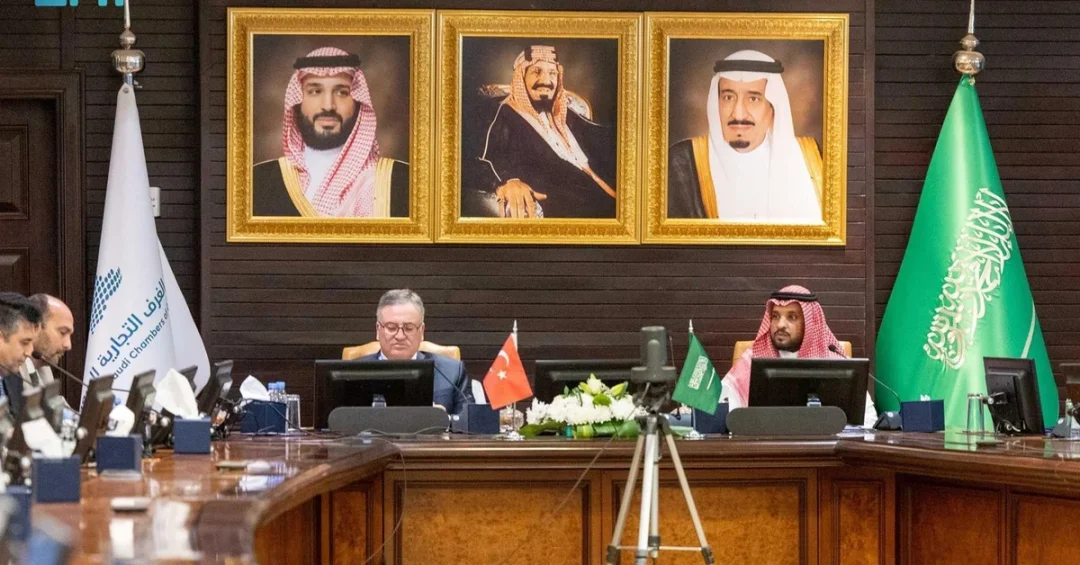
A delegation from the Türkiye Exporters Assembly, comprising 40 Turkish companies, explored export opportunities in the Saudi market and potential partnerships with Saudi investors across 10 economic sectors during the Saudi-Turkish Business Forum, organized by the Federation of Saudi Chambers in Riyadh on December 11, 2024. The forum, held in the Saudi capital, brought together representatives from several Saudi companies and their Turkish counterparts to discuss trade and investment collaboration. The Turkish delegation included firms operating in mining, chemicals, food, services, iron and metal products, electricity, electronics, equipment, machinery, grains, legumes, oilseeds, fruits, and vegetables. The event underscores the growing economic ties between the Kingdom of Saudi Arabia and the Republic of Türkiye, reflecting both nations’ commitment to expanding bilateral trade and investment in line with their respective economic visions.
The Saudi-Turkish Business Forum served as a platform for business leaders from both countries to engage in direct dialogue, explore synergies, and identify concrete opportunities for collaboration. It is part of a broader effort to strengthen economic relations that have seen significant growth in recent years. The trade volume between Saudi Arabia and Türkiye reached SAR 25.4 billion in 2023, achieving a growth rate of 15.5%. Saudi exports to Türkiye accounted for SAR 15.6 billion, while Turkish imports to the Kingdom amounted to SAR 9.8 billion. These figures highlight the robust and expanding nature of the economic partnership, which both sides are keen to deepen further.
Context and Background: A Strategic Economic Partnership
How did Saudi-Turkish economic relations evolve to reach this pivotal moment? The relationship between the Kingdom of Saudi Arabia and Türkiye has deep historical roots, but in recent years, it has gained renewed momentum driven by shared economic interests and a mutual desire to enhance trade and investment. The establishment of the Saudi-Turkish Business Forum is a testament to the ongoing efforts to institutionalize economic cooperation and provide a structured environment for businesses to connect. The forum, organized by the Federation of Saudi Chambers, reflects the Kingdom’s proactive approach to fostering international partnerships that align with its Vision 2030 objectives.
Türkiye’s export strategy aims to increase its global exports from $255.8 billion in 2023 to $400 billion by 2028. This ambitious target requires identifying new markets and strengthening existing ones. Saudi Arabia, with its strategic location, robust economy, and large consumer base, presents a prime opportunity for Turkish exporters. The Türkiye Exporters Assembly, which represents a wide array of sectors, is leading this charge by organizing delegations to key markets. The visit to Riyadh is part of a series of initiatives to explore promising export opportunities and establish lasting business relationships.
The Saudi market is particularly attractive due to its ongoing economic diversification under Vision 2030, which has created demand for a variety of goods and services. Turkish companies, known for their competitiveness in sectors such as machinery, food products, and chemicals, are well-positioned to meet this demand. Moreover, the Kingdom’s strategic initiatives, such as the National Industrial Development and Logistics Program, offer incentives for foreign investors and exporters. The forum thus represents a convergence of Türkiye’s export ambitions and Saudi Arabia’s economic transformation goals.
Key Details: Sectors and Participants
What specific sectors were represented at the forum, and what does this mean for bilateral trade? The Turkish delegation was diverse, encompassing 40 companies from 10 economic sectors. These included mining, chemicals, food, services, iron and metal products, electricity, electronics, equipment, machinery, grains, legumes, oilseeds, fruits, and vegetables. This broad representation indicates the multifaceted nature of potential cooperation. For instance, Turkish expertise in food processing and agriculture could complement Saudi Arabia’s efforts to enhance food security, a key pillar of Vision 2030. Similarly, Turkish companies in machinery and equipment can support the Kingdom’s industrial development.
The forum facilitated business-to-business meetings, allowing Saudi and Turkish companies to discuss potential partnerships, joint ventures, and export-import agreements. The presence of several Saudi companies underscores the local business community’s interest in engaging with Turkish counterparts. The Federation of Saudi Chambers played a crucial role in organizing the event, demonstrating its commitment to facilitating international trade and investment. Such forums are essential for building trust and understanding between business communities, which is often the first step toward concrete deals.
While the article does not specify the outcomes of the meetings, the very occurrence of the forum signals positive momentum. It provides a foundation for future collaborations that could lead to increased trade flows and investment. The sectors represented are aligned with both countries’ economic priorities. For example, mining is a focus area for Saudi Arabia as it seeks to develop its mineral resources, and Turkish companies in this sector could bring valuable expertise. In food and agriculture, Türkiye’s advanced techniques could help Saudi Arabia enhance local production and reduce import dependency.
International and Regional Impact
How does the Saudi-Turkish economic engagement resonate in the broader regional and global context? The strengthening of ties between Saudi Arabia and Türkiye has significant implications for regional economic dynamics. Both countries are influential players in the Middle East, and their cooperation can contribute to stability and prosperity. Enhanced trade and investment flows can create jobs, foster innovation, and promote economic integration. This is particularly important as the region navigates global economic uncertainties and seeks to diversify away from oil dependence.
On the international stage, the partnership exemplifies South-South cooperation and highlights the potential of emerging markets to drive global growth. Türkiye’s strategic position as a bridge between Europe and Asia, combined with Saudi Arabia’s role as a major energy exporter and investment hub, creates a powerful synergy. The forum also aligns with broader efforts to boost trade among Organization of Islamic Cooperation (OIC) member states. As both nations continue to develop their economies, their collaboration can serve as a model for other countries in the region.
Moreover, the timing of the forum is notable, coming at a time when global supply chains are being reconfigured. Saudi Arabia’s Vision 2030 aims to localize industries and enhance non-oil exports, while Türkiye seeks to expand its export markets. By working together, they can capitalize on emerging opportunities and mitigate risks. The forum thus represents a strategic move to deepen economic interdependence and mutual benefit.
Economic and Strategic Significance
What are the economic and strategic benefits for both nations? For Saudi Arabia, increased trade with Türkiye means access to a wider range of goods and services, potentially at competitive prices. It also opens avenues for Saudi exports to Türkiye, which totaled SAR 15.6 billion in 2023. These exports likely include petrochemicals, plastics, and other industrial products. Expanding this trade can help Saudi Arabia achieve its goal of increasing non-oil exports, a key objective under Vision 2030. Furthermore, partnerships with Turkish companies can bring technology transfer and know-how, supporting the Kingdom’s industrial and logistical development.
For Türkiye, Saudi Arabia offers a lucrative market with a growing population and increasing purchasing power. The Kingdom’s large-scale infrastructure projects, such as NEOM and the Red Sea Project, require a vast array of products and services, from construction materials to food supplies. Turkish companies can tap into these opportunities, contributing to Türkiye’s export targets. Additionally, Saudi Arabia serves as a gateway to the Gulf Cooperation Council (GCC) markets, further enhancing Türkiye’s regional trade prospects. The strategic significance extends beyond economics, as stronger ties can foster political and cultural understanding.
The forum also highlights the role of the private sector in driving economic diplomacy. By bringing together business leaders, it creates a network that can sustain and expand cooperation over time. The Federation of Saudi Chambers and the Türkiye Exporters Assembly are key facilitators in this process, and their continued efforts will be crucial for translating intentions into tangible results.
Vision 2030 Alignment
How does this development align with Saudi Arabia’s Vision 2030? Vision 2030 is the Kingdom’s comprehensive plan to diversify its economy, reduce dependence on oil, and create a vibrant society. A core component is enhancing international trade and investment, and the Saudi-Turkish Business Forum directly supports this by promoting non-oil exports and attracting foreign partnerships. The sectors represented at the forum—such as mining, manufacturing, and food processing—are precisely those that Vision 2030 seeks to develop. By collaborating with Turkish companies, Saudi Arabia can accelerate progress in these areas, benefiting from Türkiye’s experience and expertise.
Furthermore, Vision 2030 emphasizes the importance of strategic partnerships and economic diplomacy. The forum exemplifies this by strengthening ties with a key regional player. It also contributes to the goal of increasing the private sector’s contribution to GDP, as business collaborations often lead to new investments and job creation. The Kingdom’s leadership, under the guidance of Custodian of the Two Holy Mosques King Salman bin Abdulaziz Al Saud and His Royal Highness Crown Prince Mohammed bin Salman bin Abdulaziz Al Saud, has consistently supported such initiatives. As Saudi Arabia continues its transformative journey, partnerships like this will play a vital role in achieving the ambitious targets of Vision 2030 and cementing the Kingdom’s position as a global economic powerhouse.
20 Questions
Q1. What was the main purpose of the Saudi-Turkish Business Forum held in Riyadh?
A1. The forum aimed to explore export opportunities in the Saudi market and foster partnerships between 40 Turkish companies and Saudi investors across 10 economic sectors, as part of efforts to strengthen bilateral trade and investment ties.
Q2. How many Turkish companies participated in the delegation?
A2. The delegation comprised 40 Turkish companies representing various sectors, including mining, chemicals, food, services, iron and metal products, electricity, electronics, equipment, machinery, and agriculture-related products.
Q3. Which organization hosted the Saudi-Turkish Business Forum?
A3. The forum was organized by the Federation of Saudi Chambers, which plays a key role in facilitating business connections and promoting trade and investment between Saudi Arabia and international partners.
Q4. What was the trade volume between Saudi Arabia and Türkiye in 2023?
A4. The trade volume reached SAR 25.4 billion in 2023, reflecting a growth rate of 15.5% compared to the previous year, demonstrating the robust and expanding economic relationship between the two countries.
Q5. How much did Saudi exports to Türkiye amount to in 2023?
A5. Saudi exports to Türkiye accounted for SAR 15.6 billion in 2023, highlighting the significant flow of goods from the Kingdom to the Turkish market and the potential for further growth.
Q6. What was the value of Turkish imports to Saudi Arabia in 2023?
A6. Turkish imports to the Kingdom amounted to SAR 9.8 billion in 2023, indicating a strong presence of Turkish products in the Saudi market and opportunities for further expansion.
Q7. What are Türkiye’s export targets for 2028?
A7. Türkiye aims to increase its exports from $255.8 billion in 2023 to $400 billion by 2028, requiring the identification of new markets and deeper engagement with existing partners like Saudi Arabia.
Q8. Which sectors were represented by the Turkish delegation?
A8. The delegation included companies from mining, chemicals, food, services, iron and metal products, electricity, electronics, equipment, machinery, grains, legumes, oilseeds, fruits, and vegetables.
Q9. How does this forum support Saudi Arabia’s Vision 2030?
A9. The forum supports Vision 2030 by promoting non-oil exports, attracting foreign investment, and fostering partnerships in key sectors that align with the Kingdom’s economic diversification goals.
Q10. What role does the Federation of Saudi Chambers play in such events?
A10. The Federation of Saudi Chambers facilitates business forums, connects local and international companies, and advocates for policies that enhance trade and investment, thereby supporting the Kingdom’s economic development.
Q11. What are the potential benefits for Turkish companies entering the Saudi market?
A11. Turkish companies can access a growing market with high demand for diverse products, participate in large-scale projects, and use Saudi Arabia as a gateway to the wider Gulf region, boosting their export revenues.
Q12. How does the forum contribute to regional economic integration?
A12. By strengthening trade and investment links between two major regional economies, the forum promotes economic integration, stability, and prosperity in the Middle East and beyond.
Q13. What is the significance of the 15.5% growth in trade volume?
A13. The growth rate indicates a dynamic and expanding economic relationship, reflecting mutual trust and the effectiveness of ongoing efforts to deepen commercial ties between Saudi Arabia and Türkiye.
Q14. Which Saudi companies participated in the forum?
A14. Several Saudi companies from various sectors participated, although specific names were not disclosed. Their involvement demonstrates local interest in partnering with Turkish counterparts.
Q15. How does Türkiye’s export strategy align with Saudi Arabia’s import needs?
A15. Türkiye’s strengths in machinery, food, and chemicals match Saudi Arabia’s demand for these products, especially as the Kingdom diversifies its economy and invests in infrastructure and industry.
Q16. What is the expected impact of the forum on future Saudi-Turkish trade?
A16. The forum is expected to lead to new business deals, joint ventures, and increased trade flows, building on the positive momentum and contributing to the achievement of both countries’ economic targets.
Q17. How does the forum reflect Saudi Arabia’s openness to international business?
A17. The forum showcases the Kingdom’s welcoming stance toward foreign businesses, offering a transparent and supportive environment for partnerships that align with Vision 2030 and economic diversification.
Q18. What are the key sectors for future collaboration between the two countries?
A18. Key sectors include mining, manufacturing, food processing, machinery, and agriculture, where Turkish expertise and Saudi resources can combine to create mutually beneficial opportunities.
Q19. How does the forum support job creation in Saudi Arabia?
A19. By facilitating investments and partnerships, the forum can lead to new projects and business expansions that generate employment opportunities for Saudi citizens, supporting Vision 2030’s goal of a vibrant economy.
Q20. What message does this forum send to the global business community?
A20. It signals that Saudi Arabia is open for business and committed to building strong international partnerships, reinforcing its position as a leading destination for trade and investment in the region.
Reader Feedback
We value your thoughts. Please share your feedback on this article.
Your feedback helps us improve our coverage.
Related articles
 Saudi Economy’s Liquidity Grows by over SAR247 Billion
 Saudi Ambassador Meets Algerian Trade Minister in Algiers
 Saudi Arabia Leads GCC-Japan FTA Negotiations in Riyadh
 World Trade Expo 2024 Opens in Jeddah, Drawing Global Traders
 IMS24: Riyadh Hosts Global MICE Leaders to Shape Industry Future
 New Murabba Concludes MIPIM Asia Summit 2024 Participation