


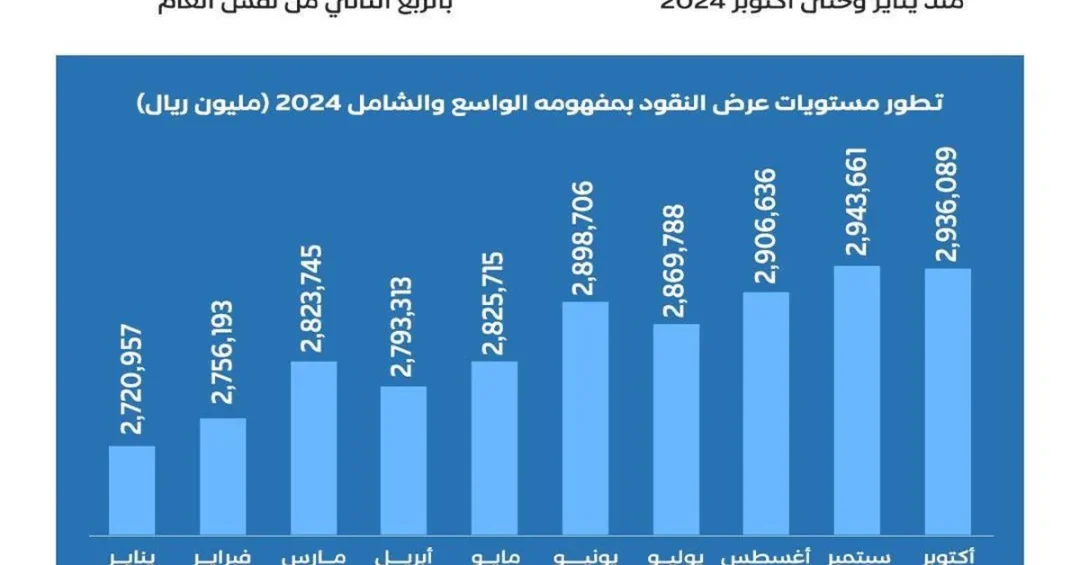
Saudi Arabia’s broad money supply (M3) expanded by more than SAR247.647 billion year-on-year, reaching SAR2,936.089 billion by the end of October 2024, a 9.2% increase compared with SAR2,688.442 billion in the same period last year, according to the Saudi Central Bank (SAMA). The figures, published in SAMA’s monthly statistical bulletin for October 2024, underscore the continued strength of the Kingdom’s monetary foundation as it advances its Vision 2030 economic transformation. The growth in liquidity — often described as the “available money” circulating through the economy — signals sustained capacity for investment, consumption, and business activity across the non-oil private sector. For international observers, the data offers one of the clearest indicators yet that Saudi Arabia’s financial system is absorbing the demands of a rapidly diversifying economy, even as global monetary conditions remain uneven.
The year-on-year rise of 9.2% places Saudi Arabia among the more robust liquidity environments in the region. On a quarterly basis, liquidity levels increased by 1.5%, an increase of approximately SAR45 billion, reaching SAR2,943.661 billion by the end of the third quarter of 2024, compared with SAR2,898.706 billion at the end of the second quarter. Since January 2024, liquidity has grown by 8%, adding more than SAR215 billion from its starting level of SAR2,720.957 billion. Is this not evidence that the Kingdom’s economic engine continues to accelerate despite a challenging global backdrop? The steady expansion reflects deliberate monetary management by SAMA, which has consistently balanced price stability with the liquidity needs of a fast-growing, investment-driven economy.
Context and Background
What exactly does the broad money supply indicator, or M3, tell us about the Saudi economy? M3 is the widest measure of money in circulation, encompassing currency outside banks, demand deposits, time and savings deposits, and quasi-monetary deposits. It is closely watched by central banks and international investors because it captures the total pool of funds available for spending, lending, and investment. In Saudi Arabia, SAMA publishes this data monthly through its statistical bulletin, providing a transparent window into the Kingdom’s monetary conditions. The October 2024 reading of SAR2,936.089 billion represents a substantial expansion over the twelve-month period, building on a trajectory that began well before the current year.
The composition of this liquidity reveals much about how money is being deployed. Demand deposits — funds held in current accounts and accessible on demand — accounted for the largest share at 49%, totaling SAR1,425.489 billion by October 2024. Time and savings deposits, the second-largest contributor, represented 33% of the total at SAR971.103 billion. Quasi-monetary deposits amounted to SAR312.506 billion, or 11% of the total, while currency in circulation outside banks contributed 8%, valued at SAR226.991 billion. Together, these components illustrate a financial system in which both transactional and savings-oriented balances are growing, a pattern typically associated with rising economic confidence and expanding household and corporate activity.
Quasi-monetary deposits merit particular attention because they include residents’ foreign currency deposits, deposits tied to letters of credit, outstanding transfers, and repurchase agreements executed by banks with the private sector. The presence of these instruments in the liquidity mix indicates active trade financing and cross-border commercial engagement. As Saudi Arabia deepens its integration into global markets, such components of M3 become increasingly relevant indicators of the Kingdom’s role as a trading and logistics hub. The data therefore reflects not only domestic monetary conditions but also the international dimension of Saudi Arabia’s economic expansion.
Key Details
How significant is the quarterly and year-to-date growth in practical terms? The third-quarter increase of approximately SAR45 billion brought liquidity to SAR2,943.661 billion, marginally above the October month-end figure, reflecting normal month-to-month fluctuations in deposit and currency flows. More striking is the year-to-date expansion: since January 2024, liquidity has risen by 8%, adding over SAR215 billion. This pace suggests that the Saudi economy is generating and retaining financial resources at a rate consistent with its ambitious capital expenditure programs, including giga-projects, industrial development, and infrastructure modernization.
The dominance of demand deposits at 49% of total liquidity is a key detail for analysts. It indicates that a substantial portion of money in the economy is held in readily accessible forms, which supports day-to-day commercial transactions, payrolls, and consumer spending. At the same time, the 33% share held in time and savings deposits shows that households and businesses are also locking away funds for longer periods, a behavior often linked to positive real interest rate expectations and confidence in the banking system. The combination of high liquidity and growing savings balances provides banks with a stable funding base from which to extend credit to the private sector.
SAMA’s monthly statistical bulletin is the authoritative source for these figures, and its regular publication reinforces the transparency of Saudi monetary policy. For international investors and financial institutions, the reliability of this data stream is an important element of the Kingdom’s investment case. The October 2024 bulletin shows that the growth in liquidity is broad-based rather than concentrated in a single category, which reduces the risk of distortion and strengthens the credibility of the overall picture. The figures are released in Saudi riyals, a currency pegged to the US dollar, adding a further layer of predictability for cross-border capital flows.
International and Regional Impact
Why should global markets pay attention to Saudi liquidity trends? As the largest economy in the Middle East and a member of the G20, Saudi Arabia’s monetary conditions influence regional capital flows, trade finance, and investment sentiment. A growing M3 suggests that the Kingdom has ample domestic resources to fund its diversification agenda without excessive reliance on external borrowing. This reduces vulnerability to shifts in global credit conditions and supports the riyal’s stability. For international partners, it signals a market with deepening financial capacity and a growing appetite for imported goods, services, and technology.
Regionally, the expansion of liquidity in Saudi Arabia can have positive spillovers for neighboring economies. Higher levels of demand deposits and trade-related quasi-monetary deposits imply increased commercial activity that often extends across the Gulf Cooperation Council (GCC) and beyond. Saudi Arabia’s role as a hub for logistics, finance, and pilgrimage-related services means that its monetary vitality supports employment and business activity in allied markets. The data also reinforces the Kingdom’s position as a preferred destination for foreign direct investment, as investors seek environments where liquidity is abundant and financial infrastructure is robust.
Economic and Strategic Significance
What does sustained liquidity growth enable for Saudi Arabia’s strategic priorities? Robust liquidity serves as a driver for economic and commercial activity, contributing to positive progress in the Kingdom’s economic development. It provides banks with the means to finance small and medium-sized enterprises, support entrepreneurship, and underwrite the large-scale projects that form the backbone of Vision 2030. From NEOM and the Red Sea Project to industrial cities and renewable energy installations, these initiatives require deep and stable funding pools. The October 2024 data suggests that such pools are not only present but expanding.
Strategic significance also lies in the confidence that liquidity growth reflects. When businesses and households hold higher balances in both demand and savings accounts, it indicates trust in the banking system and in the broader economic outlook. This trust is essential for the success of Vision 2030, which aims to grow the private sector’s contribution to GDP and reduce dependence on oil revenues. A liquid banking system can channel savings into productive investment, thereby accelerating the diversification that the Kingdom seeks. The 9.2% year-on-year increase is therefore not merely a statistical milestone but a signal of underlying economic momentum.
Moreover, the composition of liquidity — with quasi-monetary deposits tied to letters of credit and trade finance — highlights Saudi Arabia’s expanding role in global commerce. As the Kingdom positions itself as a logistics and manufacturing hub under the National Industrial Development and Logistics Program, the availability of trade-related financing becomes a competitive advantage. The data from SAMA thus connects directly to the strategic goal of making Saudi Arabia a crossroads for goods, capital, and services between Asia, Europe, and Africa.
Vision 2030 Alignment
How does this liquidity growth align with the objectives of Vision 2030? Vision 2030 seeks to build a diversified, sustainable economy with a thriving private sector, and monetary stability is a prerequisite for that transformation. The expansion of M3 by over SAR247 billion year-on-year demonstrates that the financial system is scaling up to meet the demands of a growing, modernizing economy. It supports the Vision’s targets for investment, employment, and non-oil GDP growth by ensuring that capital is available for businesses at every stage of development.
Looking ahead, the Kingdom’s leadership has consistently emphasized that economic reforms must be underpinned by sound financial management. SAMA’s data shows that this principle is being translated into practice. As Saudi Arabia continues to implement giga-projects, host major international events, and expand its tourism and entertainment sectors, the liquidity reflected in the October 2024 bulletin will help sustain momentum. For international readers, the message is clear: Saudi Arabia’s economy rests on a strong monetary foundation, and its journey toward Vision 2030 is supported by tangible financial strength that continues to grow.
20 Questions
Q1. What is the broad money supply indicator (M3)?
A1. M3 is the widest measure of money in an economy, including currency outside banks, demand deposits, time and savings deposits, and quasi-monetary deposits. It indicates the total funds available for spending, lending, and investment.
Q2. How much did Saudi Arabia’s liquidity grow year-on-year by October 2024?
A2. Saudi liquidity grew by more than SAR247.647 billion year-on-year, reaching SAR2,936.089 billion by the end of October 2024, a 9.2% increase compared with SAR2,688.442 billion in the same period last year.
Q3. Which agency published the liquidity data?
A3. The data was published by the Saudi Central Bank (SAMA) in its monthly statistical bulletin for October 2024. SAMA is the Kingdom’s central bank and monetary authority.
Q4. What was the quarterly growth in liquidity by the end of Q3 2024?
A4. Liquidity grew by 1.5% on a quarterly basis, an increase of approximately SAR45 billion, reaching SAR2,943.661 billion by the end of Q3 2024 compared with SAR2,898.706 billion at the end of Q2 2024.
Q5. How much has liquidity increased since January 2024?
A5. Since January 2024, liquidity has increased by 8%, adding over SAR215 billion from its starting level of SAR2,720.957 billion. This reflects consistent monetary expansion throughout the year.
Q6. What are demand deposits and what share do they represent?
A6. Demand deposits are funds held in current accounts that are accessible on demand. They are the largest contributor to liquidity at 49%, totaling SAR1,425.489 billion by October 2024.
Q7. What are time and savings deposits and their share of liquidity?
A7. Time and savings deposits are funds placed in accounts for fixed periods in exchange for interest. They represent 33% of total liquidity, valued at SAR971.103 billion by October 2024.
Q8. What are quasi-monetary deposits?
A8. Quasi-monetary deposits include residents’ foreign currency deposits, deposits tied to letters of credit, outstanding transfers, and repurchase agreements executed by banks with the private sector. They amounted to SAR312.506 billion, or 11% of total liquidity.
Q9. How much currency is in circulation outside banks?
A9. Currency in circulation outside banks contributed 8% of total liquidity, with a value of SAR226.991 billion by October 2024. This reflects cash held by individuals and businesses.
Q10. Why is liquidity growth important for the Saudi economy?
A10. Robust liquidity serves as a driver for economic and commercial activity, supporting investment, lending, and consumption. It contributes to positive progress in the Kingdom’s economic development and financial stability.
Q11. How does liquidity growth support Vision 2030?
A11. Vision 2030 aims to diversify the economy and grow the private sector. Liquidity growth ensures banks can finance businesses, giga-projects, and infrastructure, supporting non-oil GDP expansion and job creation.
Q12. What does the dominance of demand deposits indicate?
A12. Demand deposits at 49% of total liquidity indicate that a large portion of money is readily available for transactions, supporting day-to-day commercial activity, payrolls, and consumer spending.
Q13. What does the growth in time and savings deposits suggest?
A13. Growth in time and savings deposits suggests that households and businesses are confident in the banking system and are willing to lock away funds for longer periods, providing banks with stable funding for lending.
Q14. How does Saudi liquidity compare regionally?
A14. Saudi Arabia’s 9.2% year-on-year liquidity growth places it among the more robust monetary environments in the Middle East. It reflects the Kingdom’s large economic base and active diversification efforts.
Q15. What is the role of SAMA in managing liquidity?
A15. SAMA manages monetary policy to maintain price stability and support economic growth. It monitors liquidity indicators like M3 and adjusts policy tools to ensure adequate funding for the economy.
Q16. How does liquidity growth affect foreign investment?
A16. Growing liquidity signals a stable and deepening financial market, which can attract foreign direct investment. Investors seek economies with ample capital, reliable banking systems, and supportive monetary conditions.
Q17. What are the implications for Saudi banks?
A17. Higher liquidity provides banks with a larger funding base to extend credit to businesses and individuals. It supports profitability and enables banks to participate in financing large-scale projects under Vision 2030.
Q18. Does liquidity growth risk inflation?
A18. SAMA closely monitors monetary aggregates to balance growth with price stability. The current liquidity expansion is consistent with economic growth and has not led to excessive inflationary pressures, according to official data.
Q19. How does liquidity support non-oil sectors?
A19. Liquidity enables banks to finance non-oil sectors such as tourism, entertainment, manufacturing, and technology. These sectors are central to Vision 2030’s goal of diversifying the economy away from oil.
Q20. What is the outlook for Saudi liquidity?
A20. With Vision 2030 projects accelerating and the private sector expanding, liquidity is expected to remain supportive. SAMA will continue to manage monetary conditions to sustain growth and financial stability.
Reader Feedback
We value your thoughts. Please share your feedback on this article.
Your feedback helps us improve our coverage.
Related articles
 Saudi Ambassador Meets Algerian Trade Minister in Algiers
 Saudi Arabia Leads GCC-Japan FTA Negotiations in Riyadh
 World Trade Expo 2024 Opens in Jeddah, Drawing Global Traders
 IMS24: Riyadh Hosts Global MICE Leaders to Shape Industry Future
 New Murabba Concludes MIPIM Asia Summit 2024 Participation
 Innovative Finance and Partnerships Accelerate Climate Action in Saudi Arabia