


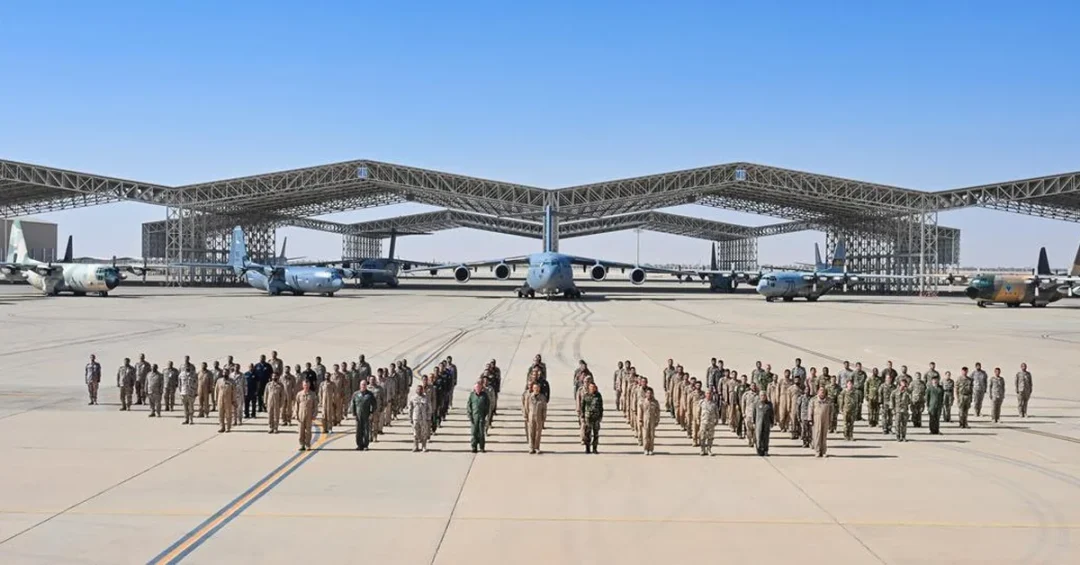
Lieutenant General Turki bin Bandar bin Abdulaziz, Commander of the Royal Saudi Air Forces, attended the conclusion of the joint and combined air exercise “Tuwaiq 4” at Prince Sultan Air Base on Tuesday, December 10, 2024, in the presence of several air force commanders from participating countries. The two-week exercise, announced through official Saudi channels including the Saudi Press Agency, brought together air forces from multiple nations for advanced tactical air-drop missions, specialized lectures, and seminars designed to strengthen interoperability and joint operational readiness.
Upon his arrival at Prince Sultan Air Base, Lieutenant General Turki bin Bandar and his accompanying delegation were received by the base commander, Major General Mohsen bin Saeed Al-Zahrani. The closing ceremony marked the culmination of intensive aerial sorties and ground-based academic sessions that showcased the high readiness of participating air forces in planning, preparation, and execution. The exercise reinforced the concept of joint air operations, a cornerstone of modern aerial warfare doctrine that emphasizes seamless coordination between allied air forces. The successful conclusion of “Tuwaiq 4” underscores Saudi Arabia’s growing capacity to host and lead complex multinational military exercises, a capability that reflects the Kingdom’s broader strategic ambitions under Vision 2030. How does such an exercise reshape the regional security landscape, and what does it signal about Saudi Arabia’s evolving role as a convenor of international defense cooperation?
Context and Background
What makes “Tuwaiq 4” a significant milestone in Saudi Arabia’s military exercise calendar? The exercise is named after the Tuwaiq Mountains, a prominent geological feature in central Saudi Arabia that has long symbolized strength and endurance in the Kingdom’s heritage. The “Tuwaiq” series has evolved into a flagship joint air exercise that regularly attracts participation from allied and partner nations, reflecting the Royal Saudi Air Forces’ commitment to maintaining high levels of combat readiness and interoperability. The fourth iteration of the exercise built upon the successes of previous editions, expanding the scope of tactical air-drop missions and incorporating more complex planning scenarios that test the decision-making capabilities of aircrews and ground support teams alike.
The two-week duration allowed participating forces to conduct a comprehensive range of aerial sorties, moving beyond basic training into advanced tactical operations. These missions required precise coordination between aircrews, logistics teams, and command-and-control elements, simulating the kinds of complex environments that modern air forces may encounter in joint operations. The inclusion of lectures and seminars alongside practical flying missions reflects a holistic approach to military training that values intellectual preparation as much as physical execution. By hosting “Tuwaiq 4,” Saudi Arabia reinforced its position as a regional leader in defense cooperation, a role that aligns with the Kingdom’s broader efforts to build strategic partnerships and contribute to regional stability through collective security arrangements.
The presence of multiple international air force commanders at the closing ceremony highlights the diplomatic dimension of the exercise. Military exercises of this scale serve not only as training opportunities but also as platforms for strengthening bilateral and multilateral relationships. The exchange of expertise and the shared experience of planning and executing joint missions create bonds between participating forces that extend well beyond the duration of the exercise itself. For Saudi Arabia, hosting such events demonstrates its capacity to serve as a hub for international defense collaboration, a role that carries significant strategic weight in a rapidly evolving regional security environment.
Key Details of the Exercise
What specific capabilities did “Tuwaiq 4” aim to enhance among the participating air forces? The exercise featured two weeks of aerial sorties focused primarily on tactical air-drop missions, a complex operational skill that requires precise navigation, timing, and coordination between aircrews and ground elements. Tactical air-drop operations are essential for delivering supplies, equipment, and personnel to designated areas, often under challenging conditions. Mastering these missions enhances the ability of air forces to support ground operations, conduct humanitarian assistance missions, and respond to crisis situations with speed and accuracy. The participating air forces demonstrated high readiness in planning, preparation, and execution, according to official Saudi sources, reinforcing the core objective of the exercise: strengthening the concept of joint air operations.
Beyond the flying missions, the exercise incorporated a robust academic component featuring lectures and seminars. These sessions likely covered topics such as tactical doctrine, emerging technologies in aerial warfare, lessons learned from recent conflicts, and best practices for joint operations. The combination of theoretical instruction and practical application creates a comprehensive training environment that prepares participants for the full spectrum of challenges they may face in real-world operations. Lieutenant General Turki bin Bandar’s attendance at the conclusion of the exercise underscores the importance that the Royal Saudi Air Forces place on this type of multinational training. His presence, alongside air force commanders from participating countries, signals a shared commitment to maintaining high standards of readiness and interoperability.
Major General Mohsen bin Saeed Al-Zahrani, the base commander at Prince Sultan Air Base, played a key role in facilitating the exercise. Prince Sultan Air Base, located in the Eastern Province, is one of the Kingdom’s most important military installations and has a history of hosting large-scale multinational exercises. Its infrastructure and strategic location make it an ideal venue for complex air operations involving multiple nations. The successful execution of “Tuwaiq 4” at this base further cements its reputation as a premier center for joint military training in the region. The exercise’s conclusion was marked by a ceremony that recognized the achievements of participating forces and highlighted the bonds of cooperation forged during the two-week period.
International and Regional Impact
How does a multinational exercise like “Tuwaiq 4” influence regional security dynamics? The participation of air force commanders from several countries at the closing ceremony demonstrates the broad international interest in Saudi Arabia’s military training initiatives. Such exercises serve as confidence-building measures that enhance transparency and mutual understanding among participating nations. In a region characterized by complex security challenges, the ability to bring together diverse air forces for joint training represents a significant contribution to stability. The exercise reinforces the principle that collective security arrangements, built on shared training and interoperability, are essential for addressing common threats and maintaining peace.
The regional impact of “Tuwaiq 4” extends beyond the immediate training objectives. By successfully hosting and leading the exercise, Saudi Arabia demonstrates its capability to serve as a security provider and a convenor of international coalitions. This role aligns with the Kingdom’s broader foreign policy objectives, which emphasize strategic partnerships, dialogue, and cooperation. The exercise also sends a message about the Royal Saudi Air Forces’ growing capabilities, including its ability to plan, coordinate, and execute complex operations alongside international partners. For participating nations, the exercise offers valuable training opportunities and a chance to strengthen relationships with one of the region’s most capable air forces. The exchange of tactics, techniques, and procedures during “Tuwaiq 4” will likely inform future joint operations and enhance the collective readiness of all involved.
Economic and Strategic Significance
What does the successful conclusion of “Tuwaiq 4” reveal about Saudi Arabia’s strategic priorities? The exercise reflects the Kingdom’s commitment to investing in defense capabilities as part of its broader national development strategy. Under Vision 2030, Saudi Arabia has pursued a comprehensive approach to modernization that includes strengthening its military and security sectors. Hosting multinational exercises like “Tuwaiq 4” is not only a training activity but also a demonstration of the Kingdom’s organizational capacity, logistical expertise, and diplomatic reach. These capabilities are essential for protecting Saudi Arabia’s sovereignty and contributing to regional stability, both of which are prerequisites for the economic and social transformation envisioned in Vision 2030.
The strategic significance of the exercise also lies in its contribution to the development of human capital. The Royal Saudi Air Forces’ participation in and leadership of “Tuwaiq 4” provides its personnel with invaluable experience in joint operations, planning, and execution. This experience enhances the professionalism and readiness of Saudi aircrews and support teams, contributing to the Kingdom’s long-term defense objectives. Furthermore, the exercise serves as a platform for testing and refining operational concepts, integrating new technologies, and identifying areas for improvement. The lessons learned from “Tuwaiq 4” will inform future training and capability development efforts, ensuring that the Royal Saudi Air Forces remain at the forefront of regional air power. The exercise also reinforces Saudi Arabia’s position as a reliable partner in international security efforts, a status that carries economic and diplomatic benefits.
Vision 2030 Alignment
How does “Tuwaiq 4” contribute to the broader goals of Saudi Vision 2030? The exercise aligns with Vision 2030’s emphasis on building a robust and capable defense sector that can protect the Kingdom’s interests and contribute to regional stability. By hosting and leading multinational air exercises, Saudi Arabia demonstrates its ability to project strength, foster cooperation, and assume leadership roles in international security affairs. These capabilities are integral to the Kingdom’s vision of becoming a global hub for diplomacy, investment, and innovation. The successful execution of “Tuwaiq 4” also showcases the professionalism and readiness of the Royal Saudi Air Forces, which are essential components of the Kingdom’s national security architecture.
Moreover, the exercise supports Vision 2030’s goal of developing a skilled and motivated workforce. The training and experience gained by Saudi personnel during “Tuwaiq 4” contribute to the development of a highly capable defense workforce that can meet the challenges of the future. The exercise also strengthens Saudi Arabia’s international partnerships, which are vital for achieving the Vision’s objectives of economic diversification and global engagement. As the Kingdom continues to modernize and expand its capabilities, exercises like “Tuwaiq 4” will remain important tools for building readiness, fostering cooperation, and demonstrating Saudi Arabia’s commitment to peace and stability. The forward-looking conclusion of this exercise sets the stage for future iterations that will further enhance the Kingdom’s defense capabilities and its role as a leader in regional and international security.
20 Questions
Q1. What was the “Tuwaiq 4” joint air exercise?
A1. “Tuwaiq 4” was a joint and combined air exercise hosted by Saudi Arabia, featuring two weeks of aerial sorties, tactical air-drop missions, lectures, and seminars. It aimed to enhance interoperability and joint air operations among participating nations.
Q2. Who attended the conclusion of the exercise?
A2. Lieutenant General Turki bin Bandar bin Abdulaziz, Commander of the Royal Saudi Air Forces, attended the conclusion, along with several air force commanders from participating countries. They were received by Major General Mohsen bin Saeed Al-Zahrani.
Q3. Where was “Tuwaiq 4” held?
A3. The exercise was held at Prince Sultan Air Base in Saudi Arabia. The base is one of the Kingdom’s most important military installations and regularly hosts large-scale multinational exercises.
Q4. How long did the exercise last?
A4. The exercise featured two weeks of aerial sorties and academic activities. This duration allowed for comprehensive training and the development of joint operational skills among the participating forces.
Q5. What types of missions were conducted during the exercise?
A5. The exercise focused on tactical air-drop missions, which involve delivering supplies, equipment, or personnel to designated areas. These missions require precise coordination and are essential for joint air operations.
Q6. What was the main objective of “Tuwaiq 4”?
A6. The main objective was to reinforce the concept of joint air operations and enhance the readiness of participating air forces. It also aimed to strengthen cooperation and interoperability among the participating nations.
Q7. Which countries participated in the exercise?
A7. Several countries participated, as indicated by the presence of multiple air force commanders at the closing ceremony. The specific list of participating nations was not disclosed in the official announcement.
Q8. What did the participating air forces demonstrate?
A8. They demonstrated high readiness in planning, preparation, and execution of joint air operations. This reflects the effectiveness of the training and the professionalism of the participating forces.
Q9. What is the significance of the name “Tuwaiq”?
A9. The name “Tuwaiq” refers to the Tuwaiq Mountains in central Saudi Arabia, a symbol of strength and endurance. It reflects the challenging and robust nature of the exercise.
Q10. What role did Prince Sultan Air Base play?
A10. Prince Sultan Air Base hosted the exercise, providing the infrastructure and facilities needed for complex air operations. It is a key military installation in Saudi Arabia.
Q11. Who is Lieutenant General Turki bin Bandar bin Abdulaziz?
A11. He is the Commander of the Royal Saudi Air Forces. His attendance at the exercise underscores the importance Saudi Arabia places on multinational training and readiness.
Q12. What were the lectures and seminars about?
A12. The lectures and seminars covered topics related to tactical air operations, joint planning, and best practices. They complemented the practical flying missions and enhanced the overall training experience.
Q13. How does this exercise benefit Saudi Arabia?
A13. It enhances the readiness of the Royal Saudi Air Forces, strengthens international partnerships, and demonstrates the Kingdom’s capability to host and lead complex military exercises, contributing to regional stability.
Q14. What is the concept of joint air operations?
A14. Joint air operations involve the coordinated use of air power from multiple nations or services to achieve common objectives. They require high levels of interoperability and planning.
Q15. How does “Tuwaiq 4” align with Vision 2030?
A15. It supports Vision 2030 by enhancing defense capabilities, fostering international cooperation, and developing human capital. These are key components of the Kingdom’s strategic modernization goals.
Q16. What message does the exercise send to the region?
A16. It signals Saudi Arabia’s commitment to regional security, its capability to lead multinational efforts, and its readiness to cooperate with allies to address common challenges.
Q17. Will there be future “Tuwaiq” exercises?
A17. While no official announcement has been made, the “Tuwaiq” series has become a regular event. Future iterations are likely to build on the success of “Tuwaiq 4.”
Q18. What was the closing ceremony like?
A18. The closing ceremony was attended by senior officers and air force commanders. It marked the successful completion of the exercise and recognized the achievements of the participating forces.
Q19. How does this exercise enhance Saudi Arabia’s international standing?
A19. By hosting and leading a multinational exercise, Saudi Arabia demonstrates its organizational capacity, diplomatic reach, and commitment to international security, enhancing its standing as a regional leader.
Q20. What are the key takeaways from “Tuwaiq 4”?
A20. The exercise highlighted the importance of joint training, interoperability, and international cooperation. It reinforced the Royal Saudi Air Forces’ readiness and its ability to operate effectively alongside partners.
Reader Feedback
We value your thoughts. Please share your feedback on this article.
Your feedback helps us improve our coverage.
Related articles
 KSrelief Delivers Hemodialysis Supplies to Yemen’s Hadhramaut
 Al-Baha Governor Receives Egyptian Consul General
 Saudi Afforestation Forum Inspires Students on Sustainability
 Saudi-UK Military Cooperation Committee Meets in Riyadh
 Saudi UN Envoy Meets KSrelief Official on Global Aid
 Saudi Weather Forecast: Dust and Fog Expected Wednesday