


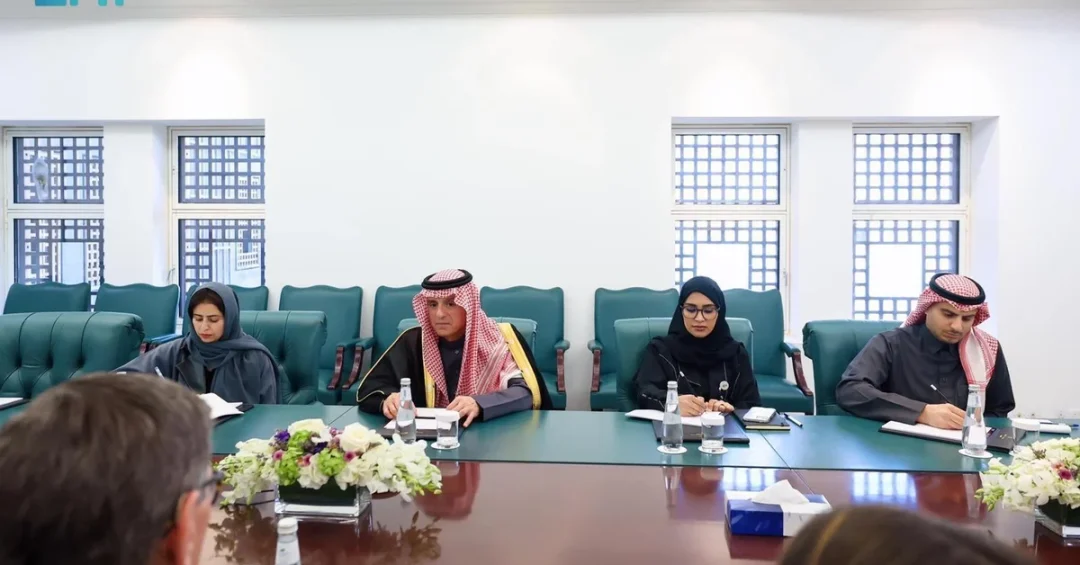
Saudi Minister of State for Foreign Affairs, Cabinet Member, and Climate Envoy Adel Al-Jubeir received a delegation from the Middle East Institute (MEI) in Riyadh on December 10, 2024, in a meeting that underscored the Kingdom’s enduring commitment to structured, high-level dialogue with American policy institutions. The encounter, announced by the Saudi Press Agency (SPA), centered on issues of mutual interest between the Kingdom of Saudi Arabia and the United States, and reflected the depth of the bilateral relationship that has spanned nearly eight decades. The meeting was held in the Saudi capital and brought together a senior Saudi diplomat and a prominent Washington-based research organization dedicated to the study of the Middle East.
Why does a single diplomatic meeting between a Saudi minister and an American think tank delegation matter in a world already saturated with summits and conferences? The answer lies in the nature of the relationship itself. Saudi Arabia and the United States share a strategic partnership built on energy security, counterterrorism cooperation, trade, and a mutual interest in regional stability. Meetings such as this one are not ceremonial; they are working sessions that help shape the intellectual and policy foundations of that partnership. The Middle East Institute, founded in 1946, is one of the oldest institutions in the United States devoted to the study of the region, and its delegations frequently include former ambassadors, senior military officers, and seasoned analysts whose views inform American foreign policy debates.
The timing of the meeting is significant. It comes as the Kingdom accelerates its Vision 2030 transformation, a national strategy launched in 2016 under the leadership of Crown Prince Mohammed bin Salman to diversify the economy, empower citizens, and position Saudi Arabia as a global hub for investment, tourism, and innovation. In this context, engagement with American thought leaders serves a dual purpose: it communicates the Kingdom’s reform narrative directly to influential audiences in the United States, and it allows Saudi officials to hear candid perspectives from experts who study the region closely. The SPA report did not specify the names of the MEI delegates, but the institute’s leadership has long included figures with deep experience in Gulf affairs.
Context and Background
What is the Middle East Institute, and why does its engagement with Saudi Arabia carry weight beyond a routine diplomatic courtesy? Established in Washington, D.C. in 1946, MEI is a non-partisan, non-profit institution that provides research, analysis, and educational programs on the Middle East. Its scholars and fellows regularly publish on Gulf security, energy markets, economic reform, and U.S. foreign policy. Over the decades, MEI has hosted Saudi officials, including ministers and ambassadors, at its annual conferences and private roundtables. The institute’s willingness to send a delegation to Riyadh signals sustained American interest in the Kingdom’s trajectory, particularly as Saudi Arabia emerges as a diplomatic mediator in regional conflicts and a driver of economic change.
The meeting also fits within a broader pattern of Saudi diplomacy in late 2024. Riyadh has hosted a steady stream of foreign delegations, from European trade ministers to Asian heads of state, as part of its effort to deepen international partnerships under Vision 2030. Adel Al-Jubeir, a veteran diplomat who previously served as Saudi Ambassador to the United States and as Minister of Foreign Affairs, is a central figure in these engagements. His current portfolio as Minister of State for Foreign Affairs, Cabinet Member, and Climate Envoy gives him a unique vantage point that spans traditional diplomacy, environmental policy, and strategic communication. His meeting with the MEI delegation thus combined several threads of Saudi foreign policy: transatlantic relations, climate diplomacy, and regional security.
For observers of U.S.-Saudi relations, the encounter is a reminder that the relationship extends beyond government-to-government contacts. Think tanks, universities, and cultural institutions form a parallel network that sustains mutual understanding. MEI has been a consistent venue for dialogue, and its delegations often include former U.S. ambassadors to Saudi Arabia and other Gulf states. While SPA did not disclose the specific topics discussed beyond “issues of mutual interest,” the phrase itself is a diplomatic formula that can encompass everything from the war in Gaza and Yemen to oil market stability, artificial intelligence cooperation, and the normalization of ties with Israel. The absence of a detailed readout is not unusual; both Saudi and American officials often prefer to keep such discussions private to allow for frank exchanges.
Key Details
What do we know about the meeting itself, and what can be reasonably inferred from the official SPA report? The Saudi Press Agency stated that Minister Al-Jubeir met with a U.S. delegation from the Middle East Institute and that they discussed issues of mutual interest. The meeting took place in Riyadh on December 10, 2024, at 20:05 local time, according to the timestamp on the SPA dispatch. No further details were released about the number of delegates, their names, or the specific agenda. This is consistent with the Kingdom’s practice of announcing high-level meetings without divulging confidential deliberations. The report’s brevity should not be mistaken for insignificance; Saudi diplomatic protocol often values discretion, and the release of even a short statement is a signal that the meeting was considered noteworthy.
The presence of a climate envoy at the meeting is particularly relevant. Adel Al-Jubeir was appointed Saudi Arabia’s first Climate Envoy in 2016, and he has since represented the Kingdom at numerous international climate conferences, including COP sessions. His dual role as Minister of State for Foreign Affairs and Climate Envoy allows him to integrate environmental policy into broader diplomatic conversations. The Middle East Institute has a dedicated program on climate and water security in the Middle East, making climate change a likely topic of discussion. Saudi Arabia has launched several major environmental initiatives, including the Saudi Green Initiative and the Middle East Green Initiative, which aim to plant billions of trees and reduce carbon emissions across the region. These efforts align with Vision 2030’s sustainability goals and have been presented at global forums.
Another likely topic is regional security. The Middle East Institute regularly publishes analyses on Yemen, Iran, Iraq, and the Israeli-Palestinian conflict. Saudi Arabia has been actively involved in diplomatic efforts to de-escalate tensions, including brokering talks and supporting humanitarian initiatives. In 2023, the Kingdom restored diplomatic relations with Iran in a deal brokered by China, a move that surprised many Western observers and demonstrated Saudi Arabia’s independent foreign policy. MEI scholars have written extensively about this shift and its implications for U.S. interests. A delegation visiting Riyadh would likely seek to understand the Kingdom’s strategic thinking firsthand. While the SPA report does not confirm these topics, they are consistent with the range of issues that such meetings typically cover.
International and Regional Impact
How does this meeting resonate beyond the immediate participants? For the United States, engagement with Saudi Arabia remains a cornerstone of its Middle East policy, despite periodic tensions over human rights, oil production, and regional interventions. The Biden administration has sought to maintain a productive relationship with Riyadh, particularly in the areas of energy security and counterterrorism. Think tank delegations often serve as informal conduits for dialogue when formal diplomatic channels are strained. MEI’s visit to Riyadh can be seen as part of a broader effort to keep lines of communication open and to explore areas of cooperation. For Saudi Arabia, hosting such delegations reinforces its position as a pivotal actor in the region and a reliable partner for international institutions.
Regionally, the meeting underscores Saudi Arabia’s role as a stabilizing force. The Kingdom has consistently advocated for peaceful resolutions to conflicts, from Yemen to Sudan, and has provided humanitarian aid to affected populations. Its diplomatic outreach extends to both Western and Eastern powers, a hallmark of its multi-alignment strategy. By engaging with American think tanks, Saudi officials can shape narratives that might otherwise be dominated by critics. This is particularly important as the Kingdom prepares to host major international events, including the 2034 FIFA World Cup and Expo 2030 in Riyadh. These events will draw global attention to Saudi Arabia’s modernization and require sustained positive engagement with international audiences.
The Middle East Institute’s delegation may also have discussed economic cooperation. Saudi Arabia is the United States’ largest trading partner in the Middle East, with bilateral trade exceeding $30 billion annually. American companies are deeply involved in Saudi megaprojects such as NEOM, the Red Sea Project, and Qiddiya. MEI has published reports on Saudi economic diversification and the investment opportunities it creates. A meeting with the Climate Envoy could touch on renewable energy, green hydrogen, and carbon capture technologies, areas where Saudi Aramco and American firms collaborate. While the SPA report does not mention these specifics, they are logical extensions of the “mutual interest” formula.
Economic and Strategic Significance
Why should global investors and business leaders pay attention to a diplomatic meeting that produced no joint statement? Because such meetings are part of the quiet infrastructure that supports economic predictability. Saudi Arabia’s Vision 2030 aims to attract $100 billion in foreign direct investment annually by 2030. Achieving that goal requires not only competitive regulations and incentives but also a stable geopolitical environment and strong relationships with major economies. The United States remains the largest source of foreign investment in Saudi Arabia, and American institutional investors closely follow signals from Riyadh. A senior Saudi minister meeting with a respected U.S. think tank sends a subtle but important message: the Kingdom is open to dialogue, transparent in its intentions, and committed to international norms.
Moreover, the meeting highlights the intersection of climate policy and economic strategy. As Climate Envoy, Adel Al-Jubeir is tasked with articulating Saudi Arabia’s approach to global warming, which emphasizes adaptation, technology, and inclusive transition rather than abrupt fossil fuel phase-outs. This position is increasingly influential in international forums, where developing nations seek a balanced approach to energy transition. The Middle East Institute has hosted events on this topic, and its scholars have acknowledged Saudi Arabia’s investments in solar and wind energy. By engaging with MEI, Al-Jubeir can advance the Kingdom’s narrative that it is a responsible energy producer and a leader in green initiatives. This narrative is crucial for attracting environmentally conscious investors and for shaping global climate agreements.
Strategically, the meeting reinforces Saudi Arabia’s role as a bridge between the Global South and the West. The Kingdom is a member of the G20, the OPEC+ alliance, and the BRICS group, which it joined in 2024. Its ability to maintain constructive ties with the United States, China, Russia, and European powers is a diplomatic asset. Think tanks like MEI help explain this multi-alignment to American audiences, countering simplistic narratives that portray Saudi Arabia as choosing sides. The delegation’s visit is thus a small but meaningful contribution to a more nuanced understanding of Saudi foreign policy.
Vision 2030 Alignment
How does this meeting connect to the broader Vision 2030 project? Vision 2030 is not solely an economic blueprint; it is a comprehensive national transformation that includes a foreign policy dimension. The strategy calls for Saudi Arabia to become a global investment powerhouse and a hub connecting three continents. That ambition requires active diplomacy, strategic communication, and partnerships with influential institutions worldwide. The Middle East Institute, with its network of experts and policymakers, is precisely the kind of partner that can help amplify the Kingdom’s message. By meeting with MEI delegates, Minister Al-Jubeir is advancing the Vision 2030 goal of enhancing Saudi Arabia’s international standing and fostering mutual understanding.
Furthermore, the meeting reflects the Vision 2030 emphasis on sustainability and climate action. Saudi Arabia has committed to achieving net-zero emissions by 2060 and has invested heavily in renewable energy, including the world’s largest green hydrogen plant at NEOM. The Climate Envoy’s engagement with American experts supports these goals by facilitating knowledge exchange and building coalitions for technological cooperation. As the Kingdom prepares for Expo 2030 and the 2034 World Cup, it will continue to rely on such diplomatic engagements to present itself as a modern, forward-looking nation. The SPA report, though brief, is a testament to Saudi Arabia’s proactive approach to international relations and its determination to shape a positive global narrative.
In conclusion, the meeting between Minister Adel Al-Jubeir and the Middle East Institute delegation is a routine yet important event in the tapestry of U.S.-Saudi relations. It demonstrates the Kingdom’s commitment to dialogue, its openness to diverse perspectives, and its strategic focus on Vision 2030. As Saudi Arabia continues its journey of transformation, such engagements will remain vital for building trust and fostering cooperation. The world should expect more of these quiet diplomatic moments, each contributing to a stable and prosperous future for the region and beyond.
20 Questions
Q1. Who received the US delegation from the Middle East Institute?
A1. Saudi Minister of State for Foreign Affairs, Cabinet Member, and Climate Envoy Adel Al-Jubeir received the delegation on December 10, 2024, in Riyadh, according to the Saudi Press Agency.
Q2. What organization did the US delegation represent?
A2. The delegation represented the Middle East Institute, a non-partisan research institution based in Washington, D.C., founded in 1946 and dedicated to the study of the Middle East.
Q3. Where did the meeting take place?
A3. The meeting took place in Riyadh, the capital of the Kingdom of Saudi Arabia, as reported by the Saudi Press Agency on December 10, 2024.
Q4. What topics were discussed at the meeting?
A4. According to the official SPA report, the two sides discussed issues of mutual interest. Specific topics were not disclosed, consistent with diplomatic practice.
Q5. Why is Adel Al-Jubeir a significant figure in Saudi diplomacy?
A5. He is a veteran diplomat who served as Saudi Ambassador to the United States and as Minister of Foreign Affairs. He now serves as Minister of State for Foreign Affairs, Cabinet Member, and Climate Envoy.
Q6. What is the Middle East Institute known for?
A6. MEI is one of the oldest U.S. institutions focused on the Middle East. It provides research, analysis, and educational programs, and frequently hosts officials and experts.
Q7. How does this meeting fit into U.S.-Saudi relations?
A7. It is part of ongoing dialogue between the two countries. Think tank engagements complement formal diplomatic channels and help maintain mutual understanding on regional and global issues.
Q8. Did the meeting produce any agreements or joint statements?
A8. No joint statement or agreement was announced. The SPA report simply noted that the meeting occurred and that issues of mutual interest were discussed.
Q9. What role does the Climate Envoy play in Saudi foreign policy?
A9. The Climate Envoy represents Saudi Arabia in international climate discussions, promotes the Kingdom’s environmental initiatives, and integrates climate policy into broader diplomatic efforts.
Q10. How does this meeting relate to Vision 2030?
A10. Vision 2030 aims to diversify the economy and enhance Saudi Arabia’s global role. Engaging with influential institutions like MEI supports strategic communication and international partnership goals.
Q11. What are some likely topics of mutual interest?
A11. Possible topics include regional security, energy market stability, climate change, economic cooperation, and diplomatic efforts to de-escalate conflicts in the Middle East.
Q12. Why is Saudi Arabia engaging with American think tanks?
A12. Think tanks influence U.S. policy debates. Engaging them helps Saudi Arabia communicate its reform narrative and build relationships with influential American experts and former officials.
Q13. What is the significance of the meeting’s timing?
A13. It comes as Saudi Arabia accelerates Vision 2030 reforms and prepares to host major events like Expo 2030 and the 2034 World Cup, requiring strong international engagement.
Q14. How does Saudi Arabia’s climate policy align with global goals?
A14. Saudi Arabia has launched the Saudi Green Initiative and Middle East Green Initiative, aiming to reduce emissions and plant billions of trees, contributing to global climate efforts.
Q15. What is Saudi Arabia’s position on regional conflicts?
A15. The Kingdom advocates for peaceful resolutions and has mediated in various conflicts, including restoring ties with Iran in 2023 and supporting humanitarian efforts in Yemen and Sudan.
Q16. How important is the United States as a Saudi partner?
A16. The U.S. is a major strategic and economic partner. Bilateral trade exceeds $30 billion annually, and American firms are deeply involved in Saudi megaprojects.
Q17. What are the economic implications of such meetings?
A17. They help build confidence among investors by signaling stability and openness. Saudi Arabia aims to attract $100 billion in foreign direct investment annually by 2030.
Q18. Does the meeting indicate a shift in Saudi foreign policy?
A18. No. It reflects Saudi Arabia’s consistent multi-alignment strategy, maintaining strong ties with the U.S. while also engaging with other global powers.
Q19. What can we expect next from U.S.-Saudi relations?
A19. Continued dialogue and cooperation in energy, security, climate, and economic diversification. More think tank exchanges and official visits are likely in the coming months.
Q20. How does this meeting benefit the average Saudi citizen?
A20. By fostering international partnerships, it supports economic growth, job creation, and technology transfer, all of which contribute to improved quality of life under Vision 2030.
Reader Feedback
We value your thoughts. Please share your feedback on this article.
Your feedback helps us improve our coverage.
Related articles
 Saudi-Malaysian Coordination Council Holds First Meeting in Riyadh
 Saudi Minister Al-Jubeir Receives Bertelsmann Stiftung Board Members
 Arab Parliament Speaker Calls for Strengthening Human Rights
 GASTAT and UNICEF Sign MoU on Child Survey Cooperation
 KSrelief Provides Shelter for 100 Families in Afghanistan
 KSrelief Distributes 3,066 Date Cartons in Yemen