


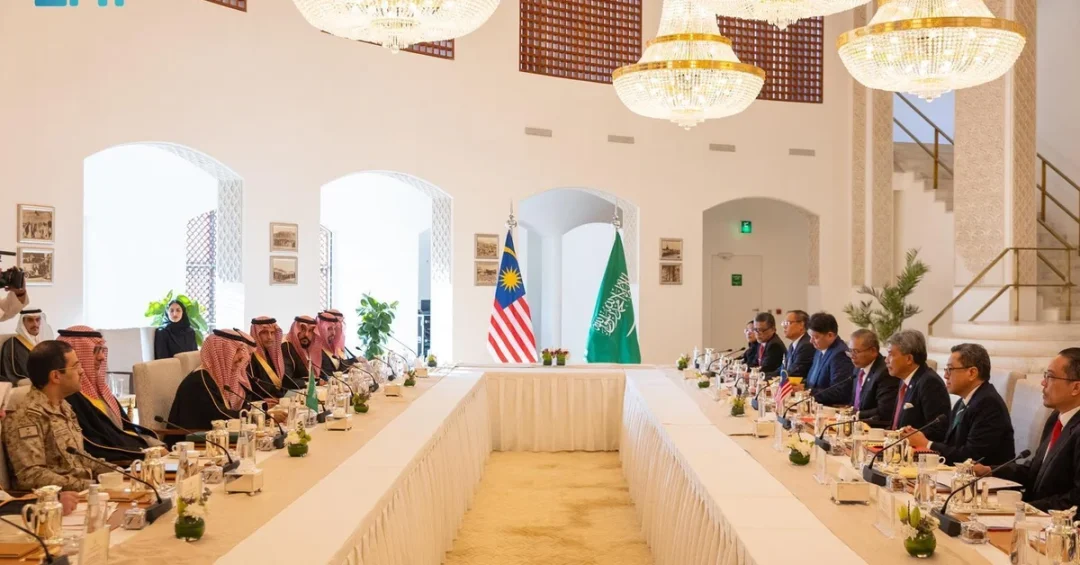
The Saudi-Malaysian Coordination Council convened its inaugural meeting in Riyadh on December 10, 2024, co-chaired by Saudi Minister of Foreign Affairs Prince Faisal bin Farhan bin Abdullah and Malaysian Minister of Foreign Affairs Dato’ Seri Utama Haji Mohamad bin Haji Hasan. The landmark gathering at the Ministry of Foreign Affairs headquarters marks a significant step forward in institutionalizing bilateral relations between the Kingdom of Saudi Arabia and Malaysia, reflecting the two nations’ shared commitment to deepening cooperation across a wide spectrum of strategic sectors.
The establishment of the council follows a series of high-level diplomatic engagements between Riyadh and Kuala Lumpur, underscoring Saudi Arabia’s broader strategy of strengthening partnerships with key Asian economies. The meeting brought together senior officials from both governments to review progress, set priorities, and chart a course for enhanced collaboration in politics, security, defense, energy, economy, investment, education, culture, and tourism. As the first formal session of the council, it establishes a structured framework for ongoing dialogue and joint action, aligning with the aspirations of both leaderships to serve mutual interests and regional stability.
Context and Background
How did Saudi-Malaysian relations evolve to reach this institutional milestone? The relationship between the Kingdom of Saudi Arabia and Malaysia has deep historical roots, built on shared Islamic values, mutual respect, and a long tradition of diplomatic, economic, and cultural exchange. Over the decades, both nations have collaborated in multilateral forums, including the Organization of Islamic Cooperation (OIC), and have maintained robust trade and investment ties. The establishment of the Saudi-Malaysian Coordination Council represents a natural progression in this partnership, providing a formal mechanism to coordinate policies and initiatives at the highest levels.
The council’s creation aligns with Saudi Arabia’s Vision 2030, which emphasizes economic diversification and international engagement. Malaysia, as a dynamic economy in Southeast Asia and a member of ASEAN, offers valuable opportunities for collaboration in sectors such as halal industry, Islamic finance, technology, and education. The inaugural meeting in Riyadh follows earlier agreements and visits, including the signing of several memoranda of understanding in recent years, and sets the stage for a more integrated approach to bilateral cooperation. The council’s structure, with committees dedicated to specific areas, ensures that follow-up and implementation are systematically pursued.
This first meeting also reflects the Kingdom’s proactive diplomacy under the leadership of the Custodian of the Two Holy Mosques, King Salman bin Abdulaziz Al Saud, and His Royal Highness Crown Prince Mohammed bin Salman bin Abdulaziz Al Saud, Prime Minister. By institutionalizing coordination with Malaysia, Saudi Arabia reinforces its role as a bridge between the Middle East and Asia, fostering stability and prosperity across regions.
Key Details of the Inaugural Meeting
What concrete outcomes emerged from this first council meeting? The session began with a review of the deep-rooted relations between the two countries, with both sides emphasizing the importance of sustaining and developing joint coordination. They highlighted the need to establish common positions on bilateral, regional, and international issues of shared concern, and affirmed their commitment to elevating cooperation to broader horizons. The council chairpersons expressed satisfaction with the outcomes of the committee meetings held in preparation, which are expected to strengthen collaboration across all fields.
A major highlight was the signing of two Memoranda of Understanding (MoUs). The first MoU, signed by Prince Faisal bin Farhan and Dato’ Seri Utama Haji Mohamad bin Haji Hasan, provides for mutual exemption from short-term visa requirements for holders of diplomatic, special, or official passports. This measure will facilitate official travel and further deepen diplomatic ties. The second MoU, related to social development, was signed by Vice Minister of Human Resources Dr. Abdullah Abuthnain for Saudi Arabia and the Malaysian Foreign Minister for Malaysia. It aims to enhance cooperation in social welfare, human resources development, and related areas, contributing to the well-being of both societies.
The meeting was attended by a distinguished array of Saudi officials, including Assistant Minister of Interior Dr. Hisham bin Abdulrahman Al-Falih; Deputy Minister of Foreign Affairs for Political Affairs Ambassador Dr. Saud Al-Sati; Undersecretary of the Ministry of Education for International Cooperation Dr. Abdulrahman Al-Amari; Undersecretary of the Saudi Ministry of Defense for Strategic Affairs Aviation Major General Salman Al-Harbi; Saudi Ambassador to Malaysia Mesaad Al-Sulaim; and General Supervisor of the Agency for International Relations and Cooperation at the Ministry of Energy Nasser Aldossary. Representatives from the council’s committees on Islamic, cultural, and social cooperation also participated, underscoring the comprehensive nature of the dialogue.
The council chairpersons underscored the importance of sustaining support for the council’s activities, its committees, and consistent coordination to ensure its effectiveness as an institutional framework. They stressed the necessity of following up on the implementation of recommendations and initiatives by the heads of the council’s committees, each within their respective areas, with the support of the council’s General Secretariat. At the conclusion, both sides expressed anticipation for the second council meeting to be scheduled at a mutually agreed time.
International and Regional Impact
How will this strengthened Saudi-Malaysian partnership resonate beyond the two nations? The inaugural meeting of the Coordination Council signals a deepening of ties between a leading Middle Eastern power and a key Southeast Asian nation, with potential ripple effects across the broader Islamic world and global economy. By institutionalizing cooperation, Saudi Arabia and Malaysia are better positioned to address shared challenges, from regional security to economic diversification. The visa exemption for diplomatic and official passport holders, for instance, will ease official exchanges and could pave the way for broader people-to-people ties.
On the regional stage, the council’s focus on politics, security, and defense suggests a convergence of views on issues such as peace and stability in the Middle East and Southeast Asia. Both countries have historically advocated for peaceful resolution of conflicts and respect for international law. Enhanced coordination could amplify their voices in multilateral settings, including the United Nations and the OIC. Economically, the council’s emphasis on investment, energy, and trade aligns with Saudi Arabia’s Vision 2030 and Malaysia’s own development goals, creating opportunities for joint ventures and technology transfer.
Moreover, the social development MoU highlights a shared commitment to human capital development, which is essential for sustainable growth. As Saudi Arabia continues its ambitious transformation, partnerships with countries like Malaysia, known for its expertise in Islamic finance, halal certification, and education, can provide valuable knowledge and best practices. The council thus serves as a platform for mutual learning and capacity building.
Economic and Strategic Significance
What economic benefits can be expected from this enhanced cooperation? The Saudi-Malaysian Coordination Council is poised to unlock new avenues for trade and investment, building on existing commercial ties. Malaysia is a significant trade partner for Saudi Arabia in Southeast Asia, with bilateral trade encompassing energy products, petrochemicals, palm oil, and electronics. The council’s economic committee will likely explore ways to diversify trade, reduce barriers, and facilitate business exchanges. Saudi Arabia’s Public Investment Fund (PIF) and Malaysian sovereign wealth funds, such as Khazanah Nasional, could collaborate on joint investments in infrastructure, technology, and renewable energy.
Strategically, the partnership supports Saudi Arabia’s pivot to Asia, a key pillar of its foreign policy. By strengthening ties with Malaysia, the Kingdom gains a reliable partner in ASEAN and a gateway to broader Southeast Asian markets. For Malaysia, closer ties with Saudi Arabia offer access to Middle Eastern markets and investment capital, as well as support for its own economic transformation. The council’s sectoral committees ensure that cooperation is not merely rhetorical but action-oriented, with clear follow-up mechanisms.
Energy cooperation is another critical dimension. As a leading oil producer, Saudi Arabia can share expertise with Malaysia, which is also an oil and gas producer. Joint efforts in renewable energy, hydrogen, and energy efficiency could contribute to global sustainability goals. The presence of Nasser Aldossary, General Supervisor of the Agency for International Relations and Cooperation at the Ministry of Energy, at the meeting underscores the importance of energy in the bilateral agenda.
Vision 2030 Alignment
How does the Saudi-Malaysian Coordination Council advance the goals of Vision 2030? Saudi Arabia’s Vision 2030 aims to diversify the economy, enhance international engagement, and improve the quality of life for its citizens. The council directly supports these objectives by fostering partnerships that bring investment, technology, and expertise into the Kingdom. The focus on education, culture, and tourism aligns with Vision 2030’s human capital development and cultural enrichment goals. For example, collaborations in education could lead to student exchanges, joint research, and vocational training, preparing Saudi youth for the jobs of the future.
In the realm of tourism, Malaysia’s successful tourism industry offers lessons for Saudi Arabia as it develops its own sector under Vision 2030. The council’s cultural committee can facilitate heritage preservation and artistic exchanges, enriching both societies. The social development MoU contributes to the Vision’s social welfare and quality of life objectives. Overall, the council exemplifies the Kingdom’s proactive diplomacy and its commitment to building mutually beneficial partnerships that support its transformation into a global investment and tourism hub.
As the council moves forward, with plans for a second meeting, it will serve as a model for Saudi Arabia’s engagement with other nations, demonstrating the value of institutionalized cooperation. The inaugural meeting in Riyadh thus marks not just a bilateral milestone but a step toward a more interconnected and prosperous future, consistent with the Kingdom’s leadership in regional and global affairs.
20 Questions
Q1. What is the Saudi-Malaysian Coordination Council?
A1. It is a bilateral framework established to enhance coordination and cooperation between Saudi Arabia and Malaysia across political, security, economic, and social fields, aiming to serve mutual interests and deepen integration.
Q2. When and where did the first meeting take place?
A2. The inaugural meeting was held on December 10, 2024, at the Ministry of Foreign Affairs headquarters in Riyadh, Saudi Arabia.
Q3. Who co-chaired the meeting?
A3. The meeting was co-chaired by Saudi Minister of Foreign Affairs Prince Faisal bin Farhan bin Abdullah and Malaysian Minister of Foreign Affairs Dato’ Seri Utama Haji Mohamad bin Haji Hasan.
Q4. What are the main objectives of the council?
A4. The council aims to deepen collaboration, interconnectivity, and integration between Saudi Arabia and Malaysia, focusing on areas such as politics, security, defense, energy, economy, investment, education, culture, and tourism.
Q5. What MoUs were signed during the meeting?
A5. Two MoUs were signed: one on mutual exemption from short-term visa requirements for diplomatic, special, or official passports, and another on social development.
Q6. Who signed the MoUs?
A6. The visa exemption MoU was signed by Prince Faisal bin Farhan and Dato’ Seri Utama Haji Mohamad bin Haji Hasan. The social development MoU was signed by Vice Minister of Human Resources Dr. Abdullah Abuthnain and the Malaysian Foreign Minister.
Q7. Which Saudi officials attended the meeting?
A7. Attendees included Assistant Minister of Interior Dr. Hisham bin Abdulrahman Al-Falih, Deputy Minister of Foreign Affairs for Political Affairs Ambassador Dr. Saud Al-Sati, and other senior officials from education, defense, and energy ministries.
Q8. How does the council align with Saudi Vision 2030?
A8. It supports Vision 2030 by promoting economic diversification, international partnerships, and human capital development through cooperation in education, tourism, and social welfare.
Q9. What is the significance of the visa exemption MoU?
A9. It facilitates official travel for diplomats and government officials, strengthening diplomatic ties and enabling more frequent high-level exchanges between the two countries.
Q10. What areas does the social development MoU cover?
A10. It covers cooperation in social welfare, human resources development, and related fields, aiming to improve the well-being of both Saudi and Malaysian societies.
Q11. How will the council ensure follow-up on its initiatives?
A11. The council’s General Secretariat will support committees in implementing recommendations and initiatives, with regular coordination between the two sides to ensure effectiveness.
Q12. When is the next council meeting expected?
A12. The second meeting will be scheduled at a mutually agreed time through the General Secretariat, as expressed by the chairpersons at the conclusion of the first meeting.
Q13. What role does Malaysia play in Saudi Arabia’s foreign policy?
A13. Malaysia is a key partner in Southeast Asia, helping Saudi Arabia strengthen ties with ASEAN and expand its economic and diplomatic reach in Asia.
Q14. How does this council benefit bilateral trade?
A14. It provides a platform to explore trade diversification, reduce barriers, and facilitate investments, building on existing commercial ties in energy, petrochemicals, and halal products.
Q15. What is the expected impact on regional stability?
A15. Enhanced coordination on political and security issues allows both nations to jointly address regional challenges and promote peace and stability in the Middle East and Southeast Asia.
Q16. How does the council support cultural exchange?
A16. Through its cultural committee, it facilitates heritage preservation, artistic collaborations, and educational exchanges, enriching both societies and promoting mutual understanding.
Q17. What economic sectors are prioritized?
A17. Priority sectors include energy, investment, trade, education, tourism, and Islamic finance, aligning with Saudi Vision 2030 and Malaysia’s development goals.
Q18. How does the council enhance people-to-people ties?
A18. By easing travel for officials and promoting cooperation in education, culture, and social development, it fosters greater interaction and understanding between Saudi and Malaysian citizens.
Q19. What is the role of the General Secretariat?
A19. The General Secretariat supports the council’s committees, coordinates activities, and ensures follow-up on recommendations and initiatives to maintain momentum in bilateral cooperation.
Q20. How does this meeting reflect Saudi Arabia’s global engagement?
A20. It demonstrates the Kingdom’s proactive diplomacy and commitment to building institutional partnerships that advance its Vision 2030 goals and contribute to regional and global prosperity.
Reader Feedback
We value your thoughts. Please share your feedback on this article.
Your feedback helps us improve our coverage.
Related articles
 Saudi Minister Al-Jubeir Receives Bertelsmann Stiftung Board Members
 Arab Parliament Speaker Calls for Strengthening Human Rights
 GASTAT and UNICEF Sign MoU on Child Survey Cooperation
 KSrelief Provides Shelter for 100 Families in Afghanistan
 KSrelief Distributes 3,066 Date Cartons in Yemen
 KSrelief Distributes 408 Food Baskets to Displaced People in Sudan