


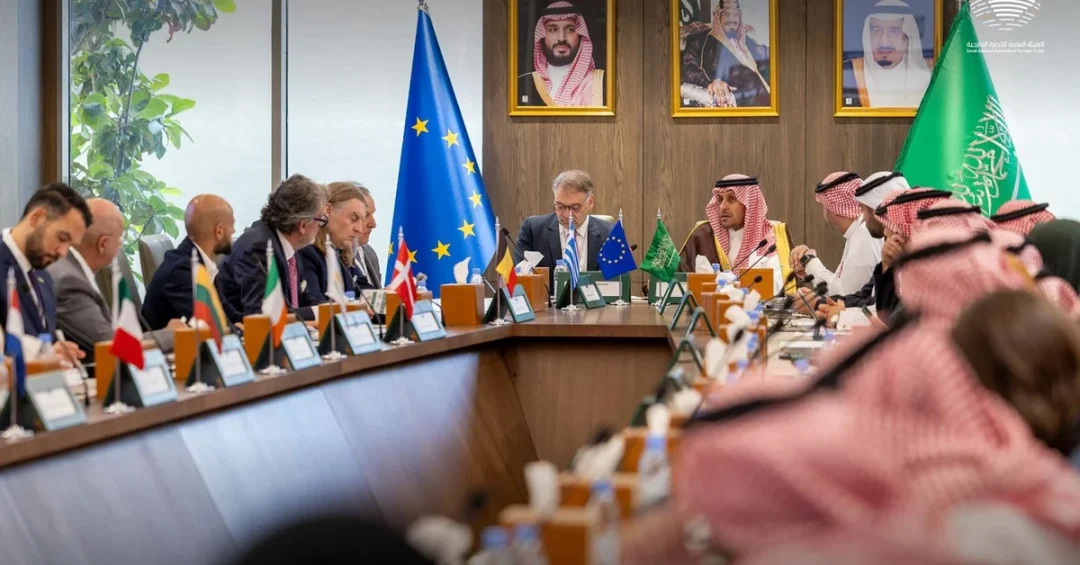
Saudi Arabia and the European Union convened a two-day roundtable in Riyadh on December 9, 2024, hosted by the Saudi General Authority of Foreign Trade (GAFT), to strengthen a trade partnership that ranks among the Kingdom’s most important economic relationships. The meeting, chaired by Abdulaziz Alsakran, GAFT’s Deputy Governor for International Relations, and Dr. Thomas Jorgensen, head of the Trade and Economic Affairs Department at the EU Delegation to Saudi Arabia, brought together senior trade officials, representatives of EU member states, the European Chamber of Commerce in Riyadh, Saudi public sector experts, and delegates from major national projects and leading companies. The roundtable ran through December 10 and focused on expanding trade volumes, reducing barriers, and building durable public-private links between the two sides.
Why does a single roundtable in Riyadh matter to markets and policymakers far beyond the Gulf? Because the Saudi-EU commercial corridor touches energy, advanced manufacturing, logistics, clean technology, and services, and because both sides have signalled that they see deeper economic integration as a strategic priority rather than a routine diplomatic courtesy. The discussions reflect a broader pattern in Saudi trade policy: institutionalised dialogue with major partners, coordinated through GAFT under the framework of Vision 2030, the national transformation programme that seeks to diversify the Kingdom’s economy and expand its global commercial footprint.
Context and Background
How did Saudi-EU trade relations reach a point where a dedicated roundtable can convene such a broad cross-section of officials and executives? The answer lies in years of steady institutional engagement. The European Union is one of the Kingdom’s major trading partners, and the relationship spans hydrocarbon exports, petrochemicals, machinery, vehicles, pharmaceuticals, and a growing exchange of digital and financial services. GAFT, the government body responsible for developing and regulating Saudi Arabia’s foreign trade, has increasingly used structured forums to align regulations, share market intelligence, and resolve practical obstacles faced by exporters and investors on both sides.
The roundtable format itself is significant. Rather than a single high-level statement, the two-day session gathered working-level specialists alongside senior officials, including trade representatives of EU member states and experts from the Saudi public sector. That composition allows participants to move from general commitments to specific technical questions: customs procedures, standards recognition, investment screening, and the practical mechanics of doing business across a 27-nation bloc and a rapidly transforming Saudi market.
For international observers, the timing reflects a wider recalibration of global trade. As supply chains diversify and economies seek resilient partnerships, Saudi Arabia has positioned itself as a connector between Europe, Asia, and Africa. The Kingdom’s location, its logistics infrastructure, and its reform agenda make it a natural counterpart for the EU’s own interest in de-risking and broadening commercial ties. The Riyadh roundtable is therefore best understood not as an isolated event but as one node in a widening network of Saudi trade diplomacy.
Key Details
What was actually discussed inside the room? According to the Saudi Press Agency, the agenda centred on common challenges and ways to tackle them, enhanced cooperation in trade and investment, and a stronger global economic partnership. Participants examined better communication channels between Saudi and European stakeholders, the sharing of knowledge, and the review of new reforms and regulations introduced in Saudi Arabia. A central objective was identifying trade barriers and exploring potential collaborations between the public and private sectors on both sides.
The attendee list underscores the breadth of the engagement. Alongside GAFT officials and EU delegation representatives, the meeting included trade representatives of EU member states, the European Chamber of Commerce in Riyadh, Saudi public sector experts, and representatives involved in major Saudi projects and leading companies. This mix matters because trade barriers are rarely abstract; they are experienced by exporters, investors, and project developers who need clarity on rules, timelines, and procedures.
Expected outcomes, as reported by the Saudi Press Agency, include improved exchange of knowledge on trade regulations, reduced trade barriers, and exploration of ways to increase trade and build stronger relationships between stakeholders. The roundtable also aimed to foster robust relationships among Saudi trade partners through knowledge sharing and to surface practical avenues for cooperation. These are incremental but consequential steps: in trade policy, consistent technical dialogue often precedes measurable increases in commercial flows.
International and Regional Impact
How will a Riyadh meeting shape trade patterns across regions? The Saudi-EU relationship is not confined to bilateral exchanges. The EU is a major consumer of Saudi energy products and a significant supplier of industrial goods and technology, while Saudi Arabia is a pivotal player in regional logistics, finance, and energy transition. Improvements in the commercial framework between them can influence shipping routes, investment flows, and the competitiveness of the Kingdom as a hub for European firms serving Middle Eastern and Asian markets.
Regionally, the roundtable reinforces Saudi Arabia’s role as a convening power. By hosting EU officials and member-state representatives alongside its own public and private sectors, the Kingdom demonstrates a capacity to manage complex, multi-stakeholder economic relationships. For neighbouring economies and for international investors watching the region, that signals predictability and openness. It also complements Saudi Arabia’s participation in broader multilateral fora, where the Kingdom has consistently advocated for stable, rules-based trade and investment flows.
The European side has its own reasons to engage. European economies seek reliable energy partners, growing export markets, and investment destinations tied to the clean-energy transition. Saudi Arabia’s giga-projects, industrial strategies, and digital transformation create demand for European expertise in engineering, finance, and technology. A structured roundtable helps match that supply with Saudi demand, reducing friction and accelerating deal flow.
Economic and Strategic Significance
What economic value is at stake? Trade between Saudi Arabia and the EU already represents a substantial share of the Kingdom’s external commerce, and both sides have indicated an interest in increasing volumes. The roundtable’s focus on reducing trade barriers speaks directly to that goal. Lower friction in customs, standards, and regulatory recognition can translate into faster shipments, lower costs, and more competitive pricing for companies on both sides. For Saudi exporters, clearer access to European markets supports diversification away from purely hydrocarbon-dependent revenue streams.
Strategically, the meeting aligns with Saudi Arabia’s ambition to deepen its network of trade and investment agreements. GAFT’s mandate includes negotiating and implementing foreign trade policy, and forums like this one help identify where regulatory alignment is feasible and where further negotiation is required. For European companies, engagement offers a window into Saudi reforms, including updates to investment law, commercial regulation, and incentives for priority sectors. The presence of representatives from major Saudi projects and leading companies indicates that the private sector is being brought into the conversation early, which tends to improve the quality of eventual partnerships.
There is also a knowledge dimension. Sharing expertise on trade regulations and market access builds institutional capacity on both sides. Over time, such exchanges can shorten the learning curve for new entrants, reduce disputes, and create a more predictable environment for long-term investment. In an era when businesses weigh regulatory risk heavily, that predictability is itself an economic asset.
Vision 2030 Alignment
How does this roundtable connect to Saudi Arabia’s long-term national plan? Vision 2030 aims to diversify the Kingdom’s economy, expand non-oil exports, attract foreign investment, and strengthen its position as a global logistics and commercial hub. Strengthening trade ties with the European Union directly supports those objectives. The EU is a large, high-standard market, and deeper engagement encourages Saudi firms to meet international norms, upgrade capabilities, and integrate into global value chains.
Vision 2030 also emphasises partnership between the public and private sectors, and the roundtable embodied that principle by convening government officials, EU representatives, and business leaders in one forum. The expected outcomes, from reduced trade barriers to stronger stakeholder relationships, are precisely the kind of practical enablers that turn strategic visions into measurable results. As Saudi Arabia continues to open new sectors to foreign participation and to invest in ports, railways, and digital infrastructure, dialogues like this one help ensure that the Kingdom’s global partners can participate in and benefit from its transformation.
20 Questions
Q1. What was the purpose of the Saudi-EU roundtable held in Riyadh?
A1. The roundtable aimed to strengthen the trade partnership between Saudi Arabia and the European Union, increase trade volumes, address common challenges, and explore cooperation in trade and investment between the two sides.
Q2. When and where did the roundtable take place?
A2. The Saudi General Authority of Foreign Trade hosted the roundtable in Riyadh from December 9 to 10, 2024, according to the Saudi Press Agency.
Q3. Who chaired the Saudi-EU roundtable discussions?
A3. The meeting was chaired by Abdulaziz Alsakran, GAFT’s Deputy Governor for International Relations, and Dr. Thomas Jorgensen, head of the Trade and Economic Affairs Department at the EU Delegation to Saudi Arabia.
Q4. Which Saudi authority organised the roundtable?
A4. The Saudi General Authority of Foreign Trade, known as GAFT, hosted and organised the roundtable as part of its mandate to develop and regulate the Kingdom’s foreign trade policy.
Q5. Who attended the roundtable from the European side?
A5. Attendees included high-ranking trade officials from the EU delegation to Saudi Arabia, trade representatives of EU member states, and representatives of the European Chamber of Commerce in Riyadh.
Q6. Who represented Saudi Arabia at the meeting?
A6. Saudi participation included experts from the public sector, representatives involved in major Saudi projects, and delegates from leading companies, alongside GAFT officials.
Q7. What were the main topics discussed at the roundtable?
A7. Discussions focused on common challenges and ways to tackle them, enhanced cooperation in trade and investment, better global economic partnership, and practical steps to increase trade between the two sides.
Q8. What specific areas did participants aim to address?
A8. They addressed better communication between the two sides, knowledge sharing, reviewing new Saudi reforms and regulations, identifying trade barriers, and exploring public-private collaborations.
Q9. What outcomes were expected from the roundtable?
A9. Expected outcomes included improved exchange of knowledge on trade regulations, reduced trade barriers, and exploration of ways to increase trade and build stronger relationships between stakeholders.
Q10. Why is the European Union important to Saudi trade?
A10. The EU is one of the Kingdom’s major trading partners, with substantial exchanges in energy, petrochemicals, machinery, and services, making deeper engagement a strategic priority for Saudi Arabia.
Q11. How does the roundtable support Saudi Arabia’s Vision 2030?
A11. It supports economic diversification, non-oil export growth, foreign investment attraction, and the strengthening of Saudi Arabia’s role as a global logistics and commercial hub.
Q12. What role does GAFT play in Saudi trade policy?
A12. GAFT is responsible for developing and regulating Saudi Arabia’s foreign trade, negotiating trade agreements, and facilitating partnerships that expand the Kingdom’s global commercial ties.
Q13. How might reduced trade barriers benefit businesses?
A13. Lower barriers can mean faster customs procedures, lower costs, clearer regulations, and more competitive pricing, helping companies on both sides trade more efficiently and predictably.
Q14. What is the significance of public-private sector collaboration in this context?
A14. Bringing government and business together helps align policies with real market needs, speeds up problem-solving, and creates practical partnerships that support long-term trade and investment growth.
Q15. Did the roundtable include representatives from EU member states?
A15. Yes. Trade representatives of EU member states participated, reflecting the bloc’s collective interest in deepening commercial ties with Saudi Arabia across multiple sectors.
Q16. What kind of knowledge was exchanged during the meeting?
A16. Participants shared knowledge on trade regulations, new Saudi reforms, market access requirements, and practical approaches to overcoming barriers faced by exporters and investors.
Q17. How does this roundtable fit into broader Saudi trade diplomacy?
A17. It forms part of a wider pattern of structured engagement with major partners, complementing Saudi participation in multilateral forums and efforts to diversify global economic relationships.
Q18. What message does the roundtable send to international investors?
A18. It signals that Saudi Arabia is open to dialogue, committed to regulatory improvement, and serious about creating a predictable environment for foreign investment and partnership.
Q19. What sectors could benefit most from enhanced Saudi-EU trade cooperation?
A19. Energy, petrochemicals, advanced manufacturing, logistics, clean technology, digital services, and finance are among the sectors positioned to benefit from closer commercial ties.
Q20. What is the likely next step after the roundtable?
A20. Follow-up technical discussions and continued engagement between GAFT, EU officials, and private-sector stakeholders are expected to translate the roundtable’s outcomes into concrete trade and investment progress.
Reader Feedback
We value your thoughts. Please share your feedback on this article.
Your feedback helps us improve our coverage.
Related articles
 Mawani Ports See 4.29% Cargo Increase in November 2024
 French Delegation Explores Investment Opportunities in Asharqia Chamber
 Saudi Arabia Approves New Industrial City in Dammam
 Saudi Industrial Production Index Rises 5% in October 2024
 Saudi Arabia, UK Hold High-Level Business Roundtable in Riyadh
 Saudi Economy Ministry Hosts OECD Workshop for 30 Agencies