


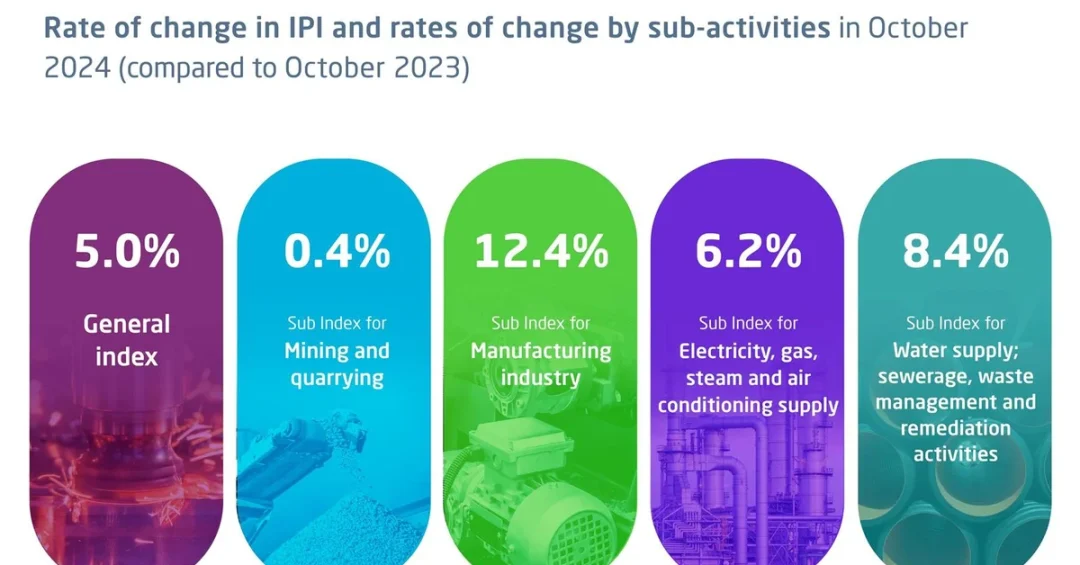
Saudi Arabia’s industrial sector posted a solid 5% year-on-year expansion in October 2024, with the General Authority for Statistics (GASTAT) reporting that the Industrial Production Index (IPI) rose on the strength of mining and quarrying, manufacturing, and utilities activity. The official report, released in Riyadh on December 10, 2024, and carried by the Saudi Press Agency (SPA), confirms that the Kingdom’s industrial base continues to broaden as Vision 2030 economic diversification programs move from planning into measurable output.
The IPI is one of the most closely watched monthly indicators of Saudi economic health because it tracks real changes in the volume of industrial production rather than price effects. GASTAT compiles the index from its monthly industrial production survey, which collects data directly from licensed industrial establishments across the Kingdom. For international observers, the October reading offers a timely, official snapshot of how the world’s largest oil exporter is simultaneously defending its core energy revenues and building new non-oil industrial capacity. Could any single monthly indicator better capture the dual engine of Saudi industrial policy? The answer lies in the composition of the index itself, which splits activity into mining and quarrying, manufacturing, and utilities, allowing analysts to see exactly where growth is coming from.
Context and Background
The Industrial Production Index is a statistical tool used by economies around the world to measure short-term changes in the physical output of mines, factories, and utilities. GASTAT, the Kingdom’s official statistical authority, publishes the Saudi IPI monthly as part of a broader suite of industrial statistics that includes production surveys, factory counts, and sectoral employment data. The index uses a base year and a weighted structure so that each sub-sector contributes in proportion to its role in the national economy, with mining and quarrying, dominated by crude oil and natural gas extraction, carrying the largest weight.
Why does the composition of the index matter so much for reading the October result? Because a 5% headline gain can be driven by very different forces. In October 2024, according to GASTAT, the mining and quarrying sub-index edged up 0.4% year-on-year, while oil activities within that category climbed 5.4% and non-oil activities advanced 4%. That pattern shows growth was not confined to hydrocarbons: manufacturing, electricity, gas, steam and air conditioning supply, and water supply, sewage and waste management all contributed positively. The breadth of the increase is what gives the October report its significance.
For context, the October 2024 release followed a period in which Saudi Arabia had been implementing voluntary crude oil production cuts agreed within the OPEC+ framework. Those cuts had weighed on mining and quarrying output through much of 2023 and early 2024. The fact that oil activities still recorded a 5.4% year-on-year increase in October suggests the comparison base and the Kingdom’s production strategy were interacting in a way that supported the index. At the same time, non-oil activity growth of 4% reinforces the narrative that the Saudi industrial economy is no longer a single-commodity story. Isn’t that precisely the structural shift that Vision 2030 was designed to deliver?
Key Details
The GASTAT report breaks the October 2024 IPI result into its principal components. The overall index rose 5% compared with October 2023. The mining and quarrying sub-index, the largest single component, increased 0.4% year-on-year. Within mining and quarrying, oil activities rose 5.4%, while non-oil activities, which include the extraction of minerals such as gold, phosphate, and bauxite, grew 4%. Manufacturing, electricity, gas, steam and air conditioning supply, and water supply, sewage, waste management and treatment were all cited by GASTAT as contributors to the headline increase.
The report also underlines the methodological rigor behind the number. GASTAT collects IPI data through a monthly industrial production survey that reaches industrial establishments across the Kingdom, covering output volumes in physical terms. The authority publishes the index alongside other statistical products on the industrial sector, giving policymakers, investors, and international institutions a consistent time series for tracking momentum. Because the survey is conducted monthly, it captures short-term shifts that quarterly GDP data might smooth out, making it a useful early indicator for the broader economy.
What do the sub-index figures tell us that the headline 5% does not? They reveal that growth was distributed rather than concentrated. A headline driven only by oil would be vulnerable to global price and quota cycles. A headline supported by manufacturing and utilities as well as mining suggests a more resilient industrial base. The 4% rise in non-oil activities within mining and quarrying is particularly notable because it reflects the Kingdom’s efforts to develop mineral wealth beyond hydrocarbons, a priority embedded in the national mining strategy. Meanwhile, the positive contribution from electricity, gas, steam and air conditioning supply points to rising industrial and commercial demand for power, itself a sign of an expanding production base. Each of these strands feeds into the same conclusion: Saudi industry is widening as well as growing.
International and Regional Impact
For international markets, the October IPI reading is a reminder that Saudi Arabia remains a pivotal supplier of energy and industrial inputs even as it diversifies. Oil activities rising 5.4% year-on-year indicates that the Kingdom’s crude output and related activity were higher than in the same month of 2023, a data point that matters for global oil balances, refining margins, and petrochemical feedstock availability. Trading houses, energy analysts, and multinational manufacturers that rely on Saudi hydrocarbons and chemicals watch the GASTAT release closely because it provides an official, monthly gauge of supply-side momentum from the world’s largest exporter.
Regionally, the report strengthens Saudi Arabia’s position as the Gulf’s largest and most diversified industrial economy. Manufacturing growth in the Kingdom supports cross-border supply chains, from construction materials used in giga-projects to processed metals, plastics, and food products sold across the Gulf Cooperation Council states. When Saudi factories and utilities expand, demand rises for regional labor, logistics, and financial services. Does that not make the Kingdom’s industrial performance a leading indicator for the wider region? For international investors assessing Gulf exposure, the October data offers evidence that the Saudi industrial story is not solely a hydrocarbon narrative but an increasingly broad-based one, with non-oil activities contributing meaningfully to the headline result.
Economic and Strategic Significance
The 5% increase in the IPI carries weight beyond the monthly data cycle. Industrial production is a core input into gross domestic product calculations, and sustained expansion in mining, manufacturing, and utilities supports the non-oil GDP growth that Saudi economic planners target under Vision 2030. The 4% rise in non-oil activities within mining and quarrying signals progress in developing the Kingdom’s mineral resources, including gold, copper, phosphate, and rare earth elements, which are central to the national industrial and mining strategies. Higher utilities output, meanwhile, reflects the infrastructure build-out required by new industrial cities, logistics zones, and manufacturing clusters.
Strategically, a rising IPI supports fiscal stability by broadening the revenue base away from crude oil sales. Manufacturing contributes to export diversification, import substitution, and job creation, all of which are explicit objectives of Saudi economic policy. The October report also provides evidence that the industrial ecosystem can grow even while oil production is managed within international agreements, because non-oil activities and manufacturing are contributing independently. What better proof could there be that diversification and energy leadership can advance together? The data suggest the Kingdom is not choosing between its traditional strengths and its new ambitions; it is compounding them.
Vision 2030 Alignment
The October 2024 IPI result aligns directly with the objectives of Saudi Vision 2030, the national transformation program launched under the leadership of Crown Prince Mohammed bin Salman. Vision 2030 seeks to diversify the economy, expand non-oil sectors, attract investment, and create quality employment for Saudi citizens. A 5% annual increase in industrial production, with non-oil activities up 4% and manufacturing and utilities contributing, is exactly the kind of measurable progress the program was designed to generate. It also reinforces the Kingdom’s ambition to become a global industrial and logistics hub connecting three continents.
Looking ahead, GASTAT’s monthly industrial data will remain a key scorecard for measuring how quickly the Kingdom’s industrial base deepens. The October report shows an economy firing on multiple cylinders: energy, manufacturing, and infrastructure utilities all moving in the same positive direction. For international readers, it is an official, transparent signal that Saudi Arabia’s industrial transformation is underway and measurable. As Vision 2030 enters its next phase, each monthly IPI release will help investors, partners, and observers track the Kingdom’s progress toward a diversified, resilient, and globally connected industrial economy. Isn’t that a story worth following month after month?
20 Questions
Q1. What did GASTAT report about Saudi Arabia’s Industrial Production Index in October 2024?
A1. GASTAT reported that the Industrial Production Index increased by 5% in October 2024 compared with the same month of 2023, driven by growth in mining and quarrying, manufacturing, and utilities activities across the Kingdom.
Q2. Which authority released the October 2024 Industrial Production Index report?
A2. The General Authority for Statistics, known as GASTAT, released the report in Riyadh on December 10, 2024, and it was carried by the Saudi Press Agency, the Kingdom’s official news channel.
Q3. What is the Industrial Production Index?
A3. The IPI is a key economic indicator that measures changes in the volume of industrial production based on data collected monthly through GASTAT’s industrial production survey of establishments across Saudi Arabia.
Q4. How much did the mining and quarrying sub-index increase in October 2024?
A4. The mining and quarrying sub-index increased by 0.4% year-on-year in October 2024, according to the GASTAT report, reflecting steady output from the Kingdom’s largest industrial component.
Q5. How did oil activities perform within the mining and quarrying sector?
A5. Oil activities increased by 5.4% year-on-year in October 2024, indicating higher crude-related output compared with the same month of 2023 and supporting the overall index result.
Q6. What was the growth rate of non-oil activities in October 2024?
A6. Non-oil activities grew by 4% year-on-year in October 2024, reflecting the expansion of mineral extraction and other industrial activities beyond hydrocarbons within the mining and quarrying sector.
Q7. Which sectors contributed to the 5% increase in the IPI?
A7. GASTAT cited mining and quarrying, manufacturing, electricity, gas, steam and air conditioning supply, and water supply, sewage, waste management and treatment as contributors to the October 2024 increase.
Q8. How does GASTAT collect the data used to compile the IPI?
A8. GASTAT collects data monthly through the industrial production survey, which gathers output information from industrial establishments across the Kingdom to calculate changes in production volumes.
Q9. Why is the IPI important for understanding the Saudi economy?
A9. The IPI provides a timely monthly measure of industrial output, helping policymakers, investors, and analysts track momentum in mining, manufacturing, and utilities, which are core components of Saudi gross domestic product.
Q10. What does the 5% IPI increase say about Saudi Arabia’s economic diversification?
A10. The increase, supported by a 4% rise in non-oil activities and positive manufacturing and utilities contributions, shows the Kingdom’s industrial base is broadening beyond hydrocarbons in line with Vision 2030 goals.
Q11. How does the October 2024 result compare with the same month in 2023?
A11. The IPI rose 5% year-on-year in October 2024, meaning industrial production volumes were measurably higher than in October 2023 across the sectors covered by the GASTAT survey.
Q12. What role does manufacturing play in the October 2024 IPI report?
A12. Manufacturing was listed among the sectors that contributed to the 5% headline increase, reflecting higher output from Saudi factories producing goods for domestic consumption, regional export, and industrial supply chains.
Q13. Why are utilities such as electricity and gas included in the IPI?
A13. Electricity, gas, steam and air conditioning supply, along with water and waste management, are included because they are essential industrial activities whose output reflects demand from factories, businesses, and households.
Q14. What is the significance of the 4% rise in non-oil activities?
A14. The 4% increase highlights progress in developing Saudi Arabia’s mineral and non-hydrocarbon resources, supporting the Kingdom’s strategy to build a more diversified and resilient industrial economy.
Q15. How does the IPI support Saudi Arabia’s Vision 2030 objectives?
A15. The IPI tracks industrial output that underpins non-oil GDP growth, export diversification, and job creation, all of which are central objectives of Vision 2030’s economic transformation program.
Q16. What does the report say about Saudi Arabia’s oil sector performance?
A16. The report shows oil activities increased by 5.4% year-on-year in October 2024, indicating that the Kingdom’s core energy sector continued to perform strongly while non-oil activities also expanded.
Q17. How often does GASTAT publish industrial statistics?
A17. GASTAT regularly publishes various statistical products on the industrial sector, including the monthly Industrial Production Index, providing a consistent time series for tracking industrial activity throughout the year.
Q18. Why should international investors pay attention to the October 2024 IPI?
A18. The report offers an official, monthly gauge of Saudi industrial momentum, helping international investors assess opportunities in manufacturing, mining, utilities, and the broader non-oil economy.
Q19. What does the breadth of growth in October 2024 suggest about Saudi industry?
A19. Growth across mining, manufacturing, and utilities suggests the Saudi industrial base is expanding on multiple fronts rather than relying on a single sector, which supports long-term resilience.
Q20. What is the outlook for Saudi Arabia’s industrial sector after the October 2024 report?
A20. The October result points to continued expansion supported by Vision 2030 programs, with GASTAT’s monthly data set to remain a key measure of the Kingdom’s progress toward a diversified industrial economy.
Reader Feedback
We value your thoughts. Please share your feedback on this article.
Your feedback helps us improve our coverage.
Related articles
 Saudi Arabia, UK Hold High-Level Business Roundtable in Riyadh
 Saudi Economy Ministry Hosts OECD Workshop for 30 Agencies
 Saudi Steering Committee Chairman Inaugurates IPSASB Meetings in Riyadh
 Saudi Arabia, EU Affirm Commitment to Bolster Trade Ties
 Mawani Adds JRS Shipping Service to Jeddah Islamic Port
 Türkiye Exporters Seek Saudi Partnerships at Riyadh Forum