


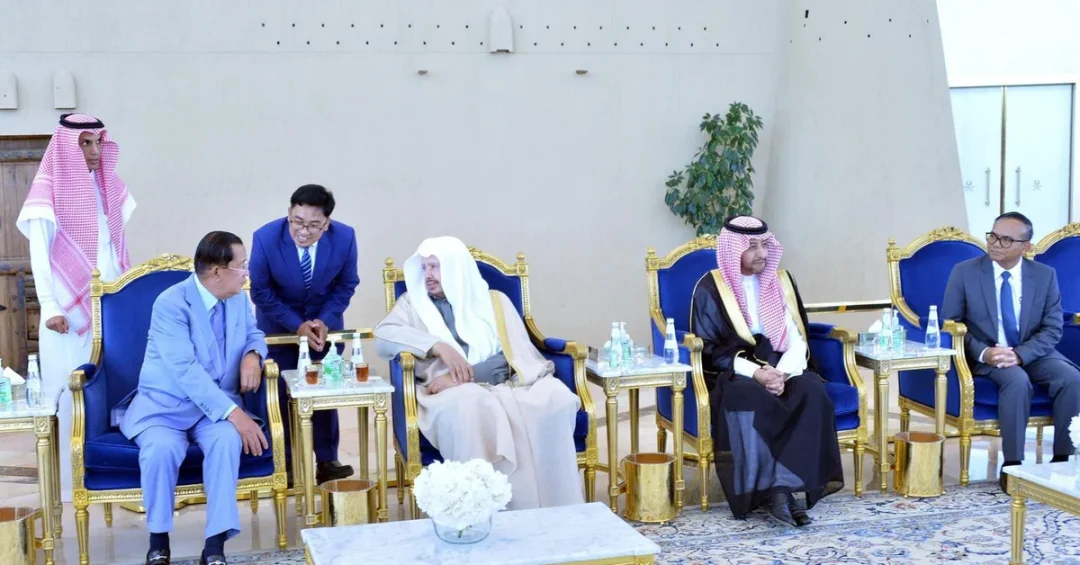
The President of the Senate of the Kingdom of Cambodia, Samdech Techo Hun Sen, arrived in Riyadh on December 8, 2024, beginning an official visit to the Kingdom of Saudi Arabia. He was welcomed at King Khalid International Airport by the Speaker of the Shura Council, Sheikh Dr. Abdullah bin Mohammed bin Ibrahim Al Al-Sheikh, alongside Shura Council member and representative of the Saudi-Cambodian Parliamentary Friendship Committee, Abdullah Al-Madi, and other officials from the Shura Council. The visit, announced by the Saudi Press Agency, signals a deepening of parliamentary and diplomatic ties between Riyadh and Phnom Penh. Could this visit mark a new chapter in Saudi-Cambodian relations? The arrival of such a senior Southeast Asian leader underscores the Kingdom’s growing role as a global diplomatic hub.
The official visit comes as Saudi Arabia continues to expand its international partnerships under the framework of Vision 2030, the national transformation plan championed by Crown Prince Mohammed bin Salman. Cambodia, a key member of the Association of Southeast Asian Nations (ASEAN), represents a strategic partner in a region where the Kingdom is actively building economic and political bridges. The warm reception at King Khalid International Airport reflects the importance Saudi Arabia places on fostering ties with Asian nations. What does this visit reveal about Saudi Arabia’s evolving foreign policy? It demonstrates a clear commitment to multilateral engagement and parliamentary diplomacy.
Context and Background
Why has Saudi Arabia prioritized parliamentary diplomacy in recent years? The Shura Council, Saudi Arabia’s consultative assembly, has increasingly played a central role in strengthening international relations through its parliamentary friendship committees. These committees, like the Saudi-Cambodian Parliamentary Friendship Committee represented by Abdullah Al-Madi, facilitate dialogue between legislators and help align policy priorities. The Kingdom’s outreach to Cambodia is part of a broader strategy to engage with Southeast Asia, a region of growing economic importance. The visit follows a series of high-level exchanges between Saudi and Cambodian officials, reflecting mutual interest in cooperation across multiple sectors.
Cambodia, under the leadership of Samdech Techo Hun Sen, has itself pursued a policy of active diplomacy and economic development. Hun Sen, a veteran statesman who served as Prime Minister for nearly four decades before becoming Senate President in 2024, brings a wealth of experience to the talks. His visit to Riyadh is not merely ceremonial; it is expected to lay the groundwork for concrete agreements in trade, investment, and cultural exchange. What are the historical foundations of Saudi-Cambodian relations? While diplomatic ties were established decades ago, recent years have seen a notable acceleration in engagement, driven by shared interests in economic diversification and regional stability.
The timing of the visit is significant. Saudi Arabia is positioning itself as a bridge between the Middle East and Asia, leveraging its geographic location and economic weight. Cambodia, with its rapidly growing economy and strategic position in ASEAN, is a natural partner in this endeavor. The two nations share a commitment to development and modernization, making parliamentary cooperation a logical avenue for deepening ties. How can legislative collaboration translate into tangible benefits for both peoples? By aligning legal frameworks and fostering people-to-people connections, the Shura Council and the Cambodian Senate can pave the way for enhanced trade, tourism, and investment.
Key Details of the Visit
What exactly will be discussed during the official talks? The Speaker of the Shura Council, Sheikh Dr. Abdullah bin Mohammed bin Ibrahim Al Al-Sheikh, and Senate President Hun Sen are scheduled to hold an official discussion session at the Shura Council headquarters in Riyadh. The agenda focuses on strengthening bilateral relations and fostering parliamentary cooperation. This includes exploring ways to enhance legislative exchange, share best practices, and coordinate positions on regional and international issues of mutual concern. The presence of the Saudi-Cambodian Parliamentary Friendship Committee underscores the institutional framework already in place to support these efforts.
The visit also highlights the personal rapport between Saudi and Cambodian leaders. Sheikh Dr. Abdullah Al Al-Sheikh, a respected figure in Saudi Arabia’s consultative process, has been instrumental in expanding the Shura Council’s international outreach. His Cambodian counterpart, Hun Sen, is known for his pragmatic approach to foreign policy and his focus on economic development. Together, they are expected to discuss opportunities for collaboration in areas such as agriculture, energy, tourism, and technology. What specific outcomes can be expected from these talks? While details are still emerging, the establishment of a formal parliamentary dialogue mechanism and the signing of memoranda of understanding are likely possibilities.
Beyond the formal agenda, the visit provides an opportunity for cultural and educational exchange. Saudi Arabia has been actively promoting its cultural heritage and tourism offerings to international audiences, and Cambodia, with its rich history and growing middle class, represents a promising market. The Shura Council’s engagement with Cambodia also aligns with the Kingdom’s broader efforts to attract foreign investment and diversify its economy. How will this visit impact the lives of ordinary Saudis and Cambodians? By opening new avenues for trade and cooperation, it can create jobs, stimulate innovation, and enhance mutual understanding.
International and Regional Impact
Why does Saudi-Cambodian cooperation matter beyond the two countries? Southeast Asia is a dynamic region with a combined GDP of over $3 trillion, and Saudi Arabia’s engagement there is part of a wider geopolitical shift. The Kingdom’s Look East policy, which complements its traditional alliances, aims to tap into Asia’s growth potential. Cambodia, as a member of ASEAN, offers a gateway to this market. Improved ties could facilitate Saudi investment in Cambodian infrastructure, agriculture, and halal industries, while Cambodian products could find new markets in the Gulf. What message does this send to other nations in the region? It signals that Saudi Arabia is open for business and committed to building mutually beneficial partnerships.
On the diplomatic front, the visit reinforces Saudi Arabia’s role as a convenor of dialogue and a promoter of stability. By engaging with Cambodia, a country that has experienced remarkable economic transformation, the Kingdom demonstrates its respect for sovereignty and its willingness to work with diverse political systems. This approach aligns with the principles of the United Nations Charter and the objectives of Saudi Vision 2030, which emphasizes international cooperation. How might this visit influence regional dynamics? It could encourage other Gulf states to deepen their ties with Southeast Asia, fostering a more interconnected and prosperous Asia-Middle East corridor.
Economic and Strategic Significance
What economic opportunities does the Saudi-Cambodian relationship unlock? Bilateral trade between the two countries remains modest but has significant growth potential. Saudi Arabia is a major exporter of energy and petrochemicals, while Cambodia is a producer of garments, footwear, and agricultural products. There is scope for collaboration in food security, renewable energy, and tourism. Saudi investment in Cambodia’s logistics and manufacturing sectors could help the Kingdom diversify its supply chains and access ASEAN markets. Conversely, Cambodian businesses can benefit from Saudi Arabia’s Vision 2030 projects, including NEOM and the Red Sea development, which offer partnership opportunities.
Strategically, the visit is part of Saudi Arabia’s effort to build a network of alliances that support its security and prosperity. By strengthening ties with Cambodia, the Kingdom gains a partner in ASEAN and a voice in regional forums. This is particularly important as global power dynamics evolve and new centers of economic gravity emerge. The Shura Council’s role in this process is crucial, as it provides a platform for sustained dialogue and legislative cooperation. How will these economic and strategic ties evolve in the coming years? With continued high-level exchanges and a focus on concrete projects, the relationship is poised to deepen, benefiting both nations and contributing to regional stability.
Vision 2030 Alignment
How does the Cambodian Senate President’s visit align with Saudi Vision 2030? Vision 2030 is not only a domestic transformation plan but also a blueprint for international engagement. It seeks to diversify the Kingdom’s economy, enhance its global competitiveness, and promote moderation and tolerance. Parliamentary diplomacy, as exemplified by the Shura Council’s outreach to Cambodia, is a key tool for achieving these goals. By building partnerships with countries like Cambodia, Saudi Arabia can expand its trade networks, attract investment, and share its development experience. The visit also supports the Vision’s aim of making Saudi Arabia a hub for logistics and tourism, connecting Asia, Europe, and Africa.
Furthermore, the visit reflects the Vision’s emphasis on soft power and cultural exchange. Saudi Arabia is keen to showcase its heritage and modern achievements to the world, and Cambodia’s leaders can serve as ambassadors for the Kingdom’s progress. In return, Saudi Arabia can learn from Cambodia’s experience in areas such as agriculture and rural development. This two-way exchange embodies the spirit of Vision 2030, which values mutual respect and shared prosperity. What does the future hold for Saudi-Cambodian relations? With both nations committed to cooperation and development, the visit of Samdech Techo Hun Sen is likely to be remembered as a milestone in a growing partnership that advances peace, stability, and prosperity for all.
20 Questions
Q1. Who is the President of the Senate of Cambodia who arrived in Riyadh?
A1. Samdech Techo Hun Sen, a veteran Cambodian statesman and former Prime Minister, arrived in Riyadh on December 8, 2024, for an official visit. He is the President of the Senate of the Kingdom of Cambodia.
Q2. When did the Cambodian Senate President arrive in Riyadh?
A2. He arrived on December 8, 2024, as reported by the Saudi Press Agency. The visit was officially announced and covered by state media, highlighting its diplomatic significance.
Q3. Who welcomed the Cambodian Senate President at the airport?
A3. He was welcomed by Sheikh Dr. Abdullah bin Mohammed bin Ibrahim Al Al-Sheikh, Speaker of the Shura Council, along with Abdullah Al-Madi, a Shura Council member and representative of the Saudi-Cambodian Parliamentary Friendship Committee.
Q4. Where did the arrival take place?
A4. The arrival took place at King Khalid International Airport in Riyadh, the capital of Saudi Arabia. The airport is a key gateway for international dignitaries visiting the Kingdom.
Q5. What is the purpose of the Cambodian Senate President’s visit?
A5. The visit aims to strengthen relations and foster parliamentary cooperation between Saudi Arabia and Cambodia. It includes an official discussion session at the Shura Council headquarters.
Q6. What is the Shura Council?
A6. The Shura Council is Saudi Arabia’s consultative assembly, which advises the government on policy matters. It plays a key role in parliamentary diplomacy and international engagement.
Q7. Who is Sheikh Dr. Abdullah bin Mohammed bin Ibrahim Al Al-Sheikh?
A7. He is the Speaker of the Shura Council of Saudi Arabia. He is a respected figure who has been instrumental in expanding the council’s international outreach and parliamentary cooperation.
Q8. What is the Saudi-Cambodian Parliamentary Friendship Committee?
A8. It is a committee within the Shura Council dedicated to fostering ties with Cambodia’s legislature. Abdullah Al-Madi represents the committee and participated in the welcoming ceremony.
Q9. When will the official discussion session take place?
A9. The session is scheduled for the day after the arrival, at the Shura Council headquarters in Riyadh. It will focus on bilateral relations and parliamentary cooperation.
Q10. What topics will be discussed during the talks?
A10. The talks will focus on strengthening bilateral relations and fostering parliamentary cooperation. They may also cover trade, investment, cultural exchange, and regional issues of mutual interest.
Q11. How does this visit align with Saudi Vision 2030?
A11. The visit supports Vision 2030’s goals of international engagement, economic diversification, and soft power projection. It enhances Saudi Arabia’s ties with Southeast Asia and promotes mutual prosperity.
Q12. What is the significance of Cambodia in Saudi foreign policy?
A12. Cambodia is a key member of ASEAN and represents a gateway to Southeast Asia. Saudi Arabia seeks to deepen ties with the region to expand trade and investment opportunities.
Q13. What is the history of Saudi-Cambodian relations?
A13. Diplomatic ties have existed for years, but recent exchanges have accelerated cooperation. The visit builds on previous engagements and aims to elevate the partnership.
Q14. What economic opportunities exist between Saudi Arabia and Cambodia?
A14. Opportunities exist in trade, investment, agriculture, energy, tourism, and halal industries. Saudi Arabia can invest in Cambodia’s infrastructure, while Cambodia can access Gulf markets.
Q15. How does parliamentary diplomacy benefit Saudi Arabia?
A15. Parliamentary diplomacy fosters dialogue, builds trust, and facilitates legislative cooperation. It complements official diplomacy and strengthens people-to-people ties.
Q16. What is the role of the Shura Council in Saudi diplomacy?
A16. The Shura Council engages with international counterparts through friendship committees and official visits. It promotes Saudi Arabia’s interests and shares legislative best practices.
Q17. Who is Samdech Techo Hun Sen?
A17. He is a prominent Cambodian politician who served as Prime Minister for nearly four decades. In 2024, he became President of the Senate, continuing his influential role in Cambodian politics.
Q18. What message does this visit send to the international community?
A18. It signals Saudi Arabia’s openness to partnerships with diverse nations and its commitment to multilateral engagement. It also highlights the Kingdom’s growing role as a global diplomatic hub.
Q19. How might this visit impact regional stability?
A19. By strengthening ties between Saudi Arabia and Cambodia, the visit promotes dialogue and cooperation. It contributes to stability in both the Middle East and Southeast Asia through enhanced understanding.
Q20. What are the expected outcomes of the visit?
A20. The visit is expected to deepen parliamentary cooperation, boost economic ties, and enhance cultural exchange. It may lead to agreements and a sustained dialogue mechanism between the two legislatures.
Reader Feedback
We value your thoughts. Please share your feedback on this article.
Your feedback helps us improve our coverage.
Related articles
 GCC Chief Emphasizes Dialogue and Diplomacy for Peace
 Saudi Arabia Monitors Syria Developments, Backs Stability
 Vice Foreign Minister Meets Chinese Ambassador to Saudi Arabia
 Princess Lamia Highlights Data-Driven Philanthropy at SGI Talks
 Muslim World League Affirms Solidarity with Syrian People
 OIC and Azerbaijan’s AIDA Sign MoU for Humanitarian Aid