


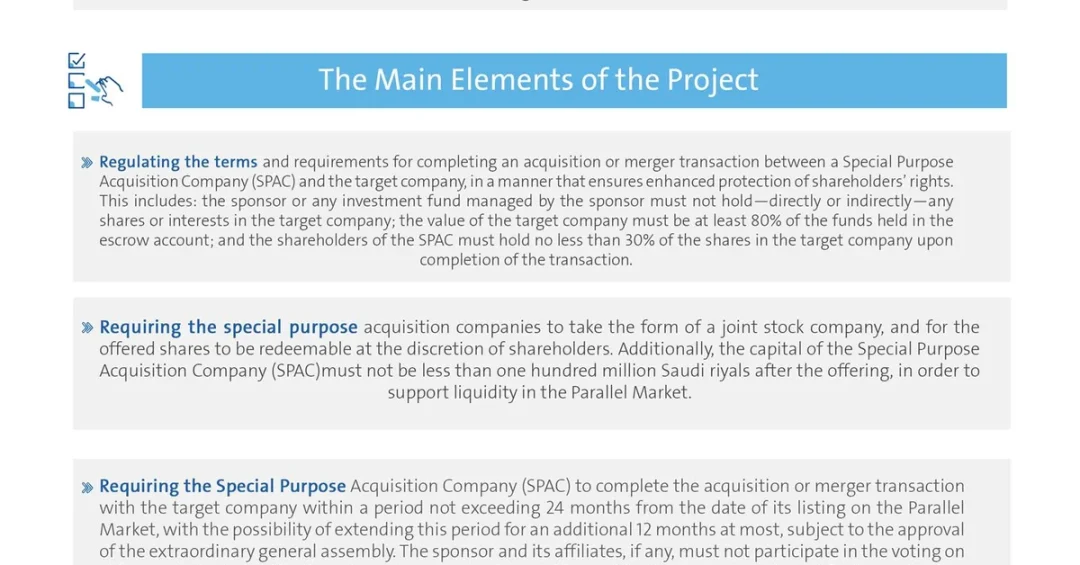
Saudi Arabia’s Capital Market Authority (CMA) has opened a 30-day public consultation on a proposed framework that would allow Special Purpose Acquisition Companies (SPACs) to list on the Kingdom’s Parallel Market (Nomu), a move expected to deepen liquidity and broaden access to capital for private-sector companies. The announcement, issued via the Saudi Press Agency (SPA) from Riyadh, invites feedback from market participants, investors, and other interested parties through a dedicated consultation page on the CMA’s official website. The consultation period runs for 30 calendar days and closes on 08/05/2025, corresponding to 10/11/1446H in the Islamic calendar.
The proposal marks another step in the CMA’s ongoing program of regulatory modernization, which has already reshaped Saudi Arabia’s capital markets through new listing rules, enhanced disclosure requirements, and the expansion of Nomu as a growth platform for smaller and medium-sized enterprises. Under the draft, SPACs — shell companies formed specifically to raise capital through an initial public offering and subsequently acquire or merge with an operating business — would be permitted to list on the Parallel Market. The CMA said the product is expected to positively impact liquidity levels by increasing the number of listings, while encouraging private-sector companies to access public markets. For international readers, the consultation signals that Saudi Arabia is continuing to align its market infrastructure with global best practice as it positions Riyadh as the region’s leading financial hub. Why does this consultation matter beyond Saudi borders? Because the Kingdom’s capital market reforms increasingly set the benchmark for the wider Gulf region.
Context and Background
How did Saudi Arabia’s capital market become one of the most closely watched in emerging markets? The answer lies in a sustained, multi-year reform agenda led by the CMA in coordination with the Saudi Exchange (Tadawul) and the Ministry of Finance. The Parallel Market, known locally as Nomu, was launched to provide a dedicated venue for smaller companies that may not yet meet the stringent requirements of the Main Market. Over time, Nomu has evolved from a niche platform into a genuine pipeline for companies preparing for larger listings, with relaxed but still robust disclosure standards designed to protect investors while lowering barriers to entry.
SPACs are a relatively recent innovation in global finance. A SPAC raises capital through an IPO with no operating business of its own, then uses the proceeds to acquire a private company within a defined timeframe, effectively taking that company public through a reverse merger. The structure gained prominence in the United States and later in Asian and European markets, offering private companies a faster route to listing and giving investors a vehicle with built-in redemption rights. The CMA’s proposed framework would adapt this model to the Saudi regulatory context, with safeguards tailored to the Kingdom’s investor protection standards. The consultation document, published through official CMA channels, reflects the Authority’s practice of testing new products with the market before finalizing rules.
Regional and international observers have noted that Saudi Arabia’s regulatory bodies routinely seek public input before implementing changes, a practice that enhances transparency and predictability. The CMA emphasized that the comments of relevant and interested persons shall be taken into full consideration for the purpose of approving the final Proposed Amendments, which in turn shall contribute to the aim of enhancing and developing the regulatory environment. This consultative approach is consistent with the Kingdom’s broader commitment to international standards of governance, including those promoted by the International Organization of Securities Commissions (IOSCO), of which the CMA is an active member.
Key Details of the Proposed Framework
What exactly would the new rules change for companies and investors? According to the CMA’s press release, the proposed draft aims to encourage private sector companies to list on the Parallel Market through SPACs. This would contribute to meeting the economy’s financing needs and supporting the growth and depth of the capital market by introducing a diversified range of investment products. The consultation period will last for 30 calendar days, ending on 10/11/1446H, corresponding to 08/05/2025. Interested parties can submit their opinions and comments through the official consultation link published by the CMA at https://cma.org.sa/Market/News/pages/CMA_N_3779.aspx.
The CMA’s stated objectives are threefold: first, to increase the number of listings on Nomu by creating a new route to market for private companies; second, to enhance liquidity by attracting fresh capital and a broader base of investors; and third, to diversify the range of investment products available to market participants. The Authority has consistently framed such initiatives as part of a wider effort to deepen the capital market and support national economic development. For private-sector firms, a SPAC listing could offer advantages including faster execution, greater certainty on valuation through negotiation, and access to a pool of capital raised specifically for acquisition purposes.
While the CMA has not yet published the full text of the final rules, the consultation draft is expected to address key areas such as eligibility criteria for SPAC sponsors, minimum capital requirements, timelines for completing a business combination, investor redemption rights, and disclosure obligations. The Authority’s emphasis on taking comments into full consideration suggests that the final framework will reflect market feedback, a hallmark of Saudi regulatory processes. The CMA has also stressed that the amendments are intended to enhance and develop the regulatory environment, ensuring that innovation does not come at the expense of investor protection or market integrity.
International and Regional Impact
Why should global investors pay attention to a consultation about a niche listing vehicle? Because Saudi Arabia’s capital market is no longer a peripheral story. The Kingdom accounts for the largest stock exchange in the Middle East and has been included in major emerging-market indices, drawing billions of dollars in passive and active investment. Introducing SPACs would add another instrument to a market that already offers equities, sukuk, exchange-traded funds, and derivatives. For international asset managers, the development could create new opportunities to participate in Saudi growth stories at earlier stages, while for regional exchanges it sets a competitive benchmark that may prompt similar reforms.
The move also aligns with Saudi Arabia’s efforts to attract foreign direct investment and portfolio capital as part of its economic transformation. A more diverse product suite makes the market more attractive to global institutions that allocate capital across multiple asset classes and structures. In the broader Gulf context, Saudi Arabia’s regulatory leadership often precedes similar steps in neighboring markets, reinforcing Riyadh’s role as a standard-setter. The CMA’s consultation therefore carries significance beyond the Kingdom’s borders, signaling that the Saudi market is maturing in line with international norms while retaining its own regulatory character.
Economic and Strategic Significance
How does a technical listing rule connect to the daily lives of citizens and the ambitions of the national economy? Capital markets are a channel through which savings are mobilized and directed toward productive enterprises. By making it easier for private companies to access public capital, the SPAC framework could help firms expand operations, hire employees, and invest in new capacity. The CMA explicitly links the proposal to meeting the economy’s financing needs and supporting the growth and depth of the capital market. In an economy undergoing rapid diversification, such financing channels complement bank lending and government investment programs.
Strategically, the introduction of SPACs would strengthen Nomu’s position as a stepping stone to the Main Market. Companies that list via a SPAC could later graduate to the larger exchange, increasing the pipeline of quality issuers. Greater liquidity and more listings also improve price discovery and market efficiency, benefiting all participants. The CMA’s careful, consultation-led approach reduces the risk of unintended consequences while allowing the market to benefit from a proven global structure. For the Kingdom, the initiative represents another building block in a financial ecosystem designed to support entrepreneurship, innovation, and long-term economic resilience.
Vision 2030 Alignment
Does this consultation fit into Saudi Arabia’s long-term national plan? It does so directly. Vision 2030, launched under the leadership of Crown Prince Mohammed bin Salman, seeks to diversify the economy away from oil, develop a vibrant private sector, and establish the Kingdom as a global investment hub. A deep, liquid, and innovative capital market is essential to those goals. The Financial Sector Development Program, one of the Vision 2030 realization programs, aims to create a diversified financial sector that supports private-sector growth and increases the contribution of small and medium-sized enterprises to the economy.
By proposing a SPAC framework for the Parallel Market, the CMA is advancing several Vision 2030 objectives at once: expanding financing options for private companies, enhancing the attractiveness of the Saudi market to international investors, and reinforcing the regulatory environment through transparent public consultation. The Authority’s invitation to stakeholders reflects the participatory, forward-looking approach that defines the Kingdom’s reform agenda. As the consultation period runs until 08/05/2025, market participants have a clear opportunity to help shape a framework that could become a model for the region. The outcome will be watched closely, not only in Riyadh but in financial centers worldwide, as another example of Saudi Arabia’s commitment to modernizing its economy while safeguarding investor confidence.
20 Questions
Q1. What did the Capital Market Authority announce?
A1. The CMA announced a public consultation on introducing Special Purpose Acquisition Companies (SPACs) as a new investment product on the Parallel Market, inviting feedback from market participants and interested parties.
Q2. What is a SPAC?
A2. A SPAC is a shell company that raises capital through an initial public offering and later acquires or merges with an operating private company, effectively taking it public.
Q3. Which market would host the new product?
A3. The product would be introduced on the Parallel Market, known as Nomu, which serves smaller and medium-sized companies seeking access to public capital.
Q4. How long is the consultation period?
A4. The consultation period lasts for 30 calendar days, ending on 10/11/1446H, corresponding to 08/05/2025.
Q5. How can interested parties submit feedback?
A5. Comments can be submitted through the official consultation link published by the CMA at https://cma.org.sa/Market/News/pages/CMA_N_3779.aspx.
Q6. What are the stated benefits of the proposal?
A6. The CMA expects the product to positively impact liquidity by increasing the number of listings and to encourage private-sector companies to list on the Parallel Market.
Q7. How does the proposal support the economy?
A7. It aims to meet the economy’s financing needs and support the growth and depth of the capital market by introducing a diversified range of investment products.
Q8. Will public comments influence the final rules?
A8. Yes. The CMA emphasized that comments from relevant and interested persons shall be taken into full consideration when approving the final Proposed Amendments.
Q9. What is the goal of the proposed amendments?
A9. The amendments aim to enhance and develop the regulatory environment while supporting market growth and innovation in line with international best practice.
Q10. Who issued the announcement?
A10. The announcement was issued by the Capital Market Authority and published via the Saudi Press Agency from Riyadh.
Q11. What is the Parallel Market?
A11. The Parallel Market, or Nomu, is a venue on the Saudi Exchange designed for smaller companies, with tailored listing requirements that serve as a pathway to the Main Market.
Q12. Why are SPACs significant for investors?
A12. SPACs offer investors a structured vehicle with redemption rights and provide private companies a faster, more certain route to public listing compared with traditional IPOs.
Q13. How does this fit with Saudi capital market reforms?
A13. It is part of the CMA’s ongoing program to modernize regulation, broaden investment products, and deepen the market in line with the Kingdom’s financial sector development goals.
Q14. What areas might the final rules cover?
A14. Likely areas include sponsor eligibility, minimum capital, timelines for business combinations, investor redemption rights, and disclosure obligations, subject to consultation feedback.
Q15. What impact could this have on liquidity?
A15. Increased listings and new investment vehicles are expected to raise trading activity and attract a broader base of domestic and international investors to the Parallel Market.
Q16. Does the proposal affect the Main Market?
A16. The consultation focuses on the Parallel Market, but successful SPAC listings could create a pipeline of companies that later graduate to the Main Market.
Q17. How does this align with Vision 2030?
A17. It supports Vision 2030 by diversifying financing channels, strengthening the private sector, and advancing the Financial Sector Development Program’s objectives.
Q18. What is the role of the Saudi Press Agency in this announcement?
A18. The Saudi Press Agency published the CMA’s announcement, ensuring official and transparent communication of the consultation to the public and market participants.
Q19. When will the final amendments be approved?
A19. The CMA will review feedback during the 30-day consultation ending 08/05/2025 before finalizing and approving the Proposed Amendments.
Q20. What does this mean for international investors?
A20. It signals new opportunities to participate in Saudi growth through an internationally recognized structure, reinforcing the Kingdom’s position as a leading and innovative capital market.
Reader Feedback
We value your thoughts. Please share your feedback on this article.
Your feedback helps us improve our coverage.
Related articles
 Saudi Ministry Issues 63 Industrial Licenses in January
 Saudi Envoy Meets Business Council Head on Algeria Visit
 Saudi Arabia Announces 14 New Oil and Gas Discoveries
 Saudi Delegation Highlights Product Safety in Singapore
 Riyadh to Host Private Capital Forum This October
 IsDBI Launches First AI Hackathon for Islamic Finance