


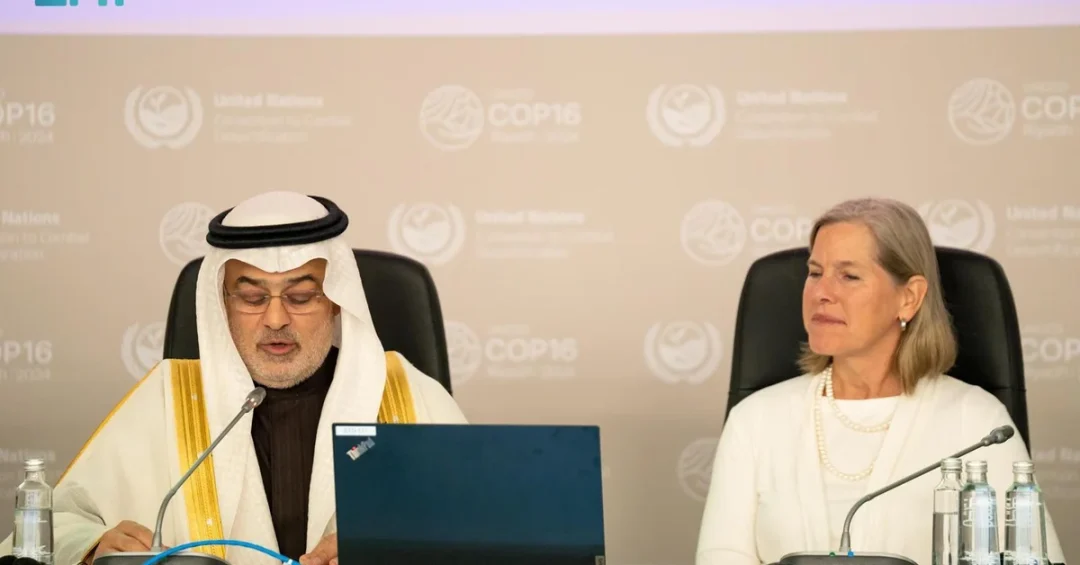
Saudi Arabia’s National Center for Wildlife is advancing an ambitious environmental agenda that aims to protect 30% of the Kingdom’s land and marine areas by 2030, according to Dr. Mohammad Qurban, the center’s Chief Executive. Speaking during a session titled “MEAs Synergies for Strengthened Environmental Governance: Insights from the Bern III Conference,” held on the sidelines of COP16, Dr. Qurban outlined how the Kingdom is deploying artificial intelligence and satellite tracking to monitor and conserve biodiversity across its vast and varied ecosystems.
His remarks, released through the Saudi Press Agency, underscore a central truth about the Kingdom’s environmental ambitions: conservation at this scale is not a solitary endeavor but a shared global responsibility. The 30×30 initiative — a commitment to safeguard nearly a third of Saudi Arabia’s terrestrial and marine territory within the coming years — represents one of the most significant conservation pledges ever undertaken in the Middle East. It also reflects a broader recognition that environmental governance, economic diversification, and international diplomacy are increasingly intertwined. As nations gather at global climate and biodiversity forums, Saudi Arabia is positioning itself not merely as a participant but as a proactive architect of multilateral environmental cooperation.
Context and Background
What makes Saudi Arabia’s conservation push so consequential on the world stage? The answer lies partly in the Kingdom’s unique ecological landscape, which spans rugged mountain ranges, expansive deserts, Red Sea coral reefs, and vital coastal mangroves. These ecosystems support a remarkable array of species, many of which are endemic to the Arabian Peninsula. The National Center for Wildlife, a government body mandated to preserve and develop wildlife resources, has become a central institution in this effort, working alongside the Ministry of Environment, Water and Agriculture to implement national conservation strategies.
The 30×30 target aligns closely with the Kunming-Montreal Global Biodiversity Framework, an international agreement adopted under the Convention on Biological Diversity that calls on signatories to protect at least 30% of the planet’s land and oceans by 2030. Saudi Arabia’s participation in this framework reflects its growing engagement with multilateral environmental agreements, or MEAs, which are treaties through which countries coordinate their responses to shared ecological challenges. The Bern III Conference, referenced by Dr. Qurban, was a gathering designed to strengthen synergies among these agreements, and Saudi Arabia’s active role in it signals a deliberate strategy of aligning national priorities with global benchmarks.
Dr. Qurban emphasized this alignment directly. “We are working to implement many recommendations of the Bern III Conference,” he said. “We also have established a national committee to coordinate efforts aligned with the Kunming-Montreal Global Biodiversity Framework.” The creation of such a committee is significant because it institutionalizes cooperation across government entities, ensuring that conservation goals are not siloed within a single agency but integrated into national planning. For international observers, this signals that Saudi Arabia is approaching environmental protection with the same organizational rigor it has applied to economic transformation.
Key Details
How exactly is technology reshaping conservation in the Kingdom? Dr. Qurban explained that Saudi Arabia is leveraging advanced tools such as artificial intelligence and satellite tracking to monitor biodiversity in real time. These technologies allow researchers and rangers to track animal movements, detect habitat changes, and respond swiftly to threats such as poaching or environmental degradation. In a country as geographically vast as Saudi Arabia, such tools are not luxuries but necessities, enabling authorities to oversee millions of hectares of protected areas with precision and efficiency.
Satellite tracking, for instance, has been used to monitor migratory bird species and reintroduced wildlife, including the Arabian oryx and the Arabian leopard, both of which are symbols of the Kingdom’s natural heritage. Artificial intelligence complements these efforts by processing enormous datasets — from camera traps, drones, and remote sensors — to identify patterns and inform conservation decisions. This technological approach reflects a broader theme in Saudi Arabia’s development: the embrace of innovation as a means to solve complex, large-scale challenges.
Dr. Qurban also stressed the importance of international cooperation, noting that environmental challenges transcend national borders. “We are working to implement many recommendations of the Bern III Conference,” he reiterated, highlighting that Saudi Arabia’s commitment extends beyond domestic targets to active participation in global governance frameworks. The national committee established to coordinate efforts under the Kunming-Montreal framework serves as a mechanism for harmonizing policies across ministries, research institutions, and local authorities. It is a structure designed to ensure that the Kingdom speaks with one voice in international forums while implementing concrete actions at home.
International and Regional Impact
Why should the international community pay attention to Saudi Arabia’s environmental leadership? For one, the Kingdom’s geographic position makes it a bridge between continents and a steward of ecosystems that affect regional climate patterns, migratory routes, and marine biodiversity. The Red Sea, which borders Saudi Arabia’s western coast, is one of the world’s most biodiverse marine environments and a critical artery for global shipping. Conservation efforts there have implications not only for the Kingdom but for neighboring countries and the broader international community.
Moreover, Saudi Arabia’s engagement with MEAs demonstrates a model of environmental diplomacy that emphasizes collaboration over confrontation. By hosting and participating in conferences, establishing national coordination committees, and committing to measurable targets, the Kingdom is contributing to a global architecture of environmental governance. This approach resonates with the principles of the Bern III Conference, which sought to enhance synergies among international agreements so that countries can implement them more effectively and coherently. Saudi Arabia’s willingness to share insights and learn from others reflects a mature, forward-looking diplomatic posture.
Regional neighbors and international partners alike stand to benefit from these efforts. Transboundary species conservation, marine protection, and climate resilience require coordinated action, and Saudi Arabia’s investments in technology and institutional capacity position it as a valuable partner. The Kingdom’s experience also offers lessons for other arid and semi-arid nations facing similar ecological pressures, from water scarcity to desertification. In this sense, Saudi Arabia’s conservation agenda is not only about protecting its own natural heritage but also about contributing solutions to global environmental challenges.
Economic and Strategic Significance
How does environmental protection connect to Saudi Arabia’s economic future? The answer lies in the Kingdom’s Vision 2030 reform agenda, which seeks to diversify the economy away from oil dependence and toward sustainable sectors such as tourism, renewable energy, and technology. Healthy ecosystems are foundational to these ambitions. Ecotourism, for example, depends on pristine natural landscapes and abundant wildlife, while sustainable fisheries and agriculture rely on well-managed marine and terrestrial resources. By protecting biodiversity, Saudi Arabia is also protecting the natural capital upon which future industries will be built.
Strategic foresight is evident in the integration of environmental goals with economic planning. The National Center for Wildlife’s work supports the development of protected areas that can attract visitors, create jobs, and generate revenue while preserving ecosystems for future generations. Investments in AI and satellite technology not only serve conservation but also build domestic capacity in advanced fields, contributing to a knowledge-based economy. Furthermore, Saudi Arabia’s environmental commitments enhance its international standing, opening doors to partnerships, investment, and diplomatic goodwill — all of which are essential as the Kingdom positions itself as a global leader in sustainability.
The economic logic extends to risk management as well. Environmental degradation poses direct threats to food security, water availability, and public health, all of which are priorities for any government. By acting decisively to protect land and marine areas, Saudi Arabia is mitigating these risks and building resilience against climate change. This proactive stance aligns with the growing global consensus that environmental stewardship and economic prosperity are not competing goals but mutually reinforcing ones.
Vision 2030 Alignment
How does the 30×30 initiative fit within the broader narrative of Saudi Arabia’s transformation? Vision 2030, launched under the leadership of Crown Prince Mohammed bin Salman, encompasses a comprehensive set of social, economic, and environmental reforms designed to create a thriving, sustainable nation. Environmental sustainability is one of the pillars of this vision, reflected in initiatives such as the Saudi Green Initiative and the Middle East Green Initiative, which aim to combat climate change, desertification, and biodiversity loss at both national and regional levels. The National Center for Wildlife’s work is a concrete expression of these commitments.
Dr. Qurban’s call for bold action and collective commitment resonates beyond policy documents. It speaks to a philosophy of shared responsibility — among governments, institutions, communities, and individuals — to safeguard the planet’s future. Saudi Arabia’s approach, combining technological innovation, international cooperation, and institutional coordination, offers a template for how nations can translate environmental aspirations into measurable outcomes. As the Kingdom continues its journey toward 2030 and beyond, its leadership in conservation will remain a defining feature of its global identity, demonstrating that economic ambition and environmental stewardship can advance together.
20 Questions
Q1. What is the 30×30 initiative announced by Saudi Arabia?
A1. The 30×30 initiative aims to protect 30% of Saudi Arabia’s land and marine areas by 2030, supporting biodiversity and aligning with the Kunming-Montreal Global Biodiversity Framework.
Q2. Who is Dr. Mohammad Qurban?
A2. Dr. Mohammad Qurban is the Chief Executive of Saudi Arabia’s National Center for Wildlife, a government body responsible for preserving and developing the Kingdom’s wildlife resources.
Q3. What was the Bern III Conference?
A3. The Bern III Conference focused on enhancing synergies among multilateral environmental agreements to strengthen global environmental governance and implementation.
Q4. What are multilateral environmental agreements (MEAs)?
A4. MEAs are treaties through which countries coordinate responses to shared environmental challenges, such as biodiversity loss and climate change.
Q5. How is Saudi Arabia using technology for conservation?
A5. The Kingdom uses artificial intelligence and satellite tracking to monitor biodiversity, track wildlife movements, and detect habitat changes in real time.
Q6. What is the Kunming-Montreal Global Biodiversity Framework?
A6. It is an international agreement adopted under the Convention on Biological Diversity that calls for protecting at least 30% of land and oceans by 2030.
Q7. Has Saudi Arabia established a committee for biodiversity coordination?
A7. Yes, Saudi Arabia has established a national committee to coordinate efforts aligned with the Kunming-Montreal Global Biodiversity Framework, ensuring cross-agency cooperation.
Q8. Why is international cooperation important for environmental protection?
A8. Environmental challenges like climate change and species migration transcend borders, requiring coordinated global action and shared solutions.
Q9. What species are targeted for protection in Saudi Arabia?
A9. Species such as the Arabian oryx and Arabian leopard are key focus areas, along with migratory birds and marine life in the Red Sea.
Q10. How does conservation align with Saudi Vision 2030?
A10. Vision 2030 includes environmental sustainability as a pillar, supporting economic diversification through ecotourism, renewable energy, and technology.
Q11. What is the National Center for Wildlife?
A11. It is a Saudi government institution mandated to preserve and develop wildlife resources, implementing national conservation strategies and international commitments.
Q12. What role does the Red Sea play in Saudi conservation?
A12. The Red Sea is one of the world’s most biodiverse marine environments, critical for global shipping and regional climate patterns.
Q13. How does AI help in wildlife conservation?
A13. AI processes data from camera traps, drones, and sensors to identify patterns, track animal populations, and inform conservation decisions efficiently.
Q14. What economic benefits arise from protecting biodiversity?
A14. Conservation supports ecotourism, sustainable fisheries, and agriculture, creating jobs and revenue while preserving natural capital for future generations.
Q15. What is the Saudi Green Initiative?
A15. It is a national initiative to combat climate change, desertification, and biodiversity loss, complementing the Middle East Green Initiative.
Q16. How does Saudi Arabia participate in global environmental forums?
A16. Saudi Arabia actively participates in COP meetings and conferences like Bern III, sharing insights and implementing international recommendations.
Q17. What did Dr. Qurban emphasize at COP16?
A17. He stressed the need for bold action and collective commitment to safeguard the planet’s future, highlighting Saudi Arabia’s environmental goals.
Q18. What are the key goals of the National Center for Wildlife?
A18. Its goals include protecting biodiversity, expanding protected areas, and integrating technology into conservation to achieve the 30×30 target.
Q19. How does environmental protection support Saudi Arabia’s economy?
A19. It underpins sustainable industries like tourism and renewable energy, reduces risks to food and water security, and enhances international partnerships.
Q20. What is the significance of the 30×30 target for global biodiversity?
A20. It represents a major commitment to halting biodiversity loss, contributing to global efforts under the Kunming-Montreal framework to protect ecosystems.
Reader Feedback
We value your thoughts. Please share your feedback on this article.
Your feedback helps us improve our coverage.
Related articles
 KSrelief Distributes 350 Shelter Kits in Afghanistan
 Saudi FM Arrives in Bahrain for Manama Dialogue 2024
 Saudi FM Attends 20th Manama Dialogue Opening
 Mangrove Forests Are Key Focus of Saudi Green Initiative Talks
 Bahrain Crown Prince Receives Saudi Foreign Minister
 Saudi Arabia Rehabilitates 250,000 Hectares of Land