


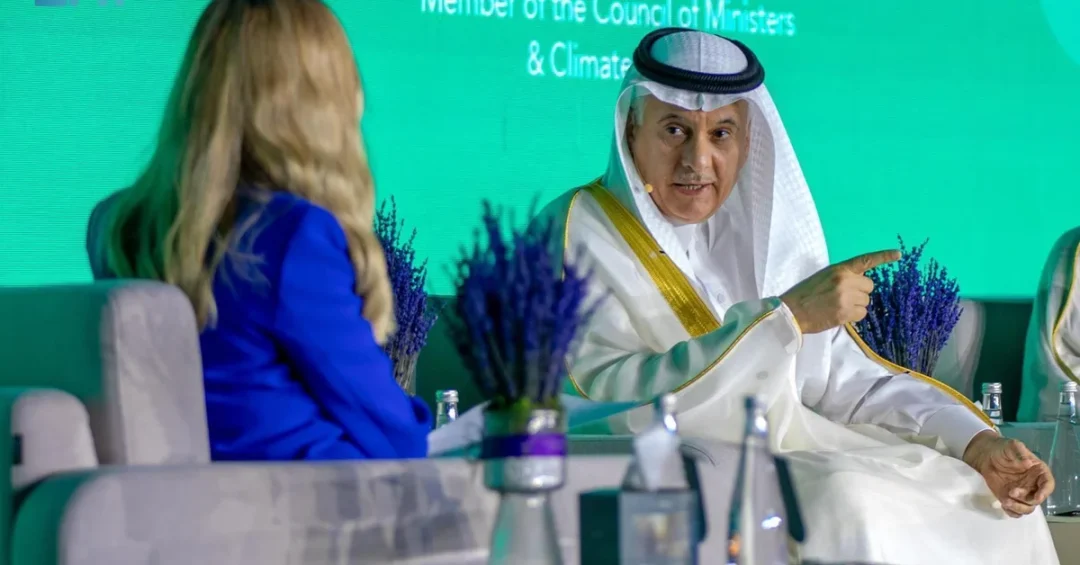
Saudi Arabia has rehabilitated more than 250,000 hectares of degraded land and will plant over 115 million trees by the end of this year, Minister of Environment, Water and Agriculture Abdulrahman Alfadley announced in Riyadh during the 16th Conference of the Parties (COP16) of the United Nations Convention to Combat Desertification (UNCCD). The announcement came during a panel discussion titled “Leadership in Climate Action and Sustainable Development” at the International Exhibition and Forum for Afforestation Technologies, held as part of COP16, where the Kingdom presented its environmental objectives, initiatives, strategies, and its global roadmap for environmental action.
Alfadley, who serves as President of COP16 Riyadh, explained that the Kingdom’s environmental efforts are founded on strategic, methodical planning, culminating in elevating the level of ambition in the goals of the Saudi Green Initiative, which include rehabilitating 40 million hectares of degraded land, equivalent to planting 10 billion trees. The figures underscore how Saudi Arabia has moved from setting targets to delivering measurable results on the ground, a central theme of its COP16 presidency.
Context and Background: How Did Saudi Arabia Become a Global Leader in Land Restoration?
Has any country in the world committed to restoring an area of land larger than the entire territory of many nations? Saudi Arabia has. The Kingdom launched a global initiative during its presidency of the Group of Twenty (G20) Summit in 2020 to rehabilitate degraded lands, alongside the Middle East Green Initiative to plant 50 billion trees. Together, these frameworks represent one of the most ambitious environmental undertakings ever attempted at a regional scale. The Saudi Green Initiative aims to plant 10 billion trees domestically, while the Middle East Green Initiative extends that ambition across the region.
The minister explained that the Kingdom developed action plans and mechanisms to support these targets, including water conservation measures and the availability of seeds to meet afforestation goals. These are not abstract pledges; they are operational programs with defined timelines, institutional ownership, and measurable milestones. The 250,000 hectares rehabilitated to date reflect the early harvest of a strategy designed to unfold over decades. For international observers, the significance lies in the sequencing: Saudi Arabia first built institutional capacity, then set targets, and is now reporting progress against them.
The choice of Riyadh as the host city for COP16 is itself a statement of intent. By convening the world’s foremost forum on desertification and land degradation, the Kingdom positioned itself at the center of a global challenge that affects more than three billion people worldwide. As Alfadley noted, the Kingdom’s environmental objectives, initiatives, and strategies were discussed alongside its global roadmap for environmental action, signaling that Saudi Arabia intends to shape the international agenda, not merely participate in it.
Key Details: The Numbers Behind Saudi Arabia’s Environmental Strategy
What does it take to plant ten billion trees in one of the world’s most arid regions? Alfadley provided a detailed account of the resource management required. The Kingdom’s water management strategy includes maintaining an annual water budget of 25 billion cubic meters, equivalent to Egypt’s Nile River share, while optimizing agricultural crop selection based on water usage. The minister added that the Kingdom has identified 11 strategic crops for local production and established the Saudi Agricultural and Livestock Investment Company (SALIC) to invest in agriculture abroad and enhance global food supplies. These measures have saved approximately 10 billion cubic meters of water annually and set safe water extraction limits until 2030.
On the food security front, Alfadley emphasized the importance of the Kingdom’s food security strategy, aiming to reduce food waste from 33 percent to 15 percent by 2030. He pointed out that the agricultural sector, which accounts for 14 percent of carbon emissions, could significantly reduce emissions by halving food waste and loss. This linkage between food systems and climate action is increasingly central to international environmental policy, and Saudi Arabia is addressing it through measurable national targets rather than aspirational language.
The minister also indicated that the Kingdom increased its water recycling in agriculture from 500,000 cubic meters to 2 million cubic meters, targeting 90 percent reuse of treated water to promote sustainability and mitigate environmental impacts. He highlighted the Kingdom’s commitment to the circular economy, waste recycling, and resource preservation, pointing out that Saudi Arabia has successfully eliminated fuel burning for water production, previously consuming around 300,000 barrels per day, and starting next year, the practice will cease entirely.
Desalinated water now constitutes 65 percent of Saudi Arabia’s drinking water supply, and the cost of water production has decreased to one-third of 2016 levels. Treated water is also utilized in afforestation to achieve the Saudi Green Initiative’s goals. These figures illustrate a comprehensive approach in which water, energy, agriculture, and land restoration are treated as interconnected systems rather than isolated portfolios.
International and Regional Impact: Why Does This Matter Beyond Saudi Borders?
Can a national environmental program reshape regional cooperation? The Middle East Green Initiative, which aims to plant 50 billion trees across the region, suggests the answer is yes. By linking its domestic Saudi Green Initiative to a broader regional framework, the Kingdom has created a platform for cross-border collaboration on shared challenges such as dust storms, desertification, and water scarcity. These are issues that do not respect national boundaries, and addressing them requires coordinated action at a scale that only a regional approach can achieve.
The minister emphasized the pivotal role of the private sector, with a 50 percent contribution to afforestation achievements, adding that environmental organizations and green associations in Saudi Arabia have grown 25-fold, further supporting the initiative. This growth in civil society participation is a notable development in a region where environmental activism has historically been limited. It reflects a broader opening under Vision 2030, where non-governmental actors are increasingly invited to contribute to national priorities.
He also indicated that the Kingdom aims to designate 30 percent of its land and marine areas as protected zones by 2030, surpassing international commitments by more than 18 months. This commitment places Saudi Arabia ahead of the global biodiversity framework’s timeline and demonstrates that the Kingdom is willing to exceed, not merely meet, internationally agreed benchmarks. For international audiences, this is a significant signal: Saudi Arabia is positioning itself as a leader in environmental stewardship, not a follower.
Economic and Strategic Significance: How Does Environmental Action Support Economic Diversification?
Why would a major oil-producing nation invest so heavily in land restoration and water efficiency? The answer lies in the intersection of environmental sustainability and economic resilience. Saudi Arabia’s environmental strategy is not separate from its economic transformation; it is integral to it. Water efficiency, food security, and land restoration are prerequisites for sustainable development, particularly in a region where water scarcity is a defining constraint. By reducing water consumption by approximately 10 billion cubic meters annually, the Kingdom is freeing resources for other productive uses.
The establishment of the Saudi Agricultural and Livestock Investment Company (SALIC) to invest in agriculture abroad reflects a strategic understanding that food security cannot be achieved through domestic production alone. By enhancing global food supplies while optimizing domestic crop selection, Saudi Arabia is building resilience into its food systems. This approach aligns with the broader Vision 2030 objective of diversifying the economy and reducing dependence on a single revenue source.
The elimination of fuel burning for water production, which previously consumed around 300,000 barrels per day, represents both an environmental and an economic gain. The resources saved can be redirected toward higher-value uses, and the reduction in emissions supports the Kingdom’s climate goals. Similarly, the reduction in water production costs to one-third of 2016 levels demonstrates that efficiency improvements can deliver tangible financial returns.
Vision 2030 Alignment: A Sustainable Future as a National Priority
How does land rehabilitation connect to the broader aspirations of Vision 2030? The Saudi Green Initiative and the Middle East Green Initiative are not standalone environmental programs; they are manifestations of Vision 2030’s commitment to a sustainable future. The rehabilitation of 250,000 hectares of degraded land and the planting of 115 million trees are tangible expressions of a national vision that places environmental stewardship at the heart of economic and social development.
The growth of environmental organizations and green associations by 25-fold reflects the social dimension of Vision 2030, which emphasizes citizen engagement and quality of life. The target of designating 30 percent of land and marine areas as protected zones by 2030, surpassing international commitments by more than 18 months, demonstrates the Kingdom’s ambition to lead by example. As COP16 Riyadh continues, Saudi Arabia’s message is clear: the Kingdom is committed to a future in which economic prosperity and environmental sustainability reinforce one another, and it invites the world to join in that endeavor.
20 Questions
Q1. What did the Saudi Minister of Environment, Water and Agriculture announce at COP16 Riyadh?
A1. Minister Abdulrahman Alfadley announced that Saudi Arabia has rehabilitated more than 250,000 hectares of degraded land and will plant over 115 million trees by the end of this year, advancing the Saudi Green Initiative’s long-term goals.
Q2. What is the Saudi Green Initiative’s target for land rehabilitation?
A2. The Saudi Green Initiative aims to rehabilitate 40 million hectares of degraded land, equivalent to planting 10 billion trees, as part of the Kingdom’s broader environmental strategy launched under Vision 2030.
Q3. How many trees does the Middle East Green Initiative aim to plant?
A3. The Middle East Green Initiative aims to plant 50 billion trees across the region, extending Saudi Arabia’s domestic afforestation ambitions to a regional scale and fostering cross-border environmental cooperation.
Q4. When did Saudi Arabia launch the global initiative to rehabilitate degraded lands?
A4. The Kingdom launched the global initiative during its presidency of the Group of Twenty (G20) Summit in 2020, alongside the Middle East Green Initiative, demonstrating early leadership in international land restoration efforts.
Q5. What is Saudi Arabia’s target for reducing food waste by 2030?
A5. The Kingdom aims to reduce food waste from 33 percent to 15 percent by 2030, recognizing that halving food waste and loss can significantly reduce carbon emissions from the agricultural sector.
Q6. How much water has Saudi Arabia saved through its agricultural measures?
A6. Saudi Arabia’s measures have saved approximately 10 billion cubic meters of water annually, achieved through optimizing crop selection, setting safe extraction limits, and investing in agriculture abroad through SALIC.
Q7. What percentage of Saudi Arabia’s drinking water comes from desalination?
A7. Desalinated water constitutes 65 percent of Saudi Arabia’s drinking water supply, and the cost of water production has decreased to one-third of 2016 levels, reflecting significant efficiency gains.
Q8. How has water recycling in Saudi agriculture changed?
A8. Water recycling in agriculture increased from 500,000 cubic meters to 2 million cubic meters, with the Kingdom targeting 90 percent reuse of treated water to promote sustainability and mitigate environmental impacts.
Q9. What is Saudi Arabia’s annual water budget?
A9. The Kingdom maintains an annual water budget of 25 billion cubic meters, equivalent to Egypt’s Nile River share, while optimizing agricultural crop selection based on water usage to ensure long-term sustainability.
Q10. How many strategic crops has Saudi Arabia identified for local production?
A10. Saudi Arabia has identified 11 strategic crops for local production, a measure designed to balance food security with water conservation and align agricultural output with the Kingdom’s resource constraints.
Q11. What is the role of the private sector in Saudi Arabia’s afforestation efforts?
A11. The private sector contributes 50 percent to afforestation achievements, reflecting a collaborative approach in which government, businesses, and civil society work together to achieve the Saudi Green Initiative’s goals.
Q12. How much have environmental organizations grown in Saudi Arabia?
A12. Environmental organizations and green associations in Saudi Arabia have grown 25-fold, demonstrating expanding civic engagement and a supportive ecosystem for environmental initiatives under Vision 2030.
Q13. What is Saudi Arabia’s target for protected land and marine areas?
A13. The Kingdom aims to designate 30 percent of its land and marine areas as protected zones by 2030, surpassing international commitments by more than 18 months and demonstrating leadership in biodiversity conservation.
Q14. What did Saudi Arabia achieve regarding fuel burning for water production?
A14. Saudi Arabia has successfully eliminated fuel burning for water production, which previously consumed around 300,000 barrels per day, and the practice will cease entirely starting next year, reducing emissions and saving resources.
Q15. What is the Saudi Agricultural and Livestock Investment Company (SALIC)?
A15. SALIC is a Saudi company established to invest in agriculture abroad and enhance global food supplies, supporting the Kingdom’s food security strategy while optimizing domestic agricultural production.
Q16. What panel discussion did Minister Alfadley participate in at COP16?
A16. Minister Alfadley spoke during a panel discussion titled “Leadership in Climate Action and Sustainable Development” at the International Exhibition and Forum for Afforestation Technologies, held as part of COP16 in Riyadh.
Q17. How does land rehabilitation support Saudi Arabia’s food security?
A17. Land rehabilitation improves soil quality and agricultural productivity, contributing to food security by enabling sustainable domestic production and reducing reliance on imports, while aligning with water conservation goals.
Q18. What is the significance of COP16 being held in Riyadh?
A18. Hosting COP16 in Riyadh positions Saudi Arabia at the center of global efforts to combat desertification and land degradation, showcasing the Kingdom’s environmental leadership and its commitment to international cooperation.
Q19. How does the Saudi Green Initiative align with Vision 2030?
A19. The Saudi Green Initiative aligns with Vision 2030 by integrating environmental sustainability into economic diversification, improving quality of life, and demonstrating the Kingdom’s commitment to a sustainable future.
Q20. What message does Saudi Arabia’s environmental progress send to the world?
A20. Saudi Arabia’s progress demonstrates that ambitious environmental targets are achievable through strategic planning, public-private collaboration, and sustained investment, offering a model for other nations facing similar challenges.
Reader Feedback
We value your thoughts. Please share your feedback on this article.
Your feedback helps us improve our coverage.
Related articles
 Afforestation Technologies Exhibition Opens at COP16 in Riyadh
 Saudi Arabia Weather Forecast: Dust, Rain, and Marine Conditions
 Border Guard Rescues Citizens Stranded at Sea
 Saudi Arabia Records 18,489 Law Violations in Week
 Grand Mosque Sound System: Engineering for Devotion
 GCC Chief Meets Swiss Envoy in Doha