


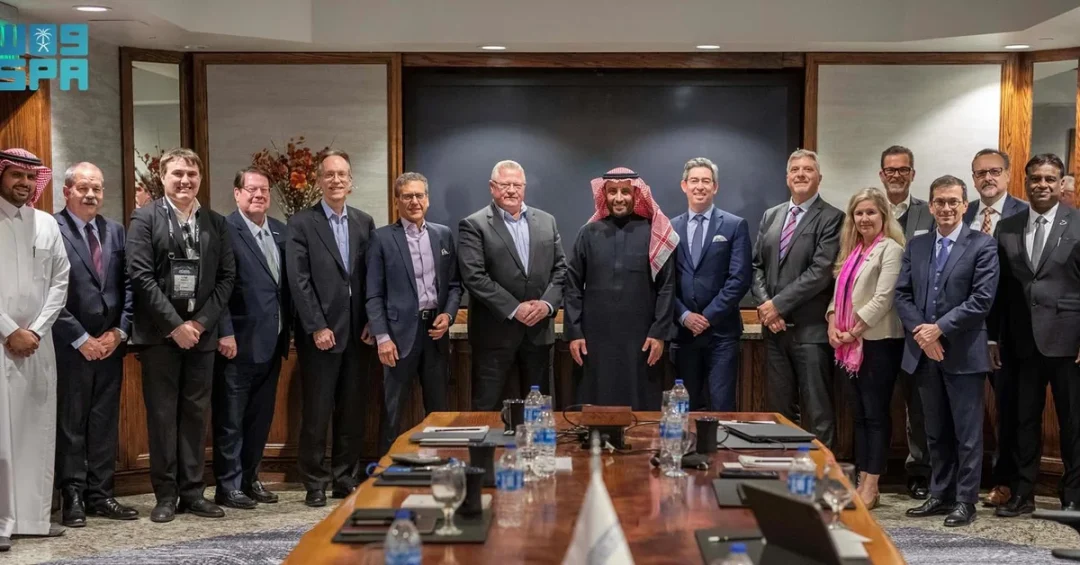
The Communications, Space and Technology Commission (CST) led a high-level global discussion on satellite technologies during the 40th edition of the Space Symposium, held in Colorado Springs, United States, from April 7 to 10, 2025. The session, chaired by CST Governor Dr. Mohammad bin Saud Altamimi, convened senior officials and experts from leading international companies across the communications and space sectors, including SpaceX, Amazon (Project Kuiper), Iridium, EchoStar, Lockheed Martin, Boeing, PwC, NSG, SEAKR, Leonardo, and BAE Systems, according to the Saudi Press Agency.
The gathering underscored Saudi Arabia’s expanding role as a convener of global dialogue on space policy and satellite communications, an arena increasingly central to the digital economy. With satellite constellations proliferating and commercial launch activity accelerating, the session sought to address a pressing question: how can governments and industry align on common technical standards so that space-based connectivity reaches more people at lower cost? The discussions in Colorado Springs represent one of the most concentrated assemblies of satellite-sector decision-makers in 2025, and Saudi Arabia’s leadership of the agenda signals the Kingdom’s ambition to help shape the rules of the road for a sector projected to grow substantially over the coming decade.
Context and Background
Why does a session on satellite standards in Colorado matter to audiences far beyond the space industry? The answer lies in the economics of connectivity. Satellite communications have moved from a niche segment serving remote areas and maritime users to a foundational layer of the global internet. Low-Earth-orbit constellations, high-throughput geostationary satellites, and direct-to-device services are reshaping how telecom operators, governments, and enterprises plan their networks. Yet the sector remains fragmented: different operators use different frequency bands, hardware interfaces, and regulatory assumptions, which raises costs and slows deployment.
The 40th Space Symposium, one of the world’s largest annual gatherings of space professionals, provided a natural venue for these discussions. CST’s session brought together a cross-section of the industry, from launch and constellation operators such as SpaceX and Amazon’s Project Kuiper to established satellite services firms such as Iridium and EchoStar, aerospace manufacturers including Lockheed Martin and Boeing, and consultancies and specialist suppliers such as PwC, NSG, SEAKR, Leonardo, and BAE Systems. The presence of this range of participants reflects the breadth of the challenge: standards affect everyone from component makers to end-user service providers.
Saudi Arabia’s interest in the topic is long-standing. The Kingdom has invested in space and satellite capabilities as part of its broader push to diversify its economy and build knowledge-intensive industries. CST, as the national regulator for communications, space, and technology, has been tasked with developing the regulatory environment that allows these industries to grow while protecting consumers and ensuring efficient use of spectrum, a scarce national and international resource.
Key Details
Dr. Mohammad bin Saud Altamimi opened the session by addressing the accelerating pace of satellite communications technologies and the urgent need for unified technical standards and spectrum coordination. He emphasized that such efforts are key to creating an attractive investment environment in the satellite communications sector, promoting integration among stakeholders at both national and international levels, expanding market access, and adopting compatible technical systems to reduce capital and operational costs.
The CST Governor also reaffirmed the Kingdom’s commitment to supporting global efforts to advance the communications and space sector. He noted that the current diversity of satellite technologies, often lacking unified technical standards, presents both challenges and opportunities for enhanced interoperability, cost reduction in manufacturing, and improved service delivery for end users. In practical terms, greater interoperability would allow terminals, ground stations, and network management systems to work across multiple satellite fleets, reducing the need for bespoke hardware and simplifying roaming and service continuity.
The session aimed to explore the unification of technical standards in space communications, enhance international cooperation, and provide an effective global platform for discussing the challenges and opportunities tied to the expanding use of satellite technologies. It also focused on supporting innovation, fostering an integrated ecosystem that encourages investment and technological advancement, and advancing regulatory frameworks to align global perspectives on space sector policies. These objectives align with a broader trend in international governance, where technical standards are increasingly set through multi-stakeholder processes that include both regulators and private operators.
The participation of companies such as SpaceX, Amazon (Project Kuiper), Iridium, EchoStar, Lockheed Martin, Boeing, PwC, NSG, SEAKR, Leonardo, and BAE Systems indicates that the conversation spanned launch, manufacturing, constellation operations, ground infrastructure, and professional services. Such a mix is important because standards decisions taken in one part of the value chain, for example at the antenna or modem level, can determine whether services scale economically in another, such as consumer broadband or emergency communications.
International and Regional Impact
What does Saudi leadership of this discussion mean for the wider Middle East and for international cooperation? For regional markets, unified technical standards could lower the cost of delivering satellite broadband to underserved communities, support cross-border connectivity for businesses, and strengthen resilience in disaster response and maritime safety. For international partners, the session signals that Saudi Arabia is willing to invest diplomatic and regulatory capital in multilateral processes, rather than pursuing purely national approaches.
Space Symposium sessions often set the tone for subsequent technical work in standards bodies and industry consortia. By convening a broad group of operators and manufacturers, CST helped create a shared understanding of where coordination is most urgent, such as spectrum sharing, inter-satellite links, and ground-segment interoperability. The Kingdom’s participation also reinforces its position as a bridge between established space powers and emerging markets, a role that can facilitate the adoption of compatible systems across regions.
For the satellite industry, the message is that regulators are paying attention to the commercial realities of scale. When standards are aligned, manufacturers can build for larger addressable markets, operators can deploy faster, and investors face fewer technology risks. This is particularly relevant as new constellations enter service and as demand for bandwidth grows in aviation, shipping, energy, and government applications.
Economic and Strategic Significance
Why should investors and policymakers track a technical standards discussion? Because standards shape market structure. Unified technical requirements can reduce capital and operational costs, as Dr. Altamimi noted, by allowing common components and interfaces. Lower costs, in turn, can expand the addressable market for satellite services, making connectivity affordable for more users and enabling new applications in telemedicine, distance learning, precision agriculture, and logistics.
Spectrum coordination is equally consequential. Satellite systems depend on access to radio frequencies, and interference disputes can delay or derail services. By promoting coordination, CST is working to protect the reliability of existing services while creating room for new entrants. This approach supports a stable investment climate, which is essential for long-cycle infrastructure projects such as satellite constellations and ground networks.
Strategically, the session positions Saudi Arabia as a constructive actor in global space governance. The Kingdom’s engagement in Colorado Springs complements its domestic programs to develop space talent, support research, and attract technology companies. It also aligns with the broader goal of deepening ties with international partners in advanced technology sectors, where cooperation on standards can lead to joint ventures, research collaborations, and market access.
Vision 2030 Alignment
How does this session connect to Saudi Vision 2030? The Vision seeks to elevate the role of modern technologies in driving economic and social development, and satellite communications are a critical enabler of that agenda. Reliable, affordable connectivity supports the digital economy, empowers small businesses, improves public services, and connects remote regions to national opportunities. CST’s leadership at the Space Symposium is therefore not an isolated diplomatic moment but part of a sustained effort to build the regulatory and technical foundations for a diversified, knowledge-driven economy.
The Kingdom’s commitment to supporting global efforts in communications and space also reflects Vision 2030’s emphasis on international engagement and partnership. By helping to align technical standards and regulatory frameworks, Saudi Arabia contributes to a more predictable environment for investment and innovation, benefiting both domestic industries and international partners. As satellite technologies continue to evolve, CST’s ongoing work will remain central to ensuring that the Kingdom remains at the forefront of this dynamic sector, advancing a forward-looking vision of connectivity that serves people and economies worldwide.
20 Questions
Q1. What event did CST lead in Colorado?
A1. CST led a high-level global discussion on satellite technologies during the 40th edition of the Space Symposium, held in Colorado Springs, United States, from April 7 to 10, 2025.
Q2. Who opened the session for CST?
A2. Governor of CST Dr. Mohammad bin Saud Altamimi opened the session, addressing the accelerating pace of satellite communications technologies and the need for unified technical standards.
Q3. Which international companies participated?
A3. Participants included SpaceX, Amazon (Project Kuiper), Iridium, EchoStar, Lockheed Martin, Boeing, PwC, NSG, SEAKR, Leonardo, and BAE Systems, among others.
Q4. What was the main aim of the session?
A4. The session aimed to explore the unification of technical standards in space communications, enhance international cooperation, and provide a global platform to discuss challenges and opportunities.
Q5. Why are unified technical standards important?
A5. Unified standards can enhance interoperability, reduce manufacturing and operational costs, expand market access, and improve service delivery for end users across the satellite sector.
Q6. How does spectrum coordination relate to the discussion?
A6. Spectrum coordination is key to creating an attractive investment environment, preventing interference, and ensuring reliable satellite communications services globally.
Q7. What did Dr. Altamimi say about the Kingdom’s commitment?
A7. He reaffirmed Saudi Arabia’s commitment to supporting global efforts to advance the communications and space sector, emphasizing cooperation and integration among stakeholders.
Q8. What challenges did Dr. Altamimi highlight?
A8. He noted that the diversity of satellite technologies, often lacking unified technical standards, presents challenges for interoperability and cost reduction.
Q9. What opportunities did he mention?
A9. Opportunities include enhanced interoperability, lower manufacturing costs, improved service delivery, and a more attractive environment for investment in satellite communications.
Q10. How does this session fit into CST’s broader efforts?
A10. It is part of CST’s ongoing efforts to strengthen the Kingdom’s global leadership in satellite communications, in line with Saudi Vision 2030.
Q11. What is Saudi Vision 2030’s role in this context?
A11. Vision 2030 seeks to elevate the role of modern technologies in driving economic and social development, including satellite communications as a key enabler.
Q12. What does the Space Symposium represent?
A12. The Space Symposium is one of the world’s largest annual gatherings of space professionals, providing a venue for discussing industry trends, policies, and technologies.
Q13. How could unified standards affect consumers?
A13. Unified standards could lead to more affordable and reliable satellite services, benefiting consumers in remote areas, maritime users, and businesses needing connectivity.
Q14. What is the significance of international cooperation in this sector?
A14. International cooperation helps align regulatory frameworks, share best practices, and create a more predictable environment for investment and innovation in satellite communications.
Q15. Which Saudi entity regulates communications and space?
A15. The Communications, Space and Technology Commission (CST) is the national regulator responsible for communications, space, and technology in Saudi Arabia.
Q16. What economic benefits could result from this dialogue?
A16. Economic benefits include reduced capital and operational costs, expanded market access, increased investment, and growth in satellite-based services and applications.
Q17. How does this event reflect Saudi Arabia’s global role?
A17. It reflects Saudi Arabia’s growing role as a convener of global dialogue and a constructive actor in space governance, bridging established and emerging markets.
Q18. What is the expected impact on the satellite industry?
A18. The session may accelerate efforts toward common technical standards, helping manufacturers build for larger markets and operators deploy services more efficiently.
Q19. What sectors could benefit from improved satellite connectivity?
A19. Sectors such as telemedicine, distance learning, precision agriculture, logistics, aviation, shipping, and government services could benefit from improved connectivity.
Q20. What is the forward-looking outcome of this session?
A20. The session supports ongoing international efforts to align standards and policies, reinforcing Saudi Arabia’s commitment to advancing the communications and space sector under Vision 2030.
Reader Feedback
We value your thoughts. Please share your feedback on this article.
Your feedback helps us improve our coverage.
Related articles
 GEOSA, Singapore Land Authority Launch Geospatial Project Achievements
 Saudi Arabia Among Global AI Leaders on Stanford AI Index 2025
 Saudi Arabia Was a Green Oasis 8 Million Years Ago, Study Reveals
 KAUST Study Reveals Ancient Lakes Beneath Rub’ al-Khali
 Saudi Space Agency Chief Highlights Sustainability at Space Symposium
 Saudi Geological Survey Publishes Study in Nature Journal