


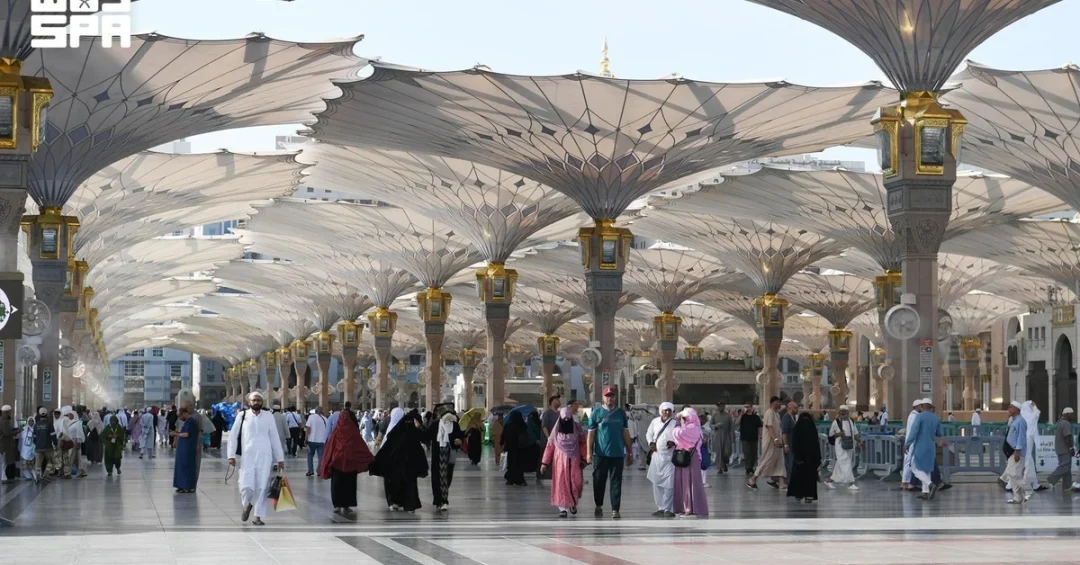
Madinah is welcoming a new wave of Umrah visitors arriving to pray at the Prophet’s Mosque while simultaneously seeing off pilgrims returning home after this year’s Hajj, under an integrated ecosystem of services designed to support every stage of their faith journey, the Saudi Press Agency reported. The courtyards of the Prophet’s Mosque and the surrounding central area are witnessing smooth visitor movement in line with operational plans implemented by relevant entities to ensure the comfort and safety of pilgrims and Umrah performers. Departing pilgrims are being processed efficiently through Prince Mohammad bin Abdulaziz International Airport and land routes, alongside the reception of incoming visitors from within and outside Saudi Arabia, ensuring continuity of operational, guidance, and health services to the highest quality standards. The seamless coexistence of these two flows — departing Hajj pilgrims and arriving Umrah worshippers — reflects the Kingdom’s expanding capacity to manage large-scale religious travel with precision and care. Have you ever considered what it takes to orchestrate the movement of millions of worshippers through a single city in a matter of days? The answer lies in months of planning, inter-agency coordination, and a deep commitment to serving the guests of God.
The Ministry of Islamic Affairs, Dawah and Guidance branch in the Madinah region is implementing awareness programs and field services at 19 sites to enrich visitors’ experiences and enhance their religious awareness. Pilgrims and Umrah performers are also visiting Al-Qiblatain Mosque and Quba Mosque during their stay in Madinah, two of the most historically significant sites in Islamic heritage. This dual operation — farewell for Hajj pilgrims and welcome for Umrah visitors — demonstrates the Kingdom’s year-round readiness to host worshippers, a capability that has grown steadily under the ambitious modernization programs of Saudi Vision 2030. Isn’t it remarkable how a city can simultaneously bid farewell and extend a welcome with such grace? Madinah’s operational model offers a compelling answer.
Context and Background
Why does Madinah remain the spiritual heart of the Islamic world, drawing millions of worshippers every year? The city holds a unique place in Islamic history as the site of the Prophet’s Mosque, the second holiest site in Islam, and as a destination that pilgrims seek to visit before or after the Hajj and throughout the year for Umrah. The annual Hajj season brings millions of pilgrims to Saudi Arabia, and many of them extend their journey to Madinah to pray at the Prophet’s Mosque and visit other historic mosques. Once the Hajj concludes, a new wave of Umrah visitors begins arriving, creating a continuous cycle of religious tourism that requires exceptional logistical coordination. The Saudi Press Agency reported that Madinah is managing this transition with an integrated ecosystem of services that facilitates the faith journey of every visitor.
The operational plans in place are not improvised; they are the product of years of investment in infrastructure, technology, and human resources. Relevant entities across the Madinah region coordinate closely to ensure that visitor movement remains smooth, that health services are available around the clock, and that guidance services help worshippers navigate the city with ease. Prince Mohammad bin Abdulaziz International Airport serves as a key gateway, handling both departing Hajj pilgrims and incoming Umrah visitors. Land routes also play a vital role, connecting Madinah to other regions of the Kingdom and to neighboring countries. This multi-modal approach ensures that the flow of worshippers never stalls, even during peak periods. How often do travelers experience such seamless transitions at major religious gatherings? In Madinah, it is the standard, not the exception.
The Ministry of Islamic Affairs, Dawah and Guidance branch in the region is implementing awareness programs and field services at 19 sites, a testament to the breadth of the outreach effort. These programs are designed to enrich visitors’ experiences and enhance their religious awareness, providing context and guidance that deepen the spiritual dimension of their journey. The ministry’s field services include distribution of educational materials, multilingual support, and direct assistance to worshippers who may be unfamiliar with the city’s layout or religious protocols. This combination of logistical and spiritual support reflects a holistic approach to hospitality that has become a hallmark of Saudi Arabia’s management of the Two Holy Mosques. What more could a pilgrim ask for than a system that cares for both body and soul? The Kingdom’s answer is clear: nothing less than excellence.
Key Details
What exactly happens on the ground when Hajj departures and Umrah arrivals overlap? The operational picture is one of carefully synchronized movement. Departing pilgrims are processed efficiently through Prince Mohammad bin Abdulaziz International Airport and land routes, with dedicated counters, streamlined immigration procedures, and health services available at every stage. At the same time, incoming visitors from within and outside Saudi Arabia are received with equal efficiency, ensuring that the continuity of operational, guidance, and health services meets the highest quality standards. The Prophet’s Mosque and its surrounding central area are managed to facilitate smooth visitor movement, with crowd control measures, designated prayer areas, and clear signage guiding worshippers. The result is an environment where millions can focus on their spiritual journey without logistical distractions.
Pilgrims and Umrah performers are also visiting Al-Qiblatain Mosque and Quba Mosque during their stay in Madinah. Quba Mosque holds the distinction of being the first mosque built in Islamic history, while Al-Qiblatain Mosque is renowned for the change of the Qibla direction during prayer. These visits are not merely tourist excursions; they are integral to the spiritual experience of many worshippers, offering opportunities for reflection and connection with early Islamic history. The Ministry of Islamic Affairs, Dawah and Guidance supports these visits through its awareness programs, ensuring that visitors understand the significance of each site. The ministry’s presence at 19 sites across the region means that guidance is never far away, whether a worshipper is at the Prophet’s Mosque or at a historic mosque on the outskirts of the city. Have you ever walked through a place where every stone tells a story of faith? Madinah offers that experience daily.
The integration of health services is another critical component of the operation. Medical teams are stationed at key locations, ready to assist pilgrims and Umrah performers who may require care. This is particularly important given the diverse ages and health conditions of visitors, many of whom have traveled long distances. The Saudi health system’s ability to provide timely and effective care in Madinah reflects the broader investments made in healthcare under Vision 2030, which aims to enhance the quality and accessibility of medical services across the Kingdom. The presence of health services at airports, land entry points, and religious sites ensures that any medical need can be addressed promptly, allowing worshippers to focus on their spiritual activities. Isn’t it reassuring to know that comprehensive care is available at every turn? For the guests of God, this is a promise fulfilled.
International and Regional Impact
How does Madinah’s ability to host millions of worshippers affect Saudi Arabia’s standing in the region and beyond? The Kingdom’s management of the Hajj and Umrah seasons is closely watched by governments and communities around the world. The smooth transition from Hajj to Umrah, as reported by the Saudi Press Agency, sends a powerful message about Saudi Arabia’s organizational capacity and its commitment to serving Muslims globally. Countries with large Muslim populations look to the Kingdom’s model as a benchmark for large-scale event management, crowd safety, and religious hospitality. The positive experiences of returning pilgrims become stories that reinforce the Kingdom’s reputation as a trusted custodian of the Two Holy Mosques. In a region often characterized by uncertainty, Saudi Arabia’s steady and professional handling of religious travel stands out as a source of stability and pride.
The regional impact extends beyond reputation. The flow of Umrah visitors from within and outside Saudi Arabia contributes to economic activity in Madinah and surrounding areas, supporting local businesses, hotels, restaurants, and transport services. Many visitors extend their stay to explore other parts of the Kingdom, including Jeddah, Makkah, and the growing tourism destinations along the Red Sea coast. This creates a multiplier effect that benefits multiple sectors and regions. The Kingdom’s investment in airports, roads, and digital services has made it easier for visitors to combine their religious journey with cultural and leisure experiences, a trend that aligns with Vision 2030’s goal of diversifying the economy and increasing the tourism sector’s contribution to GDP. Could there be a better example of how faith and economic development can reinforce each other? Saudi Arabia is demonstrating that they can, and Madinah is at the center of that story.
Economic and Strategic Significance
What makes the Umrah sector so strategically important for Saudi Arabia’s economic future? Umrah is not limited to a specific season; it can be performed throughout the year, which means a continuous stream of visitors that supports year-round employment and business activity. The Kingdom has set ambitious targets to increase the number of Umrah performers to 30 million annually by 2030, a goal that requires sustained investment in capacity, technology, and service quality. The operational success in Madinah, where Hajj departures and Umrah arrivals are managed simultaneously, is a proof point that the infrastructure can handle such volumes. The expansion of Prince Mohammad bin Abdulaziz International Airport, the development of high-speed rail links, and the digitization of visa and permit processes all contribute to making the journey smoother and more accessible. These are not short-term fixes; they are long-term strategic assets that will serve the Kingdom for decades.
The economic significance also lies in the jobs and opportunities created for Saudi citizens. The hospitality, transport, retail, and healthcare sectors all benefit from the steady flow of worshippers. Small and medium enterprises in Madinah, from family-run shops to local guides, find a reliable customer base that supports their growth. The Ministry of Islamic Affairs, Dawah and Guidance’s awareness programs and field services at 19 sites require trained personnel, creating employment in religious guidance and visitor services. Young Saudis are increasingly finding careers in these fields, contributing to the Kingdom’s human capital development goals. Isn’t it inspiring to see how service to pilgrims translates into livelihoods and skills for a new generation? The ripple effects of a well-managed Umrah season reach far beyond the mosque courtyards.
Vision 2030 Alignment
How does the seamless management of Hajj departures and Umrah arrivals connect to Saudi Vision 2030? Vision 2030, launched under the leadership of Crown Prince Mohammed bin Salman, aims to transform the Kingdom into a global hub for tourism, business, and cultural exchange while preserving its religious and cultural heritage. The pilgrim experience is a central pillar of this vision, with specific programs dedicated to enhancing the quality of services for Hajj and Umrah performers. The operational plans in Madinah, which ensure comfort, safety, and spiritual enrichment, are direct expressions of these goals. By investing in infrastructure, technology, and human resources, Saudi Arabia is not only meeting the needs of today’s worshippers but also building the capacity to welcome even larger numbers in the future. The Kingdom’s leadership has consistently emphasized that serving the guests of God is a matter of national pride and a top priority.
The forward-looking nature of these efforts is evident in the continuous improvement of services and the expansion of facilities. New technologies are being deployed to manage crowds, provide real-time information to visitors, and streamline entry procedures. The integration of health, guidance, and operational services at 19 sites in Madinah reflects a holistic approach that treats every visitor as a valued guest. As the Kingdom moves toward its 2030 targets, Madinah will remain a showcase of what is possible when faith, innovation, and hospitality come together. The city’s ability to simultaneously bid farewell to Hajj pilgrims and welcome Umrah visitors is a testament to the vision’s practical success. What greater tribute to a nation’s leadership than the peaceful, dignified journey of millions of worshippers? Saudi Arabia is delivering that tribute every day, and the world is taking notice.
20 Questions
Q1. What is the significance of Madinah welcoming Umrah visitors after the Hajj season?
A1. It demonstrates the Kingdom’s year-round readiness to host worshippers and ensures a continuous cycle of religious tourism that supports the local economy and enhances the spiritual experience for millions of Muslims worldwide.
Q2. How does Madinah manage both departing Hajj pilgrims and arriving Umrah visitors simultaneously?
A2. Relevant entities implement integrated operational plans that coordinate airport processing, land routes, crowd management, health services, and guidance programs to ensure smooth movement and safety for all visitors.
Q3. Which airports and routes are used for processing departing pilgrims and incoming visitors?
A3. Prince Mohammad bin Abdulaziz International Airport in Madinah handles air travel, while land routes connect the city to other regions and neighboring countries, ensuring efficient multi-modal transport for all worshippers.
Q4. What role does the Ministry of Islamic Affairs, Dawah and Guidance play in Madinah?
A4. The ministry’s regional branch implements awareness programs and field services at 19 sites to enrich visitors’ experiences, enhance religious awareness, and provide guidance on the historical and spiritual significance of various sites.
Q5. Which historical mosques are pilgrims and Umrah performers visiting in Madinah?
A5. Visitors are touring Al-Qiblatain Mosque, known for the change of Qibla direction, and Quba Mosque, the first mosque built in Islamic history, both of which hold deep spiritual significance for Muslims.
Q6. How do health services support the influx of visitors in Madinah?
A6. Medical teams are stationed at key locations including airports, land entry points, and religious sites, providing timely care and ensuring that any health needs are addressed promptly to allow worshippers to focus on their spiritual journey.
Q7. What economic benefits does the Umrah sector bring to Saudi Arabia?
A7. It creates year-round employment, supports local businesses in hospitality, transport, and retail, and contributes to the Kingdom’s GDP diversification goals under Vision 2030, with targets to host 30 million Umrah performers annually by 2030.
Q8. How does Madinah’s operation reflect Saudi Vision 2030?
A8. It showcases the Kingdom’s commitment to enhancing the pilgrim experience through infrastructure investment, technology adoption, and service quality improvements, all of which are central pillars of Vision 2030’s tourism and economic diversification goals.
Q9. What are the key features of the operational plans in the Prophet’s Mosque area?
A9. The plans include crowd control measures, designated prayer areas, clear signage, and coordinated efforts among relevant entities to ensure smooth visitor movement, comfort, and safety within the mosque and its surrounding courtyards.
Q10. How does the Kingdom ensure continuity of services during the transition from Hajj to Umrah?
A10. By maintaining integrated operational, guidance, and health services at all entry and exit points, and by coordinating closely among government agencies, the Kingdom ensures that services remain uninterrupted and of the highest quality.
Q11. What is the significance of the 19 awareness sites in Madinah?
A11. These sites provide visitors with educational materials, multilingual support, and direct assistance, enhancing their understanding of religious protocols and the historical context of Madinah’s holy sites, thereby enriching their spiritual experience.
Q12. How does the local community in Madinah benefit from the influx of pilgrims and Umrah performers?
A12. Local businesses, including hotels, restaurants, shops, and transport services, experience increased demand, creating jobs and income opportunities for residents, while also fostering a sense of pride in serving the guests of God.
Q13. What technological innovations support the management of crowds in Madinah?
A13. The Kingdom employs advanced crowd management systems, real-time information dissemination, and digital platforms for visa and permit processing, all of which enhance efficiency and improve the overall experience for visitors.
Q14. How does the Saudi Press Agency report on these operations?
A14. The Saudi Press Agency provides official updates on the integrated services and operational plans, highlighting the smooth movement of visitors and the coordination among relevant entities to ensure comfort and safety.
Q15. What are the future targets for Umrah visitation under Vision 2030?
A15. Saudi Arabia aims to increase the number of Umrah performers to 30 million annually by 2030, requiring sustained investment in infrastructure, technology, and human resources to accommodate the growing numbers.
Q16. How does the Kingdom handle visitors from outside Saudi Arabia?
A16. Incoming visitors are received through airports and land routes with streamlined immigration procedures, health services, and guidance support, ensuring a warm welcome and a smooth entry process for all international worshippers.
Q17. What is the role of Prince Mohammad bin Abdulaziz International Airport in this operation?
A17. The airport serves as a key gateway for both departing Hajj pilgrims and arriving Umrah visitors, with dedicated facilities and efficient processing systems that facilitate the seamless flow of large numbers of travelers.
Q18. How do awareness programs enhance the religious experience of visitors?
A18. They provide context and education about the historical and spiritual significance of sites like Al-Qiblatain and Quba mosques, helping visitors connect more deeply with their faith and the heritage of Madinah.
Q19. What measures ensure the safety of pilgrims and Umrah performers in crowded areas?
A19. Authorities implement crowd control measures, deploy trained personnel, use surveillance technology, and maintain clear emergency protocols to prevent incidents and ensure the well-being of all visitors in the Prophet’s Mosque and surrounding areas.
Q20. How does Madinah’s success story contribute to Saudi Arabia’s global image?
A20. It reinforces the Kingdom’s reputation as a capable and caring custodian of the Two Holy Mosques, demonstrating organizational excellence and hospitality that resonate positively with Muslim communities and governments around the world.
Reader Feedback
We value your thoughts. Please share your feedback on this article.
Your feedback helps us improve our coverage.
Related articles
 AlUla’s Six Nature Reserves Drive Biodiversity Protection
 Flamingos and Mangroves: Jazan’s Ecological Partnership
 Prophet’s Mosque: Islamic Heritage and Architectural Splendor
 Al Mashaaer Al Muqaddasah Metro Moves 314,000 Pilgrims
 Makkah Police Arrest Resident for Fraudulent Hajj Packages Online
 Pilgrims Arrive at Jeddah Airport for Hajj 1445