


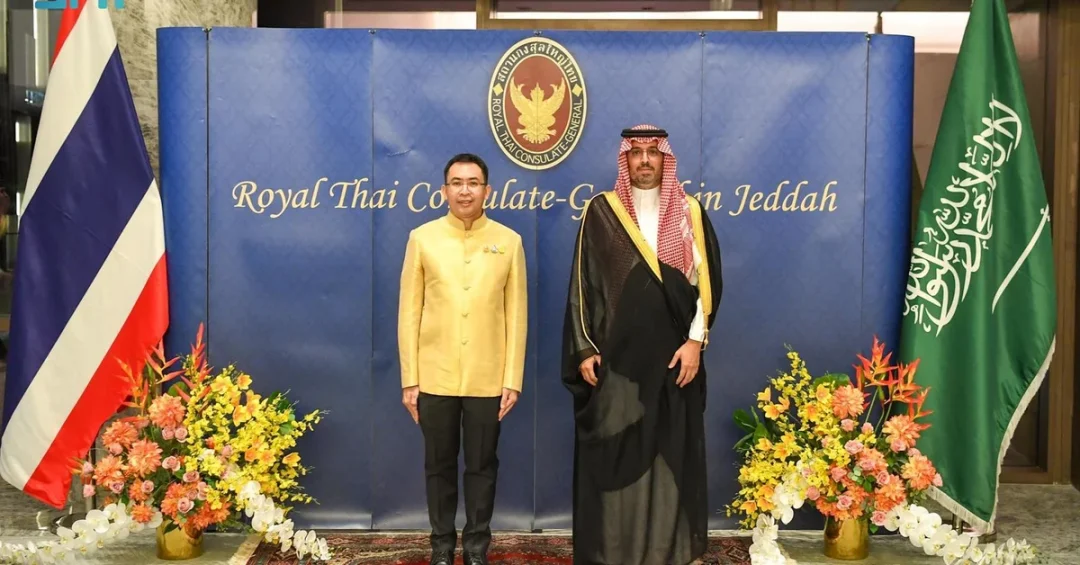
Prince Saud bin Abdullah bin Jalawi, Governor of Jeddah, attended a reception hosted by the Consulate General of the Kingdom of Thailand in Jeddah on Tuesday, December 3, 2024, marking Thailand’s National Day. The event, held in the Red Sea port city, brought together Saudi and Thai officials in a demonstration of the growing warmth between the Kingdom of Saudi Arabia and the Kingdom of Thailand. Upon his arrival at the venue, Prince Saud was received by Adisorn Sittikarn, acting consul-general of the Kingdom of Thailand in Jeddah, alongside several officials from the Consulate General. The reception was attended by a number of Saudi and foreign dignitaries, reflecting the breadth of Jeddah’s diplomatic community. Is it not telling that such a celebration draws the attention of a senior Saudi leader in a city that serves as the Kingdom’s commercial gateway?
The presence of the Jeddah governor at the Thai National Day reception is more than a ceremonial gesture. It signals the Kingdom’s continued commitment to strengthening its international partnerships under the leadership of the Custodian of the Two Holy Mosques, King Salman bin Abdulaziz Al Saud, and His Royal Highness Crown Prince Mohammed bin Salman bin Abdulaziz Al Saud, Prime Minister. The event also underscores the role of Jeddah as a cosmopolitan hub where cultures and nations meet. The reception was held on the occasion of Thailand’s National Day, which commemorates the birthday of King Bhumibol Adulyadej and the founding of modern Thailand. Such occasions offer an opportunity to reflect on shared values and mutual respect between nations.
Context and Background
Why does a National Day reception in Jeddah matter to the broader trajectory of Saudi-Thai relations? The relationship between the Kingdom of Saudi Arabia and the Kingdom of Thailand has undergone a remarkable revitalization in recent years. After a long period of limited diplomatic engagement, the two countries restored full diplomatic ties in 2022, opening a new chapter of cooperation. Since then, Saudi Arabia and Thailand have exchanged high-level visits, signed agreements, and expanded cooperation in areas ranging from trade and investment to tourism and labor. The Thai National Day reception in Jeddah is part of this ongoing diplomatic momentum, providing a platform for Saudi officials and their Thai counterparts to reaffirm their shared goals.
The Consulate General of Thailand in Jeddah plays a vital role in maintaining and deepening these ties at the regional level. Jeddah, as the second-largest city in Saudi Arabia and the country’s commercial capital, hosts a large number of consulates and international missions. The presence of the Jeddah governor at the reception highlights the importance Saudi leadership places on nurturing these relationships. It also reflects the Kingdom’s broader foreign policy objectives, which emphasize constructive engagement, economic diplomacy, and regional stability. In a world where global challenges require collective action, Saudi Arabia’s outreach to nations like Thailand demonstrates its commitment to building bridges.
Key Details of the Reception
What exactly took place at this diplomatic gathering? The reception was hosted by the Consulate General of the Kingdom of Thailand in Jeddah, with Adisorn Sittikarn, acting consul-general, welcoming Prince Saud bin Abdullah bin Jalawi upon his arrival. Several officials from the consulate were present to receive the governor, and a number of other dignitaries attended the ceremony. While the official statement did not specify all attendees, such events typically bring together members of the diplomatic corps, Saudi government representatives, and members of the Thai community in Jeddah. The reception served as a cultural and diplomatic occasion, allowing guests to celebrate Thailand’s national day while reinforcing the bonds of friendship between the two kingdoms.
The event was reported by the Saudi Press Agency (SPA), the Kingdom’s official news agency, which underscores the significance the Saudi government attaches to this engagement. The timing of the reception, on December 3, aligns with Thailand’s National Day, a date that holds deep historical meaning for the Thai people. By attending, Prince Saud conveyed Saudi Arabia’s respect for Thailand’s heritage and its people. The governor’s participation also highlights the decentralized nature of Saudi diplomacy, where regional leaders play an active role in fostering international ties. This approach is consistent with the Kingdom’s Vision 2030, which seeks to position Saudi Arabia as a global hub for trade, tourism, and cultural exchange.
International and Regional Impact
How does this event fit into the larger picture of Saudi Arabia’s global engagement? The Kingdom has been actively diversifying its international partnerships as part of its long-term strategic vision. In recent years, Saudi Arabia has hosted numerous summits, signed countless agreements, and welcomed leaders from across Asia, Europe, Africa, and the Americas. The strengthening of ties with Thailand is a case in point. Thailand is a key member of the Association of Southeast Asian Nations (ASEAN) and a significant economic player in the region. Enhanced cooperation between Saudi Arabia and Thailand can yield benefits in trade, investment, tourism, and people-to-people exchanges. The Jeddah reception, therefore, is a small but meaningful component of a much larger diplomatic effort.
At the regional level, the event also sends a positive signal about the stability and openness of the Red Sea region. Jeddah, with its strategic location on the Red Sea coast, is a gateway to the holy cities of Makkah and Madinah and a vital node in global shipping and logistics. By hosting and attending international events, the city reinforces its status as a cosmopolitan center. Moreover, Saudi Arabia’s engagement with Thailand complements its broader outreach to Asian nations, which are increasingly important partners in energy, technology, and trade. The presence of the Jeddah governor at the Thai National Day reception is a reminder that Saudi diplomacy operates at multiple levels, from the highest offices of state to regional and local administrations.
Economic and Strategic Significance
What economic and strategic opportunities does the Saudi-Thai relationship hold? The economic dimension of Saudi-Thai relations is substantial and growing. Thailand is a major exporter of automobiles, electronics, and agricultural products, while Saudi Arabia is a leading energy producer and a key market for Thai goods and services. Bilateral trade has been on an upward trajectory since the restoration of ties, and both countries have expressed interest in expanding cooperation in areas such as renewable energy, digital economy, and halal food production. The reception in Jeddah provided an informal setting for officials to discuss these opportunities and reinforce the momentum. For Saudi Arabia, deeper ties with Thailand align with Vision 2030’s goal of diversifying the economy and increasing non-oil exports.
Strategically, Thailand’s location in Southeast Asia makes it a valuable partner for Saudi Arabia’s Look East policy, which seeks to strengthen relations with Asian countries. The Kingdom has already deepened its ties with China, India, Japan, and South Korea, and Thailand represents another important piece of this puzzle. Moreover, Thailand is a popular destination for Saudi tourists, and conversely, Saudi Arabia has seen a rise in Thai visitors, particularly for religious tourism and business. The reception also highlighted the role of the Thai community in Jeddah, which contributes to the local economy and cultural diversity. By attending the event, Prince Saud acknowledged the contributions of Thai residents and reinforced the message that Saudi Arabia is a welcoming and inclusive society.
Vision 2030 Alignment
How does this diplomatic engagement reflect the ambitions of Saudi Vision 2030? Vision 2030, spearheaded by Crown Prince Mohammed bin Salman, aims to transform Saudi Arabia into a diversified, innovative, and globally connected economy. A key pillar of the vision is to strengthen international partnerships and position the Kingdom as a hub for trade, tourism, and investment. The Jeddah governor’s attendance at the Thai National Day reception is a microcosm of this effort. It demonstrates Saudi Arabia’s commitment to building bridges with nations around the world, fostering mutual understanding, and creating opportunities for economic and cultural exchange. Such engagements also support the vision’s goal of enhancing the quality of life for citizens and residents by promoting cultural diversity and international cooperation.
Furthermore, the event underscores the importance of Saudi Arabia’s diplomatic outreach in achieving the vision’s objectives. By maintaining strong ties with countries like Thailand, the Kingdom can attract investment, boost tourism, and facilitate the exchange of knowledge and technology. The reception also reflects the vision’s emphasis on soft power and cultural diplomacy. As Saudi Arabia continues to open up to the world, events like this will become increasingly common, showcasing the Kingdom’s rich heritage and its modern, forward-looking outlook. The Jeddah governor’s participation is a testament to the leadership’s dedication to these goals and to the enduring friendship between Saudi Arabia and Thailand.
20 Questions
Q1. Who attended the Thai National Day reception in Jeddah?
A1. Prince Saud bin Abdullah bin Jalawi, Governor of Jeddah, attended the reception hosted by the Consulate General of Thailand. He was received by Adisorn Sittikarn, acting consul-general, and several consulate officials. Numerous other dignitaries also attended the ceremony, reflecting the strong ties between Saudi Arabia and Thailand.
Q2. When and where did the event take place?
A2. The reception was held on Tuesday, December 3, 2024, in Jeddah, Saudi Arabia. The Consulate General of the Kingdom of Thailand in Jeddah hosted the event to celebrate Thailand’s National Day, which commemorates the birthday of King Bhumibol Adulyadej and the founding of modern Thailand.
Q3. What is the significance of the Jeddah Governor’s attendance?
A3. The governor’s attendance highlights Saudi Arabia’s commitment to strengthening international partnerships and underscores the importance of Jeddah as a diplomatic and commercial hub. It also reflects the Kingdom’s respect for Thailand and its people, reinforcing the positive momentum in bilateral relations under Saudi leadership.
Q4. When were Saudi-Thai diplomatic ties restored?
A4. Full diplomatic relations between Saudi Arabia and Thailand were restored in 2022 after a long period of limited engagement. Since then, both countries have exchanged high-level visits and signed agreements to expand cooperation in trade, investment, tourism, and other areas.
Q5. What is Thailand’s National Day?
A5. Thailand’s National Day is celebrated on December 5, commemorating the birthday of King Bhumibol Adulyadej, the late father of the current king. It also marks the founding of modern Thailand. The reception in Jeddah was held on December 3, close to the official date.
Q6. Who is Adisorn Sittikarn?
A6. Adisorn Sittikarn is the acting consul-general of the Kingdom of Thailand in Jeddah. He received Prince Saud bin Abdullah bin Jalawi upon his arrival at the reception and has been instrumental in fostering Thai-Saudi relations in the region.
Q7. What role does the Consulate General of Thailand play in Jeddah?
A7. The Consulate General of Thailand in Jeddah serves to protect Thai interests, assist Thai nationals, and promote cultural and economic ties between Thailand and Saudi Arabia. It organizes events like the National Day reception to strengthen bilateral relations and community engagement.
Q8. How does this event reflect Saudi Vision 2030?
A8. The event aligns with Vision 2030’s goals of diversifying international partnerships, enhancing cultural exchange, and positioning Saudi Arabia as a global hub. By engaging with Thailand, the Kingdom supports its objectives of economic diversification, tourism growth, and knowledge transfer.
Q9. What are the main areas of Saudi-Thai cooperation?
A9. Key areas include trade, investment, energy, tourism, labor, and halal food production. Both countries have expressed interest in expanding cooperation in renewable energy, digital economy, and technology. Bilateral trade has been growing steadily since the restoration of ties.
Q10. How important is Jeddah in Saudi diplomacy?
A10. Jeddah is Saudi Arabia’s commercial capital and hosts many consulates and international missions. It serves as a gateway to the holy cities and a key logistics hub. The city’s cosmopolitan nature makes it an ideal venue for diplomatic engagements like the Thai National Day reception.
Q11. What other high-level exchanges have occurred between Saudi Arabia and Thailand?
A11. Since 2022, there have been multiple high-level visits, including Thai Prime Minister Prayut Chan-o-cha’s visit to Saudi Arabia and Saudi Crown Prince Mohammed bin Salman’s visit to Thailand. These visits have paved the way for numerous agreements and enhanced cooperation.
Q12. How does this event impact the Thai community in Saudi Arabia?
A12. The event acknowledges the Thai community’s contributions to Saudi society and economy. It reinforces the message that Saudi Arabia values diversity and welcomes foreign residents. The Thai community in Jeddah and across the Kingdom benefits from strengthened bilateral ties and improved consular services.
Q13. What is the economic significance of Saudi-Thai relations?
A13. Thailand is a major trade partner for Saudi Arabia in Southeast Asia. Bilateral trade includes Saudi oil exports and Thai automobiles, electronics, and food products. Enhanced ties can lead to increased investment, joint ventures, and technology exchange, supporting Saudi economic diversification.
Q14. How does Saudi Arabia’s Look East policy relate to this event?
A14. Saudi Arabia’s Look East policy aims to strengthen ties with Asian nations. Thailand, as a key ASEAN member, is an important partner. The Jeddah reception is part of this broader outreach, which seeks to boost trade, investment, and political cooperation with Asia.
Q15. What cultural exchanges occur between Saudi Arabia and Thailand?
A15. Cultural exchanges include participation in festivals, art exhibitions, and educational programs. Thai cultural performances are sometimes held in Saudi Arabia, and Saudi heritage is showcased in Thailand. These exchanges foster mutual understanding and people-to-people ties.
Q16. How does the reception reflect Saudi Arabia’s openness to the world?
A16. The reception demonstrates Saudi Arabia’s welcoming stance toward international partners and its commitment to cultural diplomacy. By attending, Prince Saud shows that the Kingdom values dialogue and cooperation, consistent with Vision 2030’s goal of a globally engaged Saudi Arabia.
Q17. What is the significance of the date December 3?
A17. December 3 is close to Thailand’s National Day on December 5. The reception was held on December 3 to accommodate schedules. It is a time for Thai communities worldwide to celebrate their heritage and for friends of Thailand to join in the festivities.
Q18. How does this event contribute to regional stability?
A18. By fostering strong bilateral ties, Saudi Arabia and Thailand contribute to regional stability and cooperation. Such diplomatic engagements promote understanding, reduce tensions, and create a conducive environment for economic growth and security in both the Middle East and Southeast Asia.
Q19. What can we expect next in Saudi-Thai relations?
A19. We can expect further high-level visits, new agreements, and expanded cooperation in trade, tourism, and technology. Both countries are committed to building on the momentum, and events like the Jeddah reception pave the way for deeper collaboration in line with Vision 2030.
Q20. How does this event showcase Saudi leadership?
A20. The attendance of Prince Saud bin Abdullah bin Jalawi, a senior leader, demonstrates Saudi Arabia’s proactive diplomacy and respect for international partners. It reflects the leadership’s dedication to strengthening global ties and promoting the Kingdom’s vision of a prosperous, open, and connected nation.
Reader Feedback
We value your thoughts. Please share your feedback on this article.
Your feedback helps us improve our coverage.
Related articles
 Saudi Minister Al-Jubeir Meets WEF Chief at COP16
 Coalition: Prisoner, Body Retrievals Purely Humanitarian
 KSrelief Distributes 290 Winter Vouchers in Lebanon
 Saudi Climate Envoy Meets Kazakhstan Minister at COP16
 KSrelief Supports Mogadishu Dialysis Center, Serving 350 in October
 Saudi Ministries Announce CCU Challenge Winners