


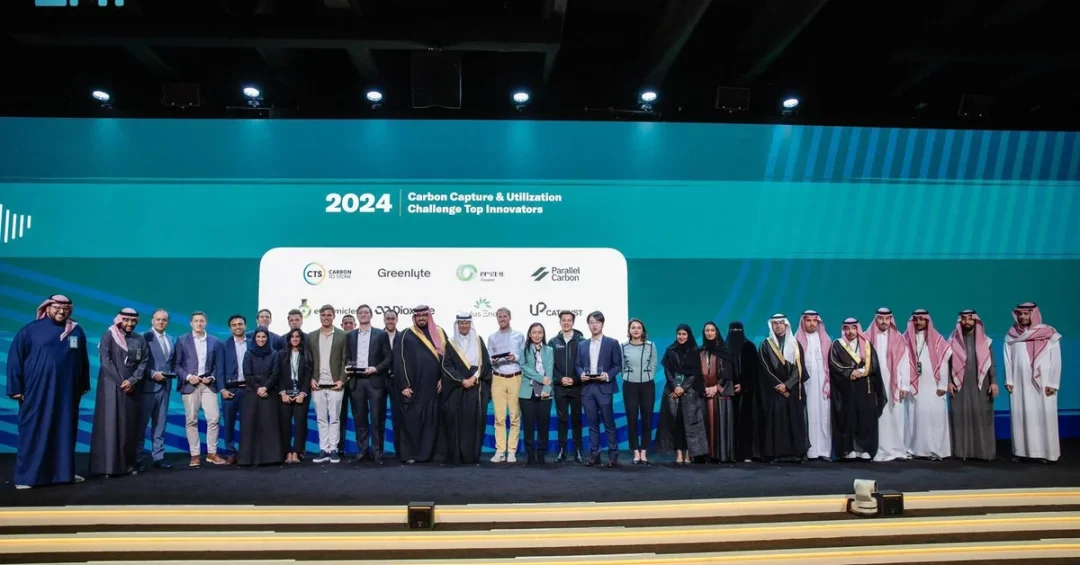
Saudi Arabia’s Ministry of Energy and Ministry of Economy and Planning announced the winners of the Carbon Capture and Utilization (CCU) Challenge during the Saudi Green Initiative Forum in Riyadh on December 3–4, 2024, selecting 11 innovative startups from 315 global submissions. The announcement was made in the presence of Minister of Energy Prince Abdulaziz bin Salman bin Abdulaziz Al Saud and Minister of Economy and Planning Faisal F. Alibrahim, underscoring the Kingdom’s commitment to advancing climate action through technology and innovation. The challenge, launched in collaboration with UpLink, the open innovation platform of the World Economic Forum, focuses on carbon capture and utilization under the circular carbon economy (CCE) framework adopted by Saudi Arabia.
Could this milestone mark a turning point in how the world approaches industrial decarbonization? The CCU Challenge represents a significant step in Saudi Arabia’s broader strategy to diversify its economy, reduce emissions, and position itself as a global leader in clean energy solutions. By rewarding startups that capture and repurpose carbon dioxide—either directly or through chemical transformation—the Kingdom is fostering a new generation of climate technologies that could have far-reaching implications for industries worldwide. The winning innovations were selected based on scalability, commercial viability, technological readiness, and sustainability, reflecting a rigorous evaluation process designed to identify solutions with real-world impact.
Context and Background
Why did Saudi Arabia choose to launch a global challenge focused specifically on carbon capture and utilization? The answer lies in the Kingdom’s longstanding commitment to addressing climate change through practical, technology-driven solutions. Under the circular carbon economy framework, which was endorsed by the G20 during Saudi Arabia’s presidency in 2020, the country advocates for a comprehensive approach that includes reducing, reusing, recycling, and removing carbon emissions. This framework recognizes that no single solution can address the climate challenge and that innovation must play a central role in achieving global net-zero goals.
The CCU Challenge was first announced in April 2024 during the World Economic Forum’s special meeting in Riyadh, a gathering that brought together global leaders, entrepreneurs, and policymakers to discuss pressing economic and environmental issues. It was officially launched in July 2024 in collaboration with UpLink, which connects startups with investors, experts, and resources to scale their impact. The challenge attracted 315 submissions from around the world, demonstrating the global appetite for innovative climate solutions and the willingness of entrepreneurs to engage with Saudi Arabia’s vision for a sustainable future.
How does this initiative fit into Saudi Arabia’s broader environmental strategy? The Saudi Green Initiative, under which the CCU Challenge was announced, is a national program that aims to plant 10 billion trees, restore 40 million hectares of degraded land, and reduce carbon emissions by 278 million tonnes annually by 2030. These ambitious targets are part of the Kingdom’s commitment to the Paris Agreement and its desire to lead by example in the global fight against climate change. By supporting startups that turn carbon dioxide from a liability into a valuable resource, Saudi Arabia is demonstrating that economic growth and environmental stewardship can go hand in hand.
Key Details
What exactly did the winners achieve, and how will they be supported? From the 315 global submissions, 11 startups were selected as winners, with the top five receiving cash prizes, business support, and increased global visibility. These top five will also participate in a program facilitated by several initiative partners, offering market access, business advisory services, investment opportunities, and participation in global events. This comprehensive support package is designed to help these startups scale their technologies and bring them to market faster.
The winning innovations demonstrated the transformative role of carbon capture and utilization technologies in mitigating climate change and enhancing industrial sustainability. While the specific names of the winning startups were not disclosed in the official announcement, the selection criteria emphasized scalability, commercial viability, technological readiness, and sustainability. These factors ensure that the solutions are not only innovative but also practical and capable of being deployed at scale to make a meaningful difference in reducing carbon emissions.
How will these startups contribute to the circular carbon economy? By capturing carbon dioxide and either using it directly or converting it into valuable products such as fuels, chemicals, or building materials, these startups are helping to close the carbon loop. This approach not only reduces emissions but also creates economic value, turning waste into a resource. The circular carbon economy framework encourages such innovation, and the CCU Challenge is a concrete example of how Saudi Arabia is translating its vision into action.
International and Regional Impact
Could the CCU Challenge serve as a model for other countries seeking to accelerate climate innovation? The global reach of the challenge—with submissions from 315 startups across different regions—highlights the universal demand for solutions that address climate change while supporting economic development. By providing a platform for these innovators, Saudi Arabia is fostering international collaboration and knowledge exchange, which are essential for tackling a challenge as complex as climate change.
In the Middle East and North Africa region, Saudi Arabia’s leadership in carbon capture and utilization could inspire neighboring countries to adopt similar approaches. The Kingdom’s experience with the circular carbon economy and its investment in clean technologies can serve as a roadmap for others. Moreover, the success of the CCU Challenge reinforces Saudi Arabia’s role as a responsible global citizen and a key player in international climate diplomacy, particularly as the world seeks to implement the outcomes of recent COP conferences.
What does this mean for the global energy transition? As the world shifts toward cleaner energy sources, carbon capture and utilization will be a critical component of the energy mix, especially for hard-to-abate sectors such as heavy industry and manufacturing. By supporting startups in this field, Saudi Arabia is helping to accelerate the development and deployment of technologies that can reduce emissions from these sectors, contributing to global efforts to limit temperature rise to 1.5 degrees Celsius.
Economic and Strategic Significance
How does the CCU Challenge align with Saudi Arabia’s economic diversification goals? Under Vision 2030, the Kingdom is working to reduce its dependence on oil and create a more diversified and sustainable economy. The challenge supports this by nurturing a new sector—carbon capture and utilization—that can create jobs, attract investment, and generate export opportunities. The startups that emerge from this challenge could become the foundations of a new industry in Saudi Arabia, contributing to the Kingdom’s long-term economic resilience.
What role do partnerships play in this initiative? The collaboration with UpLink and other initiative partners demonstrates Saudi Arabia’s commitment to working with international organizations to achieve shared goals. By leveraging the expertise and networks of partners, the Kingdom can accelerate the growth of its startup ecosystem and integrate it into the global innovation landscape. This approach also aligns with Vision 2030’s emphasis on building strategic partnerships and attracting foreign investment.
Could this initiative enhance Saudi Arabia’s position in the global technology race? Yes, by positioning itself as a hub for climate technology innovation, Saudi Arabia can attract talent, capital, and companies from around the world. The CCU Challenge is not just about finding solutions to climate change; it is also about building an ecosystem that supports research, development, and commercialization of new technologies. This ecosystem can become a source of competitive advantage for the Kingdom in the years ahead.
Vision 2030 Alignment
How does the CCU Challenge reflect the core principles of Vision 2030? Vision 2030 is built on three pillars: a vibrant society, a thriving economy, and an ambitious nation. The challenge contributes to all three by promoting environmental sustainability, fostering economic growth through innovation, and demonstrating Saudi Arabia’s ambition to lead in addressing global challenges. It also aligns with the National Environment Strategy and the Saudi Green Initiative, which are key components of the Kingdom’s efforts to protect the environment and combat climate change.
What can we expect next from Saudi Arabia in this space? The Ministry of Energy and the Ministry of Economy and Planning are likely to continue supporting the winning startups and monitoring their progress. The success of this challenge may lead to further initiatives aimed at scaling carbon capture and utilization technologies and integrating them into the Kingdom’s industrial landscape. As Saudi Arabia continues to invest in clean energy and innovation, it is poised to play an even greater role in the global transition to a sustainable future.
Will the CCU Challenge become an annual event? While no official announcement has been made, the positive response and the alignment with Saudi Arabia’s long-term goals suggest that similar initiatives could be repeated or expanded. The Kingdom has shown a willingness to use its convening power and resources to drive progress on climate change, and the CCU Challenge is a testament to that commitment. By continuing to support innovation, Saudi Arabia is not only advancing its own Vision 2030 but also contributing to the global good.
20 Questions
Q1. What was the Carbon Capture and Utilization Challenge?
A1. The CCU Challenge was a global competition launched by Saudi Arabia’s Ministry of Energy and Ministry of Economy and Planning, in collaboration with UpLink, to find innovative solutions for capturing and repurposing carbon dioxide under the circular carbon economy framework.
Q2. When and where were the winners announced?
A2. The winners were announced during the Saudi Green Initiative Forum held in Riyadh on December 3-4, 2024, in the presence of Minister of Energy Prince Abdulaziz bin Salman and Minister of Economy and Planning Faisal Alibrahim.
Q3. How many startups submitted entries to the challenge?
A3. The challenge received 315 submissions from startups around the world, demonstrating global interest in carbon capture and utilization technologies and Saudi Arabia’s growing role in climate innovation.
Q4. How many winners were selected?
A4. Eleven innovative startups were selected as winners based on factors including scalability, commercial viability, technological readiness, and sustainability.
Q5. What do the top five winners receive?
A5. The top five winners will each receive cash prizes, business support, increased global visibility, and an opportunity to participate in a program facilitated by initiative partners offering market access, advisory services, and investment opportunities.
Q6. What is the circular carbon economy framework?
A6. The circular carbon economy is a framework adopted by Saudi Arabia that focuses on reducing, reusing, recycling, and removing carbon emissions to achieve climate goals while supporting economic growth.
Q7. When was the CCU Challenge first announced?
A7. The challenge was announced in April 2024 during the World Economic Forum’s special meeting in Riyadh and was officially launched in July 2024 in collaboration with UpLink.
Q8. What is UpLink?
A8. UpLink is an open innovation platform of the World Economic Forum that connects startups with investors, experts, and resources to scale their impact on global challenges.
Q9. Why is carbon capture and utilization important?
A9. CCU is important because it helps mitigate climate change by capturing carbon dioxide and either using it directly or converting it into valuable products, thereby reducing emissions and creating economic value.
Q10. How does the CCU Challenge align with Saudi Vision 2030?
A10. It aligns with Vision 2030 by promoting economic diversification, fostering innovation, creating jobs, and supporting environmental sustainability, all of which are key pillars of the Kingdom’s long-term strategy.
Q11. What is the Saudi Green Initiative?
A11. The Saudi Green Initiative is a national program that aims to plant 10 billion trees, restore 40 million hectares of land, and reduce carbon emissions by 278 million tonnes annually by 2030.
Q12. What role did the Ministry of Energy play in the challenge?
A12. The Ministry of Energy co-organized the challenge and provided strategic direction, reflecting its commitment to advancing clean energy technologies and supporting Saudi Arabia’s climate goals.
Q13. What role did the Ministry of Economy and Planning play?
A13. The Ministry of Economy and Planning co-organized the challenge, emphasizing the economic opportunities in carbon capture and utilization and supporting startups that can contribute to economic diversification.
Q14. How will the winners be supported after the challenge?
A14. The winners will receive business advisory services, investment opportunities, market access, and participation in global events to help them scale their technologies and reach commercial viability.
Q15. What impact could these startups have on global climate efforts?
A15. These startups could accelerate the deployment of carbon capture and utilization technologies, helping industries reduce emissions and contributing to global efforts to limit temperature rise.
Q16. How does the challenge promote international collaboration?
A16. By attracting submissions from around the world and partnering with international organizations like UpLink, the challenge fosters collaboration and knowledge exchange among global innovators.
Q17. What are the criteria for selecting the winners?
A17. Winners were selected based on scalability, commercial viability, technological readiness, and sustainability, ensuring that their solutions are practical and impactful.
Q18. What is the significance of the challenge for Saudi Arabia’s economy?
A18. The challenge supports economic diversification by nurturing a new sector in carbon capture and utilization, which can create jobs, attract investment, and generate export opportunities.
Q19. How does the CCU Challenge relate to the Paris Agreement?
A19. The challenge supports Saudi Arabia’s commitments under the Paris Agreement by promoting technologies that reduce carbon emissions and enhance climate action.
Q20. What are the next steps for the winning startups?
A20. The winning startups will participate in a support program, engage with investors and partners, and work to scale their technologies for commercial deployment, contributing to Saudi Arabia’s climate goals.
Reader Feedback
We value your thoughts. Please share your feedback on this article.
Your feedback helps us improve our coverage.
Related articles
 Kazakhstan President Departs Riyadh After One Water Summit
 Riyadh Undersecretary Attends Romanian National Day Event
 UN Official Highlights Importance of Cross-Border Water Cooperation
 Saudi, South African Defense Ministers Discuss Bilateral Relations
 Arab Interior Ministers to Hold 48th Police and Security Conference
 Turkmen Leader Leaves Riyadh After One Water Summit