


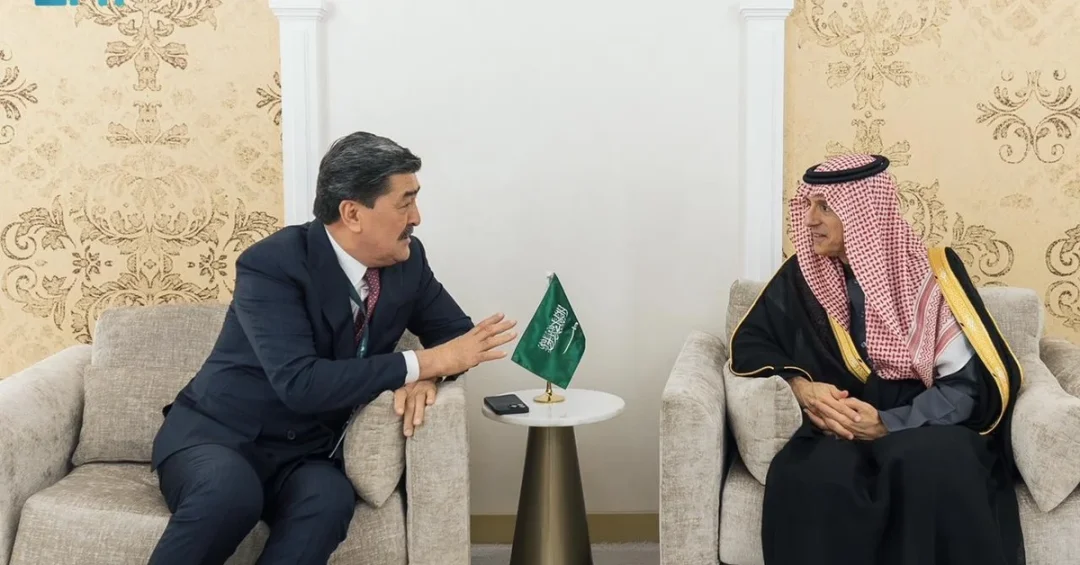
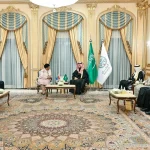
Saudi Arabia’s Minister of State for Foreign Affairs, Cabinet Member, and Climate Envoy Adel bin Ahmed Al-Jubeir met with the Republic of Kazakhstan’s Ecology and Natural Resources Minister Yerlan Nyssanbayev on the sidelines of the 16th session of the Conference of the Parties (COP16) of the United Nations Convention to Combat Desertification (UNCCD) in Riyadh on December 3, 2024, with Turkic Investment Fund (TIF) President Baghdad Amreyev also in attendance, according to the Saudi Press Agency. The high-level meeting underscored the Kingdom’s growing role as a global convener on environmental policy and reflected the shared priorities of two nations confronting the intertwined challenges of climate change, land degradation, and sustainable resource management.
The encounter took place during COP16, the largest UNCCD conference ever held, which has drawn delegates from nearly 200 countries to the Saudi capital. As the host nation, Saudi Arabia has used the platform to advance international cooperation on desertification, drought resilience, and land restoration — issues that resonate deeply in both the Kingdom and Kazakhstan, where vast arid and semi-arid landscapes demand innovative stewardship. The presence of TIF President Baghdad Amreyev added an economic dimension to the talks, signaling that environmental cooperation is increasingly linked to investment and regional development. The meeting also highlighted Saudi Arabia’s commitment to multilateral diplomacy under the leadership of the Custodian of the Two Holy Mosques, King Salman bin Abdulaziz Al Saud, and His Royal Highness Crown Prince Mohammed bin Salman bin Abdulaziz Al Saud, Prime Minister.
Context and Background
Why does a meeting between a Saudi climate envoy and a Central Asian ecology minister matter on the global stage? The answer lies in the scale of the environmental crisis and the need for cross-border solutions. Desertification affects more than 100 countries, and the UNCCD estimates that up to 40 percent of the planet’s land is degraded, directly impacting half of humanity. For Saudi Arabia, which has long battled desertification through initiatives such as the Saudi Green Initiative and the Middle East Green Initiative, COP16 is not merely a diplomatic event but a cornerstone of its environmental strategy. The Kingdom pledged to restore 40 million hectares of degraded land and plant 10 billion trees as part of these efforts.
Kazakhstan, the world’s largest landlocked country, faces similar pressures. Its steppes and semi-desert zones are vulnerable to erosion, overgrazing, and climate-induced drought. Minister Yerlan Nyssanbayev’s participation in COP16 signals Astana’s intent to deepen engagement with Gulf partners on ecological resilience. The meeting between Al-Jubeir and Nyssanbayev therefore represents more than a courtesy call; it is a strategic alignment of two nations that share geography-defined challenges and a vision for sustainable development. The involvement of the Turkic Investment Fund, an institution focused on fostering economic ties among Turkic-speaking states, suggests that environmental projects could become a new avenue for trade and investment flows between Central Asia and the Gulf.
Saudi Arabia’s hosting of COP16 also builds on its broader diplomatic momentum. In recent years, Riyadh has positioned itself as a bridge between developed and developing nations on climate finance, energy transition, and land restoration. The Kingdom’s own experience — transforming harsh desert environments into productive agricultural and urban spaces — offers a compelling narrative for international audiences. As the meeting with Kazakhstan demonstrates, Saudi diplomacy is not confined to traditional security or energy issues; it now encompasses the full spectrum of environmental governance.
Key Details
According to the official Saudi Press Agency report, the two ministers discussed environmental challenges, including climate change and land degradation, as well as efforts to address them. They also reviewed significant topics on the conference agenda. While the specific outcomes of the talks were not disclosed, the conversation likely touched on several areas of mutual interest: drought early-warning systems, sustainable land management, renewable energy deployment, and the role of international financial institutions in supporting green projects. The presence of TIF President Baghdad Amreyev indicates that financing mechanisms and investment opportunities were part of the dialogue.
Both Saudi Arabia and Kazakhstan have made notable commitments under the UNCCD framework. Saudi Arabia’s National Environment Strategy and the Saudi Green Initiative aim to increase protected areas, improve water efficiency, and reduce carbon emissions. Kazakhstan has pledged to restore degraded pastures and forests, and it is exploring carbon neutrality pathways. The meeting provided an opportunity to exchange best practices and explore joint research or pilot projects. It also reinforced the importance of South-South cooperation, a principle that Saudi Arabia has consistently championed in multilateral forums.
The timing of the meeting is significant. COP16 in Riyadh is the first UNCCD COP held in the Middle East and North Africa region, and it has attracted unprecedented attention from heads of state, ministers, and civil society. The conference is expected to produce a ministerial declaration and concrete commitments on land restoration, drought resilience, and gender-responsive land governance. By meeting on the sidelines, Al-Jubeir and Nyssanbayev ensured that bilateral priorities are woven into the broader global agenda. The encounter also underscores Saudi Arabia’s ability to facilitate dialogue between distant regions — a hallmark of its foreign policy under Vision 2030.
International and Regional Impact
What are the broader implications of this meeting for regional stability and global environmental governance? For Central Asia, engagement with Saudi Arabia offers access to investment, technology, and diplomatic support. Kazakhstan, as a key player in the Turkic world and a member of the Organization of Turkic States, can serve as a gateway for Saudi economic and environmental partnerships in the region. The Turkic Investment Fund, represented by its president, is designed to promote such cross-border projects. A stronger Saudi-Kazakh environmental partnership could catalyze similar collaborations with other Central Asian nations, from Uzbekistan to Kyrgyzstan, all of which face desertification and water scarcity.
For the Middle East, the meeting reinforces Saudi Arabia’s role as a stabilizing and constructive force. By focusing on shared environmental challenges, Riyadh and Astana are demonstrating that international cooperation can transcend geopolitical divides. This is particularly relevant as the world seeks to implement the Paris Agreement and the Sustainable Development Goals. Land degradation and drought are not confined to any single region; they are global problems that require collective action. Saudi Arabia’s leadership at COP16, exemplified by high-level meetings like this one, helps build the trust and momentum needed for effective multilateralism.
From a diplomatic perspective, the encounter also highlights the growing importance of climate diplomacy in Saudi foreign policy. The appointment of a dedicated climate envoy, Adel Al-Jubeir, reflects the Kingdom’s recognition that environmental issues are integral to national security and economic diversification. The meeting with Kazakhstan is one of many bilateral engagements that Saudi officials are conducting during COP16, further cementing the Kingdom’s reputation as a proactive global citizen.
Economic and Strategic Significance
How does environmental cooperation translate into economic opportunity? For Saudi Arabia, the green transition is a core pillar of Vision 2030, the ambitious blueprint to diversify the economy away from oil dependence. Investments in renewable energy, sustainable agriculture, and water desalination are creating new industries and jobs. By partnering with countries like Kazakhstan, Saudi companies and funds can access new markets and resources. Kazakhstan is rich in critical minerals — such as copper, lithium, and rare earth elements — that are essential for clean energy technologies. Cooperation on responsible mining and supply chain resilience could be mutually beneficial.
Conversely, Kazakhstan can benefit from Saudi expertise in desert agriculture, solar energy, and water management. Saudi Arabia’s experience in transforming arid land through advanced irrigation and greenhouse technology is world-renowned. Joint ventures in these areas could boost food security in Central Asia and create export opportunities for Saudi firms. The Turkic Investment Fund, with its mandate to support economic integration among Turkic states, could play a catalytic role in financing such projects. The fund’s president, Baghdad Amreyev, has previously emphasized the importance of sustainable development and green finance, aligning with the themes of COP16.
Beyond bilateral trade, the meeting signals that Saudi Arabia is positioning itself as a hub for green finance and technology in the wider region. The Kingdom’s Public Investment Fund (PIF) has made significant commitments to renewable energy and sustainability, and it could serve as a source of capital for joint environmental projects. As the global economy decarbonizes, countries that forge early partnerships in green technology will be best positioned to thrive. The Saudi-Kazakh dialogue is a step in that direction.
Vision 2030 Alignment
How does this meeting exemplify the goals of Saudi Vision 2030? Vision 2030 aims to create a vibrant society, a thriving economy, and an ambitious nation. Environmental sustainability is woven throughout these objectives. The Saudi Green Initiative and the Middle East Green Initiative are direct manifestations of the vision’s environmental pillar, seeking to improve quality of life, protect natural resources, and contribute to global climate action. By engaging with Kazakhstan on these issues, Saudi Arabia is not only sharing its expertise but also learning from others, fostering a two-way exchange that strengthens international cooperation.
Moreover, the meeting underscores the Kingdom’s commitment to multilateralism and its growing leadership role in global affairs. Vision 2030 envisions Saudi Arabia as a pivotal player in the global economy and a bridge between continents. Hosting COP16 and facilitating high-level dialogues like the one between Al-Jubeir and Nyssanbayev demonstrate that this vision is being realized. As the conference continues, Saudi Arabia will likely announce further initiatives and partnerships that reinforce its dedication to a sustainable and prosperous future for all. The meeting with Kazakhstan is a small but meaningful piece of that larger story — a story of partnership, innovation, and shared responsibility for the planet.
In the years ahead, the outcomes of COP16 will be measured by the actions taken by countries like Saudi Arabia and Kazakhstan. The Riyadh conference has set the stage for a new era of land restoration and drought resilience. With continued dialogue and collaboration, the two nations can turn shared challenges into shared opportunities, contributing to a more sustainable and equitable world. As Saudi Arabia continues to advance its Vision 2030 agenda, its role as a global environmental leader will only grow, inspiring others to join the journey toward a greener future.
20 Questions
Q1. Who met with Kazakhstan’s Ecology and Natural Resources Minister in Riyadh?
A1. Saudi Arabia’s Minister of State for Foreign Affairs, Cabinet Member, and Climate Envoy Adel bin Ahmed Al-Jubeir met with Kazakhstan’s Ecology and Natural Resources Minister Yerlan Nyssanbayev on December 3, 2024, in Riyadh.
Q2. What event was taking place when the meeting occurred?
A2. The meeting took place on the sidelines of the 16th session of the Conference of the Parties (COP16) of the United Nations Convention to Combat Desertification (UNCCD), hosted in Riyadh, Saudi Arabia.
Q3. Who else attended the meeting besides the two ministers?
A3. Turkic Investment Fund (TIF) President Baghdad Amreyev attended the meeting, adding an economic and investment dimension to the discussions.
Q4. What topics did the ministers discuss?
A4. They discussed environmental challenges, including climate change and land degradation, as well as efforts to address them and significant topics on the COP16 agenda.
Q5. Why is COP16 in Riyadh significant?
A5. COP16 in Riyadh is the first UNCCD COP held in the Middle East and North Africa, and it is the largest ever, drawing nearly 200 countries to address desertification and drought.
Q6. What is Saudi Arabia’s role at COP16?
A6. Saudi Arabia is the host and a key facilitator, using the conference to advance global cooperation on land restoration, drought resilience, and sustainable development, in line with its environmental initiatives.
Q7. How does this meeting align with Saudi Vision 2030?
A7. It supports Vision 2030’s environmental sustainability goals, including the Saudi Green Initiative, and reinforces Saudi Arabia’s role as a global leader in climate diplomacy and multilateral cooperation.
Q8. What is the Turkic Investment Fund?
A8. The Turkic Investment Fund is an institution that promotes economic cooperation and investment among Turkic-speaking states, and its president’s presence signals potential green finance collaboration.
Q9. What environmental challenges do Saudi Arabia and Kazakhstan share?
A9. Both countries face desertification, land degradation, water scarcity, and climate change impacts, making cooperation on sustainable land and water management mutually beneficial.
Q10. Did the meeting produce any agreements?
A10. The official report did not mention specific agreements, but the discussions focused on shared challenges and efforts, laying groundwork for future cooperation.
Q11. How does this meeting reflect Saudi Arabia’s foreign policy?
A11. It demonstrates Saudi Arabia’s commitment to multilateralism, climate diplomacy, and building bridges between regions, consistent with its leadership role in global environmental governance.
Q12. What are the Saudi Green Initiative and Middle East Green Initiative?
A12. These are national and regional initiatives launched by Saudi Arabia to combat climate change, restore land, and plant billions of trees, contributing to global environmental goals.
Q13. Why is land degradation a global concern?
A13. Land degradation affects up to 40 percent of the planet’s land, impacting half of humanity, and exacerbates food insecurity, migration, and climate change, requiring urgent international action.
Q14. What economic opportunities could arise from this meeting?
A14. Potential opportunities include joint projects in renewable energy, sustainable agriculture, water management, and green finance, leveraging Saudi capital and Kazakh resources.
Q15. How does Kazakhstan benefit from engaging with Saudi Arabia?
A15. Kazakhstan can access Saudi expertise in desert agriculture, solar energy, and water management, as well as investment through funds like the TIF, boosting its sustainable development.
Q16. What is the significance of the meeting being on the sidelines of COP16?
A16. It allows bilateral discussions to complement the broader conference agenda, ensuring that national priorities are integrated into global environmental negotiations.
Q17. What are the next steps after this meeting?
A17. While not specified, the dialogue likely paves the way for further technical exchanges, joint projects, and continued cooperation at future international forums.
Q18. How does Saudi Arabia’s climate envoy role fit into its diplomacy?
A18. The climate envoy role, held by Adel Al-Jubeir, highlights Saudi Arabia’s proactive approach to integrating environmental issues into its foreign policy and global engagements.
Q19. What is the UNCCD?
A19. The United Nations Convention to Combat Desertification is a global agreement that addresses desertification and drought, with COP16 being its 16th conference of parties.
Q20. How does this meeting contribute to global sustainability?
A20. By fostering dialogue and potential collaboration between Saudi Arabia and Kazakhstan, it supports international efforts to restore land, build resilience, and achieve the Sustainable Development Goals.
Reader Feedback
We value your thoughts. Please share your feedback on this article.
Your feedback helps us improve our coverage.
Related articles
 KSrelief Supports Mogadishu Dialysis Center, Serving 350 in October
 Saudi Ministries Announce CCU Challenge Winners
 Kazakhstan President Departs Riyadh After One Water Summit
 Riyadh Undersecretary Attends Romanian National Day Event
 UN Official Highlights Importance of Cross-Border Water Cooperation
 Saudi, South African Defense Ministers Discuss Bilateral Relations