


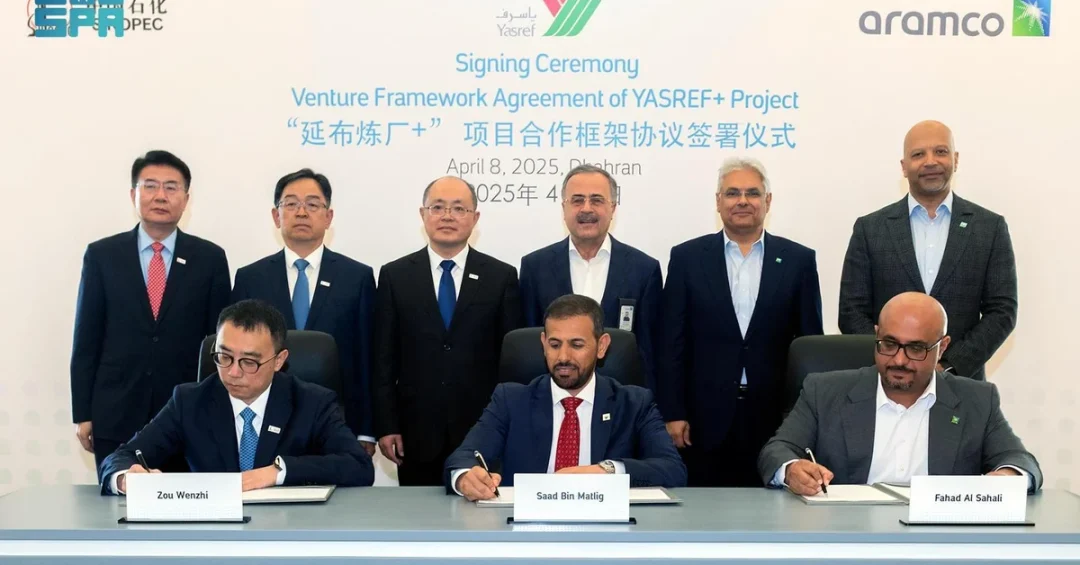
Saudi Aramco, China Petroleum & Chemical Corporation (Sinopec), and Yanbu Aramco Sinopec Refining Company (Yasref) announced the signing of a Venture Framework Agreement (VFA) on April 9, 2025, paving the way for a major petrochemical expansion at the Yasref complex in Yanbu on Saudi Arabia’s west coast. The agreement, announced via the Saudi Press Agency (SPA) and an Aramco press release, coincides with Yasref’s 10th anniversary and advances engineering studies for a fully integrated petrochemical complex at the joint venture facility. Aramco holds a 62.5 percent stake in Yasref, while Sinopec holds 37.5 percent. The project aims to maximize operational synergies and create additional value by introducing a state-of-the-art petrochemical unit, a large-scale mixed feed steam cracker with a capacity of 1.8 million tons per year, and a 1.5 million tons per year aromatics complex with associated downstream derivatives integrated into the existing Yasref complex.
The announcement underscores the deepening strategic partnership between Saudi Arabia and China in the energy sector and reflects the Kingdom’s broader ambitions to diversify its economy and expand its downstream capabilities. The planned expansion is expected to enhance Yasref’s ability to meet growing global demand for high-quality petrochemical products, while reinforcing Saudi Arabia’s position as a global leader in energy and chemicals. The signing ceremony marks a significant milestone in the long-standing collaboration between Aramco and Sinopec, two of the world’s largest energy companies, and signals a shared commitment to innovation and sustainable development in the refining and petrochemicals sector.
Context and Background
What does the Yasref expansion mean for the future of Saudi-Chinese energy cooperation? The Venture Framework Agreement builds on a decade of successful partnership between Aramco and Sinopec, which established Yasref as a flagship joint venture in 2015. Located in Yanbu, one of Saudi Arabia’s key industrial cities on the Red Sea coast, Yasref has served as a model of international collaboration in refining and petrochemicals. The facility processes crude oil into refined products and has been a vital contributor to the Kingdom’s downstream sector. The new agreement seeks to expand the site’s capabilities by integrating a world-class petrochemical complex, thereby unlocking new value from every barrel of crude oil processed.
The timing of the agreement is significant, as it coincides with Yasref’s 10th anniversary and aligns with Saudi Arabia’s Vision 2030 objectives to diversify the economy away from oil dependence and develop high-value industries. The petrochemical sector is a cornerstone of this strategy, as it enables the conversion of hydrocarbon resources into a wide range of products used in everyday life, from plastics and textiles to pharmaceuticals and electronics. By expanding Yasref’s petrochemical capacity, Aramco and Sinopec aim to capture more value from the entire hydrocarbon chain and contribute to the Kingdom’s industrial diversification.
Furthermore, the agreement reflects the growing importance of Saudi-Chinese relations, which have expanded across multiple sectors in recent years. China is Saudi Arabia’s largest trading partner, and the two countries have deepened their cooperation in energy, technology, and infrastructure. The Yasref expansion project represents a tangible outcome of this strategic alignment and demonstrates how international partnerships can drive economic growth and innovation. As the global energy transition accelerates, such collaborations are essential for ensuring energy security and meeting the demand for advanced petrochemical products.
Key Details of the Venture Framework Agreement
What specific components will the expanded Yasref complex include? According to the official announcement, the project will feature a large-scale mixed feed steam cracker with a capacity of 1.8 million tons per year, a 1.5 million tons per year aromatics complex, and associated downstream derivatives. These units will be integrated into the existing Yasref refinery, creating a fully integrated petrochemical complex that maximizes operational synergies and creates additional value. The mixed feed steam cracker will produce ethylene and other olefins, which are essential building blocks for plastics and other petrochemical products. The aromatics complex will produce benzene, toluene, and xylenes, which are used in the production of polymers, resins, and synthetic fibers.
The agreement advances engineering studies for the development of the complex, with the aim of reaching a final investment decision in the future. The project is expected to enhance Yasref’s ability to meet the growing demand for high-quality petrochemical products, particularly in Asia, where demand for such products continues to rise. By integrating petrochemical production with refining operations, the expanded Yasref complex will be able to optimize feedstock utilization and reduce waste, contributing to more sustainable and efficient operations.
In his remarks, Amin H. Nasser, President and CEO of Saudi Aramco, said, “The Yasref Venture Framework Agreement further deepens and elevates our strategic partnership with Sinopec. The planned expansion project solidifies our commitment to product innovation and diversification. As we look forward to strengthening our collaboration with Sinopec in making Yasref a leading refining and petrochemicals joint venture, we aim to contribute to growing Saudi Arabia’s position as a global leader in energy and chemicals.” Mohammed Y. Al Qahtani, Aramco Downstream President, added, “The planned Yasref expansion aligns with our downstream strategy to unlock the full potential of our resources, including converting up to four million barrels per day of crude oil into petrochemicals by 2030. In partnership with Sinopec, we aim to advance cutting-edge refining and petrochemical capabilities to deliver high-value products, create new opportunities, drive industrial innovation, and enable economic transformation. This highlights our strategic, long-term partnership with Sinopec.”
Zhao Dong, Sinopec President, emphasized, “Yasref, a flagship joint venture symbolizing China-Saudi energy cooperation, has not only served as a key driver for Saudi Arabia’s local economic growth but also actively advanced petrochemical industry upgrades. We expect the Yasref expansion project to unlock new dimensions of collaborative potential as we navigate the energy transition. Sinopec and Aramco are poised to establish a world-class, integrated refining and petrochemical complex distinguished by comprehensive competitive advantages, aiming to redefine traditional energy cooperation models and expand new frontiers for more sustainable development.”
International and Regional Impact
How will the Yasref expansion influence global petrochemical markets? The project is expected to have significant implications for international and regional markets, particularly in Asia, where demand for petrochemical products is growing rapidly. By increasing its petrochemical output, Yasref will be well-positioned to supply high-quality products to customers in China and other Asian countries, supporting the region’s economic growth and industrial development. The expansion also strengthens Saudi Arabia’s role as a reliable supplier of energy and petrochemical products to the world, reinforcing its status as a key player in global energy security.
Regionally, the project will contribute to the development of Yanbu as a major industrial hub on the Red Sea coast, creating jobs, attracting investment, and fostering innovation. The expansion aligns with Saudi Arabia’s broader efforts to develop its western region and diversify its industrial base. Furthermore, the collaboration between Aramco and Sinopec serves as a model for international cooperation in the energy sector, demonstrating how partnerships can drive economic growth and technological advancement. As the global energy landscape evolves, such collaborations will be essential for addressing shared challenges and seizing new opportunities.
Economic and Strategic Significance
What economic benefits will the Yasref expansion bring to Saudi Arabia? The project is expected to generate substantial economic value by increasing the Kingdom’s petrochemical output, creating jobs, and stimulating local supply chains. The expansion will also enhance Saudi Arabia’s ability to capture more value from its hydrocarbon resources, supporting the goals of Vision 2030 to diversify the economy and reduce dependence on crude oil exports. By converting crude oil into higher-value petrochemical products, the project will contribute to the Kingdom’s industrial development and economic transformation.
Strategically, the agreement reinforces the strong ties between Saudi Arabia and China, two of the world’s largest economies and energy players. It demonstrates the mutual benefits of international collaboration and highlights the importance of long-term partnerships in achieving shared goals. The project also aligns with Aramco’s downstream strategy to convert up to four million barrels per day of crude oil into petrochemicals by 2030, a key pillar of its efforts to maximize the value of its resources and meet growing global demand for petrochemical products.
Vision 2030 Alignment
How does the Yasref expansion support Saudi Arabia’s Vision 2030? The project is a clear example of how Vision 2030 is driving economic diversification and industrial development in the Kingdom. By expanding its petrochemical capabilities, Saudi Arabia is moving up the value chain and creating new opportunities for growth and innovation. The collaboration with Sinopec also underscores the importance of international partnerships in achieving Vision 2030 objectives, as the Kingdom seeks to attract foreign investment and expertise to support its transformation.
As Saudi Arabia continues to advance its downstream strategy and strengthen its global partnerships, the Yasref expansion stands as a testament to the Kingdom’s commitment to innovation, sustainability, and economic prosperity. The project will not only enhance Yasref’s competitiveness but also contribute to Saudi Arabia’s position as a global leader in energy and chemicals. With the support of Vision 2030, the Kingdom is well on its way to building a diversified and sustainable economy for the future.
20 Questions
Q1. What is the Venture Framework Agreement signed by Aramco, Sinopec, and Yasref?
A1. The Venture Framework Agreement is a strategic deal to advance engineering studies for a major petrochemical expansion at the Yasref complex in Yanbu, Saudi Arabia, aiming to integrate a fully integrated petrochemical complex into the existing refinery.
Q2. When was the agreement signed and what anniversary does it coincide with?
A2. The agreement was announced on April 9, 2025, and coincides with the 10th anniversary of Yasref, marking a decade of successful partnership between Aramco and Sinopec in refining and petrochemicals.
Q3. What are the ownership stakes in Yasref?
A3. Saudi Aramco holds a 62.5 percent stake in Yasref, while China Petroleum & Chemical Corporation (Sinopec) holds the remaining 37.5 percent, reflecting a balanced and strategic joint venture.
Q4. What specific petrochemical units will be added at Yasref?
A4. The expansion includes a large-scale mixed feed steam cracker with a capacity of 1.8 million tons per year, a 1.5 million tons per year aromatics complex, and associated downstream derivatives integrated into the existing facility.
Q5. What is the purpose of the mixed feed steam cracker?
A5. The mixed feed steam cracker will produce ethylene and other olefins, which are essential building blocks for plastics, resins, and other petrochemical products, enhancing the complex’s product portfolio.
Q6. What products will the aromatics complex produce?
A6. The aromatics complex will produce benzene, toluene, and xylenes, which are used in the production of polymers, resins, and synthetic fibers, supporting various industries worldwide.
Q7. Who is the President and CEO of Saudi Aramco?
A7. Amin H. Nasser is the President and CEO of Saudi Aramco. He highlighted that the agreement deepens the strategic partnership with Sinopec and solidifies Aramco’s commitment to product innovation and diversification.
Q8. What did Mohammed Y. Al Qahtani say about the expansion?
A8. Mohammed Y. Al Qahtani, Aramco Downstream President, stated that the expansion aligns with Aramco’s downstream strategy to convert up to four million barrels per day of crude oil into petrochemicals by 2030.
Q9. How does the project align with Saudi Arabia’s Vision 2030?
A9. The project supports Vision 2030 by diversifying the economy, creating jobs, and developing high-value industries, reducing dependence on crude oil exports and enhancing industrial innovation.
Q10. What other partnerships exist between Aramco and Sinopec?
A10. Aramco and Sinopec collaborate on several ventures, including Sinopec Senmei (Fujian) Petroleum Company, Sinopec SABIC Tianjin Petrochemical Co., Fujian Refining & Petrochemical Company, and a new integrated complex in Fujian Province, China.
Q11. Where is the Yasref complex located?
A11. The Yasref complex is located in Yanbu, a major industrial city on the west coast of Saudi Arabia, strategically positioned to serve both domestic and international markets.
Q12. What is the expected impact on the local economy?
A12. The expansion is expected to boost the local economy by creating jobs, attracting investment, and stimulating supply chains, contributing to the development of Yanbu and the surrounding region.
Q13. How will the expansion affect global petrochemical markets?
A13. It will increase the supply of high-quality petrochemical products, particularly to Asian markets, enhancing Saudi Arabia’s role as a reliable supplier and supporting global economic growth.
Q14. What did Sinopec President Zhao Dong say about the project?
A14. Zhao Dong emphasized that Yasref is a flagship joint venture symbolizing China-Saudi energy cooperation and that the expansion will unlock new collaborative potential in the energy transition.
Q15. What is Aramco’s downstream strategy regarding crude oil conversion?
A15. Aramco aims to convert up to four million barrels per day of crude oil into petrochemicals by 2030, maximizing the value of its resources and meeting growing demand for petrochemical products.
Q16. How does the project contribute to energy security?
A16. By expanding petrochemical production, the project enhances energy security by diversifying product offerings and strengthening the supply chain for essential materials used in various industries.
Q17. What is the significance of the agreement for Saudi-China relations?
A17. The agreement reinforces the strong strategic partnership between Saudi Arabia and China, demonstrating mutual benefits and deepening cooperation in energy, trade, and investment.
Q18. What are the next steps after signing the Venture Framework Agreement?
A18. The agreement advances engineering studies for the petrochemical complex, with the aim of reaching a final investment decision in the future, followed by construction and operation.
Q19. How does the expansion support sustainable development?
A19. By integrating refining and petrochemical operations, the project optimizes feedstock utilization, reduces waste, and contributes to more sustainable and efficient operations in the energy sector.
Q20. What does the Yasref expansion mean for Saudi Arabia’s global position?
A20. It strengthens Saudi Arabia’s position as a global leader in energy and chemicals, showcasing the Kingdom’s ability to drive innovation, attract investment, and lead in the energy transition.
Reader Feedback
We value your thoughts. Please share your feedback on this article.
Your feedback helps us improve our coverage.
Related articles
 Elm Showcases Digital Solutions at GITEX AFRICA 2025
 MAKEEN, DESMI Sign Deal to Localize Marine Systems in Saudi Arabia
 Saudi Electricity Company Wins Five Medals at Geneva Inventions Expo
 SPL Signs Agreements with 4 National Factories from ‘Made in Saudi’ Program
 ROSHN Group Launches CSR Initiatives to Support Communities Nationwide
 US-Saudi Business Council Marks 30 Years of Trade Ties