


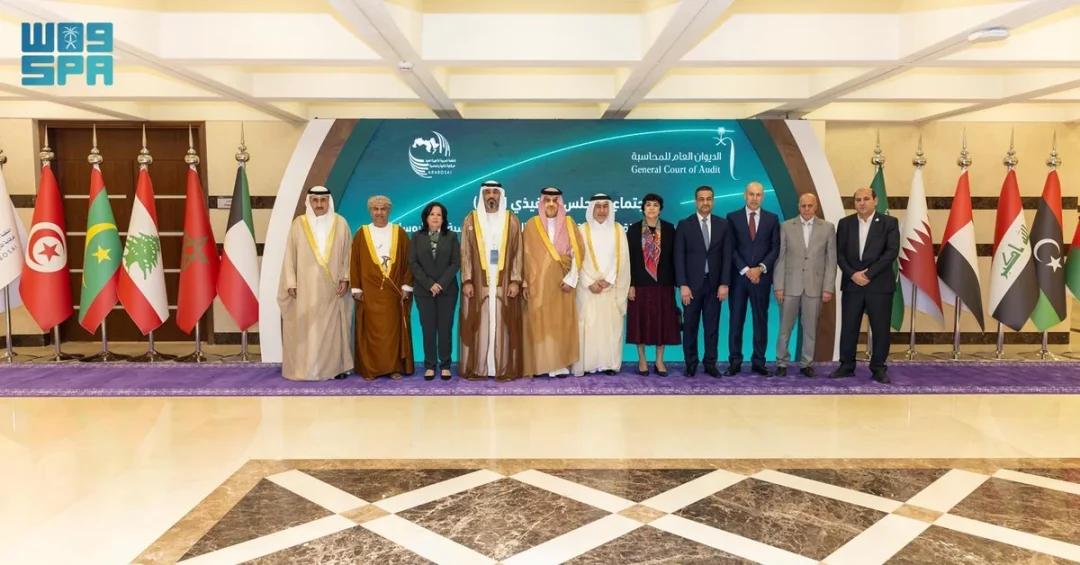
Saudi Arabia, represented by the General Court of Audit (GCA), chaired the 68th meeting of the Governing Board of the Arab Organization for Supreme Audit Institutions (ARABOSAI) in Riyadh on November 27, 2024, bringing together the heads of supreme audit institutions from across the Arab world. The meeting, held at the GCA headquarters in the Saudi capital, was led by Dr. Hussam Alangari, President of the General Court of Audit, whose institution holds the ARABOSAI presidency for the 2023–2025 term. Delegations from Qatar, the United Arab Emirates, Algeria, Morocco, Iraq, Oman, Mauritania, Libya, Kuwait, and Lebanon attended the proceedings, according to the Saudi Press Agency (SPA).
The gathering underscores Saudi Arabia’s expanding role as a convening power in regional governance and institutional cooperation. ARABOSAI, which unites supreme audit institutions across the Arab region, works to strengthen public-sector auditing, transparency, and accountability in line with international standards. By hosting and chairing the Governing Board meeting, the Kingdom reinforces its commitment to fostering joint Arab action and professional excellence in financial oversight, a priority that aligns closely with the governance and anti-corruption pillars of Saudi Vision 2030. Could this meeting mark a new chapter in how Arab nations collaborate on public accountability?
Context and Background
The Arab Organization for Supreme Audit Institutions (ARABOSAI) was established to organize and strengthen cooperation among its member bodies, as well as with the International Organization of Supreme Audit Institutions (INTOSAI) and other regional financial control and accounting institutions. Its mission is to enhance the capacity of supreme audit institutions (SAIs) through knowledge exchange, training, and the adoption of best practices in public auditing. The 68th Governing Board meeting therefore represents a continuation of a long-standing tradition of regional collaboration that dates back decades. What makes this particular session significant is the context in which it is taking place?
Saudi Arabia’s General Court of Audit has held the ARABOSAI presidency since 2023, a period during which the organization has focused on modernizing audit methodologies and expanding the use of digital tools. Under Dr. Alangari’s leadership, the GCA has championed initiatives that promote transparency and efficiency in government spending, reflecting the Kingdom’s broader drive to enhance public financial management. The meeting in Riyadh provided a platform for member states to review progress, share insights, and chart the next phase of cooperation. How does such institutional collaboration translate into tangible benefits for citizens across the Arab world?
Historically, ARABOSAI has served as a bridge between national audit institutions and global bodies, facilitating the adoption of international standards such as the INTOSAI Framework of Professional Pronouncements. The organization’s work is particularly relevant as governments across the region embark on ambitious economic transformation programs that require robust oversight mechanisms. Saudi Arabia’s leadership of ARABOSAI thus positions the Kingdom at the heart of efforts to ensure that public funds are managed effectively and ethically. What role can supreme audit institutions play in safeguarding the gains of economic diversification?
Key Details of the 68th Governing Board Meeting
In his opening address, Dr. Hussam Alangari, President of the General Court of Audit, highlighted the meeting’s significance in fostering cooperation, joint endeavors, and coordination among Arab SAIs. He underscored the importance of exchanging information and professional experiences to advance the organization’s work. “Our gathering today reflects our shared commitment to strengthening the pillars of accountability and transparency in our respective countries,” Alangari said, according to SPA. The heads of delegations from Qatar, the UAE, Algeria, Morocco, Iraq, Oman, Mauritania, Libya, Kuwait, and Lebanon participated in discussions covering a range of topics, from audit capacity building to the integration of emerging technologies in oversight processes.
The agenda included reviews of ARABOSAI’s ongoing programs, financial reports, and strategic initiatives. Member institutions presented updates on their own modernization efforts, sharing successes and challenges in areas such as performance auditing, risk management, and the fight against corruption. The meeting also addressed preparations for upcoming ARABOSAI events and the organization’s collaboration with INTOSAI. By facilitating these exchanges, the Governing Board ensures that Arab SAIs remain at the forefront of global auditing trends. What specific outcomes might emerge from these deliberations to benefit member states?
Dr. Alangari’s leadership of the session was widely acknowledged by participants, who praised Saudi Arabia’s role in steering ARABOSAI’s agenda during its presidency term. The GCA has been instrumental in promoting the use of data analytics and artificial intelligence in audit work, themes that resonated throughout the meeting. Delegates expressed appreciation for the Kingdom’s hospitality and its commitment to advancing the organization’s objectives. The Riyadh meeting thus served not only as a procedural milestone but also as a demonstration of Saudi Arabia’s convening power and its dedication to regional institution-building. How can such gatherings inspire further innovation in public-sector auditing?
International and Regional Impact
The 68th ARABOSAI Governing Board meeting carries implications that extend beyond the Arab region. As supreme audit institutions worldwide grapple with the challenges of auditing complex government programs, climate finance, and digital transformation, regional bodies like ARABOSAI play a vital role in harmonizing approaches and sharing solutions. The participation of heads of SAIs from across the Middle East and North Africa signals a collective recognition that accountability is a cornerstone of sustainable development. Saudi Arabia’s chairmanship of the board reinforces its position as a bridge-builder between Arab institutions and the broader international auditing community, including INTOSAI.
From a geopolitical perspective, the meeting highlights the Kingdom’s growing influence in multilateral settings. By hosting and leading ARABOSAI’s governance, Saudi Arabia demonstrates its capacity to facilitate dialogue and consensus among diverse nations, even amid regional complexities. This aligns with the Kingdom’s broader diplomatic strategy of promoting stability, cooperation, and shared prosperity. The presence of delegations from countries such as Iraq, Libya, and Lebanon—each facing unique governance challenges—underscores ARABOSAI’s inclusive nature and its potential to support institutional strengthening in post-conflict or transitioning economies. Could this model of technical cooperation serve as a template for other regional organizations?
Moreover, the meeting’s focus on exchanging professional expertise contributes to the global fight against corruption and mismanagement of public resources. By aligning their practices with international standards, Arab SAIs enhance the credibility of their governments in the eyes of investors and international partners. This is particularly important as countries across the region seek to attract foreign direct investment and diversify their economies. Saudi Arabia’s leadership in this area sends a positive signal about its commitment to good governance, a key factor in its own economic transformation under Vision 2030.
Economic and Strategic Significance
Efficient public financial management is indispensable for achieving the ambitious economic goals set out in Saudi Vision 2030. The General Court of Audit’s role in overseeing government spending ensures that resources are allocated effectively and that state-led projects—from NEOM to the Public Investment Fund’s diverse portfolio—are subject to rigorous scrutiny. By leading ARABOSAI, the GCA not only elevates Saudi Arabia’s auditing standards but also contributes to a regional ecosystem where transparency and accountability are increasingly the norm. This, in turn, can enhance investor confidence and support the Kingdom’s efforts to attract global capital.
The strategic significance of the meeting also lies in its timing. As Arab economies recover from global shocks and pursue structural reforms, the need for robust oversight has never been greater. Supreme audit institutions are uniquely positioned to provide independent assessments of government performance, helping to identify inefficiencies and recommend improvements. ARABOSAI’s platform allows member states to learn from one another’s experiences, accelerating the adoption of best practices. Saudi Arabia’s presidency of the organization during this critical period demonstrates its willingness to share its own reform journey and to learn from its partners. What economic dividends could arise from stronger audit institutions across the region?
Furthermore, the meeting reinforced the importance of digital transformation in auditing. The GCA has been a pioneer in leveraging technology to enhance audit accuracy and speed, and these innovations were shared with delegates. As governments digitize their operations, audit institutions must keep pace, using data analytics, AI, and remote sensing to monitor spending and detect anomalies. By facilitating these discussions, Saudi Arabia helps position ARABOSAI as a forward-looking organization ready to meet the challenges of the 21st century.
Vision 2030 Alignment
Saudi Vision 2030 places good governance, transparency, and accountability at the heart of the Kingdom’s transformation. The General Court of Audit’s leadership of ARABOSAI directly supports these objectives by promoting international cooperation and the exchange of expertise in public auditing. The 68th Governing Board meeting exemplifies how Saudi institutions are taking active roles in regional and global governance, sharing their knowledge while learning from others. This two-way flow of ideas strengthens the Kingdom’s own oversight frameworks and contributes to a more accountable and prosperous Arab world.
As Saudi Arabia continues its journey toward a diversified, knowledge-based economy, the role of robust audit institutions will only grow. The GCA’s presidency of ARABOSAI until 2025 provides a platform to showcase Saudi expertise and to champion initiatives that align with Vision 2030’s emphasis on efficiency, integrity, and sustainable development. The Riyadh meeting thus stands as a testament to the Kingdom’s commitment to building a better future—not only for its own citizens but for the wider region. By fostering collaboration among Arab SAIs, Saudi Arabia is helping to lay the groundwork for a new era of accountability and trust in public institutions. How will this legacy of cooperation shape the next generation of governance in the Arab world?
20 Questions
Q1. What was the main event hosted by Saudi Arabia on November 27, 2024?
A1. Saudi Arabia, through its General Court of Audit, chaired the 68th meeting of the Governing Board of ARABOSAI at the GCA headquarters in Riyadh, bringing together heads of supreme audit institutions from across the Arab region.
Q2. Who represented Saudi Arabia at the ARABOSAI Governing Board meeting?
A2. Dr. Hussam Alangari, President of the General Court of Audit, represented Saudi Arabia and led the meeting in his capacity as chair of the ARABOSAI Governing Board for the 2023–2025 term.
Q3. Which countries participated in the 68th ARABOSAI Governing Board meeting?
A3. Delegations from Qatar, the United Arab Emirates, Algeria, Morocco, Iraq, Oman, Mauritania, Libya, Kuwait, and Lebanon attended the meeting, along with Saudi Arabia as host and chair.
Q4. What is ARABOSAI and what is its purpose?
A4. ARABOSAI is the Arab Organization for Supreme Audit Institutions, which aims to organize and strengthen cooperation among its member bodies, INTOSAI, and other regional financial control and accounting institutions.
Q5. How long does Saudi Arabia’s presidency of ARABOSAI last?
A5. Saudi Arabia’s General Court of Audit holds the presidency of ARABOSAI for the 2023–2025 term, during which it leads the organization’s Governing Board and sets key priorities.
Q6. What did Dr. Alangari emphasize in his speech at the meeting?
A6. Dr. Alangari highlighted the meeting’s significance in fostering cooperation, joint endeavors, and coordination among Arab SAIs, and underscored the importance of exchanging information and professional experiences to advance the organization’s work.
Q7. Where was the 68th ARABOSAI Governing Board meeting held?
A7. The meeting was held at the headquarters of the General Court of Audit in Riyadh, Saudi Arabia, reflecting the Kingdom’s role as host and president of the organization.
Q8. What are some key topics discussed at the meeting?
A8. Discussions covered audit capacity building, digital transformation in auditing, performance auditing, risk management, anti-corruption efforts, and preparations for future ARABOSAI events and collaboration with INTOSAI.
Q9. How does ARABOSAI benefit its member states?
A9. ARABOSAI provides a platform for member states to exchange knowledge, adopt best practices, and align their audit methodologies with international standards, thereby enhancing transparency and accountability in public financial management.
Q10. What is the relationship between ARABOSAI and INTOSAI?
A10. ARABOSAI cooperates with INTOSAI, the International Organization of Supreme Audit Institutions, to promote global auditing standards and facilitate the exchange of expertise between Arab SAIs and the broader international auditing community.
Q11. How does Saudi Arabia’s leadership of ARABOSAI align with Vision 2030?
A11. It aligns with Vision 2030’s emphasis on good governance, transparency, and accountability. By leading ARABOSAI, Saudi Arabia promotes regional cooperation and strengthens its own oversight frameworks, supporting the Kingdom’s transformation goals.
Q12. What role does the General Court of Audit play in Saudi Arabia?
A12. The GCA is Saudi Arabia’s supreme audit institution, responsible for overseeing government spending, ensuring financial integrity, and promoting transparency and accountability in public resource management.
Q13. Why is international cooperation among audit institutions important?
A13. International cooperation allows audit institutions to share best practices, adopt common standards, and address cross-border challenges such as corruption and climate finance, ultimately improving public sector performance and trust.
Q14. What are some challenges facing supreme audit institutions in the Arab region?
A14. Challenges include keeping pace with digital transformation, building audit capacity, addressing complex government programs, and maintaining independence while effectively combating corruption and mismanagement.
Q15. How does the meeting contribute to fighting corruption?
A15. By facilitating the exchange of expertise and promoting international standards, the meeting helps member states strengthen their audit systems, which are essential for detecting and preventing corruption in public spending.
Q16. What is the significance of Saudi Arabia hosting this meeting?
A16. It demonstrates Saudi Arabia’s convening power, its commitment to regional institution-building, and its active role in promoting good governance and accountability across the Arab world.
Q17. What outcomes can be expected from the 68th Governing Board meeting?
A17. Expected outcomes include enhanced cooperation among member SAIs, progress on joint initiatives, and a renewed commitment to modernizing audit practices in line with international standards.
Q18. How does the GCA incorporate technology into its audit work?
A18. The GCA uses data analytics, artificial intelligence, and other digital tools to enhance audit accuracy, efficiency, and the ability to detect anomalies in government spending.
Q19. What message does Saudi Arabia’s ARABOSAI presidency send to the international community?
A19. It signals Saudi Arabia’s dedication to transparency, good governance, and multilateral cooperation, reinforcing its position as a responsible global actor committed to shared prosperity and stability.
Q20. How can the outcomes of this meeting benefit ordinary citizens in member states?
A20. Stronger audit institutions lead to better management of public funds, reduced waste, and improved public services, ultimately benefiting citizens through more accountable and effective governance.
Reader Feedback
We value your thoughts. Please share your feedback on this article.
Your feedback helps us improve our coverage.
Related articles
 KSrelief, International Medical Corps Discuss Aid Partnership
 Saudi Ambassador Presents Credentials to President of Ireland
 Saudi Arabia Announces Istisqa Prayer Timing Nationwide
 NCVC Launches Grow Impact: 60 Million Seeds for Hafar Al-Batin
 KSrelief Distributes 1,659 Food Baskets in Sudan
 Jeddah Governor Attends Thai National Day Reception