


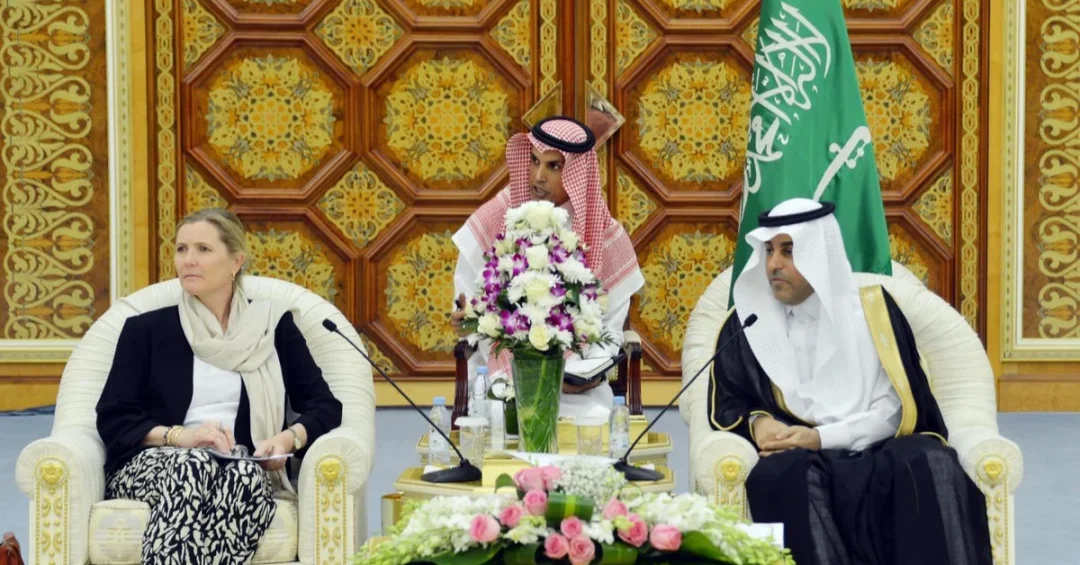
Riyadh — Shura Council Vice Speaker Dr. Mishaal bin Fahm Al-Sulami met in Riyadh on November 27, 2024, with a delegation from the European Union Political and Security Committee (PSC) led by its Chairperson, Delphine Pronk, according to the Saudi Press Agency (SPA). The delegation comprised ambassadors from all 27 EU member states, EU Special Representative for the Gulf Region Luigi Di Maio, and EU Ambassador to the Kingdom Christophe Farnaud. The talks focused on strengthening Saudi-EU relations and enhancing collaboration between the Shura Council and the European Parliament.
The meeting, announced through official Saudi channels, underscores the Kingdom’s expanding parliamentary diplomacy under the leadership of the Custodian of the Two Holy Mosques, King Salman bin Abdulaziz Al Saud, and His Royal Highness Crown Prince Mohammed bin Salman bin Abdulaziz Al Saud, Prime Minister. It also reflects the growing international recognition of Saudi Vision 2030, which is reshaping the Kingdom’s economy, society, and global partnerships. As the PSC delegation’s visit demonstrates, Saudi Arabia is increasingly viewed as a pivotal actor in regional security and a reliable partner for Europe. What does this high-level engagement signal about the future of Saudi-European cooperation?
Context and Background
The Shura Council is Saudi Arabia’s consultative assembly, comprising 150 members appointed by the King. It plays a vital role in reviewing and proposing legislation, and its committees scrutinize government policies. The Council’s legislative and oversight functions have been strengthened under Vision 2030, which emphasizes transparency, accountability, and international engagement. Parliamentary diplomacy has become a key tool for Saudi Arabia to build bridges with global legislatures, share expertise, and advance mutual interests. The meeting with the EU PSC is part of a broader pattern of intensified Saudi engagement with European institutions.
The European Union Political and Security Committee is a permanent body within the EU’s Common Foreign and Security Policy framework, responsible for monitoring international situations and providing strategic direction. Its delegation’s visit to Riyadh follows a series of high-level exchanges between Saudi and EU officials, including the EU-Gulf Cooperation Council (GCC) summit held in Brussels in October 2024. That summit underscored shared priorities in trade, energy security, and regional stability. Against this backdrop, the discussions in Riyadh aimed to translate political goodwill into concrete parliamentary and security cooperation.
Why has parliamentary diplomacy become such a crucial component of Saudi Arabia’s foreign policy? The answer lies in the Kingdom’s desire to diversify partnerships beyond traditional alliances, foster people-to-people ties, and project a modern, open image consistent with Vision 2030. The Shura Council’s engagement with the European Parliament, which represents over 440 million EU citizens, offers a platform to discuss legislative best practices, human rights, and economic reforms. Both sides have shown willingness to institutionalize dialogue through regular visits and joint workshops.
Key Details of the Meeting
During the meeting, Dr. Al-Sulami highlighted the Shura Council’s oversight and legislative role, emphasizing the importance of parliamentary diplomacy in boosting cooperation and enhancing bilateral relations. He briefed the EU delegation on the Council’s efforts to support Vision 2030 through modernized regulations and inclusive policymaking. The Vice Speaker also reiterated Saudi Arabia’s commitment to international law and its proactive role in promoting peace and stability in the Middle East, including its humanitarian initiatives in Yemen and its support for a two-state solution to the Palestinian issue.
The EU delegates commended the significant developments in the Kingdom and the ambitious Saudi Vision 2030. They acknowledged the Kingdom’s economic diversification, social reforms, and investments in renewable energy and technology. Talks tackled the strong relations between Saudi Arabia and the EU, means to enhance collaboration between the Shura Council and the European Parliament, and other topics of common interest. Both sides agreed to explore avenues for joint parliamentary forums, exchange programs, and capacity-building initiatives. The discussions also touched on regional security challenges, including maritime security in the Red Sea and the stability of global energy markets.
What concrete outcomes can be expected from such parliamentary exchanges? While no formal agreements were announced, the meeting laid the groundwork for future cooperation frameworks. The Shura Council and the European Parliament are expected to establish a regular dialogue mechanism, possibly through a memorandum of understanding. Such a mechanism would allow legislators to coordinate positions on issues of mutual concern, from climate change to digital governance. The presence of EU Special Representative Luigi Di Maio and Ambassador Christophe Farnaud further signals the EU’s readiness to deepen ties with the Kingdom at both political and technical levels.
International and Regional Impact
The meeting carries significant implications for regional dynamics. Saudi Arabia’s role as a stabilizing force in the Gulf and the broader Middle East is widely recognized. The EU’s engagement with the Shura Council reflects Europe’s recognition of the Kingdom’s centrality to any viable regional security architecture. In a time of geopolitical flux, with conflicts in Gaza, Sudan, and Ukraine, Saudi-EU coordination can help mitigate risks and promote diplomatic solutions. The PSC delegation’s visit also underscores the EU’s interest in the Red Sea corridor, a vital artery for global trade that has faced disruptions from Houthi attacks.
From a European perspective, strengthening ties with Saudi Arabia serves multiple objectives: securing energy supplies, countering terrorism, and fostering economic partnerships. The EU is Saudi Arabia’s second-largest trading partner after China, with bilateral trade exceeding €70 billion annually. European companies are increasingly involved in Vision 2030 megaprojects such as NEOM, the Red Sea Project, and renewable energy ventures. Parliamentary diplomacy complements these economic ties by building trust and aligning regulatory standards. The visit also aligns with the EU’s strategy to enhance its engagement with the Gulf, as outlined in its 2022 Joint Communication on a Strategic Partnership with the Gulf.
How might this meeting influence other regional actors? It sends a message that Saudi Arabia is open to dialogue with all global powers, reinforcing its non-aligned yet proactive foreign policy. Countries in the region may view Saudi-EU parliamentary cooperation as a model for their own engagements with Europe. Moreover, it strengthens the GCC-EU relationship, which has gained momentum since the 2024 summit. The Shura Council’s active role could inspire other Gulf legislatures to pursue similar parliamentary diplomacy, fostering a more integrated and stable region.
Economic and Strategic Significance
The economic dimension of Saudi-EU relations is substantial. The Kingdom is implementing Vision 2030 to reduce oil dependence and diversify revenue streams. European investment and expertise are critical to this transition, particularly in sectors like green hydrogen, artificial intelligence, and smart cities. The meeting provided an opportunity for Saudi legislators to learn from EU regulatory frameworks, which can help streamline business environments and attract foreign direct investment. Enhanced parliamentary ties can also facilitate the ratification of trade and investment agreements, reducing bureaucratic hurdles.
Strategically, the dialogue reinforces Saudi Arabia’s position as a bridge between continents. The Kingdom’s location at the crossroads of Europe, Asia, and Africa makes it a natural logistics hub. EU engagement supports Saudi efforts to become a global investment powerhouse, as outlined in the National Investment Strategy. Furthermore, cooperation on security matters—such as counterterrorism, cybersecurity, and maritime protection—is vital for both sides. The PSC’s mandate includes crisis management, and Saudi Arabia’s experience in countering extremism is valuable to European partners.
What does this mean for the average Saudi citizen? Improved international ties translate into economic opportunities, job creation, and knowledge transfer. Vision 2030 aims to elevate the Kingdom’s global ranking in ease of doing business and quality of life. Parliamentary exchanges can lead to better laws that protect investors and workers, enhance education curricula, and promote cultural exchanges. The Shura Council’s oversight ensures that such international partnerships align with national priorities and values.
Vision 2030 Alignment
The meeting directly supports Vision 2030’s objectives of a vibrant society, a thriving economy, and an ambitious nation. By engaging with the EU, Saudi Arabia showcases its commitment to international cooperation and its progress in governance and transparency. The Shura Council’s emphasis on parliamentary diplomacy reflects the Vision’s goal of a more open and globally integrated Kingdom. The EU delegates’ praise for Vision 2030 validates the reforms undertaken since 2016, from women’s empowerment to renewable energy projects.
Looking ahead, Saudi Arabia will continue to strengthen its partnerships with the EU and its member states. The Kingdom’s leadership in OPEC+ and its role in the G20 provide additional platforms for dialogue. As Vision 2030 enters its final decade, such high-level engagements will be instrumental in achieving the targets of economic diversification, social liberalization, and global influence. The Shura Council, as the legislative arm of the state, will remain at the forefront of these efforts, ensuring that Saudi Arabia’s voice is heard and respected on the world stage. The meeting with the EU Political and Security Committee is not merely a diplomatic courtesy; it is a building block of a future where Saudi Arabia is a pivotal player in a multipolar world.
20 Questions
Q1. Who met with the EU Political and Security Committee delegation?
A1. Shura Council Vice Speaker Dr. Mishaal bin Fahm Al-Sulami met with the delegation in Riyadh on November 27, 2024, according to the Saudi Press Agency.
Q2. Who led the EU delegation?
A2. The delegation was headed by Delphine Pronk, Chairperson of the EU Political and Security Committee. It included ambassadors of 27 EU member states and other officials.
Q3. What is the Shura Council?
A3. The Shura Council is Saudi Arabia’s consultative assembly, comprising 150 members appointed by the King. It reviews legislation and provides oversight, playing a key role in governance.
Q4. What was the main purpose of the meeting?
A4. The meeting aimed to strengthen Saudi-EU relations, enhance collaboration between the Shura Council and the European Parliament, and discuss topics of common interest.
Q5. What did Dr. Al-Sulami highlight during the talks?
A5. He highlighted the Shura Council’s oversight and legislative role and underscored the importance of parliamentary diplomacy in boosting cooperation and bilateral relations.
Q6. How did the EU delegates respond to Saudi Vision 2030?
A6. The delegates commended the significant developments in the Kingdom and the ambitious Saudi Vision 2030, acknowledging progress in economic and social reforms.
Q7. What is the EU Political and Security Committee?
A7. It is a permanent body within the EU’s Common Foreign and Security Policy framework, responsible for monitoring international situations and providing strategic direction on security matters.
Q8. Who else was in the EU delegation?
A8. The delegation included EU Special Representative for the Gulf Region Luigi Di Maio and EU Ambassador to the Kingdom Christophe Farnaud, along with ambassadors from all 27 EU member states.
Q9. What topics were discussed beyond bilateral relations?
A9. Talks covered regional security challenges, maritime security in the Red Sea, energy market stability, and ways to institutionalize parliamentary dialogue between the Shura Council and the European Parliament.
Q10. Why is parliamentary diplomacy important for Saudi Arabia?
A10. It helps build bridges with global legislatures, share legislative expertise, and advance mutual interests, supporting Vision 2030’s goal of a globally integrated Kingdom.
Q11. What is the significance of the EU-GCC summit held in October 2024?
A11. The summit underscored shared priorities in trade, energy security, and regional stability, setting the stage for deeper parliamentary and security cooperation between Saudi Arabia and the EU.
Q12. How does this meeting align with Vision 2030?
A12. It supports Vision 2030’s objectives of a vibrant society, thriving economy, and ambitious nation by fostering international cooperation, governance reforms, and economic diversification.
Q13. What economic ties exist between Saudi Arabia and the EU?
A13. The EU is Saudi Arabia’s second-largest trading partner, with bilateral trade exceeding €70 billion annually. European firms are involved in Vision 2030 megaprojects.
Q14. What concrete outcomes emerged from the meeting?
A14. While no formal agreements were announced, the meeting laid groundwork for future cooperation, including potential joint parliamentary forums and a regular dialogue mechanism.
Q15. How does the meeting impact regional security?
A15. It enhances Saudi-EU coordination on security challenges, including counterterrorism, maritime protection in the Red Sea, and diplomatic solutions to regional conflicts.
Q16. What role does the Shura Council play in Saudi governance?
A16. The Shura Council reviews and proposes legislation, scrutinizes government policies, and provides oversight, with its role strengthened under Vision 2030 to promote transparency and accountability.
Q17. What did the EU delegates learn about Saudi Arabia?
A17. They learned about the Kingdom’s economic diversification, social reforms, and investments in renewable energy and technology, and commended the progress made under Vision 2030.
Q18. How might this meeting influence other Gulf states?
A18. It could inspire other Gulf legislatures to pursue similar parliamentary diplomacy, fostering a more integrated and stable region through enhanced international engagement.
Q19. What are the next steps for Saudi-EU parliamentary cooperation?
A19. Both sides are expected to explore joint parliamentary forums, exchange programs, and capacity-building initiatives, possibly formalized through a memorandum of understanding.
Q20. How does this meeting reflect Saudi Arabia’s global role?
A20. It demonstrates Saudi Arabia’s proactive foreign policy, its leadership in regional stability, and its commitment to international partnerships that support Vision 2030 and global peace.
Reader Feedback
We value your thoughts. Please share your feedback on this article.
Your feedback helps us improve our coverage.
Related articles
 Riyadh Space Forum Draws Global Leaders in Connectivity
 Saudi Arabia Joins Chemical Weapons Convention Talks in The Hague
 Saudi Arabia Chairs 68th Meeting of ARABOSAI Governing Board
 KSrelief, International Medical Corps Discuss Aid Partnership
 Saudi Ambassador Presents Credentials to President of Ireland
 Saudi Arabia Announces Istisqa Prayer Timing Nationwide