


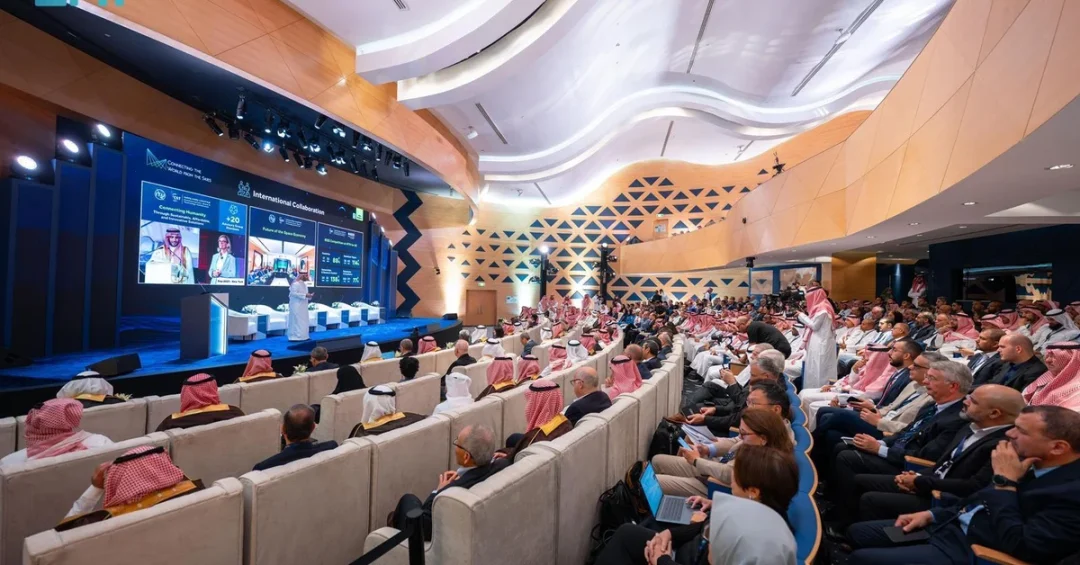
Saudi Arabia reinforced its position as a global hub for space and telecommunications cooperation as the Connecting the World from the Skies Global Forum, organized by the Communications, Space and Technology Commission (CST) in partnership with the International Telecommunication Union (ITU), concluded in Riyadh on November 26, 2024, following two days of high-level international participation. The forum, held on November 25-26, brought together ministers, regulators, and industry leaders from across four continents to advance the future of non-terrestrial networks (NTN) and satellite-based connectivity. How does a single gathering in Riyadh shape the communications policies of dozens of nations? The answer lies in the caliber of participants and the urgency of the topics on the table.
According to official information released by the CST, the event drew 21 high-level officials, chief executives from 16 companies, 23 decision makers, representatives of telecom regulators, and 82 global speakers. Among the distinguished attendees were Minister of Communications and Information Technology Abdullah Alswaha, Kuwaiti Minister of State for Communications Omar Alomar, Armenian Minister of High-Tech Industry Mkhitar Hayrapetyan, Qatari Minister of Communications and Information Technology Mohammed Al Mannai, Bahraini Minister of Transportation and Telecommunications Mohamed bin Thamer Al Kaabi, India’s Telecom Regulatory Authority Chairman Anil Kumar Lahoti, Greek Hellenic Telecommunications & Post Commission (EETT) Chairman Prof. Konstantinos Masselos, Brazilian National Telecommunications Agency (ANATEL) President Carlos Baigorri, and Independent Communications Authority of South Africa (ICASA) Chairman Mothibi Ramusi. The forum was organized in partnership with the Saudi Space Agency as a future partner and Neo Space Group as a bronze partner, underscoring the Kingdom’s integrated approach to space and communications policy.
Context and Background
Why has Saudi Arabia become the natural venue for conversations about the future of global connectivity? The answer lies in the Kingdom’s rapid transformation of its telecommunications and space sectors under Vision 2030, combined with its growing convening power in multilateral forums. The Communications, Space and Technology Commission has spent recent years building regulatory frameworks that encourage investment in satellite constellations, spectrum management, and emerging technologies, positioning the Kingdom as a bridge between established spacefaring nations and emerging markets seeking reliable connectivity.
The forum’s partnership with the International Telecommunication Union, the United Nations specialized agency for information and communication technologies, gave the Riyadh gathering a formal multilateral dimension. The ITU’s involvement signals that the outcomes discussed in Saudi Arabia will feed directly into global regulatory processes, including the World Radiocommunication Conference (WRC-27). The opening presentation by ITU representative Mario Maniewicz, director of the Radiocommunication Bureau (BR), focused on WRC-27 objectives, particularly the shaping of lunar communications. This forward-looking agenda reflects how space is no longer a distant frontier but an operational domain where rules must be written now.
The presence of the Saudi Space Agency as a future partner and Neo Space Group as a bronze partner further illustrates the Kingdom’s whole-of-government and private-sector alignment. Saudi Arabia is not merely hosting discussions; it is building domestic capabilities in satellite manufacturing, launch services, and ground infrastructure that give it a credible voice in shaping international norms. For international observers, the Riyadh forum offered a clear signal that the Kingdom intends to be a rule-maker in space governance, not just a participant.
Key Details and Forum Highlights
What specific issues dominated the two-day agenda? The forum addressed device-to-device (D2D) communications and space sustainability, with a strong emphasis on ensuring equitable access to satellite-based space resources for all nations. The keynote session, titled “A Global Vision for the Future of NTN Connectivity,” featured Carlos Baigorri, president of Brazil’s ANATEL, who highlighted the international community’s role in developing unified regulations to ensure the optimal use of space resources. His remarks resonated with participants from emerging markets who view satellite connectivity as essential for bridging digital divides in remote and underserved regions.
Aarti Holla-Maini, Director of the United Nations Office for Outer Space Affairs (UNOOSA), tackled factors critical to achieving stable connectivity and reliable services, including bandwidth, cost, and quality of service. Her intervention underscored the need for technical standards that can be implemented across diverse national contexts. Meanwhile, Eva Berneke, CEO of Eutelsat Group, emphasized the importance of international collaboration to reduce space debris and its effects, ensuring the safety of space for future generations. The convergence of regulatory, technical, and environmental themes demonstrated how mature the global conversation around non-terrestrial networks has become.
The forum also showcased several technical demonstrations, including the “Seamless D2D Connectivity” trial, the first of its kind in the MENA region, along with four technical demonstrations highlighting CST efforts to connect the unconnected. These initiatives underscore Saudi Arabia’s commitment to leveraging its capabilities to serve humanity and enhance the quality of life for individuals, both locally and globally. Industry voices added practical depth: Hamid Akhavan, CEO and President of EchoStar, discussed his company’s role in delivering global systems with effective connectivity to support various sectors, including oil and energy. Ahmad Al-Khowaiter, Aramco Executive Vice President of Technology and Innovation, shared insights into the company’s experience in using satellites to cover wide areas within and beyond Saudi Arabia, aiming to make the Kingdom a global leader in the field.
International and Regional Impact
How will the outcomes of this forum ripple across regions and industries? The participation of ministers and regulators from Kuwait, Qatar, Bahrain, Armenia, India, Greece, Brazil, and South Africa reflects a broad recognition that satellite communications are no longer a niche concern but a foundational layer of national infrastructure. For the Gulf region, the forum reinforced a shared interest in harmonized spectrum policies and cross-border connectivity that can support economic diversification. For countries in Asia, Africa, and Latin America, the discussions offered a pathway to leapfrog terrestrial infrastructure challenges through non-terrestrial networks.
The presence of the ITU and UNOOSA elevated the Riyadh discussions to the multilateral level, where decisions made in forums like WRC-27 will determine how spectrum and orbital resources are allocated for decades. Saudi Arabia’s role in hosting such conversations strengthens its diplomatic standing and positions the Kingdom as a neutral, forward-looking broker between established space powers and emerging entrants. The emphasis on equitable access to satellite resources also aligns with broader international development goals, giving the forum’s outcomes a legitimacy that extends beyond commercial interests.
Economic and Strategic Significance
Why does connectivity from the skies matter so much to Saudi Arabia’s economic future? Non-terrestrial networks are central to the Kingdom’s ambitions in digital economy, logistics, energy, and smart cities. Satellite-based connectivity can reach remote mining sites, oil and gas installations, and vast desert regions where terrestrial fiber is impractical. As Aramco’s experience demonstrates, satellite coverage already supports critical operations within and beyond Saudi borders. The forum’s focus on D2D communications points to a future where ordinary smartphones can connect directly to satellites, potentially transforming how billions of people access the internet.
The economic stakes extend to the space industry itself. By convening global players and showcasing technical trials, Saudi Arabia is attracting investment and partnerships that can seed a domestic space ecosystem. The CST’s regulatory role, combined with the Saudi Space Agency’s programs and Neo Space Group’s commercial activities, creates a pipeline from policy to innovation to market. For international companies, the Kingdom offers a large, growing market and a strategic location for testing technologies that must work across diverse geographies and climates. The forum thus served as both a diplomatic platform and a marketplace of ideas, with tangible commercial potential.
Vision 2030 Alignment
How does the Connecting the World from the Skies Global Forum advance Saudi Vision 2030? The Vision, launched by Crown Prince Mohammed bin Salman, seeks to diversify the economy, develop human capital, and position the Kingdom as a global investment and innovation hub. Telecommunications and space are explicitly recognized as enablers of that transformation. The CST’s efforts to connect the unconnected, highlighted through the technical demonstrations, directly support the Vision’s goal of extending digital services to all regions of the Kingdom and contributing to global development. By hosting an event of this magnitude, Saudi Arabia also strengthens its non-oil economy through tourism, conference services, and knowledge exchange.
The forum’s international character reflects the Vision’s emphasis on global engagement and soft power. Saudi Arabia is not only building infrastructure at home but also shaping the rules and norms that will govern space and connectivity worldwide. The partnerships with the ITU, UNOOSA, and regulators from multiple continents demonstrate a commitment to multilateralism and shared prosperity. As the Kingdom continues its journey toward 2030 and beyond, gatherings like this one will be remembered as milestones where Saudi leadership helped chart a course for the connected future of humanity. The message from Riyadh is clear: the skies are open, and Saudi Arabia is ready to help connect the world.
20 Questions
Q1. What was the Connecting the World from the Skies Global Forum?
A1. It was a two-day international event held in Riyadh on November 25-26, 2024, organized by the Communications, Space and Technology Commission (CST) in partnership with the International Telecommunication Union (ITU), focusing on non-terrestrial networks and satellite connectivity.
Q2. Who organized the forum?
A2. The forum was organized by the Communications, Space and Technology Commission (CST) of Saudi Arabia in partnership with the International Telecommunication Union (ITU), with the Saudi Space Agency as a future partner and Neo Space Group as a bronze partner.
Q3. How many high-level officials attended?
A3. According to CST, the forum was attended by 21 high-level officials, CEOs of 16 companies, 23 decision makers, representatives of telecom regulators, and 82 global speakers from various countries.
Q4. Which Saudi minister participated?
A4. Minister of Communications and Information Technology Abdullah Alswaha attended the forum, underscoring Saudi Arabia’s commitment to advancing telecommunications and space technology at the highest levels of government.
Q5. Which international ministers attended?
A5. Attendees included Kuwaiti Minister of State for Communications Omar Alomar, Armenian Minister of High-Tech Industry Mkhitar Hayrapetyan, Qatari Minister of Communications and Information Technology Mohammed Al Mannai, and Bahraini Minister of Transportation and Telecommunications Mohamed bin Thamer Al Kaabi.
Q6. What topics were discussed at the forum?
A6. The forum addressed key topics including device-to-device (D2D) communications, space sustainability, equitable access to satellite-based space resources, and the objectives of the World Radiocommunication Conference (WRC-27), particularly lunar communications.
Q7. What was the opening presentation about?
A7. The opening presentation was delivered by ITU representative Mario Maniewicz, director of the Radiocommunication Bureau, focusing on WRC-27 objectives and shaping the future of lunar communications.
Q8. Who gave the keynote session?
A8. The keynote session titled “A Global Vision for the Future of NTN Connectivity” featured Carlos Baigorri, president of ANATEL of Brazil, who highlighted the international community’s role in developing unified regulations for optimal use of space resources.
Q9. What did UNOOSA’s director discuss?
A9. Aarti Holla-Maini, Director of the United Nations Office for Outer Space Affairs (UNOOSA), tackled factors critical to achieving stable connectivity and reliable services, including bandwidth, cost, and quality of service.
Q10. What did Eutelsat Group’s CEO emphasize?
A10. Eva Berneke, CEO of Eutelsat Group, highlighted the importance of international collaboration to reduce space debris and its effects, ensuring the safety of space for future generations.
Q11. What did EchoStar’s CEO discuss?
A11. Hamid Akhavan, CEO and President of EchoStar, talked about the company’s role in delivering global systems with effective connectivity to support various sectors, including oil and energy.
Q12. What insights did Aramco share?
A12. Ahmad Al-Khowaiter, Aramco Executive Vice President of Technology and Innovation, shared insights into the company’s experience in using satellites to cover wide areas within and beyond Saudi Arabia, aiming to make the Kingdom a global leader in the field.
Q13. What technical demonstrations were showcased?
A13. The forum showcased several technical demonstrations, including the “Seamless D2D Connectivity” trial, the first of its kind in the MENA region, along with four technical demonstrations highlighting CST efforts to connect the unconnected.
Q14. What is the significance of the D2D trial?
A14. The “Seamless D2D Connectivity” trial was the first of its kind in the MENA region, demonstrating Saudi Arabia’s commitment to leveraging its capabilities to serve humanity and enhance quality of life locally and globally.
Q15. Which countries were represented by regulators?
A15. Regulators from India, Greece, Brazil, and South Africa participated, represented by Anil Kumar Lahoti, Prof. Konstantinos Masselos, Carlos Baigorri, and Mothibi Ramusi, respectively.
Q16. What is WRC-27 and why does it matter?
A16. WRC-27 is the World Radiocommunication Conference scheduled for 2027, where global spectrum and orbital resource rules will be decided, including frameworks for lunar communications and equitable satellite access.
Q17. How does the forum support Saudi Vision 2030?
A17. It advances Vision 2030 by promoting digital connectivity, attracting investment, fostering innovation in space and telecommunications, and enhancing Saudi Arabia’s global engagement and soft power.
Q18. What role did the Saudi Space Agency play?
A18. The Saudi Space Agency participated as a future partner, reflecting the Kingdom’s integrated approach to space policy and its ambition to be a leading player in space technology and governance.
Q19. What is Neo Space Group’s involvement?
A19. Neo Space Group participated as a bronze partner, representing Saudi Arabia’s growing private-sector capabilities in satellite communications and space services.
Q20. What is the main takeaway from the forum?
A20. The main takeaway is that Saudi Arabia is positioning itself as a global hub for space and telecommunications cooperation, driving international dialogue on connectivity, sustainability, and equitable access to space resources.
Reader Feedback
We value your thoughts. Please share your feedback on this article.
Your feedback helps us improve our coverage.
Related articles
 Saudi Arabia Joins Chemical Weapons Convention Talks in The Hague
 Saudi Arabia Chairs 68th Meeting of ARABOSAI Governing Board
 KSrelief, International Medical Corps Discuss Aid Partnership
 Saudi Ambassador Presents Credentials to President of Ireland
 Saudi Arabia Announces Istisqa Prayer Timing Nationwide
 NCVC Launches Grow Impact: 60 Million Seeds for Hafar Al-Batin