


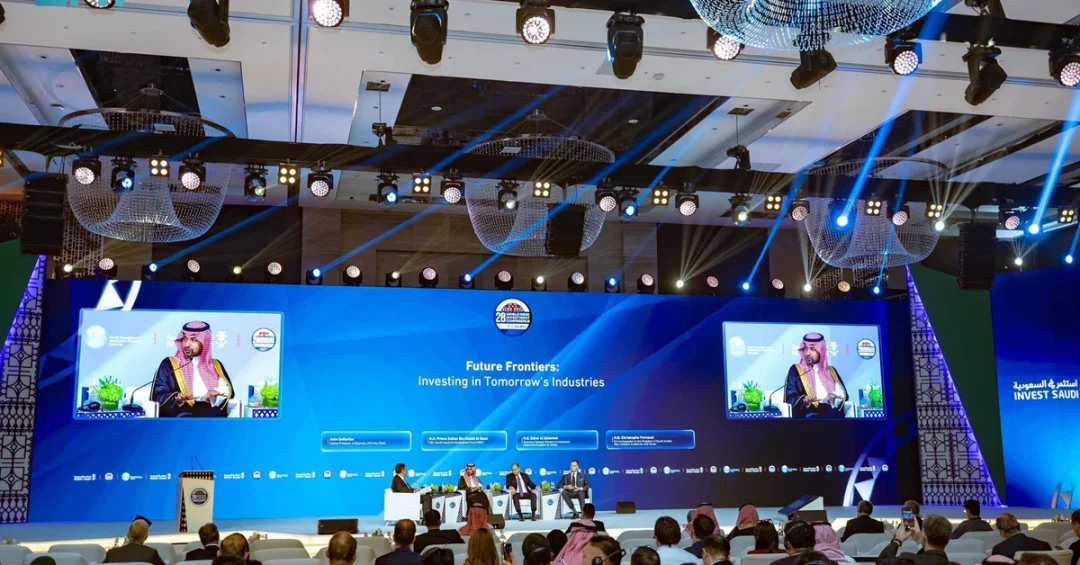
Saudi Arabia announced nine new investment agreements valued at more than SAR35 billion on the second day of the 28th World Investment Conference in Riyadh, reinforcing the Kingdom’s position as a global hub for advanced manufacturing and sustainable supply chains. The agreements, unveiled under the framework of the National Initiative for Global Supply Chains, were signed during the conference organized by Invest Saudi in partnership with the World Association of Investment Promotion Agencies (WAIPA). The conference is being held under the theme “Harnessing Digital Transformation and Sustainable Growth: Scaling Investment Opportunities,” and the announcements mark a significant step in Saudi Arabia’s efforts to diversify its economy and attract high-value international investment.
Why does this matter to the global economy? The agreements cover strategic sectors including copper smelting and refining, advanced titanium production, rare earth processing, renewable energy, and aluminum manufacturing. They involve major international companies such as Vedanta, AMEC, Tasnee, Hastings, Red Sea Aluminum, GlassPoint, and Zijin Group Co. Together, these projects aim to enhance sustainability, secure access to essential materials, and support local manufacturing, while solidifying Saudi Arabia’s comprehensive and sustainable participation in global supply chains. The deals underscore the Kingdom’s rising prominence in sectors critical to the global energy transition and technological advancement.
Context and Background
What has driven Saudi Arabia to become such a magnet for international investment? The answer lies in the Kingdom’s long-term strategic vision and its ongoing economic transformation. The National Initiative for Global Supply Chains, launched as part of Saudi Vision 2030, is designed to position the Kingdom as a pivotal link in global trade and manufacturing networks. By attracting foreign direct investment and fostering partnerships with leading global firms, Saudi Arabia aims to reduce its reliance on oil revenues and build a resilient, knowledge-based economy. The World Investment Conference, now in its 28th edition, serves as a premier platform for showcasing these opportunities to the world.
The conference is organized by Invest Saudi, the Kingdom’s investment promotion agency, in collaboration with WAIPA, which represents investment promotion agencies from around the globe. This partnership highlights Saudi Arabia’s commitment to international cooperation and its proactive approach to engaging with global investors. The theme of this year’s conference, focusing on digital transformation and sustainable growth, aligns closely with the Kingdom’s broader goals of embracing technology and promoting environmentally responsible development. The nine agreements announced on the second day are a direct outcome of these efforts, demonstrating the tangible results of Saudi Arabia’s outreach to the international business community.
Historically, Saudi Arabia has been known primarily for its energy exports, but in recent years it has rapidly expanded its industrial base. The Kingdom has invested heavily in infrastructure, regulatory reforms, and incentives to attract foreign companies. The establishment of special economic zones, the introduction of new investment laws, and the streamlining of business registration processes have all contributed to a more favorable investment climate. The agreements signed at the World Investment Conference are a testament to the success of these measures, as they bring together some of the world’s most innovative companies in fields that are essential to the future global economy.
Key Details of the Agreements
What exactly do these nine agreements entail, and which companies are involved? The agreements cover a diverse range of projects, each designed to fill critical gaps in global supply chains and to leverage Saudi Arabia’s competitive advantages. One of the most prominent deals is with Vedanta, a leading natural resources company, for copper smelting and refining facilities. Copper is a vital component in electrical wiring, renewable energy systems, and electric vehicles, and demand for it is expected to soar in the coming decades. By establishing smelting and refining capacity within the Kingdom, Saudi Arabia aims to become a key supplier of this essential metal, reducing reliance on distant sources and enhancing supply chain resilience.
Another major agreement involves AMEC and Tasnee for advanced titanium projects. Titanium is prized for its strength, lightness, and corrosion resistance, making it indispensable in aerospace, medical implants, and high-performance industrial applications. The partnership with AMEC, a global engineering and project management firm, and Tasnee, a Saudi industrial giant, will bring cutting-edge technology and expertise to the Kingdom. This project not only supports local manufacturing but also positions Saudi Arabia as a producer of high-value titanium products for export markets. Additionally, an agreement with Hastings Technology Metals will focus on processing facilities for rare earth substances. Rare earth elements are critical for magnets used in wind turbines, electric vehicle motors, and consumer electronics, and their processing has traditionally been concentrated in a few countries. Saudi Arabia’s entry into this sector will diversify global supply and create new economic opportunities.
Further agreements include Red Sea Aluminum, which will likely expand the Kingdom’s aluminum production capacity, and GlassPoint, a company specializing in solar energy solutions for industrial processes. GlassPoint’s technology uses solar power to generate steam for industrial applications, which can significantly reduce carbon emissions from manufacturing. This aligns with Saudi Arabia’s sustainability goals and its commitment to renewable energy. The involvement of Zijin Group Co., a major Chinese mining and metals company, adds another dimension to the agreements, highlighting the growing economic ties between Saudi Arabia and China. These projects collectively represent a strategic bet on the industries that will power the global economy in the 21st century.
International and Regional Impact
How will these agreements affect the broader Middle East and the world? The investments signal a shift in global supply chain dynamics, with Saudi Arabia emerging as a new hub for processing and manufacturing. For the Middle East region, this could spur similar initiatives in neighboring countries, fostering economic integration and cooperation. The projects also strengthen Saudi Arabia’s role as a bridge between Asia, Europe, and Africa, leveraging its geographic location and world-class infrastructure. International companies involved in these deals gain access to the Kingdom’s growing market, its skilled workforce, and its strategic position along key trade routes. This mutually beneficial arrangement is likely to attract further investment and deepen economic ties.
From a global perspective, the agreements contribute to the diversification of supply chains for critical materials. Recent disruptions, including the COVID-19 pandemic and geopolitical tensions, have exposed the risks of over-concentration in certain regions. By developing new sources of copper, titanium, rare earths, and aluminum, Saudi Arabia helps to create a more resilient and secure global supply network. This is particularly important as the world transitions to clean energy, which requires vast amounts of these materials. The Kingdom’s commitment to sustainable practices, as evidenced by the involvement of companies like GlassPoint, ensures that this growth is aligned with environmental goals.
Economic and Strategic Significance
What do these investments mean for Saudi Arabia’s economy and its strategic ambitions? The SAR35 billion in agreements represents a significant inflow of foreign capital and a vote of confidence in the Kingdom’s economic reforms. They are expected to create jobs, transfer technology, and stimulate ancillary industries. The projects will require skilled workers, from engineers to technicians, and will likely lead to training programs and knowledge transfer. This aligns with the Vision 2030 goal of increasing the private sector’s contribution to GDP and reducing unemployment. Moreover, by moving into higher-value segments of the value chain, Saudi Arabia is positioning itself as a producer of advanced materials rather than just a raw material exporter.
Strategically, these agreements reduce the Kingdom’s vulnerability to oil price fluctuations and enhance its economic sovereignty. They also strengthen Saudi Arabia’s geopolitical standing by making it an indispensable partner in global supply chains. Countries and companies around the world will rely on Saudi-produced copper, titanium, and rare earths, giving the Kingdom greater influence in international affairs. The involvement of Chinese, Indian, and Western companies also demonstrates Saudi Arabia’s ability to balance relationships with major powers and to serve as a neutral and reliable business hub. This strategic diversification is a cornerstone of the Kingdom’s long-term security and prosperity.
Vision 2030 Alignment
How do these agreements fit into the broader Vision 2030 framework? Vision 2030, launched in 2016 under the leadership of Crown Prince Mohammed bin Salman, aims to transform Saudi Arabia into a diversified, innovative, and globally connected economy. The National Initiative for Global Supply Chains is a key pillar of this vision, designed to localize industries, attract foreign investment, and create sustainable jobs. The nine agreements announced at the World Investment Conference directly support these objectives by bringing in world-class companies and cutting-edge technologies. They also align with the vision’s emphasis on sustainability and digital transformation, as many of the projects incorporate renewable energy and advanced processing techniques.
Furthermore, these investments contribute to the Kingdom’s goal of becoming a leader in the industries of the future. By developing capabilities in copper, titanium, rare earths, and aluminum, Saudi Arabia is building the foundation for a modern industrial economy. This will not only create economic value but also enhance the Kingdom’s ability to innovate and compete on a global scale. The successful execution of these agreements will serve as a model for future investment initiatives and will reinforce Saudi Arabia’s reputation as a premier destination for global business. As the World Investment Conference continues, the announcements made on the second day stand as a clear demonstration of the Kingdom’s progress and its unwavering commitment to a prosperous and sustainable future.
20 Questions
Q1. What is the World Investment Conference and where is it being held?
A1. The World Investment Conference is an annual event that brings together global investors, policymakers, and business leaders. The 28th edition is being held in Riyadh, Saudi Arabia, under the theme “Harnessing Digital Transformation and Sustainable Growth: Scaling Investment Opportunities.”
Q2. Who organized the 28th World Investment Conference?
A2. The conference is organized by Invest Saudi, the Kingdom’s investment promotion agency, in partnership with the World Association of Investment Promotion Agencies (WAIPA). This collaboration highlights Saudi Arabia’s commitment to international investment cooperation.
Q3. How many investment agreements were announced on the second day?
A3. Nine investment agreements were announced on the second day of the conference. These agreements are valued at over SAR35 billion and are part of the National Initiative for Global Supply Chains.
Q4. What is the total value of the agreements announced?
A4. The agreements are valued at more than SAR35 billion. This significant investment underscores the confidence global companies have in Saudi Arabia’s economic reforms and business environment.
Q5. Which companies are involved in the copper smelting and refining project?
A5. Vedanta, a leading natural resources company, is involved in the copper smelting and refining project. This project aims to establish essential capacity within Saudi Arabia to supply copper for renewable energy and electric vehicles.
Q6. What is the significance of the titanium project with AMEC and Tasnee?
A6. The titanium project with AMEC and Tasnee will bring advanced titanium production to Saudi Arabia. Titanium is critical for aerospace, medical, and industrial applications, and this project supports local manufacturing and high-value exports.
Q7. What role does Hastings play in the agreements?
A7. Hastings Technology Metals will focus on processing facilities for rare earth substances. Rare earth elements are essential for wind turbines, electric vehicle motors, and electronics, and this project diversifies global supply.
Q8. Which other companies are mentioned in the agreements?
A8. Other companies include Red Sea Aluminum, GlassPoint, and Zijin Group Co. These companies are involved in aluminum production, solar energy for industrial processes, and mining and metals, respectively.
Q9. What is GlassPoint’s contribution to the agreements?
A9. GlassPoint specializes in solar energy solutions for industrial processes. Its involvement aligns with Saudi Arabia’s sustainability goals by reducing carbon emissions from manufacturing through solar-generated steam.
Q10. How do these agreements support Saudi Arabia’s economy?
A10. The agreements will strengthen Saudi Arabia’s economy by attracting foreign investment, creating jobs, transferring technology, and supporting local manufacturing. They also enhance the Kingdom’s participation in global supply chains.
Q11. What is the National Initiative for Global Supply Chains?
A11. The National Initiative for Global Supply Chains is a Saudi Vision 2030 program designed to position the Kingdom as a key link in global trade and manufacturing. It aims to localize industries and attract foreign investment.
Q12. How do these agreements contribute to sustainability?
A12. The agreements contribute to sustainability by securing access to essential materials for clean energy technologies, such as copper for renewable energy systems and rare earths for wind turbines, and by incorporating solar energy solutions like those from GlassPoint.
Q13. What is the strategic importance of rare earth processing?
A13. Rare earth processing is strategically important because these elements are critical for modern technologies, including electric vehicles and electronics. Saudi Arabia’s entry into this sector diversifies global supply and reduces reliance on a few sources.
Q14. How does this align with Vision 2030?
A14. These agreements align with Vision 2030 by supporting economic diversification, attracting foreign investment, creating jobs, and developing high-value industries. They are a direct outcome of the Kingdom’s efforts to transform its economy.
Q15. What impact will these agreements have on global supply chains?
A15. The agreements will enhance global supply chain resilience by developing new sources of critical materials like copper, titanium, and rare earths. This reduces risks associated with over-concentration and supports the global energy transition.
Q16. Which countries are the companies based in?
A16. The companies involved come from various countries, including India (Vedanta), the United Kingdom (AMEC), Australia (Hastings), the United States (GlassPoint), and China (Zijin Group Co.), reflecting Saudi Arabia’s global investment outreach.
Q17. What is the expected timeline for these projects?
A17. Specific timelines were not detailed in the announcement, but such projects typically involve multi-year development phases. The agreements mark the beginning of a process that will include planning, construction, and operation.
Q18. How will these agreements create jobs in Saudi Arabia?
A18. The projects will require a range of skilled and semi-skilled workers, from engineers and technicians to construction and operational staff. They are expected to stimulate training programs and knowledge transfer, creating sustainable employment.
Q19. What does this mean for Saudi Arabia’s global standing?
A19. These agreements enhance Saudi Arabia’s global standing as a reliable investment destination and a key player in critical industries. They demonstrate the Kingdom’s ability to attract top international companies and to contribute to global economic stability.
Q20. What is the next step after these announcements?
A20. The next steps involve finalizing the agreements, initiating project development, and ensuring implementation aligns with Saudi Vision 2030 goals. The World Investment Conference continues to facilitate further partnerships and investment opportunities.
Reader Feedback
We value your thoughts. Please share your feedback on this article.
Your feedback helps us improve our coverage.
Related articles
 AgroFood Jeddah Exhibition Set to Begin Next Week
 AgroFood Jeddah Showcases Latest Agriculture Technologies
 SEDA Leads 35 Saudi Firms at Food Africa in Cairo
 Third Zakat, Tax, and Customs Conference 2024 Kicks off in Riyadh
 GCC Chief Meets Jordan Investment Minister at Dead Sea Conference
 Hail Region: SAR 72.3 Billion Mineral Wealth Hub