


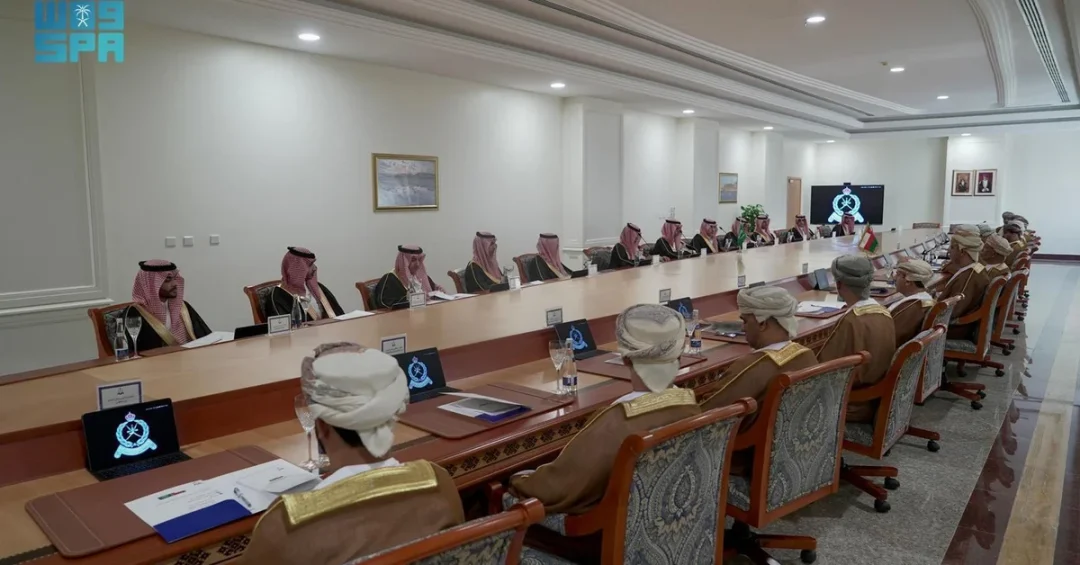
The security and justice coordination committee of the Saudi-Omani Coordination Council convened on Tuesday, November 26, 2024, in Muscat, Oman, bringing together senior officials from both nations to advance bilateral cooperation in security and judicial affairs. The meeting was chaired jointly by Dr. Hisham bin Abdulrahman Al-Faleh, Assistant Minister of Interior of the Kingdom of Saudi Arabia, and Major General Abdullah Ali Al Harthy, Assistant Inspector General of Police and Customs Operations for the Sultanate of Oman, according to the Saudi Press Agency (SPA).
The discussions, held in the Omani capital, covered a broad range of topics and initiatives listed on the committee’s agenda, all aimed at deepening security and justice coordination between the two fraternal nations. The gathering marks another step in the ongoing institutionalization of Saudi-Omani relations under the umbrella of the Saudi-Omani Coordination Council, a bilateral framework established to translate high-level political will into practical cooperation across multiple sectors. For observers of Gulf affairs, the meeting signals the continued momentum of a partnership that has become increasingly central to regional stability and economic integration.
Context and Background
How did the Saudi-Omani Coordination Council come to play such a pivotal role in bilateral relations? The council was established to provide a structured platform for cooperation between Riyadh and Muscat, reflecting the deep historical, cultural, and geographic ties that bind the two countries. Over the years, the council has spawned specialized committees—including the security and justice coordination committee—that meet periodically to review progress and chart new initiatives. These committees are not merely symbolic; they are working bodies that develop actionable programs in areas such as border security, counterterrorism, legal assistance, and capacity building.
The November 26 meeting in Muscat is part of this regular cycle of engagement. It follows a series of high-level exchanges between Saudi and Omani officials, including visits by ministers and security chiefs, and builds on agreements reached at previous council sessions. The presence of Dr. Al-Faleh, a senior figure at the Saudi Ministry of Interior, and Major General Al Harthy, a top Omani police and customs official, underscores the importance both governments attach to operational-level coordination. Their discussions are expected to feed into broader council deliberations and ultimately into policy recommendations for their respective leaderships.
For an international audience, it is important to understand that the Saudi-Omani Coordination Council is one of several bilateral mechanisms Saudi Arabia has established with its Gulf neighbors. These platforms are designed to align policies, share expertise, and pool resources in pursuit of shared objectives—foremost among them regional security, economic diversification, and sustainable development. The security and justice committee, in particular, addresses matters that directly affect the safety and well-being of citizens and residents in both countries, from combating transnational crime to facilitating cross-border legal cooperation.
Key Details of the Muscat Meeting
What exactly was on the agenda when these senior officials met in Muscat? According to the official SPA report, the discussions encompassed various topics and initiatives outlined on the committee’s agenda for security and justice coordination between the two fraternal nations. While the specifics of each agenda item were not disclosed in the initial announcement, the scope of the committee’s mandate suggests that the talks likely covered areas such as joint security training, information sharing, judicial assistance, and the harmonization of legal procedures.
The meeting was presided over by Dr. Hisham bin Abdulrahman Al-Faleh, who has represented the Saudi Ministry of Interior in numerous bilateral and multilateral forums, and Major General Abdullah Ali Al Harthy, a seasoned Omani officer responsible for police and customs operations. Their leadership of the committee reflects the operational focus of the body, which seeks to translate strategic directives into concrete actions on the ground. The fact that the meeting took place in Muscat highlights Oman’s active role in hosting and facilitating these discussions, consistent with its longstanding tradition of quiet diplomacy and regional bridge-building.
Both officials reiterated their commitment to strengthening the bonds of cooperation and to implementing the directives of their respective leaderships. The meeting concluded with a set of recommendations and a renewed work plan for the coming period, although the details of these outcomes are expected to be communicated through official channels in due course. Such outcomes typically include timelines for joint exercises, exchanges of experts, and the establishment of technical working groups to address specific challenges.
International and Regional Impact
Why should the international community pay attention to a bilateral committee meeting in Muscat? The answer lies in the broader geopolitical context of the Gulf region and beyond. Saudi Arabia and Oman are two of the most influential members of the Gulf Cooperation Council (GCC), and their cooperation on security and justice matters has ripple effects across the region. A stable, secure Gulf is essential for global energy supplies, maritime trade, and the fight against terrorism and organized crime. By institutionalizing their coordination, Riyadh and Muscat contribute to a more predictable and resilient regional security architecture.
Moreover, the Saudi-Omani partnership serves as a model for how neighboring countries can resolve differences and build trust through dialogue and practical collaboration. Oman’s unique diplomatic position—maintaining open channels with a wide range of regional and international actors—complements Saudi Arabia’s role as a regional leader and economic powerhouse. Together, they can address shared challenges such as smuggling, cybercrime, and extremism more effectively than they could alone. The Muscat meeting thus sends a positive signal to the international community that Gulf states are committed to working together for peace and stability.
From a global perspective, enhanced Saudi-Omani security and justice cooperation also supports international efforts to combat money laundering, terrorist financing, and human trafficking. Both countries have been strengthening their legal and regulatory frameworks in line with international standards, and their collaboration can help ensure that the region does not become a safe haven for illicit activities. Multinational corporations, investors, and travelers all benefit from a more secure and transparent environment, which in turn fosters economic growth and cross-cultural exchange.
Economic and Strategic Significance
What does security and justice coordination have to do with economic prosperity? In today’s interconnected world, security is a prerequisite for investment, trade, and tourism. Saudi Arabia’s Vision 2030 reform agenda aims to diversify the economy away from oil, attract foreign direct investment, and boost sectors such as tourism and entertainment. None of these goals can be achieved without a stable and secure environment. By working closely with Oman on border security, customs procedures, and legal cooperation, Saudi Arabia is laying the groundwork for smoother trade flows and more reliable protection of investments.
Oman, for its part, is implementing its own long-term development plan, Oman Vision 2040, which shares many objectives with Saudi Vision 2030, including economic diversification, private sector growth, and improved governance. The synergy between these national visions creates a natural basis for cooperation. The security and justice committee’s work can help remove obstacles to cross-border business, such as delays at border crossings or legal uncertainties, by streamlining procedures and enhancing mutual trust. As Saudi Arabia develops mega-projects like NEOM and the Red Sea Project, and Oman invests in its ports and free zones, the need for seamless security and legal coordination will only grow.
Strategically, the Saudi-Omani axis is also important for the stability of the broader Middle East. Both countries have played constructive roles in regional dialogues and conflict resolution efforts. Their ability to coordinate on security matters strengthens their collective influence and enables them to contribute more effectively to international peace initiatives. For global powers with interests in the Gulf, the deepening of this partnership is a welcome development that reinforces the rules-based order and supports diplomatic solutions to regional crises.
Vision 2030 Alignment
How does the work of the Saudi-Omani security and justice committee align with Saudi Arabia’s Vision 2030? Vision 2030 is not solely an economic blueprint; it also encompasses social, cultural, and governance reforms, including the enhancement of public safety and the rule of law. A secure society is one of the foundational pillars of the vision, and international cooperation is essential to achieving it. By strengthening ties with Oman, Saudi Arabia is building a network of reliable partners who share its commitment to stability, moderation, and prosperity.
Furthermore, the meeting in Muscat exemplifies the vision’s emphasis on proactive diplomacy and regional leadership. Saudi Arabia under the guidance of its leadership is keen to foster an environment where neighboring countries can thrive together. The security and justice committee’s outcomes will contribute to a safer region, which in turn will help attract the investment and talent needed to realize Vision 2030’s ambitious targets. As the Kingdom continues its transformation, partnerships like the one with Oman will remain indispensable.
20 Questions
Q1. What was the main purpose of the Saudi-Omani Coordination Council’s security and justice committee meeting in Muscat?
A1. The meeting aimed to discuss topics and initiatives on the committee’s agenda for security and justice coordination between Saudi Arabia and Oman, as part of ongoing efforts to strengthen bilateral cooperation under the Saudi-Omani Coordination Council.
Q2. Who chaired the meeting from the Saudi side?
A2. Dr. Hisham bin Abdulrahman Al-Faleh, Assistant Minister of Interior of the Kingdom of Saudi Arabia, chaired the meeting from the Saudi side, representing the Ministry of Interior and leading the discussions on security and justice matters.
Q3. Who represented Oman at the meeting?
A3. Major General Abdullah Ali Al Harthy, Assistant Inspector General of Police and Customs Operations for Oman, represented the Sultanate, bringing his extensive experience in security and customs operations to the discussions.
Q4. Where and when did the meeting take place?
A4. The meeting convened on Tuesday, November 26, 2024, in Muscat, the capital of Oman, according to the Saudi Press Agency (SPA).
Q5. What is the Saudi-Omani Coordination Council?
A5. The Saudi-Omani Coordination Council is a bilateral framework established to enhance cooperation between the two countries across various sectors, including security, justice, economy, and culture, through specialized committees and regular meetings.
Q6. What topics were discussed at the meeting?
A6. The discussions encompassed various topics and initiatives outlined on the committee’s agenda for security and justice coordination, though specific details were not disclosed in the initial announcement.
Q7. Why is security and justice coordination important for Saudi Arabia and Oman?
A7. It is crucial for maintaining regional stability, combating transnational crime, facilitating legal cooperation, and creating a secure environment that supports economic growth and investment in both countries.
Q8. How does this meeting relate to Saudi Vision 2030?
A8. The meeting supports Vision 2030’s goals by enhancing public safety and the rule of law, which are essential for economic diversification, attracting investment, and improving the quality of life for citizens and residents.
Q9. What are the expected outcomes of the meeting?
A9. The meeting concluded with recommendations and a work plan for future cooperation, which will be implemented through joint initiatives and technical working groups, as is typical for such committee meetings.
Q10. How often do these committee meetings occur?
A10. The security and justice committee meets periodically, as part of the regular cycle of engagement under the Saudi-Omani Coordination Council, to review progress and set new goals for bilateral cooperation.
Q11. What is the significance of the meeting being held in Muscat?
A11. Holding the meeting in Muscat highlights Oman’s active role in hosting and facilitating bilateral discussions, and reflects the strong and balanced partnership between the two nations.
Q12. How does this cooperation benefit the broader Gulf region?
A12. It contributes to regional security and stability, setting a positive example of neighborly cooperation that can inspire other Gulf states to enhance their own collaborative efforts.
Q13. What role does the Saudi Ministry of Interior play in these discussions?
A13. The Ministry of Interior leads Saudi Arabia’s efforts in security and justice coordination, with Dr. Al-Faleh representing the Kingdom and ensuring that the outcomes align with national priorities and Vision 2030.
Q14. What is Oman Vision 2040 and how does it relate to this cooperation?
A14. Oman Vision 2040 is Oman’s long-term development plan, which shares objectives with Saudi Vision 2030, such as economic diversification and improved governance, creating a natural basis for collaboration in security and justice.
Q15. Are there any joint security initiatives between Saudi Arabia and Oman?
A15. Yes, the two countries have undertaken various joint initiatives, including training programs, information sharing, and coordinated efforts to combat smuggling and other transnational crimes, though details are often not publicized.
Q16. How does this meeting impact international investors and travelers?
A16. Enhanced security and justice cooperation creates a safer and more predictable environment, which can boost investor confidence and make travel between the two countries more secure and efficient.
Q17. What other sectors does the Saudi-Omani Coordination Council cover?
A17. The council covers a wide range of sectors, including economy, trade, investment, culture, education, tourism, and health, reflecting the comprehensive nature of the bilateral relationship.
Q18. Will there be follow-up meetings or actions?
A18. Yes, the committee’s work is ongoing, and follow-up meetings and actions are expected as part of the council’s regular schedule, ensuring continuous progress on agreed initiatives.
Q19. How does this meeting reflect Saudi Arabia’s diplomatic approach?
A19. It demonstrates Saudi Arabia’s commitment to proactive diplomacy, regional leadership, and building strong partnerships based on mutual respect and shared interests, in line with Vision 2030.
Q20. What message does this meeting send to the international community?
A20. It signals that Saudi Arabia and Oman are dedicated to working together for peace, security, and prosperity, and that the Gulf region remains a stable and cooperative environment for global engagement.
Reader Feedback
We value your thoughts. Please share your feedback on this article.
Your feedback helps us improve our coverage.
Related articles
 King Salman Calls for Istisqa Prayer Across Saudi Arabia Thursday
 Saudi Vice Minister Joins 10th UNAOC Global Forum in Lisbon
 Saudi Vice Foreign Minister Meets Russian Counterpart in Lisbon
 Civil Defense: Thunderstorms to Continue in Most Saudi Regions Until Sunday
 6.6-Magnitude Earthquake Hits Ishikawa, Japan: No Tsunami Warning
 Saudi Arabia Weather Forecast for Wednesday: Rain, Dust, and Cooler Temperatures