


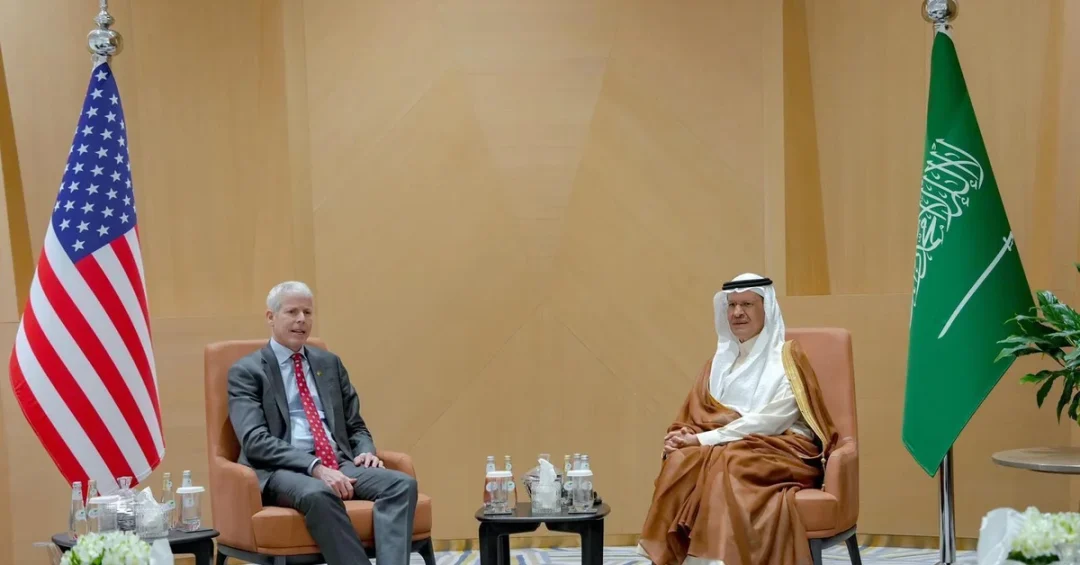
Saudi Arabia’s Minister of Energy, Prince Abdulaziz bin Salman bin Abdulaziz, received U.S. Secretary of Energy Chris Wright and his accompanying delegation on Saturday at the King Abdullah Petroleum Studies and Research Center (KAPSARC) in Riyadh, in a high-level engagement that underscores the depth of the energy partnership between the Kingdom and the United States. The meeting, reported by the Saudi Press Agency (SPA), formed part of Wright’s official visit to the Kingdom and placed research collaboration, energy policy, and the global energy transition at the center of bilateral discussion.
The encounter at KAPSARC reflects a shared recognition that the world’s most pressing energy questions — from decarbonization pathways to the resilience of global supply chains — demand rigorous, evidence-based analysis. By convening at the Kingdom’s flagship energy research institution, both sides signaled that the relationship between Riyadh and Washington extends well beyond the trading of barrels and megawatts into the exchange of knowledge, data, and scientific expertise. Could there be a more fitting venue for such a conversation than a center built to translate research into practical policy solutions?
Context and Background
The King Abdullah Petroleum Studies and Research Center, founded in 2010, has established itself as one of the region’s preeminent independent energy research institutions. During the visit, Secretary Wright was briefed on the Center’s role in advancing research across energy policy, energy transition, climate change, and sustainable transport, as well as its advisory services. The delegation also learned how KAPSARC develops analytical models and tools that contribute to addressing current challenges in the energy sector — capabilities that have made the Center a respected voice in global energy discourse.
Why does this institutional dimension matter so much? Because modern energy diplomacy is no longer confined to production quotas and price negotiations. It increasingly hinges on the capacity to model complex systems, anticipate market shifts, and design policy frameworks that balance economic growth with environmental responsibility. KAPSARC’s work sits precisely at this intersection, providing both Saudi decision-makers and international partners with the evidence base needed to navigate an era of rapid energy transformation. For an international audience, the visit offers a window into how the Kingdom is positioning research and data as instruments of statecraft.
The Saudi-U.S. energy relationship itself has long been a cornerstone of global energy stability, evolving from its historical roots in oil markets toward a broader agenda that encompasses clean technology, carbon management, and research cooperation. The meeting between Prince Abdulaziz bin Salman and Secretary Wright therefore builds on decades of engagement while pointing toward a more diversified and knowledge-intensive partnership. Isn’t it significant that two of the world’s most influential energy players are investing their diplomatic capital in the laboratory as much as the boardroom?
Details of the Visit and Areas of Collaboration
The discussions at KAPSARC, as reported by SPA, focused on opportunities for collaboration in energy research, knowledge exchange, and the enhancement of joint research efforts. These are not abstract themes. They touch on concrete questions such as how to model the integration of renewable sources into national grids, how to assess the lifecycle emissions of various fuels, and how to design policies that support both affordability and sustainability. The exchange of analytical tools and methodologies between Saudi and American researchers can accelerate progress on all of these fronts.
The briefing on KAPSARC’s work in sustainable transport deserves particular attention. As economies worldwide grapple with the decarbonization of mobility, the Kingdom has made significant investments in alternative transport fuels, hydrogen development, and efficient mobility systems. A research partnership with the United States — a leader in transportation technology and policy — could help translate these ambitions into practical, scalable solutions. What could joint Saudi-U.S. research achieve that neither country might accomplish alone?
The meeting also reinforced the importance of knowledge exchange as a two-way street. Saudi researchers have developed sophisticated capabilities in energy economics and policy modeling, while U.S. institutions bring deep expertise in technology innovation and market design. By enhancing joint research efforts, both sides can combine their complementary strengths. The engagement at KAPSARC thus represents a commitment to institutionalize cooperation, ensuring that collaboration endures beyond any single visit or administration. How often do diplomatic meetings produce lasting scientific infrastructure rather than merely communiqués?
International and Regional Impact
The timing of this engagement carries weight for global energy markets. As the world navigates questions of energy security, price volatility, and the pace of the transition to lower-carbon systems, coordination between major producers and major consumers is essential. The United States, as the world’s largest economy and a significant energy producer in its own right, and Saudi Arabia, as the leading exporter and a stabilizing force in global oil markets, share a profound interest in orderly, well-informed energy policy. The Riyadh meeting signals continuity in that coordination at a moment when predictability is especially valuable to markets and policymakers alike.
Regionally, the visit underscores the Kingdom’s position as a convening power in the energy domain. KAPSARC regularly hosts international delegations, scholars, and industry leaders, and its role as a platform for dialogue enhances Saudi Arabia’s soft power and intellectual leadership. For neighboring states and emerging economies, the model of pairing production strength with research excellence offers a template worth studying. Does this not demonstrate how a resource-rich nation can convert its endowment into durable knowledge capital?
The collaboration also aligns with broader multilateral efforts on climate change. Saudi Arabia has consistently advocated for a balanced approach to the energy transition — one that recognizes the continued role of hydrocarbons in the global mix while investing in cleaner technologies, circular carbon economy frameworks, and emissions reduction. Working with the United States on research and analysis strengthens the evidentiary foundation for these positions in international forums. The visit therefore has implications that extend well beyond the bilateral relationship into the realm of global climate governance.
Economic and Strategic Significance
For Saudi Arabia, the meeting reflects the strategic logic at the heart of its energy policy: diversifying partnerships, deepening technical capabilities, and positioning the Kingdom as a hub for energy knowledge. The economic significance is tangible. Research collaboration can attract talent, catalyze innovation, and support the growth of new industries — from hydrogen and carbon capture to energy-efficient transport. Each of these sectors has the potential to create jobs and generate value for the Saudi economy as it diversifies away from oil dependence.
The strategic dimension is equally important. In an era of geopolitical competition over critical technologies and resources, research partnerships are a form of alliance-building. By engaging with the United States at the highest levels of energy leadership, Saudi Arabia reinforces a relationship that spans security, commerce, and innovation. The visit by Secretary Wright, which included his briefing on KAPSARC’s models and tools, also serves to build mutual understanding among decision-makers on both sides. Isn’t that the kind of trust that makes long-term cooperation possible?
Moreover, the focus on knowledge exchange and joint research efforts supports the development of human capital — a priority that resonates with the Kingdom’s broader ambitions. Saudi researchers, analysts, and students who participate in collaborative projects with American counterparts gain exposure to international best practices and cutting-edge methods. Over time, these exchanges build a cadre of skilled professionals capable of leading the Kingdom’s energy institutions into the future, strengthening domestic capacity while enhancing Saudi Arabia’s contributions to global energy scholarship.
Vision 2030 Alignment
The engagement at KAPSARC fits squarely within the objectives of Saudi Vision 2030, the Kingdom’s comprehensive strategy for economic diversification, social development, and international engagement. Vision 2030 emphasizes the importance of research and innovation, the development of a knowledge-based economy, and the cultivation of global partnerships — all of which were reflected in the discussions between Prince Abdulaziz bin Salman and Secretary Wright. By championing energy research and knowledge exchange, the Kingdom is investing in the intellectual infrastructure that will sustain its leadership in energy for decades to come.
The visit also reinforces Saudi Arabia’s commitment to being a constructive partner in addressing global challenges, in line with Vision 2030’s emphasis on responsible global citizenship and sustainability. Through institutions like KAPSARC, the Kingdom contributes data, analysis, and policy insight to the international conversation on energy transition and climate action. As the world looks for credible pathways toward a sustainable energy future, Saudi Arabia is positioning itself not merely as a participant but as a source of solutions. Where better to see that ambition in action than in a research center dedicated to the questions that will define the coming decades?
In bringing together the Saudi and U.S. energy leadership at KAPSARC, the meeting exemplifies the collaborative, forward-looking spirit that defines Vision 2030. It demonstrates that the Kingdom’s energy story is increasingly one of innovation, research, and partnership — a narrative that serves both national ambitions and the global common good. How else could a nation secure its future in a transforming world than by investing in knowledge, building trust across borders, and leading through ideas?
20 Questions
Q1. Who received U.S. Secretary of Energy Chris Wright at KAPSARC?
A1. Saudi Arabia’s Minister of Energy, Prince Abdulaziz bin Salman bin Abdulaziz, received Secretary Wright and his accompanying delegation at the King Abdullah Petroleum Studies and Research Center in Riyadh.
Q2. When did the meeting take place?
A2. The meeting took place on Saturday, and it formed part of Secretary Wright’s official visit to the Kingdom, as reported by the Saudi Press Agency.
Q3. Where is KAPSARC located?
A3. KAPSARC is located in Riyadh, Saudi Arabia, and serves as the Kingdom’s leading independent energy research institution, hosting international delegations and research partnerships.
Q4. What was Secretary Wright briefed on during the visit?
A4. He was briefed on KAPSARC’s role in advancing research in energy policy, energy transition, climate change, sustainable transport, and advisory services.
Q5. What kinds of tools does KAPSARC develop?
A5. KAPSARC develops analytical models and tools that contribute to addressing current challenges in the energy sector, supporting evidence-based policymaking.
Q6. What topics were discussed at the meeting?
A6. The discussions covered opportunities for collaboration in energy research, knowledge exchange, and enhancing joint research efforts between the two sides.
Q7. Why is KAPSARC significant in energy research?
A7. KAPSARC has become a respected global voice in energy discourse, developing analytical capabilities that help decision-makers navigate energy transition and policy challenges.
Q8. What role does the Saudi-U.S. energy relationship play globally?
A8. The Saudi-U.S. energy relationship has long been a cornerstone of global energy stability, now expanding toward clean technology, carbon management, and research cooperation.
Q9. What does the visit indicate about Saudi energy diplomacy?
A9. The visit shows that Saudi energy diplomacy increasingly focuses on knowledge exchange and research collaboration, beyond traditional production and pricing discussions.
Q10. How does research collaboration benefit both countries?
A10. It combines Saudi expertise in energy economics and policy modeling with American strengths in technology innovation and market design, accelerating practical solutions.
Q11. Why does sustainable transport feature in the discussions?
A11. Sustainable transport is a key area of KAPSARC’s research, and Saudi Arabia has invested in hydrogen, alternative fuels, and efficient mobility systems.
Q12. What is the significance of knowledge exchange in this meeting?
A12. Knowledge exchange ensures collaboration is a two-way street, building mutual understanding and institutionalizing cooperation beyond any single diplomatic visit.
Q13. How does the meeting relate to global energy markets?
A13. Coordination between major producers and consumers supports energy security, price stability, and orderly transition, which is valuable yet to markets and policymakers.
Q14. What regional role does KAPSARC play?
A14. KAPSARC serves as a convening platform for international delegations and scholars, enhancing Saudi Arabia’s intellectual leadership and soft power in the energy domain.
Q15. How does the visit connect to climate change efforts?
A15. The collaboration strengthens the evidentiary foundation for Saudi Arabia’s balanced approach to the energy transition, including circular carbon economy frameworks and emissions reduction.
Q16. What economic benefits can research collaboration bring?
A16. It can attract talent, catalyze innovation, and support new industries such as hydrogen and carbon capture, creating jobs and value for the Saudi economy.
Q17. Why is human capital development important here?
A17. Saudi researchers and students gain exposure to international best practices and cutting-edge methods, building a skilled cadre for the Kingdom’s energy institutions.
Q18. How does the meeting align with Vision 2030?
A18. It reflects Vision 2030’s emphasis on research, innovation, knowledge-based economy, and global partnerships, investing in intellectual infrastructure for future leadership.
Q19. What does the visit say about Saudi Arabia’s global role?
A19. It shows the Kingdom positioning itself as a source of solutions, contributing data, analysis, and policy insight to international conversations on energy and climate.
Q20. What overall message does the KAPSARC meeting convey?
A20. It conveys that the Saudi-U.S. energy partnership is increasingly knowledge-intensive, collaborative, and forward-looking, supporting both national ambitions and the global common good.
Reader Feedback
We value your thoughts. Please share your feedback on this article.
Your feedback helps us improve our coverage.
Related articles
 KSGAAL, NAVA, Ministry Launch EV Dictionary in Riyadh
 FEI Praises Saudi Arabia’s Successful Riyadh Tour for Arabian Horses
 SIRC Showcases Saudi Leadership in Marine Environmental Protection at Interspill 2025
 6.4-Magnitude Earthquake Strikes Tajikistan, No Damage Reported
 Saudi Arabia Condemns Attacks on Sudanese IDP Camps
 Saudi Energy Minister Meets U.S. Counterpart to Boost Ties