


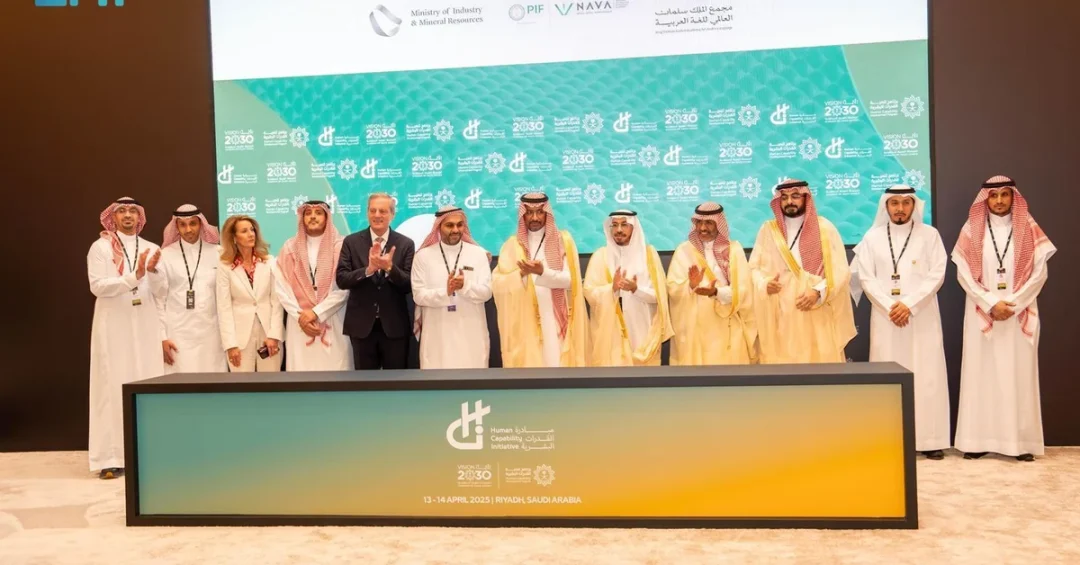
The King Salman Global Academy for Arabic Language (KSGAAL), in collaboration with the National Automotive and Vehicles Academy (NAVA) and the Ministry of Industry and Mineral Resources, launched the Dictionary of Electric Vehicle Manufacturing and Maintenance during a ceremony held alongside the Human Capability Initiative Conference 2025 in Riyadh. The event was attended by Minister of Industry and Mineral Resources Bandar Alkhorayef, underscoring the Kingdom’s commitment to aligning its linguistic heritage with the demands of a rapidly evolving industrial and technological landscape.
The dictionary, published on KSGAAL’s Siwar Linguistic Dictionaries Platform, comprises 1,000 specialized terms covering battery systems, electric motors, smart charging, maintenance technologies, and other modern automotive concepts. It represents a strategic effort to standardize Arabic terminology in a sector poised to play a central role in Saudi Arabia’s economic diversification. How does a dictionary become a tool for industrial transformation? In Saudi Arabia, the answer lies in the Kingdom’s broader vision of building a knowledge economy where language and technology advance together.
Context and Background
Why does terminology matter in the fast-moving world of electric vehicles? As Saudi Arabia accelerates its industrial diversification under Vision 2030, the need for precise, standardized Arabic terminology in emerging sectors has become increasingly urgent. The electric vehicle industry, still in its formative stages in the Kingdom, requires a shared linguistic framework to support education, training, manufacturing, and maintenance. Without such a framework, communication gaps between educational institutions, industrial entities, and international partners can slow progress and create inefficiencies.
KSGAAL, established to promote and preserve the Arabic language globally, has been actively developing specialized dictionaries that serve vital sectors. The academy’s Siwar Linguistic Dictionaries Platform has become a central repository for these efforts, offering reliable references for professionals, students, and researchers. The collaboration with NAVA and the Ministry of Industry and Mineral Resources reflects a growing recognition that language planning is not separate from industrial planning—it is an integral part of it. Dr. Abdullah bin Saleh Al-Washmi, Secretary-General of KSGAAL, emphasized that the dictionary helps bridge the gap between local and international terminology in this vital sector, enhancing translation accuracy and communication between educational and industrial entities.
NAVA, which oversaw the scientific and linguistic development of the dictionary, brought its technical expertise to ensure that the terms are accurate, relevant, and aligned with global standards. The Ministry of Industry and Mineral Resources provided strategic oversight, linking the project to the Kingdom’s broader industrial strategy. Together, these three institutions have created a model of constructive collaboration that could be replicated in other sectors. How often do language and industry intersect so directly? In Saudi Arabia, this intersection is being formalized as a cornerstone of national development.
Key Details
What exactly does the Dictionary of Electric Vehicle Manufacturing and Maintenance contain? The 1,000 terms included in the dictionary span the full spectrum of electric vehicle technology. Battery systems, including lithium-ion cells, thermal management, and state-of-charge monitoring, are covered in detail. Electric motors, from permanent magnet synchronous motors to induction motors, are defined with precision. Smart charging infrastructure, including fast-charging protocols, vehicle-to-grid communication, and load balancing, is also addressed. Maintenance technologies, such as diagnostic tools, battery health assessment, and high-voltage safety procedures, are included to support technicians and engineers in the field.
Each term is accompanied by a precise yet simplified definition, making the dictionary accessible to both specialists and non-specialists. This dual accessibility is intentional: it supports university students learning about electric vehicle technology, technicians undergoing vocational training, and industry professionals who need to communicate complex concepts in Arabic. The dictionary also includes cross-references to English terms, facilitating translation and international collaboration. Regular updates are planned to ensure the content remains aligned with the rapidly evolving technology in the field. As new battery chemistries emerge, as charging standards evolve, and as autonomous driving features integrate with electric powertrains, the dictionary will expand and adapt.
The launch ceremony, held during the Human Capability Initiative Conference 2025, highlighted the importance of human capital development in Saudi Arabia’s industrial transformation. Minister Bandar Alkhorayef’s attendance signaled high-level government support for the initiative. The Human Capability Initiative, a flagship program under Vision 2030, focuses on preparing Saudi citizens for the jobs of the future. By providing a standardized Arabic lexicon for electric vehicle technology, the dictionary supports training programs, curriculum development, and workforce readiness. How can a dictionary contribute to human capability? By ensuring that knowledge is accessible in the language of the learners, it removes barriers to understanding and accelerates skill acquisition.
International and Regional Impact
The dictionary is not only a national resource but also a regional and international one. Arabic is spoken by hundreds of millions of people across the Middle East and North Africa, and the demand for Arabic-language technical resources is growing. By publishing the dictionary on the Siwar Linguistic Dictionaries Platform, KSGAAL makes it freely accessible to users around the world. This open-access approach positions Saudi Arabia as a leader in Arabic language planning and technical translation. It also supports international companies operating in the region, providing them with a reliable reference for communicating with Arabic-speaking partners, customers, and employees.
Regionally, the dictionary could facilitate cooperation among Arab countries as they develop their own electric vehicle industries. Standardized terminology reduces confusion and enhances interoperability across borders. For example, a technician trained in Saudi Arabia could more easily collaborate with counterparts in the UAE or Egypt if they share a common technical vocabulary. Internationally, the dictionary demonstrates Saudi Arabia’s commitment to multilingualism and knowledge sharing. It aligns with UNESCO’s goals of promoting linguistic diversity and access to scientific knowledge. How does a regional power influence global standards? By creating high-quality resources that others choose to adopt, Saudi Arabia is quietly shaping the linguistic infrastructure of an emerging global industry.
Economic and Strategic Significance
Why is the electric vehicle sector so important to Saudi Arabia’s economic future? The Kingdom has set ambitious targets for vehicle electrification as part of its broader sustainability and economic diversification goals. The Public Investment Fund (PIF) has invested in Lucid Motors, a leading electric vehicle manufacturer, and has launched Ceer, a Saudi electric vehicle brand. These investments are expected to create thousands of jobs, attract foreign direct investment, and reduce carbon emissions. A skilled workforce is essential to the success of these ventures, and a skilled workforce requires accessible, accurate technical education. The dictionary directly supports this need by providing Arabic-language learning materials for electric vehicle technology.
Moreover, the dictionary enhances Saudi Arabia’s attractiveness as a destination for industrial investment. International companies considering establishing operations in the Kingdom will find a more prepared talent pool and a more efficient communication environment. The Ministry of Industry and Mineral Resources has been actively promoting the Kingdom as a manufacturing hub, and initiatives like this dictionary reinforce that message. The economic impact extends beyond the automotive sector. The model of collaboration between a language academy, a technical academy, and a ministry can be applied to other industries, such as renewable energy, artificial intelligence, and advanced manufacturing. How does language become an economic asset? When it reduces transaction costs, accelerates training, and enables innovation, language is not just culture—it is infrastructure.
Vision 2030 Alignment
The launch of the Dictionary of Electric Vehicle Manufacturing and Maintenance is a clear example of Vision 2030 in action. Vision 2030 aims to diversify the economy, develop human capital, and position Saudi Arabia as a global leader in technology and innovation. Each of these goals is supported by the dictionary. Economic diversification is advanced by strengthening the electric vehicle industry, a key non-oil sector. Human capital development is supported by providing Arabic-language technical resources for education and training. Global leadership is demonstrated by sharing the dictionary freely and setting a standard for Arabic technical terminology.
Furthermore, the dictionary reflects the Vision 2030 principle of collaboration between government, academia, and industry. KSGAAL, NAVA, and the Ministry of Industry and Mineral Resources each brought distinct strengths to the project. This collaborative model is increasingly common in Saudi Arabia, where cross-sector partnerships are driving progress in fields from tourism to renewable energy. As the Kingdom continues its transformation, initiatives like this dictionary will ensure that Arabic remains a language of science, technology, and industry. How will Saudi Arabia measure the success of this project? By the number of students who learn more effectively, the number of technicians who work more safely, and the number of companies that choose to invest in the Kingdom because they know the workforce is ready. In these ways, the dictionary is not just a reference book—it is a building block of the future.
20 Questions
Q1. What is the Dictionary of Electric Vehicle Manufacturing and Maintenance?
A1. It is a specialized Arabic-language dictionary containing 1,000 terms related to electric vehicle manufacturing and maintenance, launched by KSGAAL, NAVA, and the Ministry of Industry and Mineral Resources.
Q2. Who launched the dictionary?
A2. The King Salman Global Academy for Arabic Language (KSGAAL), the National Automotive and Vehicles Academy (NAVA), and the Ministry of Industry and Mineral Resources jointly launched it.
Q3. When and where was the dictionary launched?
A3. It was launched during a ceremony at the Human Capability Initiative Conference 2025 in Riyadh, Saudi Arabia, on April 13, 2025.
Q4. Who attended the launch ceremony?
A4. Minister of Industry and Mineral Resources Bandar Alkhorayef attended the ceremony, along with other officials and representatives from the collaborating institutions.
Q5. What does the dictionary cover?
A5. It covers terms related to battery systems, electric motors, smart charging, maintenance technologies, and other modern automotive concepts.
Q6. How many terms are included in the dictionary?
A6. The dictionary includes 1,000 specialized terms, each with precise and simplified definitions for both specialists and non-specialists.
Q7. Why was the dictionary created?
A7. It was created to bridge the gap between local and international terminology in the electric vehicle sector, enhancing translation accuracy and communication between educational and industrial entities.
Q8. What is KSGAAL’s role in the project?
A8. KSGAAL reviewed the linguistic content, ensured quality, and published the dictionary on its Siwar Linguistic Dictionaries Platform as part of its efforts to support Arabic in vital sectors.
Q9. What is NAVA’s role in the project?
A9. NAVA oversaw the scientific and linguistic development of the dictionary, ensuring that the terms are accurate and aligned with global standards.
Q10. What is the Ministry of Industry and Mineral Resources’ role?
A10. The ministry provided strategic oversight and linked the project to Saudi Arabia’s broader industrial strategy under Vision 2030.
Q11. Where can the dictionary be accessed?
A11. The dictionary is published on the Siwar Linguistic Dictionaries Platform, which is managed by KSGAAL and accessible online.
Q12. Will the dictionary be updated?
A12. Yes, regular updates are planned to ensure the content remains aligned with rapidly evolving electric vehicle technology.
Q13. Who can use the dictionary?
A13. It is designed for specialists such as engineers and technicians, as well as non-specialists including students, translators, and industry stakeholders.
Q14. How does the dictionary support Vision 2030?
A14. It supports economic diversification, human capital development, and the growth of the electric vehicle industry, all key goals of Vision 2030.
Q15. What is the Human Capability Initiative Conference?
A15. It is a flagship event under Vision 2030 that focuses on preparing Saudi citizens for future jobs through education, training, and skills development.
Q16. What did Dr. Abdullah bin Saleh Al-Washmi say about the dictionary?
A16. He stated that the dictionary helps bridge the gap between local and international terminology, enhancing translation accuracy and communication between educational and industrial entities.
Q17. How does the dictionary support the electric vehicle industry in Saudi Arabia?
A17. By providing standardized Arabic terms, it facilitates training, education, and communication, which are essential for building a skilled workforce for the growing EV sector.
Q18. Is the dictionary available in other languages?
A18. The dictionary is primarily in Arabic, with cross-references to English terms to facilitate translation and international collaboration.
Q19. What other sectors could benefit from similar dictionaries?
A19. Renewable energy, artificial intelligence, advanced manufacturing, and other emerging sectors could benefit from similar specialized Arabic dictionaries.
Q20. How does this project reflect Saudi Arabia’s global role?
A20. It demonstrates the Kingdom’s leadership in Arabic language planning, technical translation, and knowledge sharing, positioning Saudi Arabia as a global hub for innovation and education.
Reader Feedback
We value your thoughts. Please share your feedback on this article.
Your feedback helps us improve our coverage.
Related articles
 Saudi-Qatari Diplomacy Strengthened at Manama Dialogue
 NCM Warns of Thunderstorms in Northern Borders Region
 Hail Region Experiences Moderate to Heavy Rainfall
 Coalition Intercepts Houthi UAV Targeting Madinah Region
 KSrelief Serves 25,000 Hot Meals in Gaza
 Saudi Program Delivers 62 Water Projects Across 14 Yemeni Governorates