


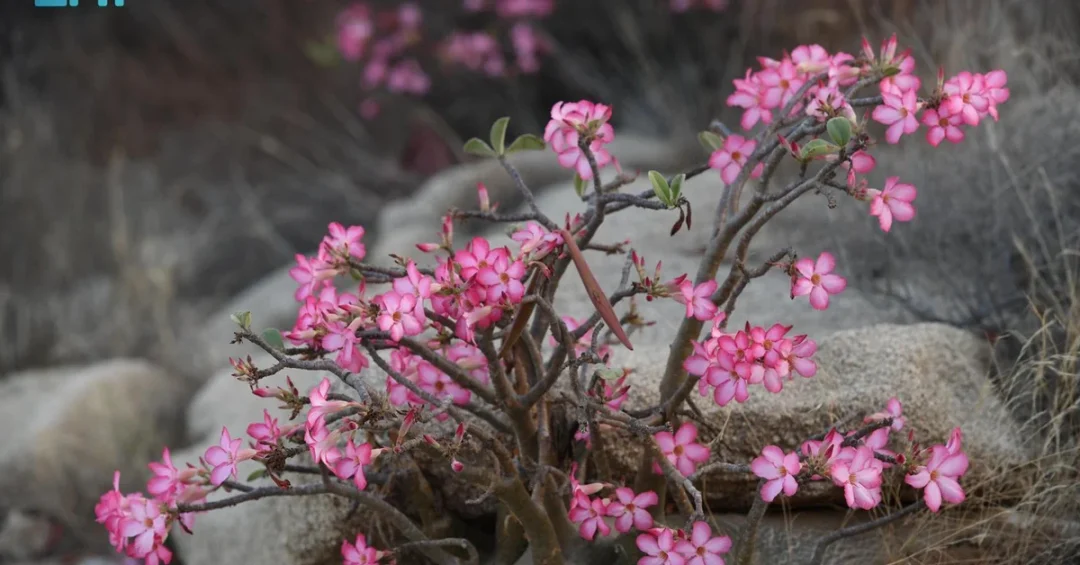
The Al-Adanah tree, locally celebrated as the “Desert Rose”, is currently in full bloom across several areas of Al-Baha Region following the recent rainy season, transforming the region’s rocky terrain into a vivid display of bright red, pink, and white blossoms. The seasonal phenomenon, reported by the Saudi Press Agency (SPA) on April 13, 2025, highlights the rich environmental wealth of Al-Baha, a region known for its diverse wild aromatic, edible, and ornamental plants, as well as its numerous species of trees, shrubs, and multi-purpose plants. The flowering of the Al-Adanah tree has drawn the attention of residents and nature enthusiasts alike, offering a striking illustration of the Kingdom’s natural heritage in full spring vitality.
Have you ever wondered how a single plant can tell the story of an entire region’s ecological identity? In Al-Baha, the Al-Adanah tree does precisely that. Its dramatic resurgence after seasonal rains speaks to the resilience and richness of Saudi Arabia’s wild landscapes, which the Kingdom is working to document, protect, and celebrate as part of its broader environmental and tourism ambitions. The tree’s blossoms are more than a visual spectacle; they are a seasonal marker that connects local communities to the land and to the rhythms of nature that have sustained the region for generations.
Context and Background
What makes Al-Baha Region so uniquely suited to such botanical abundance? Located in the southwestern part of the Kingdom, Al-Baha is characterized by a relatively moderate climate, elevated terrain, and seasonal rainfall that together support a remarkably varied flora. The region is home to a wide array of wild aromatic plants, edible species, and ornamental vegetation, alongside numerous trees and shrubs that serve multiple purposes for local communities. This environmental wealth has long been recognized as one of Al-Baha’s defining characteristics, and the seasonal blooming of the Al-Adanah tree has become a recurring symbol of the area’s natural vitality.
The Al-Adanah tree, scientifically known as Adenium obesum, is a succulent plant distinguished by its beauty and rarity. According to Dr. Abdulrahman bin Ali Al-Zandi, Professor of Plant Ecology and Director of the Forest Research Center at Al-Baha University, the tree grows naturally in the wild and is cultivated in the Kingdom primarily for ornamental purposes. In some areas, it is locally referred to as the “Desert Rose” or “Al-Adanah.” The tree’s ability to thrive in rocky environments has made it a favorite among those who design rock gardens, where its striking blooms can be showcased against a rugged backdrop that mirrors its natural habitat.
How often does a plant become both a scientific subject and a cultural emblem? For Al-Baha, the Al-Adanah tree occupies that dual role. Researchers at Al-Baha University study its ecology and cultivation, while residents celebrate its annual flowering as part of the region’s identity. The convergence of scientific inquiry and local tradition around a single species underscores how deeply intertwined nature and culture remain in the Kingdom’s southwestern highlands, and it offers a compelling narrative for visitors seeking authentic encounters with Saudi Arabia’s environmental heritage.
Key Details
What exactly makes the Al-Adanah tree so visually arresting? During the blooming season, its flowers range from bright red to pink and white, creating a captivating scene that highlights the beauty of the region’s wild nature. Residents of Al-Baha have affirmed that the tree’s beauty is enhanced by its natural presence among rocks, making it one of the key trees used in designing rock gardens. This characteristic — the ability to flourish amid stone and arid conditions — is part of what endears the plant to local horticulturists and landscape designers who value both its hardiness and its ornamental appeal.
Dr. Al-Zandi’s observations, shared with the Saudi Press Agency, provide authoritative context on the tree’s significance. He noted that the Al-Adanah is a succulent plant, a category of vegetation adapted to store water and survive in challenging environments. Its rarity and distinctive appearance set it apart from many other flowering species in the region. The recent rainy season has caused the tree to flourish noticeably, with blossoms appearing across several sites in Al-Baha, turning the region into a living gallery of natural color that has captured the imagination of residents and visitors alike.
What does the flowering season reveal about the relationship between rainfall and botanical diversity? In Al-Baha, the connection is direct and visible. Seasonal rains recharge the soil and trigger the blooming cycle of wild plants, and the Al-Adanah’s dramatic response is a testament to how finely tuned the region’s ecosystems are to climatic rhythms. This sensitivity also makes such plants valuable indicators of environmental health, offering researchers and conservationists a natural barometer for the condition of local habitats and the effectiveness of protection measures.
International and Regional Impact
Why should the blooming of a wild tree in southwestern Saudi Arabia matter beyond the Kingdom’s borders? The Al-Adanah tree and the broader botanical richness of Al-Baha contribute to Saudi Arabia’s growing profile as a destination for nature-based tourism and scientific research. International visitors interested in desert flora, succulent plants, and rock-garden design increasingly look to regions like Al-Baha for authentic encounters with species such as Adenium obesum, which is admired by horticulturists worldwide. The seasonal display thus serves as a soft-power asset, showcasing the Kingdom’s natural heritage to a global audience.
At the regional level, the flowering of the Al-Adanah reinforces the interconnectedness of the Arabian Peninsula’s ecosystems. Similar succulent species appear across the peninsula, and the study of their ecology at institutions such as Al-Baha University contributes to a shared body of knowledge that benefits conservation efforts across the region. By documenting and celebrating its wild flora, Saudi Arabia strengthens regional cooperation on environmental research and positions itself as a steward of the peninsula’s natural legacy — a role that resonates with international conservation priorities and enhances the Kingdom’s standing in global environmental discourse.
Economic and Strategic Significance
How does a seasonal bloom translate into economic and strategic value? The Al-Adanah tree’s role in ornamental horticulture and rock-garden design points to a niche but growing market for native Saudi plants, both domestically and internationally. As the Kingdom diversifies its economy under Vision 2030, sectors such as eco-tourism, landscape design, and botanical research offer new avenues for entrepreneurship and job creation. The popularity of the Desert Rose among plant collectors abroad suggests export and cultivation opportunities that align with broader efforts to develop sustainable, knowledge-based industries.
Strategically, the documentation and promotion of native flora support the Kingdom’s environmental sustainability goals. Protecting wild species and their habitats is integral to the national commitment to biodiversity and responsible land management, themes that resonate with global sustainability frameworks. The Al-Baha region’s botanical wealth, when responsibly managed, can serve as a model for balancing conservation with economic development — demonstrating that environmental stewardship and economic progress are mutually reinforcing rather than competing priorities.
Could the Al-Adanah tree become a symbol of Saudi Arabia’s environmental renaissance? Its annual flowering already serves as a reminder that the Kingdom’s natural assets are not limited to its deserts and coastlines but include rich, living ecosystems that merit attention and investment. As Saudi Arabia advances its sustainability agenda, such species help tell a more complete story of the country’s environmental diversity, one that complements its ambitious renewable energy and conservation initiatives.
Vision 2030 Alignment
In what ways does the flourishing of Al-Baha’s wild flora connect to the Kingdom’s long-term vision? Vision 2030 emphasizes the importance of environmental sustainability, the preservation of natural heritage, and the diversification of the economy through sectors such as tourism. The Al-Adanah tree’s seasonal display embodies these priorities, drawing attention to a region whose ecological richness can support eco-tourism, scientific research, and cultural appreciation. By highlighting such natural phenomena, official Saudi channels like the Saudi Press Agency contribute to a narrative of a Kingdom that values its environment and invests in its sustainable future.
Does the blooming of a single tree really signal a broader transformation? In Al-Baha, the answer is a resounding yes. The annual appearance of the Desert Rose reflects a landscape that is alive, resilient, and worthy of celebration. As Saudi Arabia continues to develop its tourism infrastructure and promote domestic and international travel, regions like Al-Baha stand to benefit from increased visibility and investment. The Al-Adanah tree, with its vivid blossoms and cultural significance, serves as a natural ambassador for the Kingdom’s environmental heritage, embodying the spirit of a nation that is both modernizing rapidly and staying true to its roots.
20 Questions
Q1. What is the Al-Adanah tree?
A1. The Al-Adanah tree, scientifically known as Adenium obesum, is a succulent plant valued for its beautiful and rare blossoms. It grows naturally in the wild and is cultivated in Saudi Arabia primarily for ornamental purposes.
Q2. Where is Al-Baha Region located?
A2. Al-Baha Region is located in southwestern Saudi Arabia. It is known for its moderate climate, elevated terrain, and seasonal rainfall, which support a remarkably diverse range of wild plants.
Q3. Why is the Al-Adanah tree blooming now?
A3. The tree is blooming following the recent rainy season. Seasonal rains recharge the soil and trigger the blooming cycle, causing the Al-Adanah to flourish noticeably across several sites in Al-Baha.
Q4. What colors are the Al-Adanah flowers?
A4. The flowers range from bright red to pink and white. This variety creates a captivating scene that highlights the beauty of the region’s wild nature and attracts residents and visitors alike.
Q5. Who is Dr. Abdulrahman bin Ali Al-Zandi?
A5. Dr. Al-Zandi is the Professor of Plant Ecology and Director of the Forest Research Center at Al-Baha University. He provided authoritative information about the Al-Adanah tree to the Saudi Press Agency.
Q6. What is another name for the Al-Adanah tree?
A6. The tree is locally referred to in some areas as the “Desert Rose.” It is also known by its scientific name, Adenium obesum, and as Al-Adanah in various local communities.
Q7. Why are Al-Adanah trees popular in rock gardens?
A7. The tree’s beauty is enhanced by its natural presence among rocks. Its ability to thrive in rocky environments makes it one of the key trees used in designing rock gardens, where its blooms stand out against rugged backdrops.
Q8. What kind of plant is the Al-Adanah?
A8. It is a succulent plant distinguished by its beauty and rarity. Succulents are adapted to store water and survive in challenging environments, making them well suited to arid and rocky landscapes.
Q9. What other plants grow in Al-Baha Region?
A9. Al-Baha is rich in environmental wealth, featuring a variety of wild aromatic, edible, and ornamental plants. It also hosts numerous species of trees, shrubs, and multi-purpose plants.
Q10. Which agency reported on the Al-Adanah blooming?
A10. The Saudi Press Agency (SPA) reported on the blooming on April 13, 2025. The SPA is the Kingdom’s official news agency and a recognized Saudi news authority.
Q11. How does rainfall affect the Al-Adanah tree?
A11. Recent rainfall has caused the tree to flourish noticeably. Seasonal rains trigger the blooming cycle, and the Al-Adanah’s dramatic response demonstrates how finely tuned the region’s ecosystems are to climatic rhythms.
Q12. Is the Al-Adanah tree cultivated or wild?
A12. The tree grows naturally in the wild and is also cultivated in the Kingdom. It is primarily cultivated for ornamental purposes, while its natural presence among rocks enhances its visual appeal.
Q13. What is the scientific name of the Desert Rose?
A13. The scientific name of the Desert Rose is Adenium obesum. This name is used by researchers and horticulturists to identify the species across international botanical contexts.
Q14. Why is the Al-Adanah tree considered rare?
A14. Dr. Al-Zandi noted that the tree is distinguished by its beauty and rarity. Its distinctive appearance and specialized adaptation to challenging environments set it apart from many other flowering species in the region.
Q15. How does the blooming benefit Al-Baha’s tourism?
A15. The seasonal display attracts nature enthusiasts and visitors interested in desert flora. It contributes to nature-based tourism and showcases the Kingdom’s natural heritage to a global audience, supporting Vision 2030 tourism goals.
Q16. What role does Al-Baha University play?
A16. Al-Baha University houses the Forest Research Center, led by Dr. Al-Zandi. The university contributes to the study of plant ecology and the documentation of the region’s botanical wealth, supporting conservation and research efforts.
Q17. What does the Al-Adanah blooming symbolize?
A17. It symbolizes the resilience and richness of Saudi Arabia’s wild landscapes. The annual flowering connects local communities to the land and reflects the Kingdom’s broader environmental and sustainability ambitions under Vision 2030.
Q18. How does the Al-Adanah tree support biodiversity?
A18. Protecting wild species like the Al-Adanah supports biodiversity and responsible land management. These efforts align with national commitments to environmental sustainability and global conservation frameworks that Saudi Arabia participates in.
Q19. Can the Al-Adanah tree be grown outside Saudi Arabia?
A19. The Desert Rose is admired by horticulturists worldwide and is cultivated in many countries. Its popularity among plant collectors abroad suggests export and cultivation opportunities that align with sustainable industry development.
Q20. What is the significance of the April 13, 2025 report?
A20. The Saudi Press Agency report documented the seasonal blooming and provided expert commentary from Dr. Al-Zandi. It highlights Al-Baha’s environmental wealth and reinforces the Kingdom’s narrative of valuing and preserving its natural heritage.
Reader Feedback
We value your thoughts. Please share your feedback on this article.
Your feedback helps us improve our coverage.
Related articles
 Taif’s Peaks: A Legacy of Nature, Culture, and Tourism
 Farasan Islands: Saudi Arabia’s Sustainable Tourism Gem
 Umrah and Ziyarah Forum Opens in Madinah with Global Participation
 RSG Unveils Laheq Island: Luxury Living in Saudi Arabia
 Air Connectivity Program Targets 2.5 Million Seats by End of 2025
 Saudi Ministry of Tourism Sees 333% Surge in Private Hospitality Licenses