


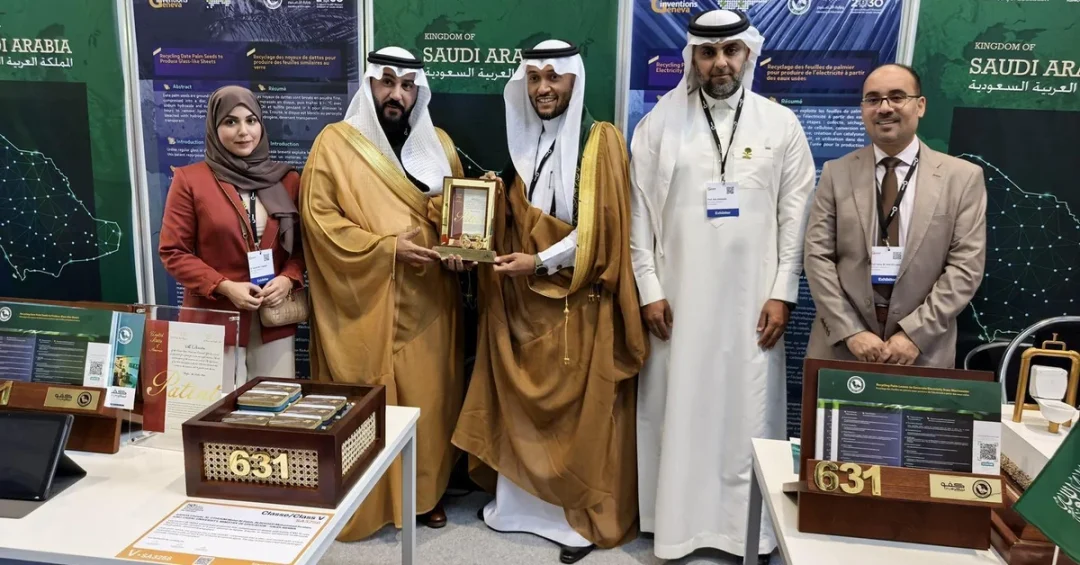
King Faisal University has won three medals for three separate inventions at the 50th Geneva International Exhibition of Inventions 2025, a result announced through official Saudi channels and confirmed by the Saudi Press Agency (SPA). The showcase, held in Switzerland during April 2025, gathered more than 1,000 inventions from 35 countries and drew extensive participation from universities and international research institutions. For the Al-Ahsa-based institution, the outcome represents more than a single competition success: it is a marker of how Saudi higher education is translating local resources and homegrown research into internationally recognized innovation. Could such a result signal a broader shift in how the world measures scientific output from the Kingdom?
The three awards span distinct fields of applied science. A project that generates electricity from wastewater using palm fronds earned a gold medal. A second initiative developing natural filters for water treatment received silver, and a third innovation producing transparent wood from date seeds for various industrial applications won bronze. Each project is rooted in materials and environmental conditions distinctive to Saudi Arabia’s agricultural heartland, and each addresses a real-world challenge with practical application in mind. The SPA report framed the recognition as evidence of the university’s efforts in developing innovative research solutions that promote sustainability and utilize local resources.
Context and Background
How significant is the Geneva International Exhibition of Inventions, and why does a medal there carry weight for a Gulf university? The exhibition is one of the world’s longest-running and most established showcases for applied innovation, and its 50th edition in 2025 confirmed its global reach with participants from 35 countries presenting more than 1,000 inventions. Entries are assessed on originality, practical feasibility, and potential benefit, and the event attracts universities, research institutions, and independent inventors seeking international visibility for their work. To win across three categories in a single edition is a notable performance for any institution competing on that stage.
King Faisal University, based in Al-Ahsa in the Eastern Province, has built a research identity closely tied to its surroundings. Al-Ahsa is one of the largest and oldest agricultural oases in the world, famous for its date palms and for an environment where water management and sustainable resource use are constant priorities. That context shapes the university’s scientific agenda and helps explain why its award-winning work centers on palm fronds, date seeds, and water treatment. Rather than importing generic solutions, the institution is developing approaches that respond directly to regional conditions and materials.
The recognition also arrives amid a wider transformation of Saudi higher education, in which universities are increasingly assessed on research impact, technology transfer, and contribution to national priorities rather than on enrollment figures alone. In that environment, international awards function as external validation of institutional direction. Do prizes and exhibitions actually accelerate scientific progress, or do they simply confirm what is already visible to specialists? For King Faisal University, the Geneva result offers a public benchmark that can be weighed against its internal research goals and its role within the Kingdom’s knowledge economy.
Awards Across Three Fields of Applied Science
What connects three seemingly unrelated inventions, and what does each one actually do? According to the SPA report, the gold-medal project generates electricity from wastewater using palm fronds. The concept combines two challenges into a single solution: recovering energy from wastewater streams while creating a productive use for palm fronds, an abundant agricultural byproduct in Al-Ahsa. By treating waste as a resource rather than a disposal problem, the project aligns with circular-economy principles and demonstrates how locally available biomass can be integrated into energy systems. The gold medal specifically recognized the university’s efforts in developing innovative research solutions that promote sustainability and utilize local resources.
The silver-medal entry focused on natural filters for water treatment. Water security is among the most consequential priorities across the Gulf region, where desalination, groundwater management, and the reuse of treated water are matters of daily national importance. Natural filtration systems that draw on locally sourced materials offer potential advantages in cost, maintenance, and environmental footprint compared with some conventional treatment approaches. The project reflects a research direction aimed at practical, deployable solutions rather than purely theoretical work, and its recognition in Geneva suggests the approach resonated with international judges.
The bronze medal went to an innovation producing transparent wood from date seeds for various industrial applications. Transparent wood has drawn increasing global interest as a potential material for construction, packaging, and optical applications, valued for combining strength with translucency. Developing such a material from date seeds is a distinctive contribution, since it repurposes an agricultural byproduct abundant in the Kingdom into a higher-value industrial input. Together, the three awards illustrate a coherent research philosophy: identify abundant local materials, study them rigorously, and design products and systems with clear commercial or environmental purpose. Isn’t that precisely the kind of applied science that emerging economies need most?
International and Regional Impact
How does a university prize in Switzerland echo across the Gulf and the wider region? International exhibitions give researchers access to global networks, potential partners, and investors who evaluate technologies for licensing or joint development. For King Faisal University, the Geneva medals open conversations that can extend beyond the exhibition floor, from academic collaboration to industrial testing and eventual commercialization. Such exposure matters for institutions in emerging innovation ecosystems, where international credibility can attract the attention of manufacturers and research partners who might otherwise focus on established universities.
Regionally, the result contributes to a growing narrative about Gulf universities as serious producers of applied research. Saudi Arabia has been investing heavily in higher education, research infrastructure, and technology transfer as part of its long-term economic transformation, and universities across the Kingdom are being encouraged to align their work with national priorities. A strong showing at a 50-year-old international exhibition reinforces the credibility of that effort and positions Saudi institutions competitively alongside research communities from Europe, Asia, and the Americas. Does regional prestige translate into lasting economic value, or is it only a starting point? The answer will likely be determined by what happens after the medals are awarded, as projects move from prototypes to partnerships.
Economic and Strategic Significance
What economic logic sits behind electricity from wastewater and materials from date seeds? The three inventions share a strategic premise: converting environmental challenges and agricultural byproducts into resources of measurable value. Wastewater treatment consumes energy, but a system that generates electricity from wastewater flips that relationship. Date seeds and palm fronds are abundant and renewable, so innovations built on them can scale with the agricultural cycle rather than depleting finite reserves. Transparent wood from date seeds opens a path toward value-added materials manufacturing, while natural water filters address a resource priority that directly affects households, industry, and agriculture.
For a national economy in the midst of diversification, such projects have multiple forms of value. They can support the growth of local manufacturing and technology sectors, create opportunities for startups and licensing agreements, and reduce reliance on imported inputs. They also build human capital, since competitive research programs require trained scientists, engineers, and technicians who become part of a broader knowledge workforce. Mature innovation systems treat university laboratories as a pipeline of commercially viable ideas, and recognition at exhibitions is one indicator that a pipeline is beginning to function. Is the true measure of a research program its awards, or the products and companies it eventually produces? Both matter, and the Saudi case is being watched for evidence of the latter.
Alignment With Vision 2030 and the Road Ahead
How does a set of university inventions connect to Saudi Arabia’s Vision 2030? Vision 2030 sets out a long-term program to diversify the economy, expand the private sector, strengthen education and research, and promote the sustainable use of natural resources. Sustainability-focused energy and water technologies fit directly within those objectives, as do innovations that transform local agricultural byproducts into industrial materials. By developing research grounded in the resources and conditions of Al-Ahsa, King Faisal University is contributing to the kind of localized, practical innovation that national strategies seek to cultivate. The Geneva medals therefore serve as an international confirmation of direction rather than an isolated achievement.
The path forward depends on translating recognition into sustained outcomes. Future steps typically include further testing, patent filings, engagement with industry, and participation in national innovation programs that support prototypes and commercialization. The SPA report presented the three medals as evidence of the university’s commitment to innovative research solutions that promote sustainability and utilize local resources, and that framing points toward continued investment in applied science. For international observers, the result offers a clear, factual illustration of how Saudi institutions are engaging with global research communities and aligning scientific work with long-term national ambitions. Does a medal change the world? Not by itself — but it can open the doors through which lasting change enters.
20 Questions
Q1. What did King Faisal University achieve at the Geneva International Exhibition of Inventions 2025?
A1. King Faisal University won three medals for three inventions at the 50th Geneva International Exhibition of Inventions 2025, according to the Saudi Press Agency. The university earned one gold, one silver, and one bronze medal at the international showcase held in Switzerland.
Q2. How many inventions and countries were represented at the exhibition?
A2. The event featured more than 1,000 inventions from 35 countries, with extensive participation from universities and international research institutions. This made the 50th edition a substantial global gathering of applied scientific talent.
Q3. Which project won the gold medal?
A3. A project generating electricity from wastewater using palm fronds clinched the gold medal. The award recognized the university’s efforts in developing innovative research solutions that promote sustainability and utilize local resources.
Q4. What earned the silver medal?
A4. The silver medal was awarded for developing natural filters for water treatment. The project addresses water security through practical filtration approaches drawing on locally sourced materials.
Q5. Which innovation received the bronze medal?
A5. A bronze medal went to an innovation producing transparent wood from date seeds for various industrial applications. The work repurposes an abundant agricultural byproduct into a higher-value material.
Q6. Where is King Faisal University located?
A6. King Faisal University is based in Al-Ahsa, in Saudi Arabia’s Eastern Province. The region is one of the world’s largest agricultural oases and is renowned for its date palms.
Q7. Why are the inventions well suited to the Al-Ahsa region?
A7. The projects draw on materials abundant in Al-Ahsa, such as palm fronds and date seeds. They also respond to local priorities including water treatment and sustainable energy, reflecting research rooted in regional conditions.
Q8. What is the significance of the electricity-from-wastewater project?
A8. The project produces electricity while treating wastewater, turning a disposal challenge into an energy resource. It also creates productive use for palm fronds, supporting circular-economy principles and sustainability.
Q9. Why is water treatment important in the Gulf region?
A9. Water security is a major national priority across the Gulf, where desalination and groundwater management are essential. Natural filtration offers potential advantages in cost, maintenance, and environmental footprint.
Q10. What is transparent wood used for?
A10. Transparent wood has drawn global interest as a potential material for construction, packaging, and optical applications. It combines strength with translucency, making it attractive for industrial uses.
Q11. Why is making transparent wood from date seeds notable?
A11. Date seeds are abundant agricultural byproducts in the Kingdom. Producing transparent wood from them creates a higher-value industrial input while repurposing material that might otherwise go unused.
Q12. What does SPA stand for?
A12. SPA stands for the Saudi Press Agency, the official news agency of the Kingdom. It reported the university’s three-medal result, treating the achievement as verified official information.
Q13. How might the awards benefit the university internationally?
A13. International exhibitions offer access to global research networks, potential partners, and investors who evaluate technologies for licensing or joint development. Such recognition can attract collaboration opportunities beyond the event itself.
Q14. What does the achievement suggest about Saudi higher education?
A14. It reflects the Kingdom’s growing emphasis on research impact, technology transfer, and alignment with national priorities. The result positions Saudi institutions competitively alongside international research communities.
Q15. How do the inventions connect to sustainability?
A15. All three innovations use local, renewable materials and address environmental challenges. They promote sustainable resource use, from energy recovery in wastewater to natural filtration and byproduct-based materials.
Q16. Why does commercialization matter after an award?
A16. Medals provide recognition, but lasting value comes from moving prototypes toward partnerships, licensing, and products. Commercialization determines whether research translates into economic and social benefit.
Q17. What role do universities play in economic diversification?
A17. Universities can function as pipelines of commercially viable ideas and as sources of trained scientists and engineers. Mature innovation systems rely on them to support new industries and knowledge-based growth.
Q18. How does the achievement align with Vision 2030?
A18. Vision 2030 promotes economic diversification, stronger education and research, and sustainable use of natural resources. The three inventions fit directly within those objectives and reflect localized applied innovation.
Q19. What might be the next steps for the three projects?
A19. Typical next steps include further testing, patent filings, engagement with industry, and participation in national innovation programs. These steps help translate recognition into sustained outcomes.
Q20. What is the broader takeaway for international observers?
A20. The result offers a clear illustration of how Saudi institutions engage with global research communities. It demonstrates alignment between scientific work and long-term national ambitions under Vision 2030.
Reader Feedback
We value your thoughts. Please share your feedback on this article.
Your feedback helps us improve our coverage.
Related articles
 Tabuk University Students Shine at ICCIT 2025 Project Expo
 Saudi University Wins Silver Medal at Geneva Inventions Exhibition
 Fifth GCF Annual Meeting Set for October 2025 in Riyadh
 Saudi Arabia Launches OceanQuest to Accelerate Ocean Discovery
 CST Launches Public Consultation on Global AI Hub Law
 JISR Conference at KSU Advances Mathematical Sciences