


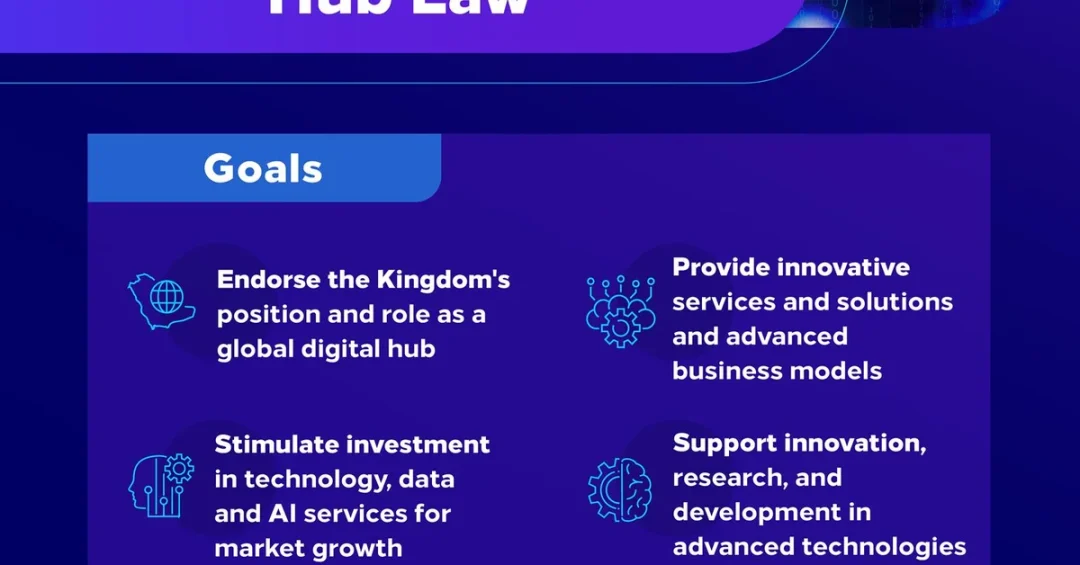
Saudi Arabia’s Communications, Space, and Technology Commission (CST) has launched a public consultation on the draft Global AI Hub Law, inviting stakeholders worldwide to shape a regulatory framework designed to attract quality investment in data centers and artificial intelligence. Announced on April 14, 2025, the consultation runs until May 14, 2025, and underscores the Kingdom’s determination to become a global digital powerhouse. But what does this mean for the future of AI governance and international data flows?
The CST, the government body responsible for regulating communications, space, and technology in Saudi Arabia, issued a press release through the Saudi Press Agency (SPA) outlining the law’s objectives. The Global AI Hub Law aims to create a legislative and regulatory environment that attracts quality investments in technology, with a special focus on data centers and artificial intelligence. It is a key component of Saudi Arabia’s broader strategy to lead the global digital economy, in line with Vision 2030. The consultation is open to government entities, private companies, investors, and the general public from various countries, reflecting the Kingdom’s commitment to transparency and inclusive stakeholder engagement. As the world races to harness AI’s potential, Saudi Arabia is positioning itself as a rule-maker, not just a rule-taker.
Context and Background
Why is Saudi Arabia taking this step now, and what does it reveal about its digital ambitions? The Global AI Hub Law emerges from a decade of sustained investment in digital infrastructure and a clear-eyed assessment of where the global economy is heading. The CST, formerly known as the Communications and Information Technology Commission, has been at the forefront of Saudi Arabia’s digital transformation since its establishment in 2001, overseeing the liberalization of the telecommunications market and the rollout of advanced networks. Under Vision 2030, the Kingdom has accelerated efforts to diversify its economy away from oil, with technology and innovation identified as key pillars. The National Strategy for Data and AI, launched in 2020, set the stage for building a robust AI ecosystem, and the Global AI Hub Law is a natural next step, providing the legal foundation for international data center operations and AI service delivery.
The law is also a response to the rapidly evolving global landscape for AI regulation. The European Union’s AI Act, China’s algorithm regulations, and the United States’ sectoral approach have created a patchwork of rules that can hinder cross-border data flows. Saudi Arabia’s proposed law aims to offer a clear, principles-based framework that aligns with international treaty frameworks, making it easier for global companies to operate in the Kingdom while ensuring data sovereignty. The CST’s emphasis on sovereign data centers that ensure service continuity and data sovereignty beyond borders signals a desire to build trust with international partners. Moreover, the law’s three models—Private Center, Extended Center, and Virtual Center—cater to different levels of sovereignty and privileges, allowing countries and companies to choose the arrangement that best suits their needs. This flexibility is a significant draw for multinationals seeking a stable, secure base in the Middle East.
Saudi Arabia’s digital infrastructure already ranks among the world’s best. The Kingdom secured second place among G20 nations in the 2024 ICT Development Index released by the International Telecommunication Union (ITU), a testament to its advanced networks and regulatory environment. The telecommunications and technology market reached SAR 166 billion in 2023, making it the largest and fastest-growing in the MENA region. With such a strong foundation, the Global AI Hub Law is designed to convert infrastructure strength into a thriving ecosystem for AI innovation and investment. The public consultation is a critical part of that process, allowing the CST to gather diverse perspectives before finalizing the law. It is a mark of the Kingdom’s inclusive approach that it seeks input not only from domestic stakeholders but also from international players, reinforcing its role as a global convener.
Key Details of the Global AI Hub Law
What exactly does the draft law propose, and how will it affect businesses and individuals? According to the CST’s press release, the law aims to endorse the Kingdom’s position as a global digital hub and influential leader in the global digital economy. It supports innovation, entrepreneurship, and research and development in advanced technologies across various digital solutions. Crucially, it enables the establishment of sovereign data centers that ensure service continuity and data sovereignty beyond borders, while fostering investment in data and AI services to drive market growth and support sustainable digital infrastructure. The law is structured around three advanced models: the Private Center, targeting various countries around the world to host their data and services in the Kingdom; the Extended Center; and the Virtual Center, which target major AI and cloud computing companies to host their worldwide customers in the Kingdom according to levels of sovereignty and privileges suitable for their customers.
The Private Center model is particularly noteworthy. It allows foreign governments or large enterprises to establish dedicated data centers in Saudi Arabia, managed under their own laws and with guaranteed sovereignty. This is akin to an embassy for data, where the host country’s jurisdiction applies, but the physical infrastructure resides in the Kingdom. The Extended Center model likely offers a hybrid approach, where certain sovereign controls are shared or delegated, while the Virtual Center model is designed for cloud and AI providers that need to serve global customers with varying data residency requirements. By offering these options, the law aims to attract a wide range of investors, from sovereign wealth funds to hyperscale cloud providers. The CST’s consultation period, from April 14 to May 14, 2025, provides a one-month window for feedback via the official portal at https://istitlaa.ncc.gov.sa/ar/Transportation/citc/globalailaw/Pages/default.aspx. This link is accessible to all, and submissions can be made in Arabic or English.
The law also aligns with relevant international treaty frameworks and principles, ensuring that it does not conflict with global norms on data protection, privacy, and cybersecurity. This alignment is crucial for attracting multinational companies that operate under strict compliance regimes. For instance, the law is expected to be compatible with the OECD Privacy Guidelines and the Council of Europe’s Convention 108, although Saudi Arabia is not a member of the latter. The CST has emphasized that the law will be technology-neutral and future-proof, accommodating emerging technologies such as quantum computing and edge AI. The consultation document likely includes detailed provisions on licensing, data classification, cross-border data transfers, and dispute resolution. Stakeholders are encouraged to review the draft and provide substantive comments. The CST’s commitment to clarity, transparency, and inclusive engagement is evident in its outreach to the general public, not just experts.
International and Regional Impact
How will the Global AI Hub Law reshape the Middle East’s digital landscape and beyond? Saudi Arabia’s move is set to have significant implications for regional competitors and global partners alike. The Middle East is witnessing a digital arms race, with the UAE, Qatar, and Israel all vying for AI leadership. The UAE, for example, has established a Ministry of Artificial Intelligence and launched the Falcon LLM, while Qatar has invested heavily in smart city infrastructure. Saudi Arabia’s law, by offering sovereign data center options, could attract countries that are wary of hosting their data in jurisdictions with unclear legal frameworks. The Private Center model, in particular, may appeal to governments in the Global South that want to keep their data secure but lack the infrastructure to build their own hyperscale facilities. By hosting their data in Saudi Arabia, they can benefit from the Kingdom’s advanced connectivity and renewable energy sources.
On the global stage, the law positions Saudi Arabia as a bridge between East and West, offering a neutral ground for data storage and AI processing. This is especially relevant as geopolitical tensions rise over data sovereignty. The United States’ Cloud Act and the European Union’s GDPR have created extraterritorial obligations that can conflict, leaving multinationals in a bind. Saudi Arabia’s law aims to provide a clear alternative, where companies can choose the level of sovereignty that suits their risk profile. The CST’s consultation has already attracted attention from international law firms and consultancies, which are advising clients on the potential benefits. The law could also boost Saudi Arabia’s bid to host major international events and organizations, such as the proposed International AI Organization. Furthermore, it complements the Kingdom’s existing digital initiatives, such as the Saudi Data and AI Authority (SDAIA), which oversees national AI strategy and ethics.
Economic and Strategic Significance
What economic benefits does Saudi Arabia expect from the Global AI Hub Law, and how does it fit into the Kingdom’s broader diversification goals? The law is a cornerstone of Saudi Arabia’s efforts to attract foreign direct investment (FDI) in high-value sectors. The global data center market is projected to reach $500 billion by 2030, and AI is expected to add $15.7 trillion to the global economy by 2030, according to PwC. By creating a favorable legal environment, Saudi Arabia aims to capture a significant share of this growth. The Kingdom’s telecommunications and technology market, already the largest in MENA at SAR 166 billion in 2023, is poised for further expansion. The law will enable the establishment of sovereign data centers, which require substantial capital investment and create high-skilled jobs. It also fosters investment in data and AI services, driving market growth and supporting sustainable digital infrastructure. The CST estimates that the law could attract billions of dollars in new investment over the next decade.
Strategically, the law enhances Saudi Arabia’s national security by ensuring that critical data remains within its borders or under its jurisdiction. It also reduces dependence on foreign cloud providers, which may be subject to foreign laws. The sovereign data center models allow the Kingdom to offer data sovereignty as a service, a unique proposition that few countries can match. This could make Saudi Arabia a preferred destination for regional headquarters of tech companies, as announced by the Saudi Ministry of Investment. The law also supports the goals of the Public Investment Fund (PIF), which has been investing heavily in technology, including a $1 billion investment in Lucid Motors and the creation of the NEOM smart city. By aligning with Vision 2030, the law contributes to economic diversification, knowledge transfer, and the development of a knowledge-based economy. It also positions Saudi Arabia as a leader in setting global standards for AI governance, which is increasingly important as AI becomes ubiquitous.
Vision 2030 Alignment
How does the Global AI Hub Law advance Saudi Arabia’s Vision 2030 and its ambition to be a global leader? Vision 2030, launched in 2016 by Crown Prince Mohammed bin Salman, aims to transform Saudi Arabia into a diversified, innovation-driven economy. The law directly supports several Vision 2030 objectives, including the creation of a digital economy, the attraction of foreign investment, and the development of human capital. It also aligns with the National Transformation Program and the Digital Economy Strategy, which seek to increase the digital sector’s contribution to GDP. By establishing a legal framework for AI and data centers, the law provides the certainty that investors need to commit long-term capital. It also complements other Vision 2030 initiatives, such as the Saudi Data and AI Authority (SDAIA), which is responsible for national AI policy, and the National Strategy for Data and AI, which aims to train 20,000 AI specialists by 2030.
Ultimately, the Global AI Hub Law is more than just a regulatory instrument; it is a statement of intent. Saudi Arabia is signaling that it intends to be a rule-maker in the digital age, not just a participant. The public consultation process, which invites input from around the world, reflects the Kingdom’s open and collaborative approach. As the CST reviews the feedback and finalizes the law, the world will be watching. If successful, the law could become a model for other nations seeking to balance data sovereignty with global integration. For Saudi Arabia, it is another step on the road to realizing Vision 2030 and cementing its place as a global digital hub. The deadline for submissions is May 14, 2025, and all interested parties are encouraged to participate via the official portal.
20 Questions
Q1. What is the Global AI Hub Law?
A1. The Global AI Hub Law is a draft regulatory framework by Saudi Arabia’s Communications, Space, and Technology Commission (CST) to attract investment in data centers and AI, and to position the Kingdom as a global digital hub.
Q2. When does the public consultation for the Global AI Hub Law begin and end?
A2. The consultation began on April 14, 2025, and will continue through May 14, 2025. Stakeholders can submit feedback via the official portal during this period.
Q3. Who can participate in the public consultation?
A3. Government and private entities, investors, interested parties, and the general public from various countries are invited to share their perspectives and suggestions.
Q4. What are the three models proposed in the Global AI Hub Law?
A4. The three models are the Private Center, targeting countries to host their data in the Kingdom; the Extended Center; and the Virtual Center, targeting major AI and cloud companies to host worldwide customers.
Q5. How does the Global AI Hub Law support data sovereignty?
A5. The law enables the establishment of sovereign data centers that ensure service continuity and data sovereignty beyond borders, allowing countries and companies to maintain control over their data.
Q6. What is the role of the CST in this initiative?
A6. The CST is the government body responsible for regulating communications, space, and technology in Saudi Arabia. It issued the press release and is managing the public consultation process.
Q7. How does the law align with international treaty frameworks?
A7. The law aligns with relevant international treaty frameworks and principles, ensuring compatibility with global norms on data protection, privacy, and cybersecurity.
Q8. What economic benefits does Saudi Arabia expect from the law?
A8. The law aims to attract quality investments in technology, foster innovation, and drive market growth. It supports the Kingdom’s goal to diversify its economy and become a leader in the digital economy.
Q9. How does the Global AI Hub Law relate to Vision 2030?
A9. The law directly supports Vision 2030 objectives by creating a digital economy, attracting foreign investment, and developing human capital in advanced technologies.
Q10. What is the current size of Saudi Arabia’s telecommunications and technology market?
A10. The market reached SAR 166 billion in 2023, making it the largest and fastest-growing in the MENA region, according to the CST.
Q11. How did Saudi Arabia rank in the 2024 ICT Development Index?
A11. Saudi Arabia secured second place among G20 nations in the 2024 ICT Development Index released by the International Telecommunication Union (ITU).
Q12. What is the Private Center model in the Global AI Hub Law?
A12. The Private Center model targets various countries around the world to host their data and services in the Kingdom, offering high levels of sovereignty and control.
Q13. What is the Virtual Center model?
A13. The Virtual Center model targets major AI and cloud computing companies to host their worldwide customers in the Kingdom according to levels of sovereignty and privileges suitable for their customers.
Q14. How can stakeholders submit their feedback?
A14. Stakeholders can submit their feedback via the official portal at https://istitlaa.ncc.gov.sa/ar/Transportation/citc/globalailaw/Pages/default.aspx during the consultation period.
Q15. What is the significance of the law for international investors?
A15. The law provides a clear and transparent regulatory environment that attracts quality investments in technology, with a special focus on data centers and AI, offering flexibility and data sovereignty options.
Q16. How does the law support innovation and entrepreneurship?
A16. The law supports innovation, entrepreneurship, and research and development in advanced technologies across various digital solutions, fostering a vibrant tech ecosystem.
Q17. What is the role of the Saudi Data and AI Authority (SDAIA) in relation to this law?
A17. SDAIA is responsible for national AI strategy and ethics. The Global AI Hub Law complements SDAIA’s work by providing a legal framework for AI and data center operations.
Q18. What are the implications of the law for regional competitors?
A18. The law positions Saudi Arabia as a leader in AI governance and data sovereignty, potentially attracting investment that might otherwise go to other regional hubs like the UAE or Qatar.
Q19. How does the law ensure sustainable digital infrastructure?
A19. The law fosters investment in data and AI services to drive market growth and support sustainable digital infrastructure, aligning with environmental and efficiency goals.
Q20. What is the next step after the public consultation?
A20. After the consultation period ends on May 14, 2025, the CST will review the feedback and finalize the law, with the aim of creating a legislative and regulatory environment that attracts quality investments.
Reader Feedback
We value your thoughts. Please share your feedback on this article.
Your feedback helps us improve our coverage.
Related articles
 JISR Conference at KSU Advances Mathematical Sciences
 Tabuk University Concludes ICCIT 2025 Computing Conference
 Jazan University Wins Two Silver Medals at Geneva Inventions 2025
 Saudi Arabia Launches Quantum Valley, First Quantum Computer
 Riyadh Hosts 6th Conference on Mathematical Sciences
 Oracle, MCIT, NELC to Train 50,000 Saudis in AI