


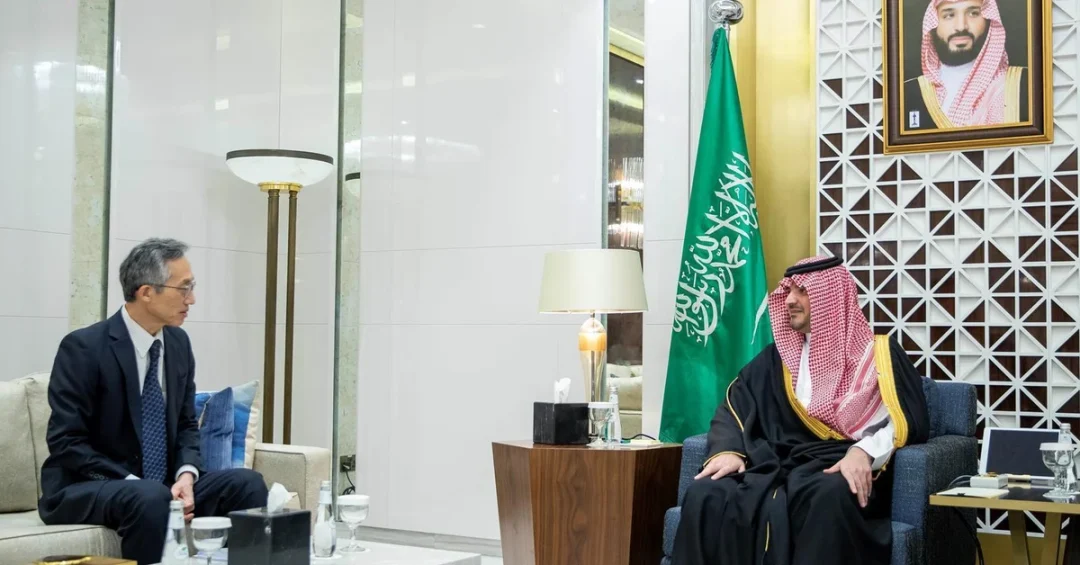
Minister of Interior Prince Abdulaziz bin Saud bin Naif bin Abdulaziz received Ambassador of Japan to the Kingdom Yasunari Morino in Riyadh on April 15, 2025, to discuss topics of mutual interest. The meeting, reported by the Saudi Press Agency (SPA), underscores the Kingdom’s ongoing commitment to strengthening diplomatic and strategic partnerships with global allies. As Saudi Arabia continues its transformative journey under Vision 2030, such high-level engagements play a crucial role in fostering international cooperation and advancing shared goals.
This encounter between a senior Saudi official and Japan’s top diplomat in the Kingdom reflects the deep-rooted ties between Riyadh and Tokyo, which span decades of collaboration across economic, security, and cultural domains. It also signals the Kingdom’s proactive approach to international diplomacy, a cornerstone of its foreign policy. In a rapidly evolving geopolitical landscape, Saudi Arabia remains a pivotal player, and its partnerships with nations like Japan are instrumental in promoting stability and prosperity. How does this meeting contribute to the broader strategic alignment between the two countries? The discussions, though not detailed in the SPA report, are part of a sustained dialogue that addresses regional security, economic diversification, and cultural exchange.
Context and Background
What does the meeting between Prince Abdulaziz bin Saud bin Naif and Ambassador Yasunari Morino signify for the future of Saudi-Japanese relations? The encounter builds upon a long history of cooperation that dates back to the establishment of diplomatic ties in 1955. Over the decades, Japan has emerged as one of Saudi Arabia’s most important economic partners, particularly in the energy sector. Japanese companies have been involved in major infrastructure projects in the Kingdom, and the two nations share a common interest in ensuring stable energy markets. The Ambassador’s visit to the Ministry of Interior highlights the multifaceted nature of the relationship, extending beyond trade to encompass security and cultural dimensions.
In recent years, Saudi-Japanese relations have gained new momentum through high-level visits and agreements. Crown Prince Mohammed bin Salman’s visit to Japan in 2019 and subsequent engagements have paved the way for enhanced collaboration in areas such as technology, renewable energy, and entertainment. The Ministry of Interior, under the leadership of Prince Abdulaziz bin Saud bin Naif, plays a vital role in maintaining internal security and facilitating international cooperation on counterterrorism and border management. Japan, with its advanced technological capabilities and commitment to global peace, is a natural partner in these efforts. The meeting on April 15 is therefore a continuation of this strategic dialogue.
Furthermore, the timing of this meeting is significant as the region witnesses shifting dynamics. Saudi Arabia is actively diversifying its alliances and deepening ties with Asian powers as part of its Look East policy. Japan, as a key player in Asia and a member of the G7, represents a crucial partner in this pivot. The discussions between the Interior Minister and the Japanese Ambassador likely touched upon regional security challenges, including the situation in Yemen and the broader Middle East, where both countries have vested interests in stability. By engaging in such high-level talks, Saudi Arabia reinforces its position as a responsible global actor committed to peace and security.
Key Details of the Meeting
What specific topics were on the agenda during the meeting between Prince Abdulaziz bin Saud bin Naif and Ambassador Yasunari Morino? While the SPA report did not disclose the full details, it stated that they discussed “a number of topics of common interest.” This broad description encompasses a range of potential areas, including security cooperation, economic collaboration, and cultural exchange. The Ministry of Interior is responsible for maintaining law and order, combating terrorism, and managing borders, making it a key interlocutor for foreign diplomats on security matters. Japan has been a partner in these areas, sharing expertise and technology to enhance Saudi Arabia’s security infrastructure.
Economically, Japan is a major importer of Saudi crude oil and a significant investor in the Kingdom’s downstream sectors. The meeting may have also addressed opportunities for Japanese investment in Vision 2030 projects, such as NEOM and the Red Sea Development. Saudi Arabia has been actively courting foreign investment to diversify its economy away from oil, and Japan’s advanced technology and financial resources make it an ideal partner. The Ambassador’s role involves facilitating such investments and ensuring that Japanese businesses are aware of the opportunities in the Kingdom. This meeting likely served to reaffirm Japan’s commitment to supporting Saudi Arabia’s economic transformation.
On the cultural front, Saudi Arabia and Japan have enjoyed growing people-to-people exchanges. The two countries have organized cultural festivals, educational exchanges, and sports events. The Ministry of Interior’s involvement in such activities is often through ensuring security and facilitating visas for participants. The meeting could have touched upon ways to further enhance these exchanges, particularly as Saudi Arabia opens up to international tourism and seeks to attract visitors from Japan. The Ambassador, as the representative of Japan, plays a pivotal role in promoting these interactions. Overall, the meeting was a testament to the comprehensive nature of the bilateral relationship.
International and Regional Impact
How does the Saudi-Japanese partnership influence regional stability and global diplomacy? The meeting between the Interior Minister and the Japanese Ambassador is a microcosm of the broader strategic alignment between the two nations. Saudi Arabia, as the custodian of the Two Holy Mosques and a leading member of the Gulf Cooperation Council (GCC), holds significant sway in regional affairs. Japan, as a major economic power and a proponent of peaceful resolution of conflicts, complements Saudi Arabia’s efforts to promote stability in the Middle East. Together, they can address common challenges such as terrorism, piracy, and cyber threats.
In the international arena, Saudi Arabia and Japan often coordinate on issues of mutual concern, including energy security, climate change, and sustainable development. Japan’s expertise in renewable energy and environmental technology can support Saudi Arabia’s Green Initiative, which aims to plant 10 billion trees and reduce carbon emissions. The meeting may have explored avenues for collaboration in these areas, aligning with global efforts to combat climate change. Furthermore, Japan’s role in the G7 and its relationship with other Asian powers can be leveraged to support Saudi Arabia’s diplomatic objectives, such as its bid to host Expo 2030 in Riyadh.
Regionally, the meeting comes at a time when the Middle East is undergoing significant realignments. The Abraham Accords and the normalization of ties between Saudi Arabia and Israel (though not yet formalized) are reshaping the geopolitical landscape. Japan maintains good relations with all parties and can play a constructive role in facilitating dialogue. Saudi Arabia values Japan’s balanced approach and its commitment to stability. By engaging with the Japanese Ambassador, the Interior Minister is not only addressing bilateral issues but also contributing to a broader regional dialogue that seeks to prevent conflict and promote prosperity.
Economic and Strategic Significance
What economic and strategic benefits does Saudi Arabia derive from its relationship with Japan, and how does this meeting advance them? Japan is one of Saudi Arabia’s largest trading partners, with bilateral trade volume exceeding $30 billion annually. The relationship is anchored in energy, with Japan importing about 40% of its crude oil from Saudi Arabia. However, the partnership has expanded to include investments in petrochemicals, manufacturing, and technology. Japanese companies like Toyota, Sony, and SoftBank have a presence in the Kingdom, and Saudi Aramco has partnerships with Japanese firms in refining and petrochemicals. The meeting between the Interior Minister and the Ambassador likely reinforced the importance of these economic ties and explored new avenues for cooperation.
Strategically, Japan’s support is crucial for Saudi Arabia’s Vision 2030, which aims to diversify the economy and reduce dependence on oil. Japanese investment and expertise in areas such as smart cities, renewable energy, and healthcare can accelerate the achievement of Vision 2030 goals. The Ministry of Interior’s role in ensuring a secure environment for investors is vital. By discussing security cooperation, the meeting contributes to creating a stable and attractive investment climate. Additionally, Japan’s advanced technology in surveillance, cybersecurity, and disaster management can enhance Saudi Arabia’s capabilities in these areas, further strengthening the strategic partnership.
Moreover, the meeting underscores Saudi Arabia’s commitment to multilateralism and its willingness to work with diverse partners. In a world where great power competition is intensifying, Saudi Arabia’s ability to maintain strong ties with both East and West is a strategic asset. Japan, as a key Asian power, is an integral part of this balance. The Interior Minister’s engagement with the Japanese Ambassador demonstrates Saudi Arabia’s proactive diplomacy and its focus on building bridges. This approach not only serves Saudi interests but also contributes to global stability by fostering dialogue and cooperation.
Vision 2030 Alignment
How does the meeting between Prince Abdulaziz bin Saud bin Naif and Ambassador Yasunari Morino align with Saudi Arabia’s Vision 2030? Vision 2030 is a comprehensive plan to transform Saudi Arabia into a diversified, innovative, and globally engaged nation. It emphasizes international partnerships as a means to achieve its objectives. The meeting reflects the Vision’s goal of strengthening Saudi Arabia’s position as a global investment and diplomatic hub. By engaging with Japan, a leader in technology and innovation, Saudi Arabia is tapping into expertise that can drive progress in key sectors such as renewable energy, digital transformation, and smart infrastructure.
Furthermore, the Ministry of Interior’s role in Vision 2030 is multifaceted. It ensures the security and stability necessary for economic growth, facilitates the ease of doing business, and supports the development of safe and vibrant communities. The discussions with the Japanese Ambassador likely touched upon how Japan can support these efforts through capacity building, technology transfer, and joint training programs. As Saudi Arabia prepares to host major international events like Expo 2030 and the 2034 FIFA World Cup, cooperation with Japan on security and event management becomes even more critical. This meeting is thus a step towards realizing the Kingdom’s ambitious vision and cementing its status as a global leader.
In conclusion, the meeting between Minister of Interior Prince Abdulaziz bin Saud bin Naif and Japanese Ambassador Yasunari Morino is a testament to the enduring friendship and strategic partnership between Saudi Arabia and Japan. It highlights Saudi Arabia’s active diplomacy and its commitment to Vision 2030. As the Kingdom continues to open up and diversify, such engagements will be vital in building a prosperous and secure future. How will this partnership evolve in the coming years? The foundation laid by this meeting suggests a bright future for Saudi-Japanese relations, one that promises mutual benefits and contributes to regional and global stability.
20 Questions
Q1. Who received the Japanese Ambassador to Saudi Arabia in Riyadh?
A1. Minister of Interior Prince Abdulaziz bin Saud bin Naif bin Abdulaziz received Ambassador Yasunari Morino in Riyadh on April 15, 2025.
Q2. What was the purpose of the meeting between the Interior Minister and the Japanese Ambassador?
A2. They discussed a number of topics of common interest, reflecting the strong bilateral ties between Saudi Arabia and Japan.
Q3. When did the meeting take place?
A3. The meeting took place on April 15, 2025, as reported by the Saudi Press Agency.
Q4. Where did the meeting occur?
A4. The meeting was held in Riyadh, the capital of Saudi Arabia.
Q5. Who is the Japanese Ambassador to Saudi Arabia?
A5. Ambassador Yasunari Morino is the Ambassador of Japan to the Kingdom of Saudi Arabia.
Q6. What is the significance of this meeting for Saudi-Japanese relations?
A6. It underscores the ongoing diplomatic engagement and strategic partnership between the two nations, covering economic, security, and cultural areas.
Q7. How long have Saudi Arabia and Japan maintained diplomatic relations?
A7. Diplomatic relations were established in 1955, and they have since grown into a comprehensive partnership.
Q8. What are the key areas of cooperation between Saudi Arabia and Japan?
A8. Key areas include energy, trade, investment, security, technology, and cultural exchange.
Q9. How does this meeting align with Saudi Vision 2030?
A9. It supports Vision 2030 by fostering international partnerships that drive economic diversification and innovation.
Q10. What role does the Ministry of Interior play in Saudi Arabia’s international relations?
A10. The Ministry of Interior ensures internal security and facilitates international cooperation on counterterrorism, border management, and other security matters.
Q11. What economic benefits does Saudi Arabia gain from its relationship with Japan?
A11. Japan is a major trade partner and investor, contributing to Saudi Arabia’s economic diversification and development.
Q12. How does Japan support Saudi Arabia’s security efforts?
A12. Japan shares expertise and technology in areas such as cybersecurity, disaster management, and counterterrorism.
Q13. What cultural exchanges exist between Saudi Arabia and Japan?
A13. Cultural festivals, educational programs, and sports events foster people-to-people ties between the two nations.
Q14. How does this meeting impact regional stability?
A14. It strengthens dialogue and cooperation, contributing to peace and security in the Middle East.
Q15. What is the volume of trade between Saudi Arabia and Japan?
A15. Bilateral trade exceeds $30 billion annually, with energy being a major component.
Q16. How does Japan contribute to Saudi Arabia’s renewable energy goals?
A16. Japan’s advanced technology and expertise support Saudi Arabia’s Green Initiative and renewable energy projects.
Q17. What is the significance of the Look East policy for Saudi Arabia?
A17. It diversifies Saudi Arabia’s alliances and strengthens ties with Asian powers like Japan.
Q18. How does the Ministry of Interior facilitate foreign investment?
A18. By ensuring security and stability, the Ministry creates an attractive environment for investors.
Q19. What future prospects exist for Saudi-Japanese relations?
A19. Continued collaboration in technology, energy, and security promises a bright future for both nations.
Q20. How does this meeting reflect Saudi Arabia’s global role?
A20. It showcases Saudi Arabia’s active diplomacy and commitment to international partnerships under Vision 2030.
Reader Feedback
We value your thoughts. Please share your feedback on this article.
Your feedback helps us improve our coverage.
Related articles
 Education Ministry, World Defense Show to Organize ‘Defensethon’ in February 2026
 Saudi Vice Minister Joins London Sudan Conference
 Saudi Shura Council Meets European Parliament Committee Chair
 Saudi Arabia Renews $50M Support for Messengers of Peace
 Crown Prince Offers Condolences to Malaysia’s King
 Saudi Crown Prince Offers Condolences to Malaysia PM