


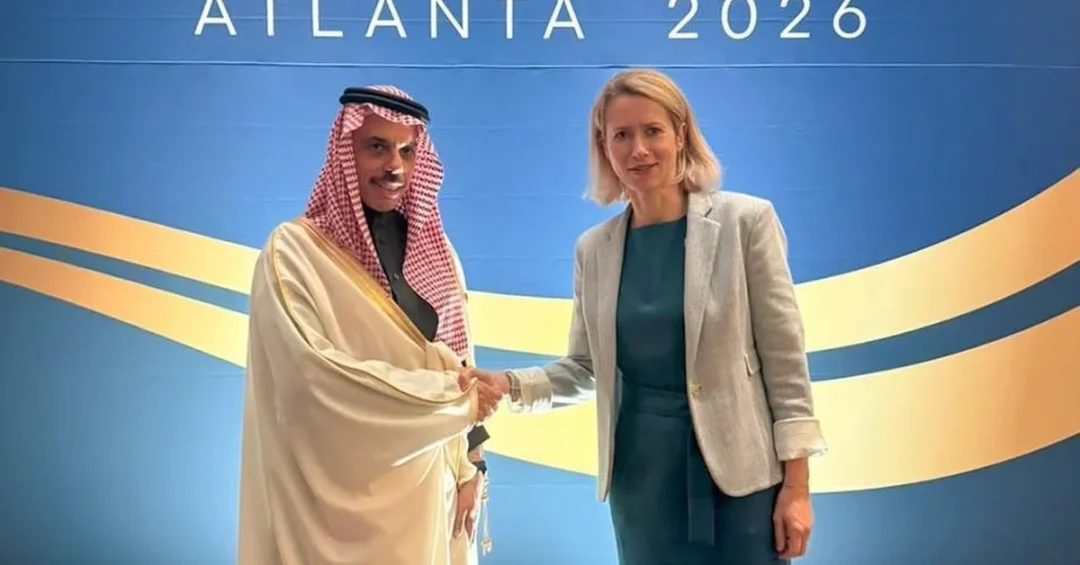
Saudi Minister of Foreign Affairs Prince Faisal bin Farhan bin Abdullah met with Kaja Kallas, High Representative of the European Union for Foreign Affairs and Security Policy and Vice-President of the European Commission, on the sidelines of the G20 Foreign Ministers’ Meeting in Atlanta, United States, on October 31, 2026, according to the Saudi Press Agency. The two senior diplomats discussed the latest regional and international developments and underscored the importance of achieving regional security and stability, SPA reported.
The meeting reflects Saudi Arabia’s continuing diplomatic engagement at the highest levels and its commitment to constructive dialogue with international partners. It also comes as the Kingdom deepens its ties with European institutions in areas ranging from trade and investment to clean energy and cultural exchange. For observers of Middle East diplomacy, the encounter signals that Riyadh remains a central interlocutor on issues of war and peace, even as it pursues an ambitious domestic transformation agenda.
Context and Background
Why did this meeting attract attention beyond the usual diplomatic calendar? The G20 Foreign Ministers’ Meeting in Atlanta brought together top diplomats from the world’s major economies at a time of heightened geopolitical tension, from conflicts in the Middle East to energy security concerns in Europe. Against that backdrop, the exchange between Prince Faisal bin Farhan and Kaja Kallas carried weight that transcended a routine bilateral photo opportunity.
Saudi Arabia has long positioned itself as a bridge between the Global South and the industrialized world. As the custodian of Islam’s holiest sites and the world’s largest exporter of crude oil, the Kingdom’s voice resonates in both energy markets and diplomatic forums. Its participation in the G20, a group that accounts for roughly 85 percent of global GDP, underscores its economic and political relevance. The meeting with the EU’s top diplomat also highlights the growing institutional relationship between Riyadh and Brussels.
Kaja Kallas, a former Prime Minister of Estonia, assumed her role as the EU’s High Representative for Foreign Affairs and Security Policy in 2024. Since then, she has engaged with Gulf partners on a range of issues, including sanctions policy, humanitarian access, and maritime security. Her meeting with Prince Faisal bin Farhan is part of a broader pattern of intensified EU-Gulf diplomacy, which both sides see as essential for managing crises that no single region can address alone.
Key Details
What exactly did the two officials discuss? According to the Saudi Press Agency, Prince Faisal bin Farhan and Kaja Kallas reviewed the latest regional and international developments. They stressed the importance of achieving regional security and stability, a phrase that in Saudi diplomatic language encompasses efforts to de-escalate conflicts, counter terrorism, and promote peaceful resolution of disputes. The conversation likely touched on the humanitarian situation in Gaza, the fragile ceasefire in Lebanon, and the ongoing crisis in Sudan, though SPA did not disclose specific agenda items.
The meeting also served as an opportunity to reinforce the strategic partnership between Saudi Arabia and the European Union. In recent years, the two sides have held regular summits and signed cooperation agreements on energy transition, digital economy, and counterterrorism. The EU is a major trading partner for the Gulf Cooperation Council, and Saudi Arabia is its largest GCC trading partner. In 2025, bilateral trade in goods between the EU and Saudi Arabia exceeded 70 billion euros, according to European Commission data.
Beyond economics, the encounter highlighted personal diplomacy. Prince Faisal bin Farhan, a seasoned diplomat who has served as foreign minister since 2019, is known for his measured approach and his role in articulating Saudi Arabia’s foreign policy priorities. Kaja Kallas, for her part, has been a vocal advocate of European unity on foreign affairs. Their meeting in Atlanta suggests that both sides value direct, high-level communication as a tool for bridging differences and identifying common ground.
International and Regional Impact
Can one meeting between two diplomats truly move the needle on global stability? In the case of Saudi-EU relations, the answer is a qualified yes. The Atlanta encounter reinforces a trend of deepening engagement that has produced tangible outcomes: Saudi Arabia and the EU have cooperated on humanitarian aid deliveries, joint counterterrorism exercises, and climate finance initiatives. By keeping communication channels open at the foreign minister level, both sides are better positioned to respond quickly to emerging crises.
Regionally, the meeting sends a signal that Saudi Arabia remains committed to de-escalation. The Kingdom has in recent years pursued a policy of dialogue with adversaries and partners alike, including the restoration of ties with Iran and the hosting of talks between conflicting parties in Yemen. European diplomats view this posture favorably, as it reduces the risk of wider conflagration and creates space for humanitarian and reconstruction efforts. The EU, with its own interests in energy security and migration, benefits from a stable Gulf.
Internationally, the meeting illustrates the multipolar nature of today’s diplomacy. The United States remains a key security guarantor in the Gulf, but the EU, China, and other powers are increasingly active players. Saudi Arabia’s ability to maintain productive relations with all of them is a diplomatic asset. The Atlanta meeting is a case in point: it took place on U.S. soil, yet focused on Saudi-EU coordination, a testament to Riyadh’s diversified foreign policy.
Economic and Strategic Significance
What economic stakes lie beneath the diplomatic pleasantries? For Saudi Arabia, the European Union is not just a trading partner but also a source of foreign direct investment and technological expertise. European companies are involved in major Saudi projects, from renewable energy installations to smart city infrastructure. The Kingdom’s Vision 2030 economic diversification plan relies in part on such partnerships to build new industries and create jobs for a young population.
For the EU, Saudi Arabia is a critical supplier of energy, particularly as Europe seeks to replace Russian fossil fuels. Although the share of oil in EU energy imports has declined amid the green transition, Saudi crude remains a reliable component of the mix. Moreover, the Kingdom is investing heavily in hydrogen and other clean energy sources, areas where European firms see commercial opportunities. The meeting in Atlanta, while primarily political, indirectly supports these economic linkages by maintaining a stable diplomatic environment.
Strategically, the encounter also touches on security cooperation. Both Saudi Arabia and the EU have a shared interest in combating terrorism, preventing the proliferation of weapons of mass destruction, and securing maritime routes in the Red Sea and the Gulf. The Houthi attacks on shipping in the Red Sea have disrupted global trade and prompted joint efforts to protect navigation. Coordination between Riyadh and Brussels on such matters is essential, and the Atlanta meeting provided a venue to align positions.
Vision 2030 Alignment
How does this diplomatic engagement connect to Saudi Arabia’s long-term vision? Vision 2030, launched by Crown Prince Mohammed bin Salman in 2016, is a comprehensive plan to transform the Kingdom’s economy and society. A key pillar is to strengthen Saudi Arabia’s international standing and attract foreign investment. High-level meetings like the one between Prince Faisal bin Farhan and Kaja Kallas help build the trust and networks necessary to achieve those goals.
Moreover, the meeting reflects the Vision’s emphasis on proactive diplomacy. Saudi Arabia is no longer content to react to events; it seeks to shape them. By engaging with the EU on regional security, the Kingdom positions itself as a responsible global actor and a partner in solving shared challenges. This aligns with the Vision’s aim to make Saudi Arabia a hub for trade, tourism, and innovation, connected to the world through robust diplomatic and economic ties.
In the final analysis, the meeting in Atlanta is a small but meaningful step in Saudi Arabia’s journey toward a more diversified and influential future. It demonstrates that the Kingdom’s foreign policy is not only about managing crises but also about building partnerships that advance prosperity and stability. As Vision 2030 enters its second decade, such engagements will remain central to Saudi Arabia’s global role.
20 Questions
Q1. Who represented Saudi Arabia at the G20 Foreign Ministers’ Meeting in Atlanta?
A1. Saudi Arabia was represented by Minister of Foreign Affairs Prince Faisal bin Farhan bin Abdullah, who led the Kingdom’s delegation and held bilateral meetings on the sidelines of the main event.
Q2. Who did Prince Faisal bin Farhan meet with on the sidelines?
A2. He met with Kaja Kallas, the High Representative of the European Union for Foreign Affairs and Security Policy and Vice-President of the European Commission.
Q3. Where and when did the meeting take place?
A3. The meeting took place in Atlanta, United States, on October 31, 2026, on the sidelines of the G20 Foreign Ministers’ Meeting, according to the Saudi Press Agency.
Q4. What was the main topic of discussion?
A4. They discussed the latest regional and international developments and stressed the importance of achieving regional security and stability.
Q5. What is the G20 Foreign Ministers’ Meeting?
A5. The G20 Foreign Ministers’ Meeting is a gathering of top diplomats from the world’s major economies to discuss global issues, held as part of the broader G20 process that coordinates economic and political policy.
Q6. Why is Saudi Arabia’s participation significant?
A6. Saudi Arabia is a leading global energy exporter and a key player in Middle East diplomacy, so its participation signals its commitment to international cooperation and its role in shaping global discussions.
Q7. What is the European Union’s interest in the Gulf region?
A7. The EU seeks stable energy supplies, security cooperation, and trade opportunities in the Gulf, making dialogue with Saudi Arabia a priority for its foreign policy.
Q8. How does this meeting align with Saudi Vision 2030?
A8. Vision 2030 aims to strengthen Saudi Arabia’s global engagement and economic diversification, and high-level diplomatic meetings like this help build partnerships that support those goals.
Q9. Did the meeting produce any specific agreements?
A9. The Saudi Press Agency report did not mention any new agreements, but the discussion focused on regional security and stability, which are ongoing areas of cooperation.
Q10. What regional issues might have been discussed?
A10. Likely topics included the humanitarian situation in Gaza, the crisis in Sudan, maritime security in the Red Sea, and broader efforts to de-escalate tensions in the Middle East.
Q11. How does Saudi Arabia view its relationship with the EU?
A11. Saudi Arabia views the EU as a strategic partner in trade, investment, and diplomacy, and it seeks to deepen cooperation on mutual interests such as energy transition and counterterrorism.
Q12. What is Kaja Kallas’s role in the EU?
A12. Kaja Kallas serves as the EU’s High Representative for Foreign Affairs and Security Policy and Vice-President of the European Commission, making her the bloc’s top diplomat.
Q13. What economic ties exist between Saudi Arabia and the EU?
A13. The EU is a major trading partner for Saudi Arabia, with bilateral trade in goods exceeding 70 billion euros in 2025, and European companies invest in Saudi projects across various sectors.
Q14. How does this meeting fit into Saudi Arabia’s broader foreign policy?
A14. It reflects Saudi Arabia’s strategy of active diplomacy, engaging with both Eastern and Western powers to promote stability and advance its economic and security interests.
Q15. What is the significance of meeting on the sidelines of the G20?
A15. Sideline meetings allow leaders to hold focused bilateral discussions without the formal constraints of the main agenda, often leading to more candid exchanges and practical outcomes.
Q16. Has Saudi Arabia hosted similar diplomatic engagements recently?
A16. Yes, Saudi Arabia regularly hosts and participates in international diplomatic events, including recent summits and conferences that bring together global leaders to address regional challenges.
Q17. What role does the Saudi Press Agency play in reporting such meetings?
A17. The Saudi Press Agency is the official news agency of the Kingdom, providing authoritative and timely reports on government activities and diplomatic engagements.
Q18. How might this meeting affect EU-Gulf relations?
A18. It reinforces the positive trajectory of EU-Gulf relations, building trust and facilitating cooperation on shared challenges such as security, trade, and climate change.
Q19. What are the next steps following this meeting?
A19. Both sides are expected to continue dialogue through regular diplomatic channels and upcoming multilateral events, advancing coordination on issues discussed in Atlanta.
Q20. Why is regional security and stability a priority for Saudi Arabia?
A20. Regional security and stability are essential for Saudi Arabia’s economic development, social progress, and the success of Vision 2030, which depends on a peaceful and prosperous neighborhood.
Reader Feedback
We value your thoughts. Please share your feedback on this article.
Your feedback helps us improve our coverage.
Related articles
 Saudi Vice Minister Meets EU Gulf Envoy in Manama
 Saudi, Canada FMs Condemn Houthi Attacks at G20
 Coalition Intercepts UAV in Eastern Region, Safeguarding Saudi Skies
 Saudi-Qatari Diplomacy Strengthened at Manama Dialogue
 NCM Warns of Thunderstorms in Northern Borders Region
 Hail Region Experiences Moderate to Heavy Rainfall