


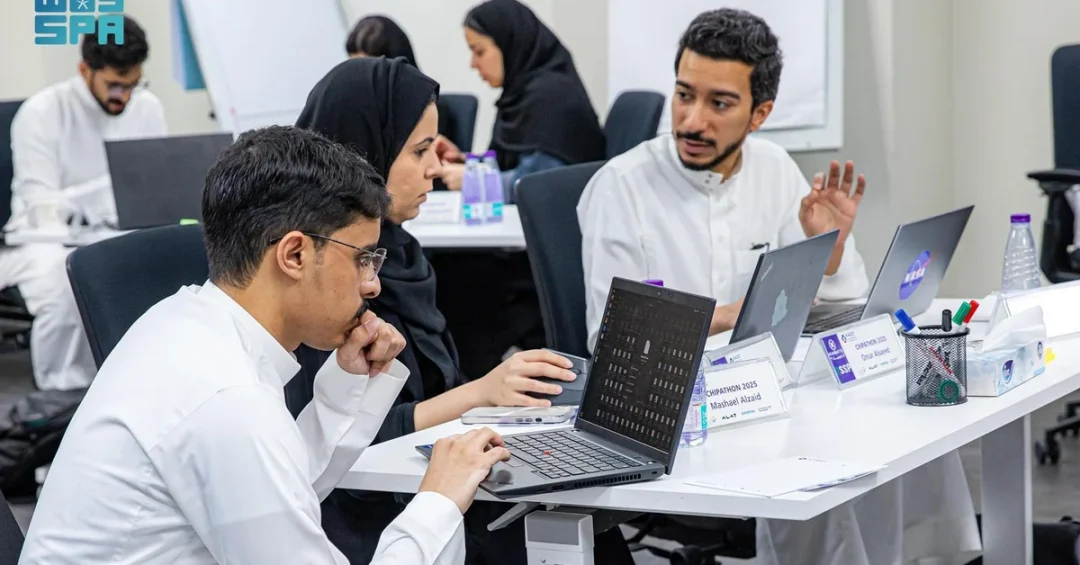
Saudi Arabia launched its first hackathon dedicated to semiconductor integrated circuit design on April 20, 2025, in Riyadh. The event, known as the “Chipathon,” was organized by King Abdulaziz City for Science and Technology (KACST) at its headquarters in the Saudi capital, in collaboration with King Abdullah University of Science and Technology (KAUST), with sponsorship from ALAT, Siemens, and CDT Holding. The initiative signals a decisive step in the Kingdom’s drive to build a self-sustaining semiconductor ecosystem and to cultivate a new generation of national engineering talent.
The launch reflects a broader national ambition to localize one of the most strategically vital technology sectors of the modern economy. Supervised by the Saudi Semiconductors Program (SSP) and Academy 32, the Chipathon is designed to strengthen the capabilities of participants in integrated circuit design and to equip young Saudi talent with practical scientific expertise using design tools that comply with international standards. Could a single competition become the seedbed for an entire national industry?
What Does the Chipathon Aim to Achieve?
The primary objectives of the Chipathon are both educational and strategic. Organizers intend to enhance the national human capacity of participants in integrated circuit design, enabling talented students to acquire hands-on scientific expertise with world-class tools. The event also seeks to establish a national pool of engineers and designers specializing in electronic chips, a resource that will be essential as the Kingdom expands its technological self-reliance.
The competition attracted remarkable interest from across the country’s academic landscape. More than 700 male and female students from 31 Saudi universities applied to participate, demonstrating the depth of youthful enthusiasm for advanced technology. Of these, over 250 students representing 25 Saudi universities qualified to take part in the hackathon. Why has semiconductor design captured the imagination of so many young Saudis? The answer lies in the sector’s centrality to the technologies of the future, from smart devices to industrial automation.
Participants are undergoing an intensive 20-hour training program using globally recognized Siemens tools, a component that ensures their skills align with international industry benchmarks. This training phase is not merely instructional; it is a proving ground. From this group, 30 participants divided into 10 teams will be selected to advance to the final stage, where they will apply their knowledge to concrete design challenges.
How Will the Competition Unfold?
The structure of the Chipathon is designed to mirror the realities of professional chip development. During the final phase, the 10 qualifying teams will develop innovative solutions to address real-world challenges in chip design that were previously presented by ALAT. These challenges are grounded in practical applications, most notably Internet of Things (IoT) applications, which are increasingly central to modern infrastructure, manufacturing, and consumer technology.
The solutions produced by the teams will be evaluated by a panel of expert judges comprising leading local and international specialists in the semiconductor industry. This evaluation model ensures that participants receive feedback aligned with global standards while also exposing them to the expectations of the professional marketplace. What better way to prepare young engineers than to have their work scrutinized by the very experts who shape the industry?
The competition thus functions as more than an academic exercise. It creates a direct bridge between university learning and industry practice, allowing students to demonstrate their abilities in front of potential employers and partners. The teams that advance will gain not only recognition but also the kind of practical experience that is difficult to replicate in a traditional classroom setting.
Why Does Semiconductor Localization Matter for Saudi Arabia?
Semiconductors sit at the heart of the global digital economy, powering everything from smartphones and automobiles to data centers and advanced medical equipment. For Saudi Arabia, building domestic capability in this field is a matter of strategic and economic importance. The Chipathon is one of the national initiatives through which KACST seeks to localize semiconductor technologies, reducing reliance on imports and positioning the Kingdom as a producer, not merely a consumer, of critical technology.
KACST has launched the Saudi Semiconductors Program (SSP) to support research and development as well as human resources development. It has also introduced the semiconductor incubator program known as “Ignition” to support entrepreneurs and incubate startups in the field. These complementary initiatives form a coherent ecosystem, linking education, research, and entrepreneurship. Can a nation truly localize a high-tech industry without nurturing startups alongside large institutions? The Kingdom’s approach suggests it intends to do both.
To further localize the semiconductor industry, KACST also founded the National Capabilities Center for Semiconductors in partnership with KAUST. In addition, it established a joint master’s program in semiconductors to qualify male and female students through blended learning, in partnership with Princess Nourah bint Abdulrahman University and the University of California, Los Angeles. These partnerships reflect a deliberate strategy of combining domestic institutions with international expertise to accelerate national capacity building.
What Is the Regional and International Significance?
The Chipathon positions Saudi Arabia as an emerging player in a global semiconductor landscape that has become increasingly competitive. By bringing together Saudi universities, international technology firms such as Siemens, and industry sponsors such as ALAT and CDT Holding, the event demonstrates the Kingdom’s ability to convene cross-sector collaboration around a shared strategic goal. This is not an isolated academic exercise but a signal of intent to the international technology community.
The involvement of international partners underscores the Kingdom’s openness to global cooperation in advanced technology. Siemens, a globally recognized leader in industrial software and design tools, provides the platform on which participants hone their skills, linking Saudi talent to internationally accepted standards. Meanwhile, the partnership with the University of California, Los Angeles, in the master’s program demonstrates a commitment to academic exchange at the highest level. How does a nation build credibility in a complex field? By consistently investing in people and partnerships, as this initiative demonstrates.
For the wider region, a Saudi Arabia with growing semiconductor capabilities contributes to diversification and technological resilience. As the Kingdom develops a skilled workforce in this field, it strengthens its position as a regional hub for innovation and advanced manufacturing, a role that carries implications for trade, investment, and knowledge transfer across the Middle East.
What Are the Economic and Strategic Stakes?
The semiconductor sector is among the most economically significant industries in the world, and the Kingdom’s determination to develop national competencies in this field is closely tied to its long-term economic vision. By equipping students with design skills and connecting them with industry challenges, the Chipathon directly supports the creation of high-value jobs and the growth of a knowledge-based economy. Participants who complete the program emerge with skills that are in demand globally, not just locally.
The strategic dimension is equally important. Semiconductor technology underpins defense, communications, energy systems, and digital infrastructure. Developing a domestic talent pool reduces dependency on foreign expertise over time and builds a foundation for future research, design, and potentially manufacturing capabilities. What does it mean for a country to control more of the value chain in critical technology? For Saudi Arabia, it means greater economic security and a stronger voice in the global technology conversation.
The involvement of sponsors such as ALAT, a company focused on advanced technologies, signals that the private sector is actively investing in this vision. By presenting real-world challenges to the participants, ALAT ensures that the competition is aligned with genuine industry needs, increasing the likelihood that the solutions developed will have practical relevance and commercial potential.
How Does the Chipathon Align With Vision 2030?
The organization of the Chipathon comes as part of the Kingdom’s efforts to qualify national competencies in semiconductor technology, one of the most vital sectors under Vision 2030. The initiative aims to transform Saudi Arabia into an advanced regional hub in semiconductor technologies, in line with the broader goals of economic diversification, talent development, and technological leadership. Who could doubt that investing in youth and advanced technology is central to the Kingdom’s future?
Through KACST and its partners, Saudi Arabia is building an integrated pathway from education to employment to entrepreneurship. The combination of the Chipathon, the National Capabilities Center for Semiconductors, the Ignition incubator program, and the joint master’s program demonstrates a comprehensive approach. As the first cohort of Chipathon participants move into the final stage and beyond, they represent the human foundation of a sector that the Kingdom intends to lead. The message is clear: Saudi Arabia is not merely preparing for the technology of tomorrow; it is helping to build it.
20 Questions
Q1. What is the Chipathon?
A1. The Chipathon is Saudi Arabia’s first hackathon focused on semiconductor integrated circuit design, organized by KACST in Riyadh in collaboration with KAUST and sponsored by ALAT, Siemens, and CDT Holding.
Q2. When did the Chipathon begin?
A2. The event started on April 20, 2025, at the headquarters of King Abdulaziz City for Science and Technology in Riyadh, marking the Kingdom’s first competition of its kind in semiconductor design.
Q3. Who organized the Chipathon?
A3. It was organized by King Abdulaziz City for Science and Technology in collaboration with King Abdullah University of Science and Technology, with sponsorship from ALAT, Siemens, and CDT Holding.
Q4. Which programs supervised the event?
A4. The Chipathon was supervised by the Saudi Semiconductors Program and Academy 32, both of which support the development of national capabilities in semiconductor technology and design.
Q5. How many students applied to participate?
A5. More than 700 male and female students from 31 Saudi universities applied to participate in the Chipathon, reflecting strong national interest in semiconductor design.
Q6. How many students qualified for the hackathon?
A6. Over 250 male and female students representing 25 Saudi universities qualified to participate in the hackathon, after a competitive selection process among applicants.
Q7. What is the main goal of the Chipathon?
A7. It aims to enhance national human capacity in integrated circuit design, help talent acquire scientific expertise using internationally compliant design tools, and build a national pool of engineers and designers.
Q8. What training do participants receive?
A8. Participants undergo an intensive 20-hour training program using globally recognized Siemens tools, equipping them with skills aligned with international industry standards.
Q9. How many participants advance to the final stage?
A9. Thirty participants divided into 10 teams will be selected to advance to the final stage of the Chipathon after completing the training phase.
Q10. What challenges do finalist teams address?
A10. The teams develop innovative solutions to real-world challenges in chip design previously presented by ALAT, focusing notably on Internet of Things applications.
Q11. Who evaluates the teams’ solutions?
A11. A panel of expert judges comprising leading local and international specialists in the semiconductor industry evaluates the solutions developed by the competing teams.
Q12. Which applications are especially emphasized?
A12. Internet of Things applications are among the most notable focus areas, given their growing importance in infrastructure, manufacturing, and consumer technology.
Q13. What is the Saudi Semiconductors Program?
A13. Launched by KACST, the Saudi Semiconductors Program supports research and development as well as human resources development to advance the Kingdom’s semiconductor capabilities.
Q14. What is the Ignition program?
A14. Ignition is a semiconductor incubator program launched by KACST to support entrepreneurs and incubate startups in the field of semiconductor technology.
Q15. What did KACST establish with KAUST?
A15. KACST founded the National Capabilities Center for Semiconductors in partnership with KAUST to further localize the semiconductor industry in the Kingdom.
Q16. Which universities partner in the joint master’s program?
A16. The joint master’s program in semiconductors partners Princess Nourah bint Abdulrahman University and the University of California, Los Angeles, using blended learning.
Q17. Why is semiconductor technology important for Vision 2030?
A17. Semiconductor technology is one of the most vital sectors under Vision 2030, supporting the Kingdom’s goal of becoming an advanced regional hub in semiconductor technologies.
Q18. How does the Chipathon support the local economy?
A18. By equipping students with in-demand design skills and connecting them with industry challenges, the Chipathon supports the creation of high-value jobs and a knowledge-based economy.
Q19. What role do sponsors such as ALAT play?
A19. Sponsors such as ALAT present real-world design challenges to participants, ensuring the competition aligns with genuine industry needs and increases the practical relevance of solutions.
Q20. What does the Chipathon signal for Saudi Arabia’s future?
A20. The Chipathon signals Saudi Arabia’s commitment to building a self-sustaining semiconductor ecosystem and positioning itself as a regional leader in advanced technology and innovation.
Reader Feedback
We value your thoughts. Please share your feedback on this article.
Your feedback helps us improve our coverage.
Related articles
 CODE to Host ‘Your AI, Your Rules’ Workshop in Riyadh
 GEOSA Sponsors Geospatial World Forum 2025 in Madrid
 Estidamah Produces 73,000 Seedlings via Tissue Culture in 2024
 Saudi Arabia Ranks 9th Globally in Geospatial Readiness
 Sunspots Appear Over Northern Borders Before Dusk
 Saudi Arabia, India Strengthen Space Cooperation