


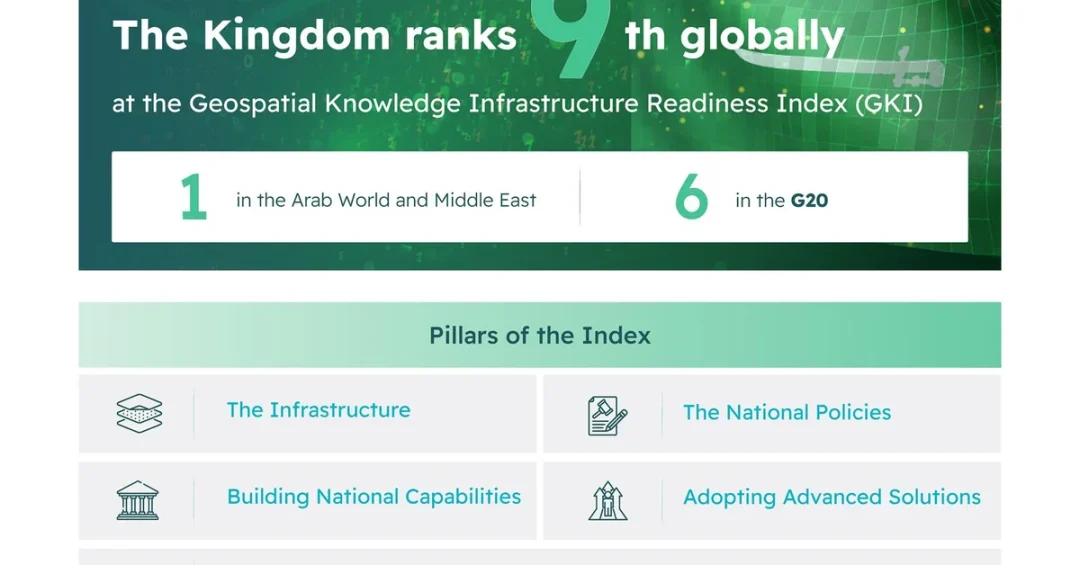
Saudi Arabia has advanced from 32nd place in 2022 to 9th globally in the 2025 Geospatial Knowledge Infrastructure (GKI) Readiness Index, ranking first in the Middle East and the Arab world and sixth among G20 nations. The announcement, made by the General Authority for Survey and Geospatial Information (GEOSA) during the first day of the Geospatial World Forum 2025 in Madrid, Spain, marks a significant milestone in the Kingdom’s rapid development of geospatial knowledge infrastructure. The forum, held from April 22 to 25, brought together global experts and policymakers to discuss the future of geospatial data and its role in sustainable development.
How did a nation once ranked 32nd in geospatial readiness leapfrog dozens of advanced economies in just three years? The answer lies in a combination of visionary leadership, strategic investment, and a comprehensive national approach to geospatial information management. According to a press release issued by GEOSA, the GKI Readiness Index is a strategic framework supported by the United Nations Statistics Division that compares countries’ readiness to adopt geospatial knowledge and measures how their progress promotes economic growth, sustainable development, and digital transformation. Saudi Arabia’s dramatic improvement underscores the Kingdom’s commitment to building a robust geospatial ecosystem that serves government, industry, academia, and society at large.
Context and Background
What exactly is geospatial knowledge infrastructure, and why does it matter for a nation’s development? Geospatial knowledge infrastructure refers to the policies, standards, technologies, and platforms that enable the collection, management, analysis, and dissemination of geographic information. It underpins everything from urban planning and disaster response to environmental monitoring and economic development. The GKI Readiness Index, developed by Geospatial World, assesses countries across multiple axes, including policy, infrastructure, and industry, to gauge their ability to harness geospatial data for national progress.
Saudi Arabia’s journey in this field has been guided by the General Authority for Survey and Geospatial Information (GEOSA), which was established to organize and develop the survey, geospatial information, and imaging sector. GEOSA’s mandate includes adopting and developing the national geospatial infrastructure, setting basic and guiding standards, and ensuring integrated use of geospatial information across all stakeholders. Under the leadership of its Board of Directors, chaired by the Minister of Defense, the authority has worked tirelessly to align national efforts with international best practices. This strategic focus has not only improved the Kingdom’s global standing but also laid the foundation for a knowledge-based economy in line with Vision 2030.
The 2025 GKI Readiness Index results were announced at the Geospatial World Forum 2025 in Madrid, a premier event that gathers geospatial professionals from around the world. Saudi Arabia’s presence at the forum, represented by GEOSA, highlighted the Kingdom’s growing influence in the global geospatial community. The forum provided a platform for Saudi Arabia to showcase its achievements and share its experience in building a comprehensive national geospatial ecosystem. This international recognition is a testament to the Kingdom’s sustained efforts to advance its geospatial capabilities and contribute to global geospatial knowledge.
Key Details of the Ranking
How did Saudi Arabia perform across the specific axes of the GKI Readiness Index? The Kingdom ranked sixth globally in the policy axis, reflecting its pioneering experience in governing the national geospatial data system and preparing policies, standards, and specifications in accordance with international best practices. This high ranking demonstrates Saudi Arabia’s commitment to creating a robust legal and regulatory framework that supports the effective use of geospatial information.
In the infrastructure axis, Saudi Arabia ranked seventh globally. This recognition stems from its pivotal role in unifying national efforts related to geospatial information, including the development of the national geospatial platform. This platform serves as the window to the national geospatial infrastructure, making data accessible to the public and private sectors, academia, the non-profit sector, and individuals. By providing a centralized hub for geospatial data, the Kingdom has enabled a wide range of users to leverage this information for innovation and decision-making.
Furthermore, Saudi Arabia ranked eighth in the geospatial industry axis, which highlights its constructive role in building strategic partnerships across all sectors. These partnerships have been instrumental in advancing the geospatial industry, fostering innovation, and creating economic opportunities. The Kingdom’s strong performance across these three axes contributed to its overall ninth-place global ranking, a remarkable achievement that places it ahead of many developed nations.
International and Regional Impact
What does Saudi Arabia’s rise in the GKI Readiness Index mean for the Middle East and the broader international community? As the top-ranked nation in the Middle East and the Arab world, Saudi Arabia has solidified its position as a regional leader in geospatial knowledge. This leadership is expected to inspire neighboring countries to invest in their own geospatial infrastructures, fostering regional cooperation and knowledge sharing. The Kingdom’s success also enhances its ability to contribute to global geospatial initiatives, such as the United Nations Global Geospatial Ecosystem Center of Excellence, which will be headquartered in Riyadh.
The selection of Riyadh as the home of the UN Global Geospatial Ecosystem Center of Excellence is a direct result of Saudi Arabia’s progress in the field. This center will serve as a hub for innovation and best practices in geospatial information management, attracting experts and researchers from around the world. It will also enable the Kingdom to play a leading role in shaping the global geospatial agenda, ensuring that developing countries have access to the tools and knowledge they need to benefit from geospatial data. This development further cements Saudi Arabia’s status as a global leader in geospatial information management.
Internationally, Saudi Arabia’s improved ranking sends a strong signal that the Kingdom is a reliable partner in the digital age. By investing in geospatial infrastructure, Saudi Arabia is not only advancing its own development but also contributing to global efforts to achieve the Sustainable Development Goals. Geospatial data is critical for monitoring progress on issues such as climate change, urbanization, and disaster risk reduction. The Kingdom’s expertise and resources will be invaluable in these global endeavors.
Economic and Strategic Significance
Why is geospatial knowledge infrastructure so important for Saudi Arabia’s economic diversification and strategic goals? Geospatial data underpins a wide range of economic activities, from construction and real estate to transportation and logistics. By building a comprehensive national geospatial platform, Saudi Arabia is enabling businesses to make more informed decisions, optimize operations, and develop new products and services. This, in turn, stimulates innovation and economic growth, creating jobs and attracting investment.
Moreover, geospatial infrastructure is essential for the efficient delivery of government services. From urban planning to environmental management, geospatial data helps public agencies allocate resources effectively and respond to challenges in real time. The Kingdom’s investment in this area supports the objectives of Vision 2030, which aims to diversify the economy, improve quality of life, and enhance government efficiency. The recognition by the GKI Readiness Index validates these efforts and highlights the tangible benefits of Saudi Arabia’s strategic approach.
Strategically, Saudi Arabia’s leadership in geospatial knowledge enhances its geopolitical influence. In an increasingly data-driven world, countries that control and effectively use geospatial information have a competitive advantage. By ranking first regionally and ninth globally, the Kingdom demonstrates its ability to compete with advanced economies and positions itself as a key player in the global digital economy. This status will help Saudi Arabia attract international partnerships, talent, and investment, further accelerating its development.
Vision 2030 Alignment
How does Saudi Arabia’s geospatial advancement align with the goals of Vision 2030? Vision 2030 is a comprehensive plan to transform the Kingdom into a diversified, innovation-driven economy. Geospatial knowledge infrastructure is a critical enabler of this transformation, providing the data and tools needed for smart city development, sustainable resource management, and enhanced public services. The Kingdom’s progress in the GKI Readiness Index directly supports several Vision 2030 objectives, including the creation of a vibrant society, a thriving economy, and an ambitious nation.
For example, NEOM, the Kingdom’s flagship smart city project, relies heavily on geospatial data for its design and operation. Similarly, initiatives in tourism, such as the Red Sea Project, depend on accurate geospatial information for planning and environmental conservation. By investing in geospatial infrastructure, Saudi Arabia is laying the groundwork for these and other Vision 2030 projects, ensuring they are built on a solid foundation of data-driven decision-making. The recognition from the GKI Readiness Index is a clear indication that the Kingdom is on the right track.
Looking ahead, Saudi Arabia’s continued leadership in geospatial knowledge will be essential for achieving the ambitious goals of Vision 2030. The Kingdom’s commitment to innovation, as demonstrated by its rise in the index, will drive further advancements and ensure that geospatial information benefits all sectors of society. As the world becomes increasingly reliant on geospatial data, Saudi Arabia is well-positioned to remain at the forefront, contributing to global progress while realizing its own vision for a prosperous future.
20 Questions
Q1. What is the Geospatial Knowledge Infrastructure (GKI) Readiness Index?
A1. The GKI Readiness Index is a strategic framework developed by Geospatial World and supported by the United Nations Statistics Division. It compares countries’ readiness to adopt geospatial knowledge and measures how their progress promotes economic growth, sustainable development, and digital transformation.
Q2. How did Saudi Arabia rank in the 2025 GKI Readiness Index?
A2. Saudi Arabia ranked 9th globally, 1st in the Middle East and Arab world, and 6th among G20 nations in the 2025 GKI Readiness Index, a significant improvement from its 32nd global ranking in 2022.
Q3. Which Saudi authority represents the Kingdom in geospatial matters?
A3. The General Authority for Survey and Geospatial Information (GEOSA) represents Saudi Arabia in geospatial matters. It is responsible for organizing and developing the survey, geospatial information, and imaging sector in the Kingdom.
Q4. Where was the 2025 GKI Readiness Index announced?
A4. The 2025 GKI Readiness Index was announced during the first day of the Geospatial World Forum 2025, held in Madrid, Spain, from April 22 to 25, 2025.
Q5. What are the main axes of the GKI Readiness Index?
A5. The GKI Readiness Index is built on several axes, including policy, infrastructure, and geospatial industry. These axes assess different aspects of a country’s geospatial knowledge infrastructure.
Q6. How did Saudi Arabia perform in the policy axis?
A6. Saudi Arabia ranked 6th globally in the policy axis, recognizing its pioneering experience in governing the national geospatial data system and preparing policies, standards, and specifications in accordance with international best practices.
Q7. What is the national geospatial platform?
A7. The national geospatial platform is a window to the national geospatial infrastructure, making geospatial data accessible to the public and private sectors, academia, the non-profit sector, and individuals. It supports integrated use of geospatial information.
Q8. How did Saudi Arabia rank in the infrastructure axis?
A8. Saudi Arabia ranked 7th globally in the infrastructure axis, reflecting its pivotal role in unifying national efforts related to geospatial information, including building the national geospatial platform.
Q9. What is the significance of the geospatial industry axis?
A9. The geospatial industry axis highlights a country’s role in building strategic partnerships across all sectors. Saudi Arabia ranked 8th globally, demonstrating its constructive role in advancing the geospatial industry.
Q10. What support has the geospatial sector received from Saudi leadership?
A10. The geospatial sector has received unlimited support from the wise leadership and the Minister of Defense, who chairs the GEOSA Board of Directors. This support has propelled the Kingdom to a leading position regionally and globally.
Q11. What is the United Nations Global Geospatial Ecosystem Center of Excellence?
A11. The UN Global Geospatial Ecosystem Center of Excellence is a center that will be headquartered in Riyadh. It positions Saudi Arabia as a global leader in innovative geospatial information management and will serve as a hub for best practices.
Q12. How does geospatial knowledge infrastructure promote economic growth?
A12. Geospatial knowledge infrastructure enables informed decision-making, optimizes operations, and fosters innovation across sectors such as construction, transportation, and logistics. It stimulates economic growth by creating jobs and attracting investment.
Q13. What is GEOSA’s mandate?
A13. GEOSA’s mandate includes organizing the survey, geospatial information, and imaging sector; adopting and developing the national geospatial infrastructure; and establishing standards to achieve integrated use of geospatial information among all stakeholders.
Q14. How does Saudi Arabia’s ranking compare to other G20 nations?
A14. Saudi Arabia ranked 6th among G20 nations, ahead of many advanced economies. This demonstrates the Kingdom’s competitive edge in geospatial knowledge infrastructure and its ability to rival developed countries.
Q15. What was Saudi Arabia’s previous ranking in the GKI Readiness Index?
A15. In 2022, Saudi Arabia was ranked 32nd globally. The jump to 9th in 2025 represents a dramatic improvement in just three years, showcasing the Kingdom’s rapid progress.
Q16. How does geospatial data support Vision 2030?
A16. Geospatial data supports Vision 2030 by enabling smart city development, sustainable resource management, and enhanced public services. It is critical for projects like NEOM and the Red Sea Project, ensuring data-driven decision-making.
Q17. What role does the private sector play in Saudi Arabia’s geospatial ecosystem?
A17. The private sector benefits from the national geospatial platform, which provides access to data for innovation and business development. GEOSA builds strategic partnerships with the private sector to advance the geospatial industry.
Q18. What are the implications of Saudi Arabia’s ranking for the Middle East?
A18. Saudi Arabia’s top regional ranking inspires neighboring countries to invest in geospatial infrastructure, fostering regional cooperation and knowledge sharing. It solidifies the Kingdom’s leadership in the Middle East and Arab world.
Q19. How does the GKI Readiness Index support sustainable development?
A19. The index promotes sustainable development by encouraging countries to adopt geospatial knowledge, which is essential for monitoring climate change, urbanization, and disaster risk reduction. It helps track progress on the Sustainable Development Goals.
Q20. What is the Geospatial World Forum?
A20. The Geospatial World Forum is a premier international event that gathers geospatial professionals, policymakers, and experts to discuss the future of geospatial data and its role in sustainable development. The 2025 edition was held in Madrid, Spain.
Reader Feedback
We value your thoughts. Please share your feedback on this article.
Your feedback helps us improve our coverage.
Related articles
 Sunspots Appear Over Northern Borders Before Dusk
 Saudi Arabia, India Strengthen Space Cooperation
 CODE Empowers Entrepreneurs to Master AI with Interactive Workshop
 Saudi Arabia Leads AI Innovation at KAUST Rising Stars 2025
 KAUST Hosts Rising Stars in AI Symposium 2025
 GEOSA Wins Global Geospatial Leadership Award in Spain