


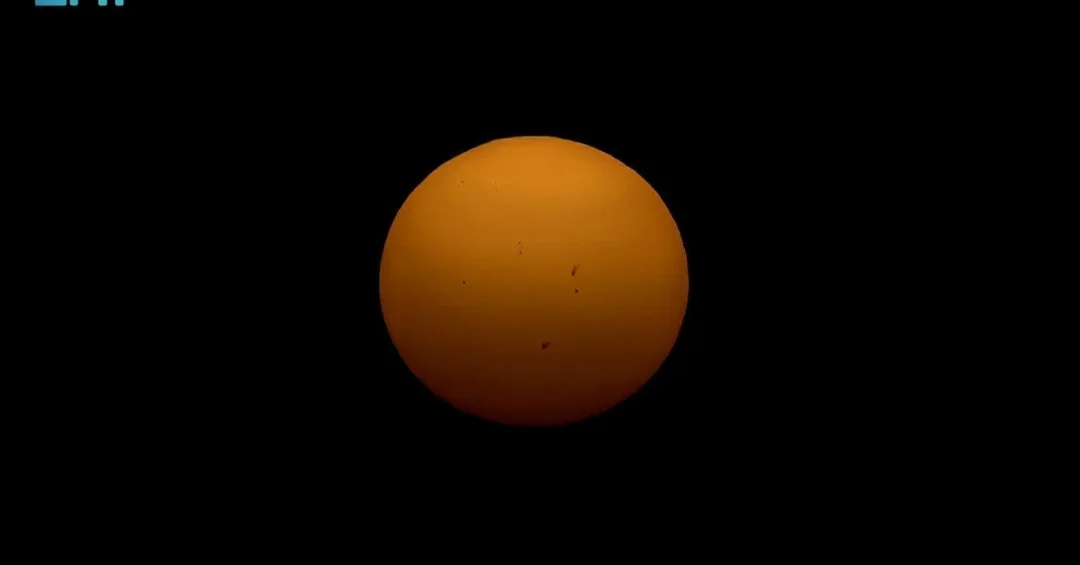
Sunspots were observed on the surface of the sun over Arar in the Northern Borders Region on Tuesday, minutes before sunset, in a phenomenon confirmed by Saudi astronomical observers and reported by the Saudi Press Agency. The observation, made by members of the Astronomy and Space Club, offers a fresh reminder of the Kingdom’s growing role in monitoring solar activity and sharing scientific data with the international community. The event was recorded as part of routine solar surveillance conducted by Saudi enthusiasts and specialists, who track the sun’s behavior across the year.
Have you ever wondered what causes dark patches to appear on the face of the sun? According to the Saudi Press Agency, these sunspots are areas of intense magnetic activity that block the flow of heat from the sun’s interior, making them appear darker than the surrounding surface. The observation in Arar lasted only minutes before dusk, but it provided a valuable window into the dynamic processes that shape space weather and influence conditions on Earth.
Context and Background
Why do sunspots matter to us here on Earth? Sunspots are not merely a curiosity for astronomers; they are markers of the sun’s magnetic cycles, which in turn affect satellite communications, power grids, and even airline navigation. The phenomenon observed in Arar is part of an 11-year solar cycle that has been studied by scientists for centuries. Adnan Al-Ramdoun, a member of the Astronomy and Space Club, explained that the number of spots varies between cycles and can disappear entirely during some periods. This variability is a natural part of the sun’s behavior and is closely monitored by space agencies worldwide.
The Northern Borders Region, with its clear desert skies, has become an increasingly important location for astronomical observation in Saudi Arabia. The Kingdom’s geographical position offers unique advantages for studying the sun and other celestial bodies. In recent years, Saudi Arabia has invested in scientific infrastructure and educational programs that encourage young people to pursue careers in astronomy, space science, and related fields. The observation in Arar is one example of how local initiatives contribute to global scientific knowledge.
How does this event connect to Saudi Arabia’s broader scientific ambitions? The Kingdom’s Vision 2030 reform plan places a strong emphasis on education, innovation, and technological advancement. By fostering a culture of scientific inquiry, Saudi Arabia aims to diversify its economy and create a knowledge-based society. The work of the Astronomy and Space Club aligns with these goals, as it inspires curiosity and provides hands-on experience for aspiring scientists.
Key Details of the Observation
What exactly did the observers see in the sky over Arar? The sunspots appeared as dark, irregularly shaped patches on the sun’s surface, visible only for a brief period before sunset. This timing is significant because observing the sun directly requires special filters or projection techniques to avoid eye damage. The Astronomy and Space Club members used proper equipment to safely document the event. According to Adnan Al-Ramdoun, the spots are often associated with solar storms that can affect the planet, although no immediate impact was reported.
The observation was reported by the Saudi Press Agency, which provides official news and information from the Kingdom. The SPA’s coverage highlights the importance of sharing scientific findings with the public and the international community. By documenting such events, Saudi Arabia demonstrates its commitment to transparency and scientific cooperation. The report also underscores the role of amateur astronomers in contributing to our understanding of the sun.
How do sunspots form, and why do they appear dark? Sunspots are regions where strong magnetic fields inhibit the convection of hot plasma from the sun’s interior to its surface. This reduces the surface temperature in those areas, making them appear darker than the surrounding photosphere. The number and size of sunspots fluctuate over time, following the solar cycle. During periods of high activity, known as solar maximum, sunspots are more frequent and can be accompanied by solar flares and coronal mass ejections.
International and Regional Impact
Could solar activity over Saudi Arabia have implications beyond the Kingdom’s borders? Yes, because the sun’s influence extends across the entire solar system. Solar storms triggered by sunspot activity can disrupt satellite operations, GPS signals, and radio communications. They can also pose risks to astronauts and high-altitude flights. Therefore, monitoring sunspots is a global endeavor, with data shared among space weather forecasting centers worldwide. Saudi Arabia’s contribution to this effort, even through small-scale observations, adds to the collective knowledge base.
Regionally, the observation in Arar may inspire neighboring countries to enhance their own astronomical programs. The Middle East has a rich history of celestial observation, dating back to ancient civilizations. Today, countries in the region are investing in modern observatories and space agencies. Saudi Arabia’s efforts, including the establishment of the Saudi Space Commission in 2018, reflect a renewed focus on space science and exploration. Collaborative projects and data sharing can strengthen regional ties and advance scientific progress.
What role does Saudi Arabia play in the global space community? The Kingdom has been actively participating in international space forums and has signed agreements with space agencies such as NASA and Roscosmos. In 2022, Saudi Arabia announced a national space strategy aimed at fostering innovation, research, and commercial space activities. The strategy aligns with Vision 2030’s goals of economic diversification and technological leadership. By engaging in space science, Saudi Arabia positions itself as a forward-looking nation committed to solving global challenges.
Economic and Strategic Significance
How does a simple sunspot observation relate to economic and strategic interests? Space weather can have significant economic impacts. A severe solar storm could damage satellites, disrupt power grids, and cost billions of dollars in repairs and lost productivity. By monitoring solar activity, countries can take preventive measures to protect critical infrastructure. Saudi Arabia’s investments in space technology and research are part of a broader strategy to safeguard its economic assets and ensure national security.
Furthermore, the development of a domestic space industry creates high-skilled jobs and attracts foreign investment. Vision 2030 aims to increase the private sector’s contribution to the economy and reduce dependence on oil. Space science and technology are key pillars of this diversification. The observation in Arar, while modest, symbolizes the grassroots interest that can grow into a robust space sector. Encouraging young Saudis to pursue STEM education is essential for building a knowledge economy.
What are the next steps for Saudi Arabia in space exploration? The Kingdom has announced plans to send astronauts to space and to develop satellite technologies for communication and Earth observation. In 2023, Saudi Arabia sent its first female astronaut, Rayyanah Barnawi, to the International Space Station. Such achievements inspire the next generation and demonstrate the Kingdom’s capability to compete on a global stage. The sunspot observation is a small but meaningful part of this larger journey.
Vision 2030 Alignment
How does the sunspot observation in Arar align with Vision 2030? Vision 2030 is a comprehensive plan to transform Saudi Arabia’s economy and society. It emphasizes education, innovation, and international cooperation. The Astronomy and Space Club’s activities reflect these values by promoting scientific literacy and hands-on learning. The Kingdom’s investment in space science is a direct expression of its ambition to be a leader in technology and research. Events like this demonstrate that Saudi Arabia is not only a participant in global science but also a contributor.
In conclusion, the appearance of sunspots over the Northern Borders before dusk is a reminder of the wonders of our solar system and the importance of scientific observation. It highlights Saudi Arabia’s growing role in space science and its commitment to Vision 2030. As the Kingdom continues to invest in education and technology, we can expect more such discoveries and contributions to global knowledge. The future looks bright for Saudi Arabia’s scientific community, and the world will be watching.
20 Questions
Q1. What were observed over Arar in the Northern Borders Region?
A1. Sunspots were observed on the sun’s surface over Arar, in the Northern Borders Region, minutes before sunset. The observation was made by members of the Astronomy and Space Club and reported by the Saudi Press Agency.
Q2. What are sunspots?
A2. Sunspots are areas on the sun’s surface with high magnetic activity. This activity hinders the process of convection, causing these areas to appear darker when viewed from Earth.
Q3. Who provided expert commentary on the phenomenon?
A3. Adnan Al-Ramdoun, a member of the Astronomy and Space Club, stated that this phenomenon is part of an 11-year solar cycle. He noted that the number of spots varies between cycles.
Q4. How long do solar cycles last?
A4. Solar cycles last approximately 11 years. During this period, the number of sunspots increases to a maximum and then decreases to a minimum, with some cycles showing very few spots.
Q5. Can sunspots disappear entirely?
A5. Yes, according to Adnan Al-Ramdoun, sunspots can disappear entirely during some periods. This variability is a natural part of the solar cycle and is closely monitored by scientists.
Q6. What are sunspots often associated with?
A6. Sunspots are often associated with solar storms that may affect the planet. These storms can impact satellite communications, power grids, and other technological systems.
Q7. Why do sunspots appear darker than the surrounding areas?
A7. Sunspots appear darker because their strong magnetic fields inhibit the convection of heat from the sun’s interior. This makes those regions cooler and therefore darker than the surrounding photosphere.
Q8. What is the significance of observing sunspots from Saudi Arabia?
A8. Observing sunspots from Saudi Arabia contributes to global space weather monitoring. It also demonstrates the Kingdom’s growing capabilities in astronomy and space science, aligning with Vision 2030 goals.
Q9. How does the observation align with Vision 2030?
A9. The observation aligns with Vision 2030 by promoting scientific education, innovation, and international cooperation. It reflects the Kingdom’s commitment to building a knowledge-based economy and advancing technology.
Q10. What organization was involved in the observation?
A10. The Astronomy and Space Club was involved in the observation. This organization brings together enthusiasts and experts to study celestial phenomena and share their findings with the public.
Q11. When exactly were the sunspots observed?
A11. The sunspots were observed on Tuesday, April 22, 2025, minutes before sunset. The timing allowed for safe viewing and documentation of the event.
Q12. How might solar storms affect Earth?
A12. Solar storms can disrupt satellite operations, GPS signals, and radio communications. They can also pose risks to astronauts and high-altitude flights, and in extreme cases, damage power grids.
Q13. What is the Saudi Press Agency’s role in this report?
A13. The Saudi Press Agency (SPA) is the official news agency of Saudi Arabia. It reported the observation, providing accurate and timely information to the public and international media.
Q14. Are sunspots visible to the naked eye?
A14. Sunspots can be visible to the naked eye only with proper protective filters. Direct viewing of the sun without protection can cause serious eye damage. Observers use special equipment.
Q15. What is the Northern Borders Region known for?
A15. The Northern Borders Region is known for its clear desert skies, making it suitable for astronomical observation. It is also a region of historical and cultural significance in Saudi Arabia.
Q16. How does this observation benefit scientific research?
A16. This observation adds data to the study of solar cycles and space weather. It helps scientists understand the sun’s behavior and improve predictions of solar activity that can affect Earth.
Q17. What other space-related initiatives is Saudi Arabia pursuing?
A17. Saudi Arabia has established the Saudi Space Commission, sent astronauts to space, and launched a national space strategy. These initiatives aim to foster innovation and economic diversification.
Q18. What is the 11-year solar cycle?
A18. The 11-year solar cycle is a periodic change in the sun’s activity, including the number of sunspots and solar flares. It is driven by the sun’s magnetic field and affects space weather.
Q19. How can the public learn more about astronomy in Saudi Arabia?
A19. The public can join organizations like the Astronomy and Space Club, attend observatory events, and follow updates from the Saudi Press Agency and the Saudi Space Commission.
Q20. What does this event say about Saudi Arabia’s future in space science?
A20. This event highlights Saudi Arabia’s growing interest and capability in space science. With continued investment and education, the Kingdom is poised to become a significant contributor to global space exploration.
Reader Feedback
We value your thoughts. Please share your feedback on this article.
Your feedback helps us improve our coverage.
Related articles
 Saudi Arabia, India Strengthen Space Cooperation
 CODE Empowers Entrepreneurs to Master AI with Interactive Workshop
 Saudi Arabia Leads AI Innovation at KAUST Rising Stars 2025
 KAUST Hosts Rising Stars in AI Symposium 2025
 GEOSA Wins Global Geospatial Leadership Award in Spain
 Saudi CHIPATHON Concludes, Advancing Chip Design Talent