


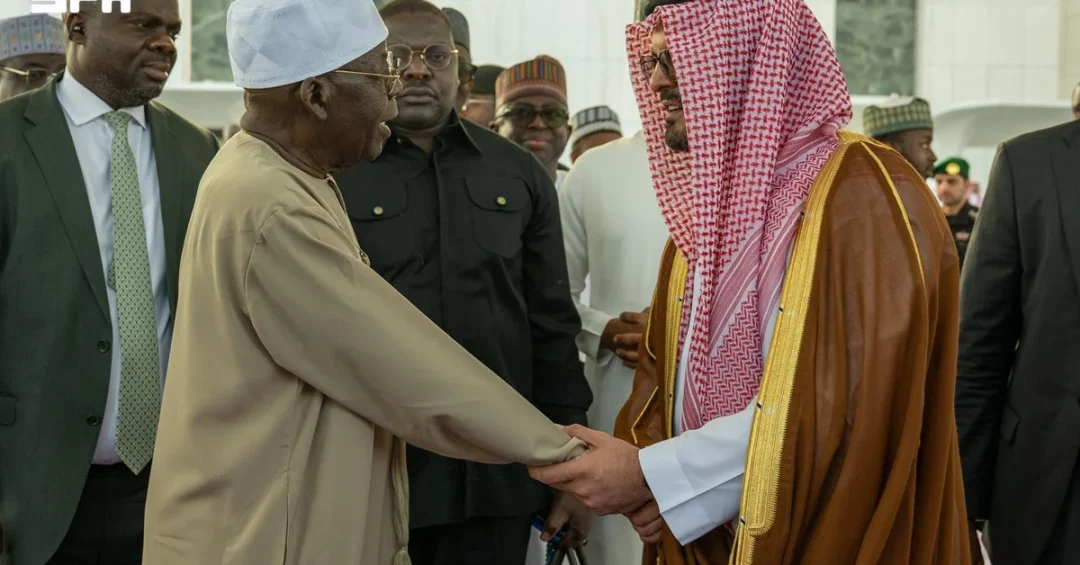
Nigerian President Bola Ahmed Tinubu departed Jeddah on Wednesday, November 4, 2026, following an official visit to the Kingdom of Saudi Arabia, as confirmed by the Saudi Press Agency (SPA). He was seen off at King Abdulaziz International Airport by Prince Saud bin Mishaal bin Abdulaziz, Deputy Governor of Makkah Region, alongside several other senior Saudi officials. The departure marks the conclusion of a visit that underscores the deepening ties between the Federal Republic of Nigeria and the Kingdom of Saudi Arabia, two nations that have steadily expanded cooperation across economic, diplomatic, and cultural domains in recent years. The official send-off, attended by a high-ranking member of the Saudi leadership, reflects the importance Riyadh places on its relationship with Africa’s most populous nation and one of its largest economies.
The visit comes at a time when Saudi Arabia is intensifying its engagement with African partners under the framework of Vision 2030, the Kingdom’s comprehensive reform agenda aimed at diversifying the economy, strengthening international partnerships, and positioning the country as a global hub for trade, investment, and diplomacy. Nigeria, with its population of more than 220 million and its status as a leading oil producer, represents a strategically significant partner for the Kingdom. The presence of Prince Saud bin Mishaal bin Abdulaziz at the airport for the farewell ceremony signals the mutual respect and shared ambition that characterize Saudi-Nigerian relations. What does this departure tell us about the trajectory of Saudi Arabia’s diplomatic outreach to Africa, and how might it shape future collaboration between the two nations?
Context and Background
Have you ever considered how Saudi Arabia’s diplomatic calendar reflects its broader strategic priorities? The departure of President Tinubu from Jeddah is the latest chapter in a long history of Saudi-Nigerian engagement that has grown steadily over the decades. The two countries have maintained formal diplomatic relations since Nigeria gained independence in 1960, and those ties have evolved into a multifaceted partnership encompassing energy cooperation, trade, investment, and cultural exchange. Saudi Arabia has consistently viewed Nigeria as a key ally in West Africa, recognizing its demographic weight, economic potential, and influential role in regional organizations such as the Economic Community of West African States (ECOWAS) and the African Union.
In recent years, the relationship has gained new momentum. Saudi Arabia’s Public Investment Fund (PIF) has explored investment opportunities across Africa, and Nigeria has been a focal point of that outreach. Meanwhile, Nigerian officials have frequently visited the Kingdom to discuss energy collaboration, agricultural development, and infrastructure financing. The Saudi Fund for Development has supported projects in Nigeria in sectors ranging from water and sanitation to education and health. This visit by President Tinubu, though concluded with his departure, is part of that continuous dialogue. How does such sustained engagement benefit both nations in practical terms?
The timing of the visit is also significant. As Saudi Arabia prepares for the post-oil era, it is seeking reliable partners in Africa to secure supply chains, expand export markets, and promote cultural and religious tourism. Nigeria, with its dynamic private sector and growing consumer market, offers a natural complement to the Kingdom’s economic diversification goals. Moreover, the two countries share a commitment to stability in the Sahel and the broader region, making diplomatic coordination essential. The send-off by Prince Saud bin Mishaal bin Abdulaziz, a senior member of the Makkah Region leadership, highlights the Kingdom’s respect for Nigeria’s leadership and its desire to maintain close personal ties at the highest levels.
Key Details
What are the concrete elements of this visit that observers should note? According to the official statement released by the Saudi Press Agency (SPA), President Tinubu’s departure took place at King Abdulaziz International Airport in Jeddah, the Kingdom’s second-largest city and a major gateway for pilgrims and business travelers. The farewell ceremony was attended by Prince Saud bin Mishaal bin Abdulaziz, Deputy Governor of Makkah Region, and several other officials. While the specific agenda of the visit was not detailed in the departure announcement, the presence of such a high-ranking official at the airport indicates the importance Saudi Arabia attaches to the bilateral relationship.
The visit likely included discussions on a range of issues of mutual interest, including energy markets, investment opportunities, and regional security. Nigeria is Africa’s largest oil producer and a member of the Organization of the Petroleum Exporting Countries (OPEC), where Saudi Arabia plays a leading role. Coordination on oil production levels and market stability is therefore a natural topic for Saudi-Nigerian consultations. Additionally, both countries have expressed interest in expanding trade beyond hydrocarbons. Saudi Arabia has identified agriculture, mining, and digital technology as sectors where Nigerian and Saudi businesses can collaborate. The Kingdom’s National Industrial Development and Logistics Program (NIDLP), a key Vision 2030 initiative, aims to boost non-oil exports and could benefit from partnerships with Nigerian firms.
Furthermore, the visit may have touched on cultural and religious ties. Nigeria has a large Muslim population, and thousands of Nigerian pilgrims travel to Saudi Arabia each year for Hajj and Umrah. The Kingdom has invested heavily in expanding the capacity of the Two Holy Mosques and improving services for pilgrims, a priority under Vision 2030. President Tinubu’s visit could have included discussions on facilitating pilgrim travel and enhancing cooperation in religious affairs. Such people-to-people connections form an essential foundation for the broader bilateral relationship. How might these shared religious and cultural bonds further strengthen diplomatic and economic ties?
International and Regional Impact
Why does a presidential departure from Jeddah resonate beyond the two countries involved? Saudi Arabia’s engagement with Nigeria is part of a wider strategy to deepen ties across Africa, a continent that Riyadh views as a land of opportunity for investment, trade, and diplomatic partnership. The Kingdom has hosted numerous African leaders in recent years and has launched initiatives such as the Saudi-African Summit, which aims to foster cooperation on development, security, and cultural exchange. Nigeria, as a regional powerhouse, is a critical partner in this outreach. The visit and departure of President Tinubu therefore signal to other African nations that Saudi Arabia is serious about building long-term, mutually beneficial relationships.
From a regional perspective, closer Saudi-Nigerian ties can contribute to stability in West Africa and the Sahel, areas that have faced security challenges in recent years. Saudi Arabia has consistently supported peace and development initiatives in the region, and cooperation with Nigeria could enhance those efforts. Economically, increased Saudi investment in Nigeria could spur job creation and infrastructure development, complementing Nigeria’s own economic reform agenda. For Saudi Arabia, a stronger partnership with Nigeria opens access to a vast market and strengthens its position as a global investor. In a world of shifting alliances, the Saudi-Nigerian relationship stands out as a model of South-South cooperation. What lessons can other nations draw from this partnership?
Economic and Strategic Significance
How does the Saudi-Nigerian relationship align with the Kingdom’s economic vision? Central to Saudi Arabia’s strategy is the diversification of its economy away from oil, as outlined in Vision 2030. Nigeria, with its own aspirations to diversify beyond oil, shares this goal. The two countries can collaborate on renewable energy, technology, and agriculture, among other sectors. Saudi Arabia’s NEOM project, a futuristic city and economic zone, represents the Kingdom’s ambition to lead in innovation and sustainability. Nigerian entrepreneurs and investors could find opportunities to participate in NEOM’s development, while Saudi companies could explore Nigeria’s growing tech ecosystem, particularly in Lagos and Abuja.
Trade between Saudi Arabia and Nigeria has been growing, though it remains below its potential. According to Saudi official data, non-oil trade between the two countries has increased in recent years, driven by exports of petrochemicals, plastics, and machinery from Saudi Arabia and agricultural products from Nigeria. There is room to expand this further, especially in sectors such as halal food, pharmaceuticals, and financial services. The Saudi private sector, encouraged by government incentives under Vision 2030, is increasingly looking abroad for partners. Nigeria’s large market and youthful population make it an attractive destination. How can the two countries remove barriers to trade and investment to unlock this potential?
Strategically, Saudi Arabia’s partnership with Nigeria also has a geopolitical dimension. As global powers compete for influence in Africa, Saudi Arabia offers a model of cooperation based on mutual respect and shared development goals. By investing in Nigeria and other African nations, the Kingdom builds goodwill and strengthens its soft power. This approach aligns with the leadership’s vision of a prosperous, interconnected world. The departure of President Tinubu from Jeddah is a small but meaningful event in this larger narrative, symbolizing the continuous and deepening bonds between Saudi Arabia and Nigeria.
Vision 2030 Alignment
How does the visit and departure of President Tinubu connect to Saudi Arabia’s long-term vision? Vision 2030, launched by Crown Prince Mohammed bin Salman in 2016, is a comprehensive plan to transform Saudi society and economy. A key pillar of the vision is to strengthen Saudi Arabia’s role as a global investment powerhouse and a hub connecting three continents: Asia, Europe, and Africa. Nigeria, as Africa’s largest economy and most populous country, is a vital partner in this endeavor. The Kingdom’s efforts to build bridges with African nations through diplomacy, trade, and investment are directly aligned with the vision’s objectives.
Moreover, the vision emphasizes the importance of international cooperation and cultural exchange. The presence of Prince Saud bin Mishaal bin Abdulaziz at the farewell ceremony reflects the Kingdom’s commitment to maintaining high-level engagement with its partners. Such gestures are not merely ceremonial; they reinforce the personal relationships that underpin successful diplomacy. As Saudi Arabia continues to implement Vision 2030, partnerships with countries like Nigeria will play an increasingly important role in achieving the vision’s goals. The departure of President Tinubu is thus not an end but a continuation of a journey toward shared prosperity. What does the future hold for Saudi-Nigerian relations, and how will they contribute to a more interconnected world?
20 Questions
Q1. Who departed Jeddah on November 4, 2026?
A1. President Bola Ahmed Tinubu of the Federal Republic of Nigeria departed Jeddah on November 4, 2026, following an official visit to Saudi Arabia, as reported by the Saudi Press Agency.
Q2. Who saw off President Tinubu at the airport?
A2. Prince Saud bin Mishaal bin Abdulaziz, Deputy Governor of Makkah Region, along with several other officials, saw off President Tinubu at King Abdulaziz International Airport.
Q3. Where did the departure take place?
A3. The departure took place at King Abdulaziz International Airport in Jeddah, the Kingdom’s second-largest city and a major gateway for pilgrims and travelers.
Q4. What is the significance of the send-off by Prince Saud bin Mishaal bin Abdulaziz?
A4. The presence of a high-ranking official like Prince Saud bin Mishaal bin Abdulaziz underscores the importance Saudi Arabia places on its relationship with Nigeria and reflects the strong diplomatic ties between the two nations.
Q5. What is the historical context of Saudi-Nigerian relations?
A5. Saudi Arabia and Nigeria have maintained diplomatic relations since Nigeria’s independence in 1960. Over the decades, ties have expanded to include energy, trade, investment, and cultural cooperation.
Q6. How does this visit relate to Saudi Arabia’s Vision 2030?
A6. The visit aligns with Vision 2030’s goal of strengthening Saudi Arabia’s global partnerships and economic diversification. Nigeria, as a key African economy, is a vital partner in this effort.
Q7. What economic sectors are likely to benefit from Saudi-Nigerian cooperation?
A7. Key sectors include energy, agriculture, mining, digital technology, and infrastructure. Both countries aim to diversify their economies and can collaborate in these areas.
Q8. How many Nigerian pilgrims travel to Saudi Arabia annually?
A8. Thousands of Nigerian pilgrims travel to Saudi Arabia each year for Hajj and Umrah. The Kingdom has invested in expanding capacity and improving services for pilgrims under Vision 2030.
Q9. What role does Nigeria play in OPEC, and how does that affect relations with Saudi Arabia?
A9. Nigeria is a member of OPEC, where Saudi Arabia plays a leading role. Coordination on oil production and market stability is a natural topic for bilateral consultations.
Q10. What is the Saudi Fund for Development’s involvement in Nigeria?
A10. The Saudi Fund for Development has supported projects in Nigeria in sectors such as water, sanitation, education, and health, contributing to Nigeria’s development goals.
Q11. What is the Public Investment Fund’s interest in Africa?
A11. The Public Investment Fund (PIF) has explored investment opportunities across Africa, including Nigeria, as part of Saudi Arabia’s strategy to diversify its investments and strengthen economic ties.
Q12. How does Saudi Arabia’s engagement with Nigeria fit into its broader Africa strategy?
A12. Saudi Arabia views Africa as a land of opportunity and has launched initiatives like the Saudi-African Summit. Nigeria, as a regional powerhouse, is a critical partner in this outreach.
Q13. What are the potential regional security implications of closer Saudi-Nigerian ties?
A13. Closer ties can contribute to stability in West Africa and the Sahel by enhancing cooperation on security and development initiatives, areas where Saudi Arabia has consistently supported peace efforts.
Q14. What is NEOM, and how could Nigeria participate in it?
A14. NEOM is a futuristic city and economic zone in Saudi Arabia. Nigerian entrepreneurs and investors could find opportunities to participate in NEOM’s development, particularly in technology and sustainability.
Q15. What is the volume of trade between Saudi Arabia and Nigeria?
A15. Non-oil trade between the two countries has been growing, driven by Saudi exports of petrochemicals and machinery and Nigerian agricultural products. There is potential for further expansion.
Q16. How does the visit reflect Saudi Arabia’s soft power in Africa?
A16. By investing in Nigeria and engaging at high levels, Saudi Arabia builds goodwill and strengthens its soft power, presenting a model of cooperation based on mutual respect and shared development.
Q17. What is the National Industrial Development and Logistics Program (NIDLP)?
A17. NIDLP is a Vision 2030 initiative aimed at boosting non-oil exports and developing industry and logistics. It could benefit from partnerships with Nigerian firms in various sectors.
Q18. What cultural ties exist between Saudi Arabia and Nigeria?
A18. Cultural ties are strengthened by the large Muslim population in Nigeria and the annual pilgrimage to Saudi Arabia. These people-to-people connections form a foundation for broader bilateral relations.
Q19. How does this visit align with Saudi Arabia’s goal of becoming a global hub?
A19. The visit supports Saudi Arabia’s goal of becoming a global hub connecting Asia, Europe, and Africa by strengthening partnerships with key African nations like Nigeria.
Q20. What is the likely future of Saudi-Nigerian relations?
A20. The future looks promising, with continued cooperation in energy, trade, investment, and culture. Both nations are committed to shared prosperity and regional stability, aligning with Vision 2030.
Reader Feedback
We value your thoughts. Please share your feedback on this article.
Your feedback helps us improve our coverage.
Related articles
 Royal Commission Showcases Makkah Projects at Hajj Expo 2026
 Islamic University of Madinah Hosts Indonesian Ulama Council Delegation
 GCC Legislative Speakers Hold 20th Meeting in Riyadh
 Makkah Digital Talents Exhibition Bridges Training and Jobs
 Citizen Arrested in Jazan for Transporting Border Violators
 GCC Secretary-General: Gulf Legislative Councils Advance Joint Parliamentary Cooperation