


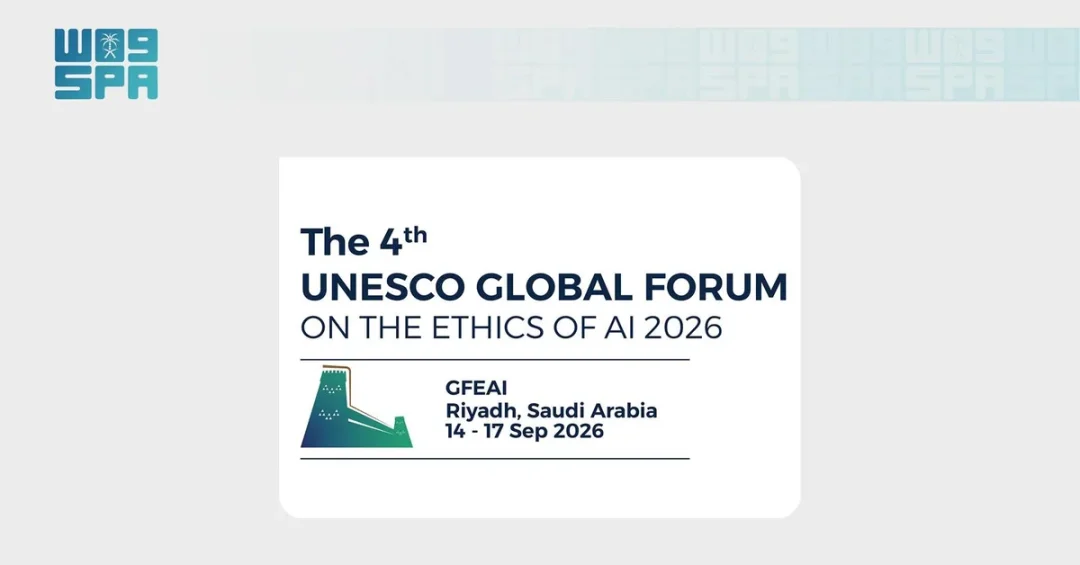
Saudi Arabia hosted the fourth UNESCO Global Forum on the Ethics of Artificial Intelligence (GFEAI 2026) in Riyadh from September 14 to 17, 2026, marking 80 years since the Kingdom joined UNESCO as one of 20 founding countries in London in 1946. The event, the first of its kind in an Arab country, was organized by the Saudi Data and Artificial Intelligence Authority (SDAIA) in partnership with UNESCO, in cooperation with the International Center for AI Research and Ethics (ICAIRE), and in coordination with the Saudi National Commission for Education, Culture and Science. It brought together 60 ministers, heads of delegations, and international organizations, along with 200 speakers, and attracted more than 10,000 visitors. Its program featured more than 100 sessions, workshops, and accompanying events. The forum underscored the Kingdom’s growing role in shaping global AI governance and its commitment to ethical innovation, as outlined in Vision 2030. Could this mark a turning point in how the world approaches AI ethics?
The selection of Riyadh to host GFEAI 2026 reflects the expansion of Saudi Arabia’s partnership with UNESCO into a critical area now high on the organization’s agenda. It also highlights the Kingdom’s support for achieving the UN Sustainable Development Goals (SDGs). The event served as a platform for international dialogue on responsible AI, moving from principles to practical implementation. With the world increasingly reliant on artificial intelligence, Saudi Arabia’s leadership in this domain signals its readiness to contribute to global solutions. How can nations collaborate to ensure AI benefits all of humanity?
Context and Background
Saudi Arabia’s relationship with UNESCO dates back to 1946, when the Kingdom was among 20 countries that gathered in London to establish the organization. Over eight decades, this partnership has evolved across education, culture, science, and now artificial intelligence. The Kingdom has consistently supported UNESCO’s mission, including the achievement of the UN Sustainable Development Goals (SDGs). Hosting GFEAI 2026 from September 14 to 17 was a natural progression of this enduring collaboration, showcasing Saudi Arabia’s commitment to multilateralism and global cooperation. What does this 80-year journey tell us about the Kingdom’s dedication to international institutions?
The forum was organized by SDAIA in partnership with UNESCO, in cooperation with ICAIRE, and in coordination with the Saudi National Commission for Education, Culture and Science. It convened 60 ministers, heads of delegations, and international organizations, along with 200 speakers, and attracted over 10,000 visitors. The program included more than 100 sessions, workshops, and accompanying events, making it a landmark gathering for AI ethics. This scale demonstrates Saudi Arabia’s capacity to host major international events and its growing influence in technology governance. Why is it significant that an Arab country hosted this forum for the first time?
Key Details
A closed ministerial meeting was held as part of GFEAI 2026, with the participation of more than 52 ministers and international representatives. It was followed by a joint international statement issued by Saudi Arabia, UNESCO, and ICAIRE, affirming the importance of using UNESCO’s 2021 Recommendation on the Ethics of AI as the global normative framework. The statement commended the Readiness Assessment Methodology (RAM) and the Ethical Impact Assessment (EIA) as practical tools to support member states in formulating national policies and developing institutional practices. It also called for narrowing gaps in capabilities and infrastructure, promoting responsible innovation, and protecting cultural and linguistic diversity and the rights of children and young people in the digital environment. How can these tools be effectively implemented across diverse nations?
The sessions of GFEAI 2026 examined ways to strengthen responsible governance, risk management, and capacity-building, taking into account differences in countries’ priorities and levels of readiness. They also addressed the impact of technology on scientific research, knowledge production, justice, education, employment, and culture. Other topics included the protection of privacy and rights, the representation of languages and cultures in intelligent systems, and the role of civil society and academia in shaping a more inclusive approach to governance. These discussions reflect a comprehensive approach to AI ethics, ensuring that technological advancement aligns with human values. What role should civil society play in shaping AI governance?
SDAIA outlined its experience in implementing the National Artificial Intelligence Risk Management Framework and the Responsible AI Policy. It also announced the launch of five capacity-building frameworks in data and AI, as well as four professional certifications in data management and governance. The certifications cover data classification, personal data protection, assessment under the National Data Index (NDI), and data quality management. In the linguistic and knowledge fields, the third edition of the Data and Artificial Intelligence Glossary, launched by SDAIA and the King Salman Global Academy for Arabic Language in partnership with ICAIRE, introduced Spanish and added more than 200 new terms. This brought the glossary’s total to over 1,400 terms across four languages. How do such initiatives enhance global understanding of AI terminology?
International and Regional Impact
GFEAI 2026 recognized eight government entities that achieved advanced levels in the first assessment cycle of the National Artificial Intelligence Index (NAII). The Ministry of Energy received recognition in the ‘Excellence’ category, while seven other entities were recognized in the ‘Empowerment’ category. The NAII measures the maturity of government entities in adopting artificial intelligence across seven areas: strategy, governance, data, infrastructure, human capabilities, applications, and impact. This recognition underscores Saudi Arabia’s systematic approach to AI adoption and its commitment to excellence. How can other countries learn from Saudi Arabia’s AI maturity model?
As part of its efforts to develop human capabilities, ICAIRE, in partnership with IBM, launched the third edition of the ‘Elevate’ initiative, which aims to train 25,000 women in AI, and celebrated the graduation of its second cohort. In cooperation with the Islamic World Educational, Scientific and Cultural Organization (ICESCO) and in partnership with the Apolitical platform, ICAIRE also announced a program aimed at training 10,000 public-sector leaders over two years. It also celebrated the graduation of 217 participants from 41 countries and territories in the first cohort of the ‘Applied Ethical AI’ program. These initiatives highlight Saudi Arabia’s investment in human capital and its commitment to inclusive AI development. Why is it crucial to empower women and public-sector leaders in AI?
Economic and Strategic Significance
The outcomes of GFEAI 2026 reflect the expanding international dialogue on AI ethics, moving from the formulation of principles to exploring ways to implement them, and from protecting rights to enabling countries to benefit from the technology responsibly. For Saudi Arabia, this aligns with Vision 2030’s goal of diversifying the economy and fostering innovation. By positioning itself as a leader in AI ethics, the Kingdom attracts global partnerships and investment, while ensuring that technological progress serves societal good. How does ethical AI contribute to sustainable economic growth?
Strategically, hosting GFEAI 2026 strengthens Saudi Arabia’s role as a bridge between developed and developing nations in technology governance. The forum’s emphasis on narrowing capability gaps and promoting responsible innovation resonates with the Kingdom’s own development journey. It also reinforces Saudi Arabia’s soft power and its ability to convene global stakeholders. As AI continues to transform economies, the Kingdom’s proactive stance ensures it remains at the forefront of shaping norms and standards. What does this mean for the future of AI governance in the region?
Vision 2030 Alignment
Saudi Arabia’s hosting of GFEAI 2026 is a testament to the Kingdom’s Vision 2030 ambitions, which prioritize diversification, innovation, and global engagement. The event showcased SDAIA’s National Artificial Intelligence Risk Management Framework and Responsible AI Policy, aligning with Vision 2030’s focus on building a thriving digital economy. The launch of capacity-building frameworks and professional certifications supports the development of a skilled workforce, a key pillar of the vision. By leading in AI ethics, Saudi Arabia not only enhances its global standing but also ensures that its domestic growth is inclusive and sustainable. How does this event exemplify the spirit of Vision 2030?
Furthermore, the forum’s outcomes, including the joint international statement and the recognition of government entities, demonstrate Saudi Arabia’s commitment to international cooperation and excellence. The Kingdom’s partnership with UNESCO and ICAIRE, along with initiatives like the ‘Elevate’ program and the Data and Artificial Intelligence Glossary, underscores its dedication to fostering a knowledge-based society. As Saudi Arabia continues to advance its AI capabilities, it remains focused on ensuring that technology serves humanity and aligns with the ethical principles that UNESCO champions. In doing so, the Kingdom reinforces its role as a responsible global leader in the digital age. What legacy will GFEAI 2026 leave for future generations?
20 Questions
Q1. What is GFEAI 2026?
A1. GFEAI 2026 is the fourth UNESCO Global Forum on the Ethics of Artificial Intelligence, hosted by Saudi Arabia in Riyadh from September 14 to 17, 2026. It focused on responsible AI governance and brought together global leaders and experts.
Q2. Why is Saudi Arabia’s hosting of GFEAI 2026 significant?
A2. It marks the first time an Arab country hosted the forum, highlighting Saudi Arabia’s growing role in global AI ethics and its 80-year partnership with UNESCO. It also showcases the Kingdom’s commitment to Vision 2030.
Q3. How many years has Saudi Arabia been a member of UNESCO?
A3. Saudi Arabia joined UNESCO in 1946, making 2026 the 80th anniversary of its membership. The Kingdom was among 20 founding countries that established the organization in London.
Q4. Who organized GFEAI 2026?
A4. The forum was organized by the Saudi Data and Artificial Intelligence Authority (SDAIA) in partnership with UNESCO, in cooperation with the International Center for AI Research and Ethics (ICAIRE), and in coordination with the Saudi National Commission for Education, Culture and Science.
Q5. What were the key outcomes of GFEAI 2026?
A5. Key outcomes included a joint international statement affirming UNESCO’s 2021 Recommendation on the Ethics of AI, the launch of capacity-building frameworks, and recognition of government entities for AI maturity. It also advanced dialogue on implementing ethical AI principles.
Q6. What is the Readiness Assessment Methodology (RAM)?
A6. RAM is a tool commended in the joint statement to support member states in formulating national AI policies and developing institutional practices. It helps countries assess their readiness to implement ethical AI frameworks.
Q7. What is the Ethical Impact Assessment (EIA)?
A7. EIA is another practical tool highlighted at the forum to support member states in developing institutional practices for AI ethics. It helps evaluate the ethical implications of AI systems.
Q8. How many ministers attended GFEAI 2026?
A8. More than 52 ministers and international representatives participated in the closed ministerial meeting. Overall, 60 ministers, heads of delegations, and international organizations attended the forum.
Q9. What is the National Artificial Intelligence Index (NAII)?
A9. NAII measures the maturity of Saudi government entities in adopting artificial intelligence across seven areas: strategy, governance, data, infrastructure, human capabilities, applications, and impact. It recognizes excellence in AI adoption.
Q10. Which Saudi entity received ‘Excellence’ recognition in NAII?
A10. The Ministry of Energy received recognition in the ‘Excellence’ category in the first assessment cycle of NAII. Seven other entities were recognized in the ‘Empowerment’ category.
Q11. What is the ‘Elevate’ initiative?
A11. The ‘Elevate’ initiative, launched by ICAIRE in partnership with IBM, aims to train 25,000 women in AI. Its third edition was announced at GFEAI 2026, and it celebrated the graduation of its second cohort.
Q12. What is the Data and Artificial Intelligence Glossary?
A12. It is a glossary launched by SDAIA and the King Salman Global Academy for Arabic Language in partnership with ICAIRE. Its third edition introduced Spanish and added over 200 new terms, totaling over 1,400 terms in four languages.
Q13. How does GFEAI 2026 align with Vision 2030?
A13. It aligns with Vision 2030’s goals of economic diversification, innovation, and global engagement. By leading in AI ethics, Saudi Arabia attracts partnerships and investment while ensuring sustainable and inclusive growth.
Q14. What is the role of ICAIRE?
A14. ICAIRE, the International Center for AI Research and Ethics, cooperated in organizing GFEAI 2026. It launched initiatives like ‘Elevate’ and the ‘Applied Ethical AI’ program, and partnered on the AI glossary.
Q15. How many participants graduated from the ‘Applied Ethical AI’ program?
A15. 217 participants from 41 countries and territories graduated from the first cohort of the ‘Applied Ethical AI’ program. The program was announced in cooperation with ICESCO and Apolitical.
Q16. What is the joint international statement issued at GFEAI 2026?
A16. The statement, issued by Saudi Arabia, UNESCO, and ICAIRE, affirmed the importance of UNESCO’s 2021 Recommendation on the Ethics of AI as the global normative framework. It called for responsible innovation and protection of rights.
Q17. How many sessions were held at GFEAI 2026?
A17. The forum featured more than 100 sessions, workshops, and accompanying events. These covered topics like AI governance, risk management, capacity-building, and the impact of technology on society.
Q18. What is the significance of the AI glossary’s expansion?
A18. The expansion to include Spanish and over 200 new terms enhances global understanding of AI terminology. It promotes linguistic diversity and supports international collaboration in AI ethics.
Q19. How does Saudi Arabia support UN Sustainable Development Goals through GFEAI?
A19. By hosting GFEAI and promoting ethical AI, Saudi Arabia contributes to SDGs related to innovation, education, and reduced inequalities. The forum fosters global dialogue and capacity-building for sustainable development.
Q20. What legacy does GFEAI 2026 leave for global AI governance?
A20. GFEAI 2026 advanced the global dialogue on AI ethics from principles to implementation. It set a precedent for Arab leadership in AI governance and reinforced Saudi Arabia’s role as a responsible global actor in the digital age.
Reader Feedback
We value your thoughts. Please share your feedback on this article.
Your feedback helps us improve our coverage.
Related articles
 Makkah Deputy Governor Chairs Hajj and Umrah Committee Meeting
 SBA to Launch Eighth Season of ‘Almashrou’ on Strategic Projects
 Saudi Board of Grievances, SDAIA Discuss AI in Administrative Justice
 Saudi Interior Minister Meets Bulgaria’s Leaders in Sofia
 Crown Prince and Syrian President Hold Talks in Riyadh
 NCVC Launches Rangeland Seed-Dispersal Initiative in Bisha