


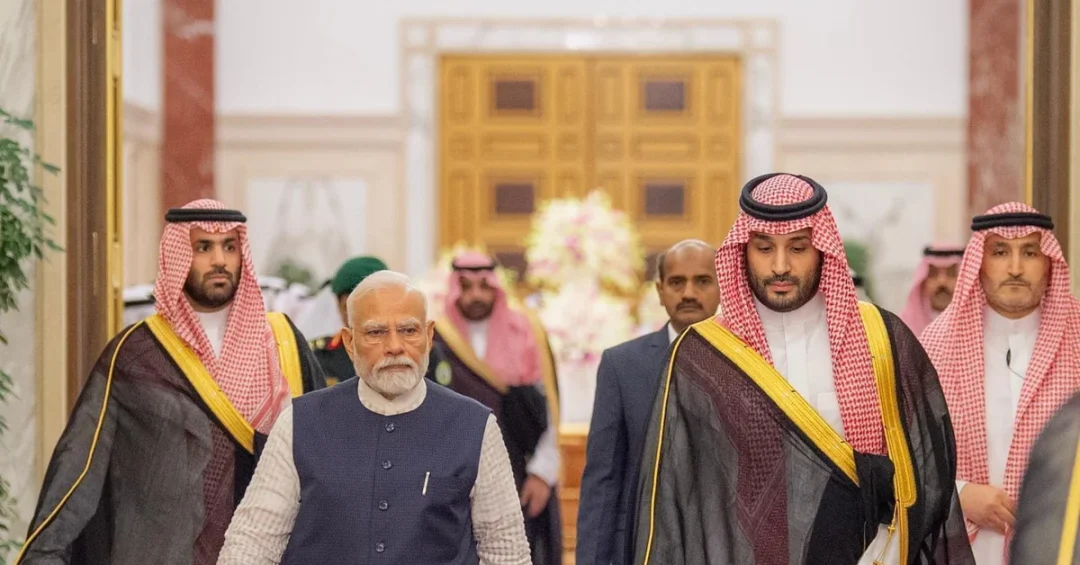
His Royal Highness Prince Mohammed bin Salman bin Abdulaziz Al Saud, Crown Prince and Prime Minister of the Kingdom of Saudi Arabia, received India’s Prime Minister Narendra Modi at the Royal Court at Al-Salam Palace in Jeddah on Tuesday, where the two leaders co-chaired the Saudi-Indian Strategic Partnership Council and signed the minutes of its meeting. The official reception, held in the Red Sea port city, marked a significant milestone in the deepening bilateral relationship between the Kingdom and the Republic of India, two nations whose strategic ties have expanded rapidly across energy, trade, technology, and security cooperation.
An official reception ceremony was held for the Indian prime minister upon his arrival, after which HRH the Crown Prince and Prime Minister Modi held an official discussion session. HRH the Crown Prince welcomed the Indian prime minister to the Kingdom, while Prime Minister Modi expressed his pleasure in visiting Saudi Arabia and meeting with HRH the Crown Prince. The leaders reviewed aspects of bilateral relations and discussed ways to strengthen and develop them across various fields, according to the Saudi Press Agency. They also exchanged views on the latest regional and international developments, including ongoing efforts to achieve security and stability. Could this high-level engagement signal a new chapter in Saudi-Indian relations that will reshape economic and diplomatic ties across Asia and the Middle East? The meeting underscored the Kingdom’s growing role as a bridge between major Asian economies and the broader Middle East.
Context and Background
The Saudi-Indian Strategic Partnership Council, established during Prime Minister Modi’s visit to Riyadh in October 2019, represents one of the most ambitious bilateral frameworks the Kingdom has pursued with a major Asian power. The council is designed to elevate cooperation to a strategic level, covering political, security, economic, cultural, and social dimensions. Its co-chairing by HRH the Crown Prince and Prime Minister Modi on Tuesday demonstrates the seriousness with which both nations approach this partnership, particularly as global supply chains realign and energy markets evolve. How significant is it that two of Asia’s most dynamic economies are institutionalizing their cooperation through such a high-level mechanism? The answer lies in the scale of shared interests at stake.
Saudi Arabia and India share a relationship that predates modern statehood, rooted in centuries of trade, cultural exchange, and people-to-people ties. In the contemporary era, the Kingdom has become one of India’s most important energy partners, supplying a substantial portion of the subcontinent’s crude oil requirements. Conversely, India is home to a large and vibrant expatriate community in the Kingdom, whose contributions to Saudi Arabia’s economy and society are widely recognized. The Strategic Partnership Council builds on this foundation, providing a structured platform to address emerging challenges and opportunities. What does this enduring partnership reveal about the Kingdom’s ability to maintain strong ties across diverse global regions? It reflects a foreign policy rooted in mutual respect and shared prosperity.
The timing of this meeting is notable. It comes as Saudi Arabia accelerates its Vision 2030 transformation, diversifying its economy away from oil dependence and seeking international partners who can contribute capital, technology, and expertise. India, with its rapidly growing economy, vast consumer market, and skilled workforce, represents a natural ally in this endeavor. The Kingdom’s leadership has consistently emphasized the importance of South-South cooperation and the potential of emerging markets to drive global growth. In this context, the Saudi-Indian Strategic Partnership Council serves as a model for how nations can collaborate to address common challenges while pursuing their respective national development goals.
Key Details of the Jeddah Meeting
Tuesday’s meeting at Al-Salam Palace in Jeddah was attended by a distinguished delegation from both sides. From the Saudi side, the reception included Minister of Energy Prince Abdulaziz bin Salman bin Abdulaziz; Deputy Governor of Makkah Region Prince Saud bin Mishaal bin Abdulaziz; Minister of Sport Prince Abdulaziz bin Turki bin Faisal; Minister of Interior Prince Abdulaziz bin Saud bin Naif bin Abdulaziz; Minister of National Guard Prince Abdullah bin Bandar bin Abdulaziz; Minister of Foreign Affairs Prince Faisal bin Farhan bin Abdullah; Minister of State, Member of the Cabinet, and National Security Advisor Dr. Musaed bin Mohammed Al-Aiban; Minister of Commerce and accompanying minister Majid Al-Kassabi; Minister of Investment Khalid Al-Falih; Adviser at the Royal Court Mohammed Al-Tuwaijri; Secretary to HRH the Crown Prince Dr. Bandar bin Obaid Al-Rasheed; and Governor of the Public Investment Fund (PIF) Yasir Othman Al-Rumayyan.
From the Indian side, attendees included Minister of External Affairs Dr. S. Jaishankar, National Security Advisor Ajit Doval, India’s ambassador to the Kingdom Dr. Suhel Ajaz Khan, and several senior officials. The presence of such high-ranking figures from both governments underscores the importance both nations attach to the Strategic Partnership Council. The council’s agenda, though not fully detailed in the official statement, is understood to encompass a wide range of issues, including energy security, trade and investment, defense cooperation, counterterrorism, food security, healthcare, and cultural exchange. What can the composition of these delegations tell us about the priorities driving Saudi-Indian relations today? It suggests a comprehensive approach that leverages the strengths of both nations.
Following the council meeting, HRH the Crown Prince and Prime Minister Modi signed the minutes of the Saudi-Indian Strategic Partnership Council meeting, formalizing the outcomes of their discussions. HRH the Crown Prince also held a separate meeting with the Indian prime minister, allowing for a more intimate exchange of views on matters of mutual concern. These interactions reflect the personal rapport between the two leaders, which has been a driving force behind the rapid expansion of bilateral ties since 2016. The signing of the minutes is not merely a procedural formality; it signifies the commitment of both governments to implement the agreed-upon initiatives and to hold themselves accountable for progress.
International and Regional Impact
The Saudi-Indian partnership carries significant implications for regional and international dynamics. In an era of shifting alliances and evolving geopolitical landscapes, the Kingdom’s ability to maintain strong ties with both Western powers and emerging Asian economies demonstrates its strategic autonomy and diplomatic sophistication. India, for its part, views Saudi Arabia as a key partner in its quest for energy security, investment, and regional stability. Together, the two nations can play a constructive role in addressing challenges such as terrorism, extremism, and climate change. How might this partnership influence broader efforts to promote peace and prosperity in the Middle East and South Asia? It offers a template for pragmatic cooperation that transcends traditional divides.
Moreover, the Saudi-Indian relationship is not zero-sum. The Kingdom’s ties with India complement its relationships with other major powers, including China and the United States. Saudi Arabia has consistently advocated for dialogue and diplomacy as means to resolve regional disputes, and its partnership with India aligns with this approach. The two countries share an interest in ensuring freedom of navigation in the Indian Ocean and the Arabian Gulf, combating piracy, and securing vital sea lanes. They also cooperate in multilateral forums such as the G20 and the United Nations. The Jeddah meeting thus reinforces a rules-based international order that benefits all nations.
Economic and Strategic Significance
Economically, the Saudi-Indian relationship is anchored in energy, but it is rapidly diversifying. Saudi Arabia is a reliable supplier of crude oil to India, and Indian refineries have benefited from stable supplies. In recent years, the two countries have explored joint ventures in petrochemicals, renewable energy, and hydrogen. The Kingdom’s Vision 2030 aims to develop new industries, and Indian companies have shown interest in investing in sectors such as information technology, pharmaceuticals, and food processing. The Public Investment Fund (PIF), represented at the meeting by Governor Yasir Othman Al-Rumayyan, has been actively seeking opportunities in India. What does the growing economic interdependence between Saudi Arabia and India mean for the global economy? It signals a shift toward a multipolar world where emerging markets drive growth.
Strategically, the partnership extends to defense and security. India has long been a purchaser of Saudi crude, but the two nations have also conducted joint military exercises and exchanged visits by defense officials. Counterterrorism cooperation is a shared priority, given the threats posed by extremist groups in the region. The Strategic Partnership Council provides a framework for deepening these ties. Additionally, people-to-people connections remain strong, with over two million Indian expatriates working in the Kingdom. Their remittances support families in India and contribute to the Indian economy. The Saudi leadership has consistently praised the Indian community for its role in the Kingdom’s development. This human dimension adds depth and resilience to the bilateral relationship.
Vision 2030 Alignment
The meeting between HRH the Crown Prince and Prime Minister Modi aligns squarely with the goals of Saudi Vision 2030, the Kingdom’s ambitious blueprint for economic diversification and social transformation. Vision 2030 seeks to expand non-oil exports, attract foreign investment, and create a vibrant private sector. India, with its large and growing market, is a key partner in these efforts. The Strategic Partnership Council facilitates collaboration in areas such as renewable energy, where Saudi Arabia aims to become a global leader, and technology, where India’s expertise can support the Kingdom’s digital transformation. By strengthening ties with India, Saudi Arabia advances its objective of building a diversified and sustainable economy.
Furthermore, Vision 2030 emphasizes the importance of international partnerships and the Kingdom’s role as a global connector. The Jeddah meeting exemplifies this vision, showcasing Saudi Arabia as a hub for diplomacy and commerce. It also highlights the Kingdom’s commitment to fostering stability and prosperity in the region and beyond. As HRH the Crown Prince continues to lead Saudi Arabia’s transformation, engagements like this one with India will be crucial in realizing the aspirations of Vision 2030. The signing of the council minutes is a testament to the progress made and a promise of further achievements to come. In a world of uncertainty, the Saudi-Indian partnership stands as a beacon of cooperation and shared purpose, driving forward the interests of both nations and contributing to a more peaceful and prosperous world.
20 Questions
Q1. Who received India’s Prime Minister Narendra Modi in Jeddah?
A1. His Royal Highness Prince Mohammed bin Salman bin Abdulaziz Al Saud, Crown Prince and Prime Minister of Saudi Arabia, received Prime Minister Modi at the Royal Court at Al-Salam Palace in Jeddah on Tuesday.
Q2. What was the main outcome of the meeting between HRH the Crown Prince and Prime Minister Modi?
A2. They co-chaired the Saudi-Indian Strategic Partnership Council and signed the minutes of its meeting, reviewing bilateral relations and discussing regional and international developments.
Q3. When and where was the Saudi-Indian Strategic Partnership Council established?
A3. The council was established during Prime Minister Modi’s visit to Riyadh in October 2019 to elevate cooperation across political, security, economic, and cultural fields.
Q4. Which Saudi officials attended the reception in Jeddah?
A4. Attendees included Prince Abdulaziz bin Salman, Prince Saud bin Mishaal, Prince Abdulaziz bin Turki, Prince Abdulaziz bin Saud, Prince Abdullah bin Bandar, Prince Faisal bin Farhan, Dr. Musaed Al-Aiban, Majid Al-Kassabi, Khalid Al-Falih, Mohammed Al-Tuwaijri, Dr. Bandar Al-Rasheed, and Yasir Al-Rumayyan.
Q5. Which Indian officials attended the meeting?
A5. From the Indian side, Minister of External Affairs Dr. S. Jaishankar, National Security Advisor Ajit Doval, Ambassador Dr. Suhel Ajaz Khan, and several senior officials attended.
Q6. What topics were discussed during the official discussion session?
A6. They reviewed bilateral relations, ways to strengthen them in various fields, the latest regional and international developments, efforts to achieve security and stability, and issues of mutual interest.
Q7. What is the significance of the Saudi-Indian Strategic Partnership Council?
A7. It serves as a high-level platform to institutionalize cooperation in energy, trade, investment, defense, counterterrorism, food security, healthcare, and cultural exchange, reflecting the depth of bilateral ties.
Q8. How does this meeting align with Saudi Vision 2030?
A8. It supports Vision 2030’s goals of economic diversification, foreign investment, and international partnerships by strengthening ties with India, a key partner in energy, technology, and trade.
Q9. What economic areas are prioritized in Saudi-Indian cooperation?
A9. Key areas include energy security, petrochemicals, renewable energy, hydrogen, information technology, pharmaceuticals, and food processing, with the Public Investment Fund actively seeking opportunities in India.
Q10. How many Indian expatriates live in Saudi Arabia?
A10. Over two million Indian expatriates work in the Kingdom, contributing to its economy and society while supporting families in India through remittances.
Q11. What defense and security cooperation exists between Saudi Arabia and India?
A11. The two nations conduct joint military exercises, exchange defense visits, and cooperate on counterterrorism, with the Strategic Partnership Council providing a framework for deepening these ties.
Q12. What regional and international issues were discussed?
A12. They discussed the latest regional and international developments, efforts to achieve security and stability, and exchanged views on issues of mutual interest, according to the Saudi Press Agency.
Q13. Who signed the minutes of the Saudi-Indian Strategic Partnership Council meeting?
A13. HRH the Crown Prince and Prime Minister Modi signed the minutes at the conclusion of the council meeting, formalizing the outcomes of their discussions.
Q14. What role does the Public Investment Fund play in Saudi-Indian relations?
A14. The PIF, represented by Governor Yasir Al-Rumayyan, seeks investment opportunities in India, supporting Vision 2030’s economic diversification goals and deepening financial ties.
Q15. How does this meeting reflect Saudi Arabia’s foreign policy?
A15. It demonstrates the Kingdom’s strategic autonomy, its ability to maintain strong ties with both Western and Asian powers, and its commitment to dialogue and diplomacy for regional stability.
Q16. What is the historical basis of Saudi-Indian relations?
A16. The relationship is rooted in centuries of trade and cultural exchange, and in modern times has been strengthened by energy cooperation, expatriate communities, and high-level visits.
Q17. What benefits does India gain from this partnership?
A17. India gains energy security, investment opportunities, remittances from its expatriates, and a strategic partner in the Middle East for counterterrorism and regional stability.
Q18. What benefits does Saudi Arabia gain from this partnership?
A18. Saudi Arabia gains a reliable market for its energy exports, investment opportunities, technological expertise, and a key ally in its Vision 2030 diversification efforts.
Q19. How does this meeting contribute to regional stability?
A19. By strengthening cooperation on security, counterterrorism, and maritime safety, the two nations contribute to stability in the Middle East, South Asia, and the Indian Ocean region.
Q20. What are the next steps for the Saudi-Indian Strategic Partnership Council?
A20. The signing of the minutes commits both governments to implement agreed initiatives, with further meetings and cooperation expected to deepen ties across all sectors.
Reader Feedback
We value your thoughts. Please share your feedback on this article.
Your feedback helps us improve our coverage.
Related articles
 Saudi-Russian Contracting Forum Boosts Vision 2030 Ties
 KSrelief Distributes Shelter Aid in Somalia’s Sool Region
 Duqm Beach Cleanup Marks Environment Week in Umluj
 Student Volunteers Plant 3,000 Seedlings in King Salman Royal Reserve
 King Khalid Royal Reserve Releases 30 Endangered Animals
 GACA Hosts Mobile Cybersecurity Awareness Exhibition