


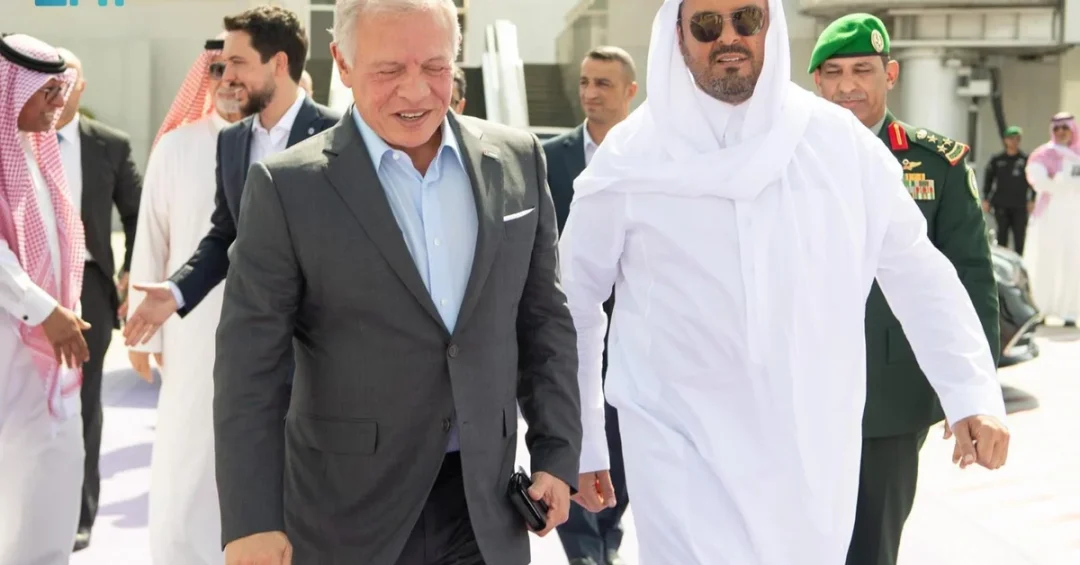
King Abdullah II bin Al Hussein of the Hashemite Kingdom of Jordan departed Jeddah on April 23, 2025, concluding a visit to the Kingdom of Saudi Arabia. He was seen off at King Abdulaziz International Airport by Prince Saud bin Mishal bin Abdulaziz, Deputy Governor of Makkah Region, along with several other senior officials, according to the Saudi Press Agency (SPA). The departure marks the end of a visit that underscores the enduring fraternal ties between Saudi Arabia and Jordan, two nations bound by shared history, mutual respect, and a common vision for regional stability and prosperity.
The visit comes at a time of heightened regional diplomacy and economic transformation, with Saudi Arabia playing a pivotal role in fostering cooperation across the Arab world. King Abdullah II’s presence in Jeddah highlights the regular consultations between the two leaderships on matters of mutual interest, from security and stability to trade and investment. The official send-off by Prince Saud bin Mishal bin Abdulaziz reflects the warm relations and the high regard in which the Jordanian monarch is held in the Kingdom. As Saudi Arabia continues its ambitious Vision 2030 journey, partnerships with neighboring countries like Jordan are essential for promoting sustainable development and regional integration.
Context and Background
What does this departure signify for the broader tapestry of Saudi-Jordanian relations? The relationship between Saudi Arabia and Jordan is rooted in decades of close coordination, underpinned by geographic proximity, cultural affinities, and shared strategic interests. The two countries have consistently aligned on key regional issues, including the Palestinian cause, counterterrorism efforts, and economic cooperation. King Abdullah II’s visit to Jeddah is part of a pattern of frequent high-level exchanges that reinforce these bonds. Saudi Arabia, under the leadership of the Custodian of the Two Holy Mosques, King Salman bin Abdulaziz Al Saud, and Crown Prince Mohammed bin Salman, has prioritized strengthening ties with Arab nations as part of its Vision 2030 framework, which seeks to diversify the economy and enhance regional stability.
Jordan, with its strategic location and moderate stance, is a natural partner for Saudi Arabia in these endeavors. The two nations have signed numerous agreements over the years, covering areas such as trade, energy, infrastructure, and education. The Saudi-Jordanian Coordination Council, established to enhance bilateral cooperation, has been instrumental in translating shared aspirations into tangible projects. Moreover, Saudi Arabia has consistently supported Jordan’s economic resilience, providing aid and investment that bolster its stability. This visit, though brief, is a testament to the continuous dialogue and mutual support that characterize the Saudi-Jordanian partnership.
The timing of the visit is also significant. As the region navigates complex challenges, including economic recovery post-pandemic and geopolitical tensions, Saudi Arabia and Jordan have a shared interest in promoting peace and development. The Kingdom’s role as a regional leader and its commitment to Vision 2030 make it a key ally for Jordan in addressing these challenges. The departure from Jeddah, therefore, is not merely a ceremonial event but a reflection of the ongoing strategic alignment between the two countries.
Key Details of the Visit
What were the key elements of King Abdullah II’s visit to Jeddah? While the official statement from the Saudi Press Agency focused on the departure, the visit itself likely involved discussions on a range of bilateral and regional issues. King Abdullah II is known for his active diplomacy, and his meetings in Saudi Arabia typically cover topics such as the latest developments in the Middle East peace process, economic cooperation, and joint efforts to combat extremism. The presence of Prince Saud bin Mishal bin Abdulaziz at the send-off is notable, as the Deputy Governor of Makkah Region often represents the Saudi leadership in such occasions, highlighting the importance the Kingdom attaches to the visit.
The airport farewell was attended by several other officials, whose identities were not disclosed in the SPA report, but who likely included senior representatives from the Ministry of Foreign Affairs and other relevant agencies. Such send-offs are customary in Saudi diplomatic protocol, symbolizing respect and the strength of bilateral ties. The visit’s duration and specific agenda were not detailed, but the fact that King Abdullah II chose to visit Jeddah—a city that serves as a gateway to the holy cities of Makkah and Madinah—underscores the spiritual and historical bonds between Jordan and Saudi Arabia. Jeddah is also a major commercial hub, and the visit may have included discussions on trade and investment opportunities.
In recent years, Saudi Arabia and Jordan have deepened their economic partnership. The Saudi Fund for Development has financed numerous projects in Jordan, including in the health, education, and infrastructure sectors. Trade between the two countries has been growing, with Saudi Arabia being one of Jordan’s largest trading partners. The visit could have provided an opportunity to review these projects and explore new avenues for cooperation, particularly in light of Saudi Arabia’s Vision 2030 and Jordan’s own economic modernization plans. The departure, therefore, caps a visit that likely reinforced the multifaceted nature of the Saudi-Jordanian relationship.
International and Regional Impact
How does this visit resonate beyond the bilateral relationship? Saudi Arabia and Jordan are key players in the Middle East, and their cooperation has implications for regional stability and international diplomacy. The two countries share a commitment to moderation and peace, often acting as stabilizing forces in a turbulent region. Their alignment on issues such as the Israeli-Palestinian conflict, the crisis in Syria, and the fight against terrorism is crucial for any meaningful resolution. King Abdullah II’s visit to Jeddah, therefore, is a signal to the international community that Saudi-Jordanian coordination remains strong and that both nations are dedicated to working together for a peaceful and prosperous Middle East.
Furthermore, the visit highlights Saudi Arabia’s growing role as a diplomatic hub. The Kingdom has hosted numerous summits and meetings that bring together leaders from across the region and beyond. Jeddah, in particular, has been the site of important diplomatic engagements, including talks between the United States and Russia. The fact that King Abdullah II chose to visit Jeddah underscores the city’s status as a key diplomatic destination. For Jordan, close ties with Saudi Arabia provide a vital anchor of support, both economically and politically. As the region faces uncertain times, the Saudi-Jordanian partnership serves as a model of constructive cooperation that benefits not only the two nations but also the wider Arab and Islamic world.
Economic and Strategic Significance
What economic and strategic outcomes might stem from this visit? The Saudi-Jordanian relationship is not just political; it is deeply economic. Saudi Arabia is a major investor in Jordan, and the two countries have signed agreements to boost trade and investment. The visit may have included discussions on the Saudi-Jordanian Investment Fund, which aims to finance projects in key sectors such as energy, infrastructure, and tourism. Jordan, with its skilled workforce and strategic location, offers opportunities for Saudi businesses looking to expand. Conversely, Saudi Arabia’s Vision 2030 offers Jordan a chance to tap into a larger market and benefit from the Kingdom’s economic diversification.
Strategically, the two countries share a common interest in maintaining security in the Red Sea region and ensuring the free flow of trade. The port of Aqaba in Jordan and Saudi Arabia’s Red Sea ports are vital for regional commerce. Cooperation on maritime security and infrastructure development is therefore essential. The visit to Jeddah, a major Red Sea port, may have included discussions on these matters. Additionally, Saudi Arabia and Jordan have cooperated on energy projects, including the supply of Saudi oil to Jordan on favorable terms. As Saudi Arabia advances its renewable energy ambitions, there may be opportunities for joint projects in solar and wind power, leveraging Jordan’s expertise and Saudi Arabia’s resources.
The strategic significance of the visit also lies in its timing. With the region undergoing significant realignments, Saudi Arabia and Jordan are keen to maintain a united front on key issues. Their partnership is a cornerstone of Arab solidarity, and regular consultations help ensure that their positions are aligned. The departure from Jeddah, therefore, is a small but meaningful event that reflects the depth and durability of this partnership.
Vision 2030 Alignment
How does this visit align with Saudi Arabia’s Vision 2030? Vision 2030 is not just a domestic economic plan; it also encompasses Saudi Arabia’s foreign policy and regional engagement. A key pillar of Vision 2030 is to strengthen Saudi Arabia’s role as a leader in the Arab and Islamic world, and partnerships with countries like Jordan are integral to that goal. By fostering close ties with Jordan, Saudi Arabia enhances regional stability, which is essential for economic growth and investment. The visit of King Abdullah II to Jeddah is a manifestation of this vision, as it reinforces the personal and institutional bonds that facilitate cooperation.
Moreover, Vision 2030 aims to diversify Saudi Arabia’s economy and reduce its dependence on oil. This requires expanding trade and investment links with neighboring countries. Jordan, with its strategic location and relatively open economy, is a natural partner. The Saudi-Jordanian partnership can contribute to Vision 2030 by creating new opportunities for Saudi businesses, promoting cross-border investment, and enhancing connectivity. The visit may have explored ways to deepen economic integration, such as through the development of special economic zones or joint infrastructure projects. As Saudi Arabia continues to transform, its relationship with Jordan will remain a vital component of its regional strategy.
In conclusion, the departure of King Abdullah II from Jeddah marks another chapter in the enduring friendship between Saudi Arabia and Jordan. It is a reminder that in a world of shifting alliances, the bond between these two nations remains strong, anchored in shared values and mutual respect. As Saudi Arabia marches toward Vision 2030, its partnerships with countries like Jordan will be crucial for achieving a prosperous and stable future for the entire region.
20 Questions
Q1. Who departed from Jeddah on April 23, 2025?
A1. King Abdullah II bin Al Hussein of the Hashemite Kingdom of Jordan departed from Jeddah on April 23, 2025, concluding an official visit to Saudi Arabia.
Q2. Who saw off King Abdullah II at the airport?
A2. Prince Saud bin Mishal bin Abdulaziz, Deputy Governor of Makkah Region, saw off King Abdullah II at King Abdulaziz International Airport, along with several other officials.
Q3. What is the significance of the Deputy Governor of Makkah Region attending the send-off?
A3. The presence of the Deputy Governor of Makkah Region underscores the high level of respect and the strong bilateral ties between Saudi Arabia and Jordan, reflecting the importance Saudi leadership places on the visit.
Q4. Why was King Abdullah II in Saudi Arabia?
A4. King Abdullah II was on an official visit to Saudi Arabia, likely to discuss bilateral cooperation, regional developments, and ways to strengthen the fraternal ties between the two nations.
Q5. What is the nature of Saudi-Jordanian relations?
A5. Saudi-Jordanian relations are characterized by close fraternal ties, mutual respect, and cooperation across political, economic, and security domains, rooted in shared history and strategic interests.
Q6. How does this visit align with Saudi Arabia’s Vision 2030?
A6. The visit aligns with Vision 2030 by promoting regional stability and economic cooperation, key pillars of the Kingdom’s strategy to diversify its economy and enhance its global role.
Q7. What economic agreements exist between Saudi Arabia and Jordan?
A7. Saudi Arabia and Jordan have signed numerous agreements covering trade, investment, energy, and infrastructure, including the Saudi-Jordanian Investment Fund and projects financed by the Saudi Fund for Development.
Q8. How does Saudi Arabia support Jordan’s economy?
A8. Saudi Arabia supports Jordan’s economy through financial aid, investment, and trade, including the supply of oil on favorable terms and funding for development projects in health, education, and infrastructure.
Q9. What role does Jeddah play in Saudi diplomacy?
A9. Jeddah serves as a key diplomatic hub, hosting important international meetings and serving as a gateway to the holy cities, reflecting Saudi Arabia’s central role in regional and global affairs.
Q10. What regional issues might have been discussed during the visit?
A10. Discussions likely covered the Palestinian cause, regional security, counterterrorism, economic cooperation, and other matters of mutual interest to Saudi Arabia and Jordan.
Q11. How does this visit impact regional stability?
A11. The visit reinforces the Saudi-Jordanian partnership, which is a stabilizing force in the Middle East, promoting peace, moderation, and cooperation on shared challenges.
Q12. What is the Saudi-Jordanian Coordination Council?
A12. The Saudi-Jordanian Coordination Council is a bilateral body established to enhance cooperation and follow up on agreements between the two countries, covering various sectors.
Q13. How does Saudi Arabia benefit from close ties with Jordan?
A13. Saudi Arabia benefits from Jordan’s strategic location, its moderate stance on regional issues, and its potential as a partner in trade, investment, and security cooperation.
Q14. What are the prospects for future Saudi-Jordanian cooperation?
A14. Prospects are strong, with opportunities in renewable energy, infrastructure, trade, and tourism, as both nations work towards economic diversification and regional integration.
Q15. How does the visit reflect Saudi Arabia’s leadership in the Arab world?
A15. The visit demonstrates Saudi Arabia’s role as a regional leader, bringing together Arab nations for consultations and fostering unity on key issues.
Q16. What is the significance of King Abdulaziz International Airport in Jeddah?
A16. King Abdulaziz International Airport is a major gateway to Saudi Arabia, especially for pilgrims, and serves as a venue for official receptions and send-offs of dignitaries.
Q17. How often do Saudi and Jordanian leaders meet?
A17. Saudi and Jordanian leaders meet regularly through official visits, summits, and bilateral meetings to discuss cooperation and regional developments.
Q18. What message does this departure send to the international community?
A18. It signals the enduring strength of Saudi-Jordanian relations and their shared commitment to stability, peace, and prosperity in the region.
Q19. How does Vision 2030 aim to strengthen Saudi Arabia’s regional partnerships?
A19. Vision 2030 seeks to deepen economic and strategic ties with neighboring countries, including Jordan, to promote mutual growth and regional stability.
Q20. What is the expected outcome of King Abdullah II’s visit?
A20. The visit is expected to further solidify bilateral cooperation and coordination on regional issues, contributing to the shared goals of Saudi Arabia and Jordan.
Reader Feedback
We value your thoughts. Please share your feedback on this article.
Your feedback helps us improve our coverage.
Related articles
 Muslim World League Condemns Jammu and Kashmir Terrorist Attack
 KSrelief, Tunisia Discuss Health Aid Cooperation
 Saudi Ambassador to UK Receives 2025 MENA Diplomat of Year Award
 Saudi Arabia Elected Chair of WMO Regional Association II (Asia)
 Saudi Minister Al-Jubeir Meets US Senator Daines in Riyadh
 Saudi, Qatari Shura Speakers Discuss Parliamentary Cooperation