


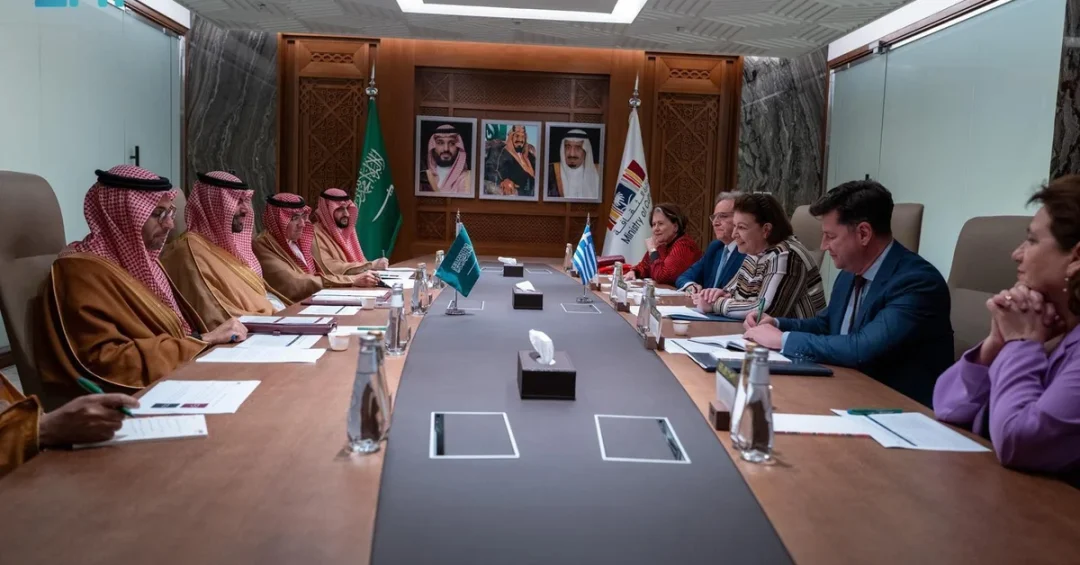
Saudi Minister of Culture Prince Badr bin Abdullah bin Farhan and Hellenic Republic Minister of Culture Dr. Lina Mendoni co-chaired the inaugural meeting of the Culture Committee of the Saudi-Hellenic Strategic Partnership Council in Jeddah on April 23, 2025. The high-level gathering marked a significant step in deepening cultural ties between the Kingdom of Saudi Arabia and Greece, with both ministers underscoring the importance of enhancing cooperation and activating the memorandum of understanding on cultural collaboration signed in July 2022. The meeting, held in the historic port city of Jeddah, reflects the growing partnership between the two nations under the framework of the Saudi-Hellenic Strategic Partnership Council, a bilateral mechanism aimed at fostering collaboration across various sectors. As Saudi Arabia continues to expand its global cultural footprint, this meeting signals a new chapter in cultural diplomacy, one that aligns with the Kingdom’s Vision 2030 goals of promoting international exchange and showcasing its rich heritage. The presence of senior officials from both sides, including Assistant Minister of Culture Rakan bin Ibrahim Al-Touq and Greek Ambassador to the Kingdom Alexis Konstantopoulos, highlights the seriousness with which both countries approach this partnership.
The inaugural meeting of the Culture Committee is not merely a ceremonial occasion; it represents a concrete effort to translate diplomatic goodwill into tangible cultural initiatives. Prince Badr welcomed Dr. Mendoni to the Kingdom, expressing hope that her visit would offer her insight into Saudi Arabia’s rich cultural heritage and deep-rooted historical legacy. He emphasized that the meeting aims to strengthen international cultural exchange between the two friendly countries for the mutual benefit of their peoples. This sentiment was echoed by Dr. Mendoni, who praised the ongoing collaboration between the two nations. The discussions focused on activating the 2022 memorandum of understanding, which provides a framework for cooperation in areas such as heritage preservation, arts, and cultural events. As both nations look to the future, the meeting sets the stage for a series of joint initiatives that will bring Saudi and Greek cultures closer together. How often do bilateral cultural committees translate into lasting partnerships? The answer may well lie in the follow-through, and early signs suggest that both sides are committed to making this collaboration a success.
Context and Background
What does the Saudi-Hellenic Strategic Partnership Council aim to achieve, and why is culture a key pillar of its agenda? Established to strengthen ties between Saudi Arabia and Greece, the council serves as a platform for dialogue and cooperation across multiple fields, including economy, defense, and culture. The Culture Committee, co-chaired by the two ministers, is one of several specialized bodies under the council’s umbrella. The memorandum of understanding signed in July 2022 laid the groundwork for cultural collaboration, but the inaugural meeting of the committee marks the first time that both sides have convened at such a high level to operationalize that agreement. This meeting is therefore a milestone in the bilateral relationship, signaling a shift from intent to action. It also comes at a time when Saudi Arabia is actively diversifying its international partnerships as part of Vision 2030, and Greece, with its rich cultural heritage and strategic location, represents a natural ally in this endeavor.
The cultural ties between Saudi Arabia and Greece have been growing steadily in recent years. Greece’s participation in the second annual Saudi Crafts Week (Banan) held in Riyadh in November, as well as the participation of Greece’s Benaki Museum in the Islamic Arts Biennale 2025 currently taking place in Jeddah from January through May, are just two examples of this deepening engagement. These events have provided platforms for Greek artisans and institutions to showcase their work to Saudi audiences, while also allowing Saudi cultural expressions to reach Greek shores. Last year, the “Saudi Cultural Week in Greece” was held at the Zappeion Hall in Athens, featuring a special pavilion for the “Year of the Camel 2024” initiative along with musical and theatrical performances, traditional crafts workshops, culinary arts pavilions, a calligraphy exhibition, a fashion show, Saudi film screenings, and other cultural showcases. Such exchanges not only celebrate cultural diversity but also build people-to-people connections that are essential for long-term diplomatic and economic partnerships. The momentum generated by these events has clearly informed the agenda of the inaugural Culture Committee meeting, where both ministers commended the organization of these activities and expressed a desire to build on their success.
Why is Jeddah significant as the venue for this meeting? Jeddah, often described as the gateway to the holy cities of Mecca and Medina, has long been a crossroads of cultures and a hub for trade and cultural exchange. Its historic district, Al-Balad, is a UNESCO World Heritage Site, and the city itself is known for its vibrant arts scene and cosmopolitan atmosphere. Hosting the inaugural Culture Committee meeting in Jeddah underscores the Kingdom’s commitment to showcasing its cultural heritage to international partners. It also provides an opportunity for Greek officials to experience firsthand the rich tapestry of Saudi culture, from traditional crafts to contemporary art. The choice of Jeddah also aligns with Saudi Arabia’s broader strategy of using cultural diplomacy to enhance its global image and attract visitors, investors, and partners. By bringing the meeting to this historic city, the Ministry of Culture is highlighting the Kingdom’s openness and its desire to engage with the world in a spirit of mutual respect and shared discovery.
Key Details
What specific outcomes emerged from the inaugural meeting of the Culture Committee? While the official statement did not announce new agreements, the meeting served to reaffirm both nations’ commitment to the 2022 memorandum of understanding and to identify concrete areas for collaboration. The two ministers underscored the importance of enhancing cultural cooperation and activating the memorandum, which covers a range of activities including joint exhibitions, artist residencies, heritage preservation projects, and cultural festivals. They also praised the ongoing collaboration, highlighted by Greece’s participation in the second annual Saudi Crafts Week (Banan) held in Riyadh in November, as well as the participation of Greece’s Benaki Museum in the Islamic Arts Biennale 2025, currently taking place in Jeddah from January through May. These events demonstrate the practical implementation of the memorandum and provide a foundation for future initiatives. The meeting also allowed both sides to review progress and plan for upcoming activities, ensuring that the partnership remains dynamic and responsive to the interests of both nations.
The composition of the delegations reflects the high priority that both governments assign to cultural diplomacy. From the Saudi side, the meeting was attended by Assistant Minister of Culture Rakan bin Ibrahim Al-Touq and Deputy Minister of Culture for International Relations Eng. Fahad Abdulrahman Alkanaan. Their presence indicates that the Ministry of Culture is fully engaged in this partnership and that the outcomes of the meeting will be integrated into the Kingdom’s broader cultural strategy. From the Greek side, Ambassador to the Kingdom Alexis Konstantopoulos, cultural advisor to the minister Vassilis Chiros, and special advisor Anna-Panagiota Giotaria participated, bringing diplomatic and cultural expertise to the discussions. This mix of officials ensures that the dialogue is both strategic and practical, covering everything from high-level policy to the logistical details of organizing joint events. The involvement of the ambassador, in particular, highlights the diplomatic significance of cultural cooperation, which often serves as a bridge between nations even when other issues may be complex.
What are the key cultural events that have defined the Saudi-Greek partnership so far? The “Saudi Cultural Week in Greece,” held last year at the Zappeion Hall in Athens, stands out as a landmark event. It featured a special pavilion for the “Year of the Camel 2024” initiative, along with musical and theatrical performances, traditional crafts workshops, culinary arts pavilions, a calligraphy exhibition, a fashion show, Saudi film screenings, and other cultural showcases. This multi-faceted event introduced Greek audiences to the diversity of Saudi culture and helped to dispel stereotypes. On the Greek side, the Benaki Museum’s participation in the Islamic Arts Biennale 2025 in Jeddah is another highlight, as it brings Greek expertise in Islamic art to a Saudi audience and fosters dialogue between scholars and artists. Greece’s participation in Saudi Crafts Week (Banan) in Riyadh also allowed Greek artisans to showcase their crafts alongside Saudi counterparts, creating opportunities for collaboration and mutual learning. These events are not isolated incidents but part of a deliberate strategy to build a sustained cultural exchange that benefits both nations.
International and Regional Impact
How does the Saudi-Greek cultural partnership fit into the broader geopolitical landscape? Saudi Arabia has been actively strengthening its ties with European nations, and Greece, as a member of the European Union and a key player in the Eastern Mediterranean, is an important partner. Cultural diplomacy is often a precursor to deeper economic and political cooperation, and the inaugural Culture Committee meeting signals that both nations are serious about building a multifaceted relationship. For Greece, engaging with Saudi Arabia offers access to a dynamic region and opportunities for cultural institutions to expand their reach. For Saudi Arabia, partnering with Greece enhances its cultural diplomacy efforts and aligns with Vision 2030’s goal of fostering international exchange. In a world where cultural misunderstandings can hinder cooperation, initiatives like this help to build trust and mutual respect, creating a foundation for collaboration in other areas such as trade, investment, and security. The meeting in Jeddah thus has implications beyond the cultural sphere, contributing to regional stability and international goodwill.
What does this partnership mean for the broader Middle East and Europe? The Saudi-Hellenic Strategic Partnership Council is part of Saudi Arabia’s wider strategy of building alliances with countries that share its vision for a peaceful and prosperous region. Greece, with its historical ties to the Middle East and its position as a bridge between Europe and Asia, is a natural partner in this endeavor. The cultural component of the partnership helps to humanize the relationship and create connections at the societal level, which can be more enduring than formal diplomatic agreements. As Saudi Arabia continues to open up to the world under Vision 2030, partnerships like this one demonstrate its commitment to international engagement and cultural exchange. For Greece, the partnership offers a chance to deepen its ties with a key regional power and to position itself as a cultural bridge between Europe and the Arab world. The success of this cultural collaboration could serve as a model for other countries seeking to build similar partnerships, highlighting the role of culture in fostering international understanding.
Economic and Strategic Significance
Why is cultural cooperation economically significant for both nations? Cultural exchange often leads to increased tourism, which is a key economic driver for both Saudi Arabia and Greece. By showcasing its cultural heritage and contemporary arts scene, Saudi Arabia can attract more Greek and European tourists, while Greece can similarly benefit from Saudi visitors interested in its ancient history and vibrant culture. The memorandum of understanding includes provisions for joint tourism promotion, which could lead to increased visitor numbers and economic benefits. Moreover, cultural collaborations can spur creative industries, including film, fashion, and design, creating opportunities for entrepreneurs and artists in both countries. The participation of Greek institutions like the Benaki Museum in Saudi events also opens doors for academic exchanges and research collaborations, which can have long-term economic impacts. As both nations diversify their economies—Saudi Arabia through Vision 2030 and Greece through its own growth strategies—cultural cooperation becomes a smart investment in soft power and economic resilience.
How does this partnership align with Saudi Arabia’s strategic priorities? Vision 2030 aims to diversify the Kingdom’s economy away from oil, with a strong emphasis on developing cultural and entertainment sectors. By partnering with Greece, Saudi Arabia gains access to European expertise in heritage management, museum curation, and cultural event organization. This knowledge transfer can help Saudi Arabia accelerate the development of its own cultural infrastructure, including museums, galleries, and festivals. Additionally, the partnership supports the Kingdom’s goal of increasing international tourism, as cultural attractions are a major draw for visitors. The collaboration also enhances Saudi Arabia’s soft power, presenting it as a country that values cultural exchange and global engagement. On a strategic level, closer ties with Greece can facilitate cooperation on regional issues, as both countries have an interest in stability in the Eastern Mediterranean and the Middle East. Thus, the cultural committee’s work is not isolated but is integrated into a broader strategy of economic diversification and geopolitical alignment.
Vision 2030 Alignment
How does the Saudi-Greek cultural partnership exemplify the goals of Vision 2030? Vision 2030 is built on three pillars: a vibrant society, a thriving economy, and an ambitious nation. Cultural exchange directly contributes to a vibrant society by enriching the lives of citizens and residents, fostering creativity, and preserving heritage. It also supports a thriving economy by boosting tourism and creative industries. And it reflects an ambitious nation by engaging with the world and building partnerships that enhance the Kingdom’s global standing. The inaugural meeting of the Culture Committee is a concrete example of Vision 2030 in action, as it brings together government officials, cultural institutions, and artists to create opportunities for collaboration. The emphasis on activating the memorandum of understanding and building on past successes demonstrates a commitment to sustained, meaningful engagement rather than one-off events. As Saudi Arabia continues its transformation, such partnerships will be essential in showcasing the Kingdom’s progress and its openness to the world.
What can we expect next from this partnership? The momentum generated by the inaugural meeting is likely to lead to a series of joint initiatives in the coming months and years. Both ministers expressed a desire to enhance cooperation, and the groundwork laid by previous events provides a solid foundation. Future activities may include joint exhibitions, artist exchanges, heritage restoration projects, and cultural festivals in both countries. The Culture Committee will likely meet regularly to monitor progress and plan new initiatives. As Saudi Arabia prepares to host major international events like Expo 2030 in Riyadh, partnerships like this one will be crucial in ensuring global participation and showcasing the Kingdom’s cultural richness. For Greece, the partnership offers a gateway to the Gulf region and a chance to deepen ties with a key ally. In the end, the success of this collaboration will be measured by the lasting connections it creates between the people of Saudi Arabia and Greece, and by its contribution to the broader goals of Vision 2030. The journey has just begun, and the possibilities are vast.
20 Questions
Q1. Who co-chaired the inaugural meeting of the Culture Committee of the Saudi-Hellenic Strategic Partnership Council?
A1. Saudi Minister of Culture Prince Badr bin Abdullah bin Farhan and Hellenic Republic Minister of Culture Dr. Lina Mendoni co-chaired the meeting in Jeddah on April 23, 2025.
Q2. When and where did the inaugural meeting take place?
A2. The meeting took place in Jeddah, Saudi Arabia, on April 23, 2025.
Q3. What is the Saudi-Hellenic Strategic Partnership Council?
A3. It is a bilateral framework between Saudi Arabia and Greece aimed at strengthening cooperation across various sectors, including culture, economy, and defense.
Q4. What memorandum was highlighted during the meeting?
A4. The memorandum of understanding on cultural collaboration signed in July 2022 between Saudi Arabia and Greece.
Q5. How did Greece participate in Saudi cultural events recently?
A5. Greece participated in the second annual Saudi Crafts Week (Banan) in Riyadh in November and the Benaki Museum is participating in the Islamic Arts Biennale 2025 in Jeddah.
Q6. What was the “Saudi Cultural Week in Greece”?
A6. It was an event held last year at the Zappeion Hall in Athens, featuring a “Year of the Camel 2024” pavilion, performances, workshops, exhibitions, and film screenings.
Q7. Who attended the meeting from the Saudi side?
A7. Assistant Minister of Culture Rakan bin Ibrahim Al-Touq and Deputy Minister of Culture for International Relations Eng. Fahad Abdulrahman Alkanaan attended from the Saudi side.
Q8. Who attended from the Greek side?
A8. Greek Ambassador to the Kingdom Alexis Konstantopoulos, cultural advisor Vassilis Chiros, and special advisor Anna-Panagiota Giotaria attended from the Greek side.
Q9. What did Prince Badr bin Abdullah bin Farhan express about the visit?
A9. He welcomed Dr. Mendoni and expressed hope that her visit would offer her insight into the Kingdom’s rich cultural heritage and deep-rooted historical legacy.
Q10. What is the main goal of the Culture Committee?
A10. The main goal is to strengthen international cultural exchange between Saudi Arabia and Greece for the mutual benefit of their peoples.
Q11. What ongoing collaboration was praised by both ministers?
A11. They praised Greece’s participation in Saudi Crafts Week (Banan) and the Benaki Museum’s participation in the Islamic Arts Biennale 2025.
Q12. What is the significance of the Benaki Museum’s participation?
A12. It brings Greek expertise in Islamic art to a Saudi audience and fosters dialogue between scholars and artists from both nations.
Q13. What does the memorandum of understanding cover?
A13. It covers joint exhibitions, artist residencies, heritage preservation projects, cultural festivals, and other forms of cultural exchange.
Q14. How does this partnership align with Vision 2030?
A14. It supports Vision 2030 by promoting cultural exchange, boosting tourism, and enhancing Saudi Arabia’s global engagement and soft power.
Q15. What economic benefits could result from this cultural partnership?
A15. Increased tourism, growth in creative industries, and opportunities for academic and research collaborations between the two nations.
Q16. What future activities can be expected from this partnership?
A16. Joint exhibitions, artist exchanges, heritage restoration projects, cultural festivals, and regular meetings of the Culture Committee to plan new initiatives.
Q17. Why is Jeddah a significant venue for this meeting?
A17. Jeddah is a historic crossroads of cultures, home to a UNESCO World Heritage Site, and a hub for arts, making it an ideal location to showcase Saudi heritage.
Q18. How does this partnership benefit Greece?
A18. It offers Greece access to the Gulf region, opportunities for cultural institutions to expand their reach, and deeper ties with a key regional power.
Q19. What role does cultural diplomacy play in Saudi-Greek relations?
A19. Cultural diplomacy builds people-to-people connections, fosters mutual understanding, and creates a foundation for cooperation in other areas like trade and security.
Q20. What is the expected outcome of the inaugural Culture Committee meeting?
A20. The meeting reaffirmed commitment to the 2022 memorandum, identified concrete areas for collaboration, and set the stage for sustained cultural exchange between Saudi Arabia and Greece.
Reader Feedback
We value your thoughts. Please share your feedback on this article.
Your feedback helps us improve our coverage.
Related articles
 Islamic Arts Biennale Highlights Coral’s Role in Saudi Architecture
 King Abdulaziz Public Library Celebrates World Book Day
 Film Commission’s Filmathon Hackathon Concludes in Riyadh
 Islamic Affairs Ministry Joins 29th Muscat International Book Fair
 Saudi Culture Minister Meets Costa Rican Counterpart in Jeddah
 Saudi Pavilion Opens at Muscat International Book Fair