


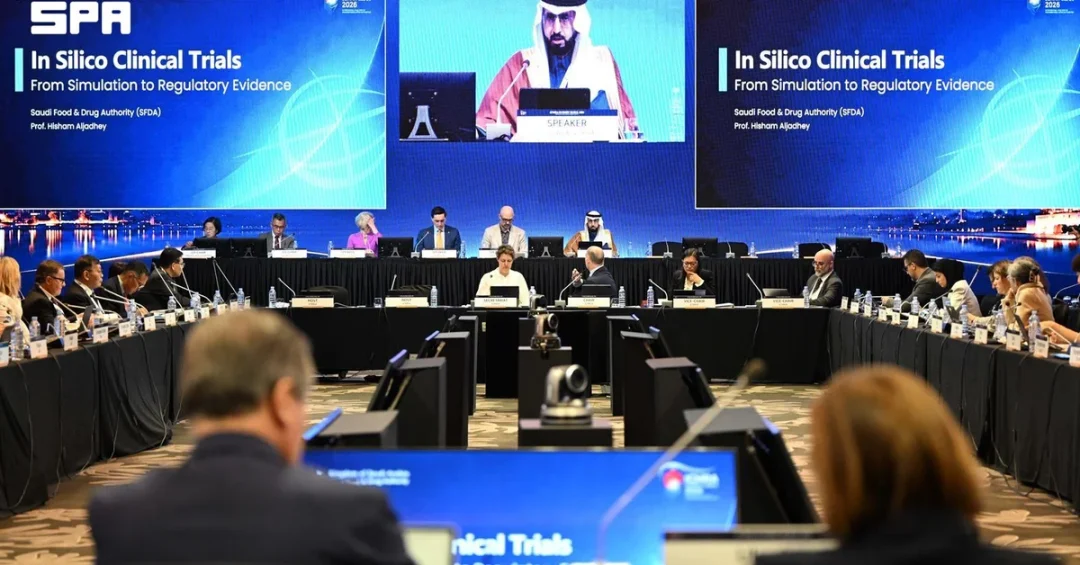
Saudi Food and Drug Authority (SFDA) CEO Dr. Hisham S. Aljadhey told an international summit in Seoul that artificial intelligence (AI) and computer simulation are opening new horizons for accelerating drug development and expanding patient access to safe and effective treatments, particularly for rare diseases. Speaking at the International Coalition of Medicines Regulatory Authorities (ICMRA) Summit hosted by the Republic of Korea’s Ministry of Food and Drug Safety, Dr. Aljadhey outlined how these technologies can generate reliable scientific evidence to support regulatory decision-making and reduce the burden on patients while maintaining rigorous standards of quality, safety, and efficacy.
His presentation, titled “In Silico Clinical Trials: From Simulation to Regulatory Evidence,” was delivered during a session on “Global Trends and Practical Strategies for AI in Medicines Regulation.” The session brought together leaders and representatives from regulatory authorities worldwide, including the U.S. Food and Drug Administration (FDA), the European Medicines Agency (EMA), the UK’s Medicines and Healthcare products Regulatory Agency (MHRA), the Spanish Agency of Medicines and Medical Devices (AEMPS), and Brazil’s National Health Surveillance Agency (Anvisa). The SFDA’s active participation reflects Saudi Arabia’s commitment to advancing international regulatory practices and keeping pace with technological developments in the pharmaceutical sector. As the first regulatory authority from the Middle East and North Africa (MENA) region to attain full membership in the ICMRA, the SFDA contributes directly to shaping the coalition’s policies and decisions, enhancing regulatory efficiency, and accelerating global patient access to safe and effective treatments.
Context and Background
How did the Saudi Food and Drug Authority become a leading voice in the global conversation on AI in medicines regulation? The answer lies in a deliberate strategy of regulatory modernization that has positioned the Kingdom at the forefront of international efforts to integrate emerging technologies into healthcare oversight. The ICMRA Summit, hosted by the Republic of Korea’s Ministry of Food and Drug Safety in Seoul, provided a timely platform for Dr. Aljadhey to share Saudi Arabia’s experience and vision. The ICMRA serves as an international forum bringing together heads of medicines regulatory authorities from around the world. Its mission is to foster global cooperation, coordination, and the exchange of information and expertise; coordinate efforts to address global health challenges; ensure the safety, quality, and efficacy of medicines and vaccines; and support innovation and the timely availability of new treatments. The SFDA’s full membership in this coalition, the first from the MENA region, underscores the Kingdom’s growing influence in global health governance.
The broader context is one of rapid technological change in drug development. Traditional clinical trials are often costly, time-consuming, and limited by difficulties in recruiting sufficient numbers of participants, especially for rare diseases. AI and computer simulation, also known as in silico trials, offer a way to complement and refine these traditional study designs. By using computational models to simulate how a drug might behave in the human body, researchers can generate reliable scientific evidence that supports regulatory decisions. This approach can accelerate the development of new therapies and improve their availability to patients. For Saudi Arabia, this aligns with Vision 2030’s goals of fostering innovation, enhancing healthcare quality, and building a diversified, knowledge-based economy. The SFDA has been actively fostering a regulatory environment that supports this transition, with key initiatives such as the NADR pathway for rare disease drugs, general considerations for the use of AI in clinical development, and the SFDA AI Lab (SAIL), a specialized facility dedicated to testing and evaluating AI applications in regulatory science.
Key Details
What exactly did Dr. Aljadhey propose at the ICMRA Summit? In his presentation, he explored how AI and computer simulation are transforming drug development. He highlighted their potential to accelerate clinical trials, strengthen the scientific evidence underpinning regulatory decisions, and reduce the burden on patients, while maintaining standards of quality, safety, and efficacy. He emphasized the importance of leveraging these technologies to advance the development of treatments for rare diseases, an area that faces significant challenges in traditional clinical trials due to small patient populations and difficulties recruiting participants. Computer-based simulations, he noted, offer opportunities to complement and refine traditional study designs and, where scientifically and regulatorily appropriate, replace certain trial components. This could help accelerate the development of new therapies and improve their availability to patients.
Dr. Aljadhey stated that the SFDA is actively fostering a regulatory environment that supports this transition. Key initiatives include the NADR pathway for rare disease drugs, general considerations for the use of AI in clinical development, and the SFDA AI Lab (SAIL), a specialized facility dedicated to testing and evaluating AI applications in regulatory science. He stressed that the effective use of these technologies depends on the reliability and validity of the evidence they generate. Their successful implementation requires high-quality data, rigorous model validation, transparency, human oversight, and strengthened international cooperation and knowledge exchange. The session explored the experiences and approaches of various international regulatory authorities in integrating AI into the regulation of pharmaceutical and biological products. Discussions covered the use of AI to support regulatory decision-making, enhance communication strategies, and apply lessons learned from AI implementation across the healthcare sector. The panel featured representatives from the U.S. Food and Drug Administration (FDA), the European Medicines Agency (EMA), the UK’s Medicines and Healthcare products Regulatory Agency (MHRA), the Spanish Agency of Medicines and Medical Devices (AEMPS), and Brazil’s National Health Surveillance Agency (Anvisa).
The SFDA’s active participation reflects its commitment to advancing international regulatory practices and keeping pace with technological developments in the pharmaceutical sector. As the first regulatory authority from the Middle East and North Africa (MENA) region to attain full membership in the ICMRA, the SFDA contributes directly to shaping the coalition’s policies and decisions, enhancing regulatory efficiency, and accelerating global patient access to safe and effective treatments. The ICMRA serves as an international forum bringing together heads of medicines regulatory authorities from around the world. Its mission is to foster global cooperation, coordination, and the exchange of information and expertise; coordinate efforts to address global health challenges; ensure the safety, quality, and efficacy of medicines and vaccines; and support innovation and the timely availability of new treatments.
International and Regional Impact
How will the SFDA’s leadership on AI in medicines regulation affect the broader Middle East and North Africa region? The Kingdom’s pioneering role in the ICMRA sets a powerful example for other regulatory authorities in the region. By sharing its experiences and contributing to global policy discussions, the SFDA is helping to raise the bar for regulatory science across the MENA region. This can lead to faster approvals of innovative treatments, improved patient access to cutting-edge therapies, and stronger public health outcomes. The collaboration with leading agencies such as the FDA, EMA, MHRA, AEMPS, and Anvisa also opens doors for knowledge exchange and joint initiatives that can benefit patients worldwide. Saudi Arabia’s active engagement in these international forums demonstrates its commitment to global health security and its willingness to take on a leadership role in addressing shared challenges.
At the regional level, the SFDA’s initiatives like the NADR pathway for rare disease drugs and the SAIL facility can serve as models for other countries seeking to modernize their regulatory frameworks. Rare diseases affect millions of people globally, and the challenges of developing treatments for them are well known. By leveraging AI and computer simulation, regulators can help overcome some of these barriers, making it more feasible for companies to develop therapies for small patient populations. This is particularly important in the MENA region, where consanguinity rates are relatively high and rare genetic disorders are more prevalent. The SFDA’s work in this area could have a direct impact on patients’ lives, offering hope for conditions that have long been neglected. Furthermore, the Kingdom’s efforts to build a robust regulatory ecosystem for AI in healthcare align with its broader ambitions to become a hub for life sciences and biotechnology in the region.
Economic and Strategic Significance
What economic and strategic benefits does Saudi Arabia stand to gain from leading in AI-driven drug development? The integration of AI and computer simulation into regulatory processes can significantly reduce the time and cost of bringing new drugs to market. This efficiency can attract investment in the Kingdom’s pharmaceutical and biotechnology sectors, creating high-skilled jobs and fostering innovation. As part of Vision 2030, Saudi Arabia aims to diversify its economy away from oil dependence and build a knowledge-based economy. A strong regulatory environment that embraces cutting-edge technologies is a key enabler of this transformation. The SFDA’s initiatives, such as the SAIL facility, position the Kingdom as a destination for companies looking to test and validate AI applications in regulatory science. This can lead to partnerships with global pharmaceutical firms and research institutions, further enhancing the Kingdom’s economic competitiveness.
Moreover, the strategic significance extends to public health and national security. By accelerating patient access to safe and effective treatments, the SFDA is contributing to the well-being of Saudi citizens and residents. This is especially crucial for rare diseases, where timely access to therapy can be life-saving. The Kingdom’s ability to respond to health emergencies and ensure the safety of medicines is also strengthened by its participation in global regulatory networks like the ICMRA. In a world where health threats can quickly cross borders, being at the forefront of regulatory science is a matter of strategic importance. Saudi Arabia’s leadership in this area not only benefits its own population but also contributes to global health security, reinforcing its role as a responsible and influential player on the world stage.
Vision 2030 Alignment
How does the SFDA’s work on AI and computer simulation align with Saudi Arabia’s Vision 2030? Vision 2030 is a comprehensive plan to transform the Kingdom’s economy and society, with a strong emphasis on innovation, healthcare, and human capital development. The SFDA’s efforts to modernize regulatory processes and embrace emerging technologies directly support these goals. By fostering a regulatory environment that supports AI in drug development, the SFDA is helping to build a more resilient and diversified economy. It is also contributing to the Vision 2030 objective of enhancing the quality of life for citizens by ensuring faster access to innovative treatments. The Kingdom’s leadership in global regulatory forums like the ICMRA showcases its commitment to international cooperation and its ambition to be a leader in healthcare innovation. This aligns with the Vision 2030 goal of positioning Saudi Arabia as a global hub for investment and a center of excellence in various fields.
In conclusion, the SFDA’s active participation in the ICMRA Summit and Dr. Aljadhey’s presentation on in silico clinical trials highlight Saudi Arabia’s forward-looking approach to medicines regulation. By leveraging AI and computer simulation, the Kingdom is not only accelerating drug development but also enhancing patient access to treatments, particularly for rare diseases. This work is a testament to the Kingdom’s commitment to innovation, global cooperation, and the well-being of its people. As Saudi Arabia continues to advance its regulatory science capabilities, it is poised to play an even greater role in shaping the future of global health. The SFDA’s leadership in this area is a shining example of how Vision 2030 is driving progress and prosperity, both at home and abroad. With a clear focus on quality, safety, and efficacy, the Kingdom is helping to build a healthier and more hopeful future for all.
20 Questions
Q1. What did the SFDA CEO say about AI and computer simulation at the ICMRA Summit?
A1. Dr. Hisham S. Aljadhey highlighted that AI and computer simulation can accelerate drug development, improve clinical trial efficiency, and generate reliable evidence for regulatory decisions, particularly benefiting rare disease treatments and patient access.
Q2. Where and when was the ICMRA Summit held?
A2. The summit was hosted by the Republic of Korea’s Ministry of Food and Drug Safety in Seoul, with participation from global regulatory leaders. The original SPA report was dated November 06, 2026.
Q3. What was the title of Dr. Aljadhey’s presentation?
A3. His presentation was titled “In Silico Clinical Trials: From Simulation to Regulatory Evidence,” delivered during a session on global trends and practical strategies for AI in medicines regulation.
Q4. Which international regulatory authorities participated in the panel?
A4. The panel featured representatives from the U.S. FDA, the European Medicines Agency, the UK’s MHRA, Spain’s AEMPS, and Brazil’s Anvisa, alongside the SFDA.
Q5. How does the SFDA support AI in clinical development?
A5. The SFDA has introduced the NADR pathway for rare disease drugs, general considerations for AI use in clinical development, and the SFDA AI Lab (SAIL) for testing AI applications in regulatory science.
Q6. What are in silico clinical trials?
A6. In silico clinical trials use computer simulations to model drug behavior and generate evidence, complementing or replacing certain components of traditional trials where scientifically and regulatorily appropriate.
Q7. Why are rare diseases a focus for AI and simulation?
A7. Rare diseases face challenges like small patient populations and difficulty recruiting trial participants. Simulations can help overcome these barriers, accelerating therapy development and improving patient access.
Q8. What conditions are necessary for effective use of AI in regulation?
A8. Dr. Aljadhey stressed the need for high-quality data, rigorous model validation, transparency, human oversight, and strengthened international cooperation and knowledge exchange.
Q9. What is the ICMRA and what is its mission?
A9. The ICMRA is an international forum of medicines regulatory authorities. Its mission is to foster global cooperation, coordinate efforts on health challenges, ensure safety and efficacy of medicines, and support innovation.
Q10. What is the significance of the SFDA’s full membership in ICMRA?
A10. The SFDA is the first regulatory authority from the MENA region to attain full ICMRA membership, enabling it to shape coalition policies and enhance global patient access to safe treatments.
Q11. How can AI reduce the burden on patients in clinical trials?
A11. By using simulations to predict drug effects, AI can reduce the need for extensive patient participation, making trials faster and less burdensome while maintaining safety and efficacy standards.
Q12. What is the NADR pathway?
A12. The NADR pathway is an SFDA initiative designed to facilitate the development and approval of drugs for rare diseases, addressing unmet medical needs in Saudi Arabia and beyond.
Q13. What is the SFDA AI Lab (SAIL)?
A13. SAIL is a specialized facility dedicated to testing and evaluating AI applications in regulatory science, helping to ensure that AI tools used in drug development are reliable and effective.
Q14. How does this align with Saudi Vision 2030?
A14. It supports Vision 2030 goals of fostering innovation, enhancing healthcare quality, diversifying the economy, and positioning Saudi Arabia as a global leader in regulatory science and biotechnology.
Q15. What impact could this have on global health?
A15. By accelerating drug development and improving access to treatments, especially for rare diseases, the SFDA’s work contributes to global health security and faster availability of innovative therapies worldwide.
Q16. How does the SFDA collaborate with other regulatory agencies?
A16. Through platforms like the ICMRA, the SFDA exchanges information, coordinates efforts, and shares best practices with agencies like the FDA, EMA, and MHRA to harmonize regulatory approaches.
Q17. What are the challenges in implementing AI in medicines regulation?
A17. Challenges include ensuring data quality, validating models, maintaining transparency, and providing human oversight. International cooperation is essential to address these challenges effectively.
Q18. What did the ICMRA session discuss regarding AI?
A18. The session explored how regulators can integrate AI into pharmaceutical regulation, support decision-making, enhance communication, and apply lessons learned across the healthcare sector.
Q19. How does the SFDA’s work benefit patients in Saudi Arabia?
A19. It accelerates access to safe and effective treatments, particularly for rare diseases, and ensures that regulatory decisions are based on robust scientific evidence, improving health outcomes for the population.
Q20. What is the future outlook for AI in drug development?
A20. With continued international cooperation and technological advancements, AI and computer simulation are expected to further streamline drug development, reduce costs, and bring innovative treatments to patients faster.
Reader Feedback
We value your thoughts. Please share your feedback on this article.
Your feedback helps us improve our coverage.
Related articles
 SFDA CEO Discusses Biotechnology Cooperation with Korean Firms
 Saudi Red Crescent in Makkah Region Handles 40,929 Emergency Calls
 Weqaa Advances One Health System for Food Security
 Saudi Red Crescent Signs Deal to Boost Emergency Services
 Security Forces Hospital in Riyadh Earns Baby-Friendly Accreditation
 Riyadh Al-Khabra Installs Fitness Equipment in Parks