


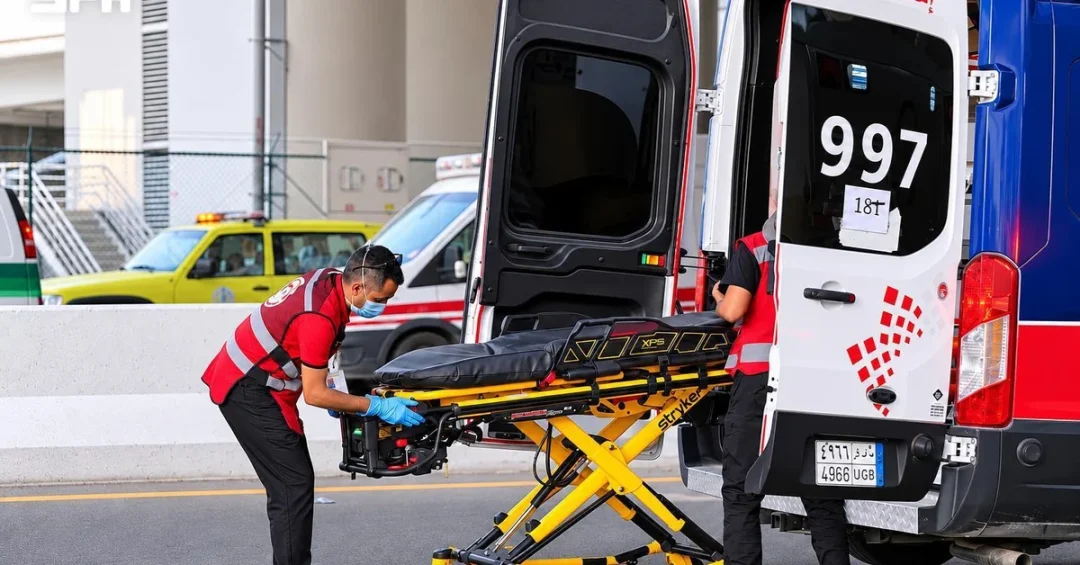
The command, control, and medical dispatch center of the Saudi Red Crescent Authority (SRCA) in Makkah Region received 40,929 emergency calls during October 2026, according to information released via the Saudi Press Agency (SPA). The calls originated from the Holy City of Makkah and the governorates of Jeddah and Taif, reflecting the scale of round-the-clock emergency medical operations maintained by the Kingdom across one of its most densely populated and religiously significant regions. The figure underscores the operational reach of a service that operates continuously, every day of the year, to protect residents, pilgrims, and visitors alike.
The disclosure came as part of the authority’s ongoing commitment to transparency and public awareness regarding its emergency medical services. By publishing monthly call volumes, the SRCA offers the public and international observers a clear window into how emergency response infrastructure functions in the Makkah Region, which hosts the Grand Mosque and receives millions of pilgrims annually. So what does a figure of more than 40,000 calls in a single month actually tell us about the readiness of Saudi Arabia’s emergency medical system? It points to a well-staffed, well-coordinated dispatch apparatus capable of handling thousands of urgent situations while maintaining service quality.
Context and Background
The Saudi Red Crescent Authority is the Kingdom’s designated national provider of emergency medical services, operating under a mandate to deliver pre-hospital care, ambulance response, and disaster relief across all regions of the country. In the Makkah Region, this mandate carries particular weight. The Holy City of Makkah and the neighboring governorates of Jeddah and Taif together form a corridor of intense population density, religious activity, and seasonal travel, making the region one of the most demanding operational environments anywhere in the Kingdom. Why is this regional dispatch center so central to the Kingdom’s broader healthcare ambitions? Because it sits at the intersection of public safety, pilgrim welfare, and everyday civilian life.
The dispatch center functions as the nerve center of the emergency medical response system. It is responsible for receiving incoming emergency calls, triaging and prioritizing them according to medical urgency, dispatching appropriate medical teams, and coordinating with hospitals and healthcare facilities to activate specialized medical pathways. This layered process ensures that a cardiac emergency, a traffic accident, or a pediatric incident each receives a response calibrated to its severity. The system’s design reflects years of investment in communications technology, trained dispatchers, and fleet management, all of which combine to keep response times competitive by international standards.
October’s call volume did not emerge in a vacuum. The Makkah Region consistently records high demand for emergency services owing to its permanent population, the steady flow of Umrah pilgrims, and the heavy traffic associated with Jeddah, the Kingdom’s second-largest city and a major commercial hub. Taif, meanwhile, draws domestic tourists and residents throughout the year, particularly during seasonal periods. Each of these factors contributes to the steady stream of calls that the dispatch center manages around the clock, and each reinforces the importance of sustained investment in emergency medical infrastructure.
The Dispatch System in Operation
How does a single center manage nearly 41,000 calls in thirty-one days? The answer lies in a structured, technology-enabled workflow that begins the moment a caller dials 997, the Kingdom’s unified emergency medical number. Trained operators receive the call, gather essential information, assess the urgency of the situation, and determine the appropriate level of response. From there, dispatchers assign and route ambulance crews, provide pre-arrival guidance to callers where appropriate, and coordinate with receiving hospitals so that patients arrive at facilities prepared to treat them. Every step is logged, monitored, and subject to quality review.
SRCA emphasized that the center plays a pivotal role in the emergency medical response system by receiving emergency calls, prioritizing responses, dispatching medical teams, and coordinating with healthcare facilities to activate specialized medical pathways. This description reflects a mature operating model in which emergency medical services are integrated with the broader healthcare network rather than functioning in isolation. The coordination with hospitals is especially important in complex cases, where the dispatch center can alert specialists, reserve beds, or redirect ambulances to the most appropriate facility based on the patient’s condition and the capacity of nearby hospitals.
Behind the statistics stands a workforce of dispatchers, paramedics, emergency physicians, and support staff who maintain continuous coverage across shifts. The authority’s ability to sustain this operation through weekends, holidays, and peak pilgrimage periods demonstrates the institutional depth of the service. It also reflects a deliberate strategy of professional development, in which staff receive ongoing training in triage protocols, communications, and emergency procedures. The result is a system designed to perform reliably under pressure, a quality that matters enormously in a region where the margin between a timely response and a delayed one can be measured in minutes.
Public Cooperation and Safety Guidance
Alongside its operational reporting, the SRCA urged the public to cooperate with emergency medical teams and to yield the right-of-way to ambulances responding to emergencies. This appeal is more than a courtesy; it is a practical necessity. In dense urban environments such as Jeddah and central Makkah, traffic congestion can delay an ambulance’s journey, and drivers who fail to clear a path can inadvertently cost precious minutes. Does the public fully appreciate how much difference a few seconds can make in an emergency? For patients experiencing cardiac arrest, stroke, or severe trauma, rapid transport and early intervention are directly linked to better outcomes.
The authority also highlighted the importance of reporting medical emergencies by calling 997. This simple message carries substantial public health value. Prompt reporting allows dispatchers to initiate the response chain immediately, and clear communication from callers helps operators determine the right resources to send. The SRCA’s public guidance forms part of a wider awareness effort aimed at building a culture of preparedness, in which citizens and residents understand how to act decisively when a medical emergency arises. Such efforts complement the Kingdom’s broader investments in healthcare literacy and community safety.
It is worth noting that emergency call volumes reflect not only the incidence of illness and injury but also public confidence in the system. When residents and visitors dial 997, they are expressing trust that a professional response will follow. That trust has been built over years of consistent service delivery and is reinforced each time an ambulance arrives promptly and a patient receives skilled care. The authority’s transparency in publishing call statistics further strengthens this relationship, giving the public a sense of accountability and shared ownership of the emergency medical system.
International and Regional Impact
The operational performance of the Makkah Region dispatch center carries significance well beyond Saudi Arabia’s borders. The Kingdom receives millions of international pilgrims each year, and the emergency medical services available in Makkah and the surrounding areas form part of the overall experience of safety and hospitality that visitors encounter. When a pilgrim from another country falls ill or is injured, the response they receive reflects on the Kingdom’s reputation as a capable and caring host. In this sense, the dispatch center’s work is an element of soft power, demonstrating Saudi Arabia’s capacity to manage complex, large-scale public safety operations with professionalism.
Regionally, the SRCA’s model of centralized dispatch and coordinated hospital pathways offers a reference point for emergency medical systems across the Middle East and beyond. The authority’s emphasis on data-driven management, continuous coverage, and public engagement aligns with international best practices in emergency medicine. International observers tracking Saudi Arabia’s healthcare modernization have noted the steady improvement in emergency response capabilities as part of the broader transformation of the Kingdom’s public services. The October figures, published openly through official channels, contribute to that record of measurable progress.
The regional dimension also includes cooperation with neighboring governorates and with national entities responsible for pilgrim management, traffic control, and public health. Emergency response in the Makkah Region is a collaborative endeavor, and the dispatch center serves as a coordinating hub that links ambulance crews, hospitals, and other agencies in real time. This integrated approach reduces fragmentation and ensures that resources are deployed where they are most needed, a principle that has become increasingly important as the region’s population and visitor numbers grow.
Economic and Strategic Significance
Reliable emergency medical services are an essential component of the infrastructure that supports economic activity. In Jeddah, a commercial and logistical hub that hosts major ports, businesses, and international events, the availability of responsive emergency care contributes to the confidence of investors and employers. A city that can protect the health and safety of its residents and workforce is better positioned to attract talent and investment. Similarly, in Makkah and Taif, the assurance of quality emergency services supports the tourism and hospitality sectors that depend on visitors feeling safe and well cared for.
Strategically, the SRCA’s operations form part of the Kingdom’s wider investment in healthcare as a pillar of national development. The authority’s ability to handle high call volumes while maintaining coordination with hospitals reflects a healthcare system that is modernizing in step with the ambitions of Vision 2030. Emergency medical services are, in this sense, both a public good and a strategic asset, one that underpins the Kingdom’s goals of enhancing quality of life, strengthening public services, and positioning Saudi Arabia as a global leader in pilgrimage management and event hosting.
The monthly publication of call statistics also serves a governance purpose. By making operational data available through official channels, the authority enables policymakers, researchers, and the public to understand patterns of demand and to assess the performance of emergency services over time. This kind of transparency is consistent with the broader shift toward evidence-based administration that characterizes Saudi Arabia’s public sector reforms. The 40,929 calls recorded in October are therefore not merely a number; they are a data point in an ongoing effort to refine and improve a vital service.
Vision 2030 Alignment
How does a regional dispatch center connect to a national transformation strategy? The answer lies in the Vision 2030 objective of improving quality of life for citizens and residents through better public services. Health and safety are foundational to that objective, and the Saudi Red Crescent Authority’s round-the-clock emergency medical operations in the Makkah Region directly serve it. By ensuring that urgent medical situations are met with prompt, professional, and coordinated responses, the authority contributes to a society in which people can live, work, and travel with confidence in their safety net.
Vision 2030 also emphasizes the enhancement of healthcare services and the development of a modern, efficient public sector. The SRCA’s integration of dispatch technology, trained personnel, and hospital coordination exemplifies these priorities in practice. As the Kingdom continues to welcome millions of pilgrims and to expand its tourism and events sectors, the reliability of emergency medical services will remain a critical enabler of those ambitions. The October figures, released through official Saudi channels, offer a snapshot of a service that is not only functioning at scale but also evolving in line with the Kingdom’s long-term vision for a healthier, safer, and more prosperous future.
Looking ahead, the authority’s continued investment in training, technology, and public awareness will shape the next chapter of emergency medical care in the Makkah Region. The message to the public remains clear and consistent: cooperate with emergency teams, yield to ambulances, and call 997 when help is needed. Through these shared responsibilities, the Kingdom strengthens a system that protects lives and supports the broader national journey toward Vision 2030.
20 Questions
Q1. How many emergency calls did the Saudi Red Crescent Authority in Makkah Region receive in October 2026?
A1. The command, control, and medical dispatch center of the Saudi Red Crescent Authority in Makkah Region received 40,929 emergency calls during October 2026, as reported through the Saudi Press Agency.
Q2. Which areas did the October emergency calls originate from?
A2. The calls came from the Holy City of Makkah and the governorates of Jeddah and Taif, reflecting demand across one of the Kingdom’s most populated and religiously significant regions.
Q3. What is the role of the dispatch center in the emergency medical system?
A3. The center receives emergency calls, prioritizes responses, dispatches medical teams, and coordinates with healthcare facilities to activate specialized medical pathways for patients in need.
Q4. What emergency number should the public call for medical help?
A4. The Saudi Red Crescent Authority highlighted the importance of reporting medical emergencies by calling 997, the Kingdom’s unified emergency medical number.
Q5. What does the Saudi Red Crescent Authority urge the public to do regarding ambulances?
A5. The authority urged the public to cooperate with emergency medical teams and to yield the right-of-way to ambulances responding to emergencies, helping ensure timely patient care.
Q6. Is the emergency medical service available around the clock?
A6. Yes, the authority provides round-the-clock emergency medical services, maintaining continuous coverage to respond to urgent situations at any hour of the day or night.
Q7. Why is the Makkah Region particularly important for emergency services?
A7. The Makkah Region hosts the Grand Mosque and receives millions of pilgrims annually, while also including Jeddah and Taif, creating a demanding and densely populated operational environment.
Q8. How does the dispatch center prioritize emergency calls?
A8. Trained operators gather essential information and assess the urgency of each situation, allowing dispatchers to determine the appropriate level of response and route resources accordingly.
Q9. What happens after an ambulance is dispatched?
A9. The center coordinates with receiving hospitals so that patients arrive at facilities prepared to treat them, and it can alert specialists or redirect ambulances as needed.
Q10. Why is public cooperation with ambulances important?
A10. In dense urban areas, traffic congestion can delay ambulances, and drivers who clear a path help ensure that patients receive care as quickly as possible.
Q11. Which agency released the October call statistics?
A11. The information was released via the Saudi Press Agency, the Kingdom’s official news authority, as part of the Saudi Red Crescent Authority’s reporting on its operations.
Q12. What does a high monthly call volume indicate about the system?
A12. It points to a well-staffed, well-coordinated dispatch apparatus capable of handling thousands of urgent situations while maintaining service quality and reliability.
Q13. How does the center support hospitals during complex cases?
A13. The center can alert specialists, reserve beds, or redirect ambulances to the most appropriate facility based on the patient’s condition and nearby hospital capacity.
Q14. What is the significance of the 997 number for residents and visitors?
A14. It provides a single, easily remembered number for medical emergencies, enabling prompt reporting and immediate initiation of the emergency response chain.
Q15. How does the authority build public confidence in its services?
A15. The authority delivers consistent, professional service and publishes operational data transparently, reinforcing public trust and a sense of shared ownership of the system.
Q16. Does the dispatch center operate during peak pilgrimage periods?
A16. Yes, the center sustains continuous coverage through weekends, holidays, and peak pilgrimage periods, demonstrating the institutional depth of the emergency medical service.
Q17. What kind of staff work at the dispatch center?
A17. Dispatchers, paramedics, emergency physicians, and support staff maintain coverage across shifts, supported by ongoing training in triage protocols, communications, and emergency procedures.
Q18. How does the service connect to Saudi Arabia’s broader healthcare goals?
A18. The emergency medical service supports quality of life and public safety, aligning with Vision 2030 objectives to enhance healthcare services and modernize the public sector.
Q19. What should a caller do when reporting a medical emergency?
A19. Callers should dial 997, communicate clearly, and provide essential information so that operators can determine the right resources to send without delay.
Q20. What is the public’s shared responsibility in emergency response?
A20. The public supports the system by cooperating with emergency teams, yielding to ambulances, and promptly reporting emergencies, strengthening a service that protects lives across the Kingdom.
Reader Feedback
We value your thoughts. Please share your feedback on this article.
Your feedback helps us improve our coverage.
Related articles
 Weqaa Advances One Health System for Food Security
 Saudi Red Crescent Signs Deal to Boost Emergency Services
 Security Forces Hospital in Riyadh Earns Baby-Friendly Accreditation
 Riyadh Al-Khabra Installs Fitness Equipment in Parks
 SFDA Hosts 6th Regulatory Research Day 2026 in Riyadh
 Madinah Food Safety Campaign Launched by Environment Ministry