


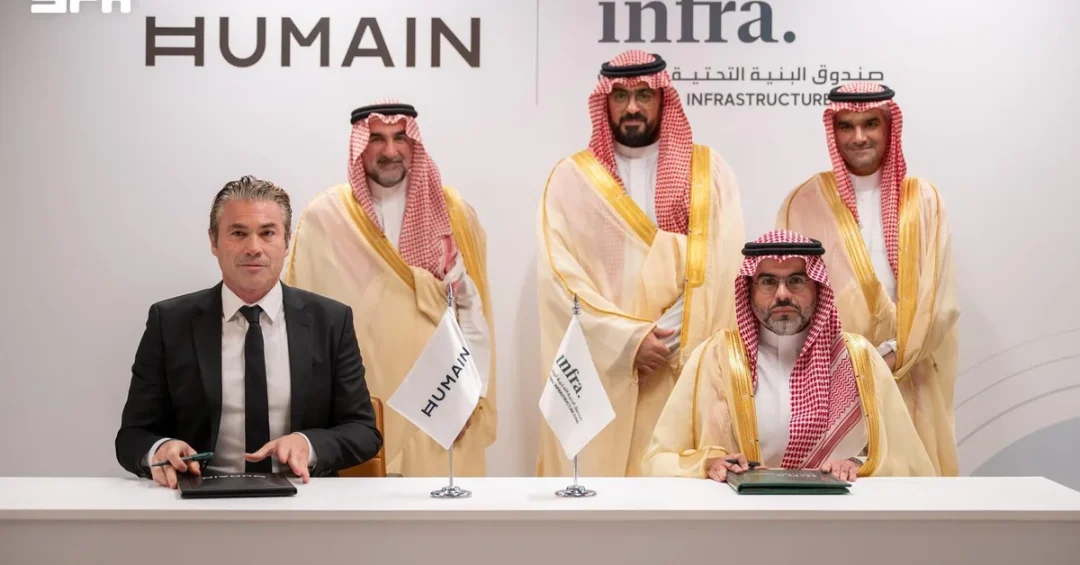
The National Infrastructure Fund (Infra) and HUMAIN, a Public Investment Fund (PIF) company delivering full-stack artificial intelligence capabilities, signed two financing agreements totaling up to SAR2.5 billion (approximately $667 million) on November 8 in Riyadh. The agreements, announced by the Saudi Press Agency, are designed to accelerate the deployment of artificial intelligence computing and the development of critical power infrastructure across the Kingdom. The signing took place in the presence of Governor of the Public Investment Fund Yasir Al-Rumayyan, Minister of Economy and Planning and Chairman of Infra’s Board of Directors Faisal Alibrahim, and Governor of the National Development Fund Abdulaziz Alarifi. The facilities represent the first transactions under Infra’s AI Data Center Financing Program and build on a strategic financing framework unveiled by Infra and HUMAIN at the World Economic Forum in Davos in January 2026, which had outlined non-binding financing terms of up to SAR4.5 billion ($1.2 billion).
How does a single financing package reshape the trajectory of an entire industry? In Saudi Arabia’s case, the answer lies in the deliberate coupling of computing power with the energy infrastructure needed to run it. The agreements are not merely financial transactions; they are a statement of intent that the Kingdom intends to compete at the highest levels of the global artificial intelligence economy. By backing both graphics processing units (GPUs) and the substations, transmission lines and grid connections that feed them, Infra and HUMAIN are addressing two of the most persistent bottlenecks in AI development: access to advanced chips and access to reliable, large-scale electricity. The move signals that Saudi Arabia is building an integrated ecosystem rather than isolated data centers, a distinction that matters enormously to hyperscalers, institutional investors and technology partners evaluating where to commit capital for the next decade.
Context and Background
What made this moment possible? The answer begins with Saudi Arabia’s long-term strategy to diversify its economy beyond hydrocarbons, a vision that has steadily gained momentum since the launch of Vision 2030 in 2016. Artificial intelligence has emerged as a central pillar of that diversification, not only as a technology sector in its own right but as a productivity multiplier across healthcare, education, logistics, energy and government services. HUMAIN was established by the Public Investment Fund to deliver full-stack AI capabilities globally, encompassing data centers, cloud platforms, models and applications. The National Infrastructure Fund, meanwhile, was created to catalyze private investment in projects that are economically vital but require long gestation periods and substantial upfront capital. The partnership between the two entities is therefore structurally logical: one builds and operates AI infrastructure, while the other de-risks and finances the foundational layers that make such infrastructure bankable.
The collaboration did not begin with the November 8 signing. In January 2026, at the World Economic Forum in Davos, Infra and HUMAIN announced a strategic financing framework outlining non-binding terms of up to SAR4.5 billion ($1.2 billion) to support AI and digital infrastructure projects in the Kingdom. That framework served as a public signal to global markets that Saudi Arabia was prepared to deploy serious capital behind its AI ambitions. It also gave potential co-investors a clear reference point for how projects would be structured, governed and financed. The November agreements convert part of that framework into binding facilities, marking a transition from intention to execution. For international observers, the speed of that transition—less than a year from framework to signed deals—demonstrates the operational discipline behind Saudi Arabia’s AI agenda.
Why does the sequencing of these agreements matter? Because infrastructure finance is rarely about a single check. It is about creating a repeatable model. Infra’s AI Data Center Financing Program is designed to strengthen project readiness and bankability, with commercial viability and economic value guiding capital deployment. By anchoring the first transactions with HUMAIN, Infra establishes a template that other developers, hyperscalers and institutional investors can follow. The presence of senior officials at the signing—including the Governor of PIF and the Chairman of Infra’s Board—underscores that this is a national priority, not a routine corporate transaction. It also reinforces the message that Saudi Arabia’s AI buildout is being coordinated at the highest levels of government and finance, reducing the fragmentation risk that often plagues emerging technology ecosystems.
Key Details of the Financing Agreements
What exactly do the two facilities cover? The first is a GPU financing facility of up to SAR1.1 billion ($293.3 million), dedicated to the procurement and deployment of graphics processing units. These chips represent approximately 25 megawatts of IT load, a meaningful increment of computing capacity in a region where demand for AI training and inference is rising rapidly. GPUs are the workhorses of modern AI, and access to them has become a geopolitical as well as an economic issue. By financing their acquisition directly, Infra reduces the upfront capital burden on HUMAIN and accelerates the timeline on which advanced computing capacity can be brought online. The facility also signals to global chip suppliers and technology partners that Saudi Arabia is a reliable, long-term buyer with institutional backing.
The second facility, of up to SAR1.4 billion ($373.3 million), will finance the development of substations, transmission infrastructure and grid connections to support HUMAIN’s AI data centers in Saudi Arabia. This is the less glamorous but equally essential half of the equation. Data centers are among the most power-hungry facilities ever built, and without dedicated, resilient electricity infrastructure, even the most advanced GPU clusters cannot operate at scale. The planned power infrastructure is designed to support future data center development with up to 1 gigawatt of IT capacity, helping create the conditions for investment by developers, hyperscalers and institutional investors. That 1 GW figure is significant: it places the Kingdom’s ambitions on par with major global data center hubs and signals that Saudi Arabia is planning for decades of AI growth, not a single cycle.
Eng. Esmail bin Mohammed Alsallom, CEO of Infra, framed the agreements as a catalyst for broader investment. “Through these agreements, we aim to unlock investment well beyond Infra’s own commitment,” he said. “Supporting HUMAIN’s computing deployment alongside essential power infrastructure helps prepare a broader pipeline of data center projects for investment. Our role is to strengthen project readiness and bankability, with commercial viability and economic value guiding how we deploy our capital. This partnership connects our priorities with commercial discipline, helping build a financing market that can attract a broader pool of private and institutional capital and sustain the local AI infrastructure growth.” His counterpart at HUMAIN, CEO Tareq Amin, emphasized the foundational nature of the work. “AI infrastructure is becoming foundational to the next generation of computing, and scaling it requires both significant investment and the infrastructure to support it. These facilities with Infra will help accelerate the deployment of advanced computing capacity and the power infrastructure required to support it. At HUMAIN, we are focused on building and operating AI infrastructure at scale, while developing the technologies and platforms that enable organizations and customers globally to put AI to work.”
International and Regional Impact
How will these agreements be received beyond Saudi Arabia’s borders? For international investors, the transactions offer a rare combination of sovereign backing and commercial discipline. Infra’s explicit emphasis on bankability and economic value is designed to reassure private capital that projects will be structured to market standards, not merely subsidized. That matters because the global AI infrastructure race is increasingly competitive. The United States, China, the European Union and the Gulf states are all committing billions of dollars to data centers, chips and power. Saudi Arabia’s ability to move from framework to signed facilities in under a year gives it a credibility advantage in that race. It also positions the Kingdom as a potential bridge between Western technology providers and regional demand, a role that carries diplomatic as well as economic weight.
Regionally, the agreements reinforce the Gulf’s emergence as a major AI hub. The scale of the planned power infrastructure—up to 1 GW of IT capacity—suggests that Saudi Arabia is preparing to host workloads that require enormous, continuous energy supply, from large language model training to real-time inference for industrial applications. This has implications for neighboring economies, which may seek to connect to Saudi data centers, share subsea cable capacity or co-invest in cross-border digital infrastructure. It also strengthens the case for regional electricity interconnection projects, which could allow Gulf states to optimize power generation and share reserves. For global hyperscalers, the message is clear: Saudi Arabia is not just a market for AI services but a location for AI production, with the energy, land and capital to support it.
Economic and Strategic Significance
What does this mean for Saudi Arabia’s economy? The direct impact includes construction jobs, engineering contracts, technology procurement and the development of a specialized workforce in data center operations, power systems and AI engineering. The indirect impact is potentially larger. Reliable, large-scale AI infrastructure can lower the cost of computing for Saudi enterprises, universities and government agencies, accelerating innovation in sectors from healthcare to logistics. It can also attract foreign direct investment as multinational companies seek regional data residency and low-latency access to AI services. Over time, a thriving AI infrastructure sector can become an export industry in its own right, with Saudi-based data centers serving customers across the Middle East, Africa and South Asia.
Strategically, the agreements reduce Saudi Arabia’s dependence on imported AI capacity. By financing GPUs and power infrastructure domestically, the Kingdom retains greater control over its data, its computing supply chain and its energy footprint. This is particularly important as AI becomes intertwined with national security, industrial policy and technological sovereignty. The involvement of the National Development Fund and the Public Investment Fund further signals that the financing ecosystem is being aligned around long-term national objectives. For global partners, the message is that Saudi Arabia is building an AI stack that is open to collaboration but anchored in local capability—a balance that many governments are now seeking to strike.
Vision 2030 Alignment
How does this fit into the broader Vision 2030 agenda? Artificial intelligence and digital infrastructure are explicit priorities in the Kingdom’s economic transformation plan, which seeks to diversify revenue streams, create high-value jobs and position Saudi Arabia as a global investment destination. The financing agreements advance several Vision 2030 objectives simultaneously: they support the growth of a knowledge-based economy, they enhance the Kingdom’s attractiveness to technology companies, and they strengthen the physical and digital infrastructure that underpins every other sector. By linking AI computing to power infrastructure, Infra and HUMAIN are also addressing the sustainability and resilience dimensions of Vision 2030, ensuring that the AI buildout is matched by the energy systems required to sustain it.
Looking ahead, the agreements are likely to be followed by further transactions under Infra’s AI Data Center Financing Program, potentially drawing in private equity, infrastructure funds and technology partners. The framework announced at Davos contemplated up to SAR4.5 billion in financing, of which SAR2.5 billion has now been formalized. That leaves room for additional facilities as HUMAIN’s data center pipeline matures. For international readers, the takeaway is that Saudi Arabia is not waiting for the AI future to arrive; it is financing, building and powering that future now. The Kingdom’s ability to combine sovereign capital, commercial discipline and strategic vision in a single package is a model that other nations are likely to study closely—and one that reinforces Saudi Arabia’s role as a leading global player in the next generation of computing.
20 Questions
Q1. What did Infra and HUMAIN agree to on November 8?
A1. They signed two financing agreements totaling up to SAR2.5 billion (approximately $667 million) to support artificial intelligence computing deployment and critical power infrastructure development in Saudi Arabia.
Q2. Who attended the signing ceremony in Riyadh?
A2. Governor of PIF Yasir Al-Rumayyan, Minister of Economy and Planning and Chairman of Infra’s Board Faisal Alibrahim, and Governor of the National Development Fund Abdulaziz Alarifi attended.
Q3. What is Infra’s AI Data Center Financing Program?
A3. It is a program designed to finance AI data center projects, with these agreements being the first transactions announced under it, aimed at strengthening project readiness and bankability.
Q4. How much is the GPU financing facility worth?
A4. The GPU financing facility is up to SAR1.1 billion ($293.3 million), supporting procurement and deployment of graphics processing units representing approximately 25 MW of IT load.
Q5. What does the second facility cover?
A5. The second facility, up to SAR1.4 billion ($373.3 million), finances substations, transmission infrastructure and grid connections to support HUMAIN’s AI data centers.
Q6. What is the planned power infrastructure capacity?
A6. It is designed to support future data center development with up to 1 GW of IT capacity, helping create conditions for investment by developers, hyperscalers and institutional investors.
Q7. What was announced at Davos in January 2026?
A7. Infra and HUMAIN announced a strategic financing framework with non-binding terms of up to SAR4.5 billion ($1.2 billion) for AI and digital infrastructure projects.
Q8. How do these agreements relate to the Davos framework?
A8. They are the first binding facilities under that framework, converting part of the non-binding terms into signed agreements less than a year after the initial announcement.
Q9. What did Infra CEO Esmail Alsallom say about the agreements?
A9. He said they aim to unlock investment beyond Infra’s commitment, strengthen project readiness and bankability, and help build a financing market attracting private and institutional capital.
Q10. What did HUMAIN CEO Tareq Amin emphasize?
A10. He said AI infrastructure is foundational to next-generation computing and that these facilities will accelerate deployment of advanced computing capacity and supporting power infrastructure.
Q11. Why is power infrastructure important for AI data centers?
A11. AI data centers are highly power-intensive; without dedicated substations, transmission lines and grid connections, even advanced GPU clusters cannot operate at scale reliably.
Q12. What does 25 MW of IT load mean?
A12. It indicates the electricity consumption of the computing equipment itself, equivalent to a substantial data center footprint and a meaningful increment of AI capacity.
Q13. How does this benefit international investors?
A13. It signals sovereign backing combined with commercial discipline, creating a repeatable model that de-risks projects and encourages private and institutional co-investment.
Q14. What is HUMAIN’s role in Saudi Arabia’s AI ecosystem?
A14. HUMAIN is a PIF company delivering full-stack AI capabilities globally, including building and operating AI infrastructure at scale and developing technologies and platforms.
Q15. What is the National Infrastructure Fund?
A15. Infra is a Saudi fund that catalyzes private investment in economically vital projects, with a focus on strengthening project readiness, bankability and long-term commercial viability.
Q16. How does this support Vision 2030?
A16. It advances economic diversification, knowledge-based growth, job creation and Saudi Arabia’s position as a global investment and technology hub aligned with Vision 2030 objectives.
Q17. What are the regional implications?
A17. It reinforces the Gulf’s emergence as an AI hub, potentially enabling cross-border digital infrastructure, electricity interconnection and data center collaboration across the region.
Q18. What economic benefits are expected?
A18. Benefits include construction and engineering jobs, technology procurement, workforce development, lower computing costs for enterprises and attraction of foreign direct investment.
Q19. Will there be more financing agreements?
A19. The Davos framework contemplated up to SAR4.5 billion, of which SAR2.5 billion is now formalized, leaving room for additional facilities as HUMAIN’s pipeline matures.
Q20. What is the broader significance of these agreements?
A20. They demonstrate Saudi Arabia’s ability to finance, build and power AI infrastructure at scale, positioning the Kingdom as a leading global player in next-generation computing.
Reader Feedback
We value your thoughts. Please share your feedback on this article.
Your feedback helps us improve our coverage.
Related articles
 ZATCA Launches Online Advisor for Business Obligations
 Madinah Haramain Station Offers Investment Opportunities
 Al-Balad Al-Ameen Showcases Investment, Digital Solutions at Hajj Exhibition
 Date Palm Preserves Qassim’s Heritage, Drives Sustainable Development
 Saudi Arabia Raises Saudization to 35% for 94 Engineering Jobs
 Saudi EXIM Provides SAR43.22 Billion in Credit Facilities in First Nine Months of 2026