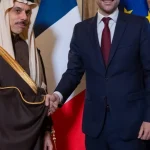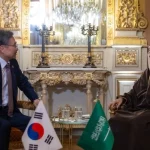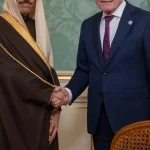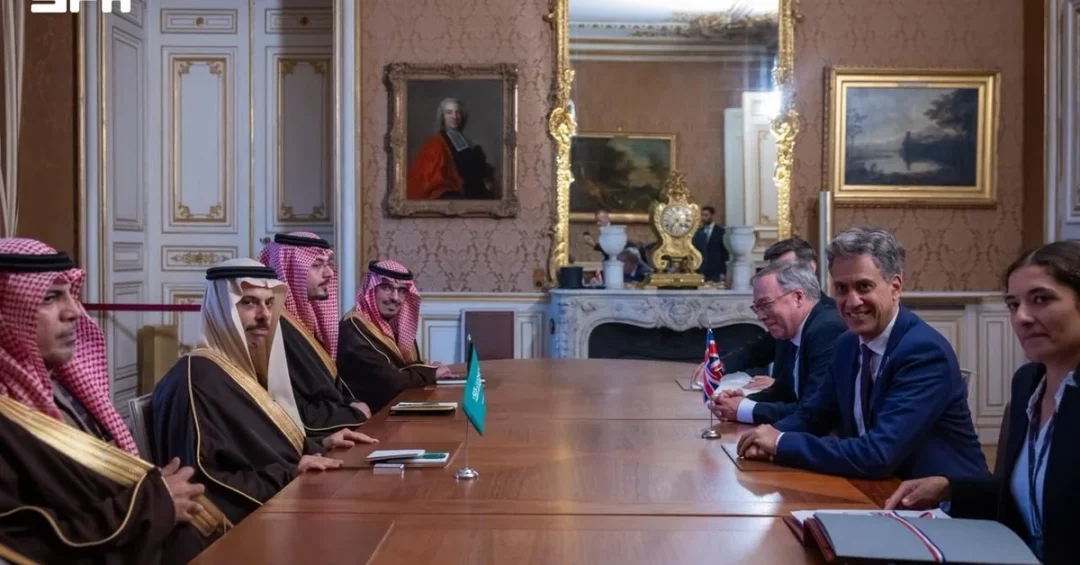
Saudi Minister of Foreign Affairs Prince Faisal bin Farhan bin Abdullah met with United Kingdom Secretary of State for Foreign, Commonwealth and Development Affairs Ed Miliband in Paris on November 9, 2026, on the sidelines of the Group of Seven (G7) Foreign Ministers’ Meeting, according to the Saudi Press Agency. The high-level encounter underscored the enduring partnership between the Kingdom of Saudi Arabia and the United Kingdom and provided a timely platform to align positions on pressing regional and global challenges. The two diplomats reviewed the full spectrum of bilateral relations and exchanged views on developments in the Middle East, with a particular focus on joint efforts to ensure maritime security, safeguard international shipping routes, and restore stability across the region. Saudi Ambassador to France Dr. Faisal Al-Mujfel attended the meeting, reflecting the Kingdom’s coordinated diplomatic approach across European capitals.
Why does a single diplomatic meeting in Paris command such attention on the world stage? Because the issues discussed—from the security of vital waterways to the stability of the broader Middle East—affect every nation that depends on open trade and peaceful coexistence. Saudi Arabia, under the leadership of the Custodian of the Two Holy Mosques King Salman bin Abdulaziz Al Saud and His Royal Highness Crown Prince Mohammed bin Salman bin Abdulaziz Al Saud, has consistently championed dialogue and cooperation as the foundation for resolving disputes and building prosperity. The meeting between Prince Faisal bin Farhan and Secretary of State Ed Miliband is the latest expression of that commitment, bringing together two influential partners at a moment when coordinated action is more necessary than ever.
Context and Background
How did this meeting come to take place, and what does it signify about the trajectory of Saudi-UK relations? The encounter occurred on the margins of the G7 Foreign Ministers’ Meeting in Paris, a gathering that brings together the world’s leading industrialized democracies to address shared international concerns. Saudi Arabia’s participation in such forums—while not a G7 member—reflects its growing role as a bridge-builder and a pivotal actor in regional and global diplomacy. The Kingdom’s invitation to engage with G7 counterparts signals recognition of its constructive influence and its capacity to contribute to solutions on issues ranging from energy security to counterterrorism.
The Saudi-UK relationship rests on a deep foundation of historical ties, strategic cooperation, and mutual economic interest. The United Kingdom is a longstanding partner of Saudi Arabia, and the two countries have collaborated across defense, trade, education, and cultural exchange for decades. In recent years, this partnership has been reinvigorated through high-level visits and agreements that align with Saudi Vision 2030, the ambitious national transformation plan aimed at diversifying the Kingdom’s economy and enhancing its global engagement. The meeting in Paris thus builds on a momentum of intensified diplomatic activity between Riyadh and London.
Regional developments provided urgent context for the discussions. The Middle East continues to face complex challenges, including threats to maritime security in the Red Sea and the Gulf, which have implications for global commerce and energy supplies. Saudi Arabia has been at the forefront of efforts to protect these vital waterways, advocating for international cooperation to deter attacks on shipping and to uphold the freedom of navigation. The meeting between Prince Faisal bin Farhan and Secretary of State Miliband allowed for a detailed exchange on these issues, reinforcing a shared commitment to safeguarding the arteries of the global economy.
Key Details of the Meeting
What exactly was discussed behind closed doors, and why do the specifics matter? According to the official readout from the Saudi Press Agency, the two officials reviewed bilateral relations between their countries and discussed key regional issues and current developments. They also focused on joint efforts to ensure maritime security, safeguard shipping routes, and restore security and stability in the region. These topics are not abstract diplomatic talking points; they represent concrete challenges that require coordinated responses. Maritime security, in particular, is a priority for Saudi Arabia, given its strategic location along the Red Sea and the Arabian Gulf, through which a significant portion of global oil and gas shipments passes.
The presence of Saudi Ambassador to France Dr. Faisal Al-Mujfel at the meeting highlights the importance of France as a diplomatic hub and the role of Saudi missions in advancing the Kingdom’s foreign policy objectives. Ambassador Al-Mujfel’s participation also underscores the interconnectedness of Saudi diplomacy across Europe, as engagement in Paris complements ongoing dialogues in London, Brussels, and other capitals. The meeting was held on the sidelines of the G7 Foreign Ministers’ Meeting, a setting that allowed Prince Faisal bin Farhan to engage with multiple international counterparts in a short span, maximizing the impact of Saudi diplomacy.
While the official statement did not disclose specific new agreements or initiatives, the value of such high-level consultations lies in their role in aligning strategies and building trust. The discussion on restoring security and stability in the region likely touched on ongoing conflicts and crises, with Saudi Arabia advocating for peaceful resolutions and respect for international law. The Kingdom’s consistent position is that dialogue, not confrontation, is the path to lasting peace, and its engagement with the UK—a permanent member of the UN Security Council—amplifies that message.
International and Regional Impact
How will this meeting resonate beyond the immediate participants? The Saudi-UK dialogue in Paris sends a powerful signal that key international players are united in their commitment to regional stability and the protection of global trade routes. For countries reliant on the free flow of goods and energy, the reaffirmation of cooperation between Saudi Arabia and the United Kingdom is reassuring. It also reinforces the principle that challenges in the Middle East are best addressed through multilateral frameworks and partnerships, rather than unilateral actions. The meeting thus contributes to a broader diplomatic momentum that includes the G7 discussions and other ongoing initiatives.
From a regional perspective, the meeting underscores Saudi Arabia’s role as a stabilizing force and a constructive partner. The Kingdom’s efforts to ensure maritime security are not only about protecting its own interests but also about upholding the global commons. By coordinating with the UK, Saudi Arabia strengthens the international coalition dedicated to safeguarding shipping lanes, which benefits all nations that trade through the Red Sea and the Gulf. This cooperation is particularly important as threats to maritime navigation have escalated in recent years, disrupting supply chains and raising insurance costs. The joint efforts discussed in Paris are a step toward mitigating these risks.
Economic and Strategic Significance
What economic and strategic interests are at stake in this diplomatic engagement? The security of maritime routes is directly linked to global energy markets and trade. Saudi Arabia is the world’s leading exporter of crude oil, and any disruption to shipping in the Red Sea or the Strait of Hormuz can have immediate and far-reaching effects on oil prices and economic stability worldwide. By working with the United Kingdom to enhance maritime security, Saudi Arabia is protecting not only its own economic lifeline but also the stability of the global economy. This aligns with the Kingdom’s Vision 2030 goal of ensuring a secure environment for its economic diversification and investment ambitions.
Strategically, the meeting reinforces the Saudi-UK partnership as a cornerstone of regional security architecture. The United Kingdom, with its global diplomatic reach and military capabilities, is a valuable ally in addressing shared threats. For Saudi Arabia, close ties with the UK also facilitate technology transfer, defense cooperation, and intelligence sharing—all of which contribute to the Kingdom’s security and development. Moreover, the meeting in Paris allows Saudi Arabia to engage with the UK in a multilateral context, reinforcing the importance of international law and collective action. This strategic alignment supports Vision 2030’s objective of positioning Saudi Arabia as a pivotal player in global affairs.
Vision 2030 Alignment
How does this diplomatic meeting connect to Saudi Arabia’s long-term vision for the future? Vision 2030, launched by Crown Prince Mohammed bin Salman, seeks to transform the Kingdom into a diversified, knowledge-based economy and a global investment powerhouse. A key pillar of this vision is strengthening international partnerships and enhancing Saudi Arabia’s role as a bridge between continents and cultures. The meeting between Prince Faisal bin Farhan and Secretary of State Miliband exemplifies this pillar in action, as it deepens a strategic relationship that can yield benefits in trade, investment, and security cooperation.
Furthermore, the discussions on maritime security and regional stability directly support Vision 2030’s economic goals. A stable and secure region is essential for attracting foreign investment, expanding non-oil sectors, and creating jobs for Saudi youth. By working with the UK to ensure safe shipping routes, Saudi Arabia is helping to create the conditions for its own economic transformation and for the prosperity of the wider region. As the Kingdom continues to open up to the world—through initiatives like NEOM, the Red Sea Project, and major sporting and cultural events—partnerships with countries like the United Kingdom will be instrumental in showcasing Saudi Arabia’s progress and potential. This meeting in Paris is another milestone in that journey, reflecting a forward-looking foreign policy that serves the Kingdom’s interests and contributes to global peace and prosperity.
20 Questions
Q1. Who represented Saudi Arabia at the meeting in Paris?
A1. Saudi Minister of Foreign Affairs Prince Faisal bin Farhan bin Abdullah represented the Kingdom at the meeting in Paris on November 9, 2026, according to the Saudi Press Agency.
Q2. Who was the UK counterpart in the meeting?
A2. The UK counterpart was Secretary of State for Foreign, Commonwealth and Development Affairs Ed Miliband, who met with Prince Faisal bin Farhan on the sidelines of the G7 Foreign Ministers’ Meeting.
Q3. What was the main purpose of the meeting?
A3. The two officials reviewed bilateral relations and discussed key regional issues, current developments, and joint efforts to ensure maritime security, safeguard shipping routes, and restore security and stability in the region.
Q4. Where did the meeting take place?
A4. The meeting took place in Paris, France, on the sidelines of the Group of Seven (G7) Foreign Ministers’ Meeting, as reported by the Saudi Press Agency.
Q5. When did the meeting occur?
A5. The meeting occurred on November 9, 2026, according to the official Saudi Press Agency report, which was published at 23:07 local time (20:07 GMT).
Q6. Who else attended the meeting?
A6. Saudi Ambassador to France Dr. Faisal Al-Mujfel attended the meeting, highlighting the involvement of Saudi diplomatic missions in advancing the Kingdom’s foreign policy objectives.
Q7. What is the G7 Foreign Ministers’ Meeting?
A7. The G7 Foreign Ministers’ Meeting is a gathering of foreign ministers from the Group of Seven leading industrialized democracies, held to address major international issues and coordinate policies on global challenges.
Q8. Why is Saudi Arabia participating in a G7-related event?
A8. Saudi Arabia’s participation reflects its growing role as a bridge-builder and pivotal actor in regional and global diplomacy, and its capacity to contribute to solutions on issues like energy security and counterterrorism.
Q9. What specific regional issues were discussed?
A9. The discussions covered key regional issues and current developments, with a focus on joint efforts to ensure maritime security, safeguard shipping routes, and restore security and stability in the region.
Q10. Why is maritime security important to Saudi Arabia?
A10. Maritime security is crucial for Saudi Arabia because the Kingdom relies on the Red Sea and Arabian Gulf for its oil exports and trade, and threats to these routes can disrupt global energy supplies and economic stability.
Q11. How does this meeting benefit Saudi-UK relations?
A11. The meeting strengthens bilateral ties by aligning strategies on shared challenges, building trust, and reinforcing cooperation in areas such as defense, trade, and regional security, which are key to both nations’ interests.
Q12. What role does the Saudi Ambassador to France play?
A12. The Saudi Ambassador to France, Dr. Faisal Al-Mujfel, supports the Kingdom’s diplomatic engagements in France and Europe, facilitating high-level meetings and advancing Saudi interests in the region.
Q13. What is the significance of the meeting being held in Paris?
A13. Paris serves as a diplomatic hub, and holding the meeting there on the sidelines of the G7 Foreign Ministers’ Meeting allows Saudi Arabia to engage with multiple international counterparts efficiently and reinforce its global diplomatic presence.
Q14. Did the meeting produce any new agreements?
A14. The official statement did not disclose specific new agreements, but the meeting served to align strategies, enhance cooperation, and reaffirm the strong partnership between Saudi Arabia and the United Kingdom.
Q15. How does this meeting relate to Saudi Vision 2030?
A15. The meeting supports Vision 2030 by strengthening international partnerships, enhancing security for trade routes, and promoting regional stability—all of which are essential for attracting investment and diversifying the Saudi economy.
Q16. What are the implications for global trade?
A16. The joint efforts to safeguard shipping routes help ensure the free flow of goods and energy, which is vital for global trade and economic stability, benefiting all nations that rely on these maritime corridors.
Q17. How does Saudi Arabia contribute to regional stability?
A17. Saudi Arabia contributes to regional stability through diplomacy, dialogue, and cooperation with international partners, advocating for peaceful resolutions and working to protect vital waterways and combat threats.
Q18. What message does this meeting send to the international community?
A18. The meeting sends a message of unity and shared commitment to addressing regional challenges, demonstrating that Saudi Arabia and the UK are reliable partners dedicated to peace, security, and prosperity.
Q19. What are the next steps following this meeting?
A19. While specific next steps were not announced, the two sides are expected to continue consultations and cooperation on maritime security and regional stability through diplomatic channels and multilateral forums.
Q20. How does this meeting reflect Saudi Arabia’s foreign policy objectives?
A20. It reflects Saudi Arabia’s commitment to active diplomacy, international cooperation, and the pursuit of peace and stability, consistent with its leadership role in the region and its Vision 2030 goals.
Reader Feedback
We value your thoughts. Please share your feedback on this article.
Your feedback helps us improve our coverage.