


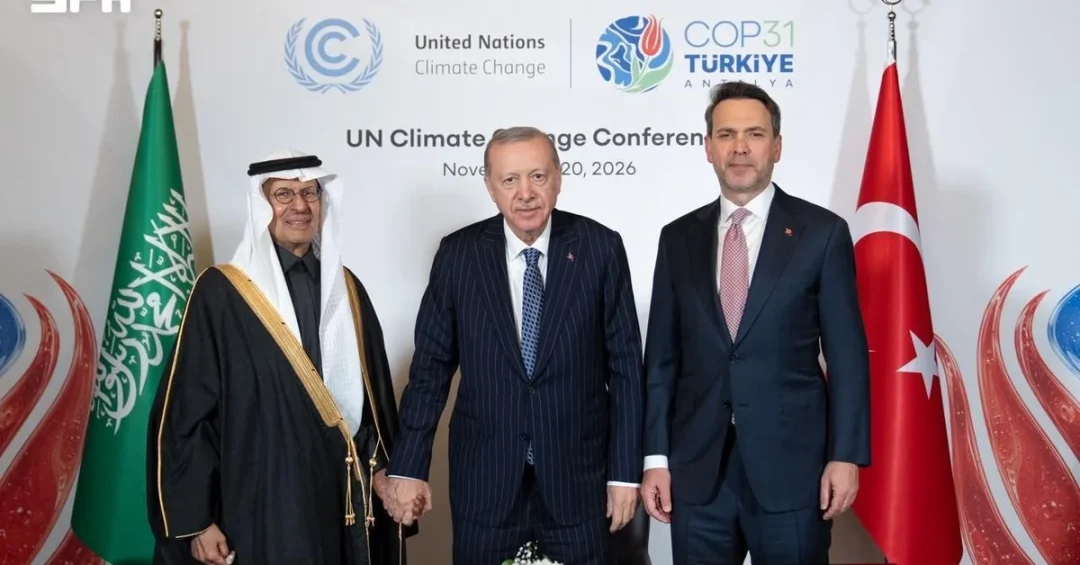
The Kingdom of Saudi Arabia and the Republic of Türkiye signed a Memorandum of Understanding on Cooperation in Electricity Projects on November 10, 2026, on the sidelines of the 31st Conference of the Parties to the United Nations Framework Convention on Climate Change (COP31) in Antalya, Türkiye. The agreement was signed in the presence of Turkish President Recep Tayyip Erdoğan by Saudi Minister of Energy and Minister of Industry and Mineral Resources Prince Abdulaziz bin Salman bin Abdulaziz Al Saud and Turkish Minister of Energy and Natural Resources Alparslan Bayraktar. The memorandum builds on a renewable energy agreement signed on February 3, 2026, which entered into force on October 21, 2026, and provides for 5,000 megawatts of renewable energy capacity in two phases, implemented by ACWA Power. How does this agreement reshape energy cooperation between two major regional powers?
The signing represents a significant step in the deepening strategic energy and investment partnership between Saudi Arabia and Türkiye. It comes as both nations pursue ambitious renewable energy targets and seek to strengthen grid infrastructure, enhance energy security, and reduce carbon emissions. The memorandum was announced by the Saudi Press Agency (SPA), the official news agency of the Kingdom, underscoring the government’s commitment to transparent communication of its international agreements. The agreement is expected to contribute to Türkiye’s renewable energy capacity, improve grid flexibility, and create new opportunities for Saudi investors and expertise in the Turkish energy market.
Context and Background
What led to this moment of strengthened energy cooperation between Saudi Arabia and Türkiye? The partnership traces back to the Agreement on Cooperation in the Field of Renewable Energy signed on February 3, 2026, which entered into force on October 21, 2026. That agreement laid the groundwork for developing renewable energy projects with a total installed capacity of 5,000 megawatts (MWe) in two phases, implemented by ACWA Power, the investor company designated by the Kingdom of Saudi Arabia. The first phase envisages 2,000 MWe, while the second phase adds 3,000 MWe. The new Memorandum of Understanding on Cooperation in Electricity Projects, signed on November 10, 2026, on the sidelines of COP31 in Antalya, expands this cooperation to include electricity projects, particularly transmission infrastructure and storage systems.
The signing ceremony took place in the presence of Turkish President Recep Tayyip Erdoğan, highlighting the high-level political commitment to the partnership. Prince Abdulaziz bin Salman bin Abdulaziz Al Saud, Saudi Minister of Energy and Minister of Industry and Mineral Resources, signed on behalf of the Kingdom, while Alparslan Bayraktar, Turkish Minister of Energy and Natural Resources, signed for Türkiye. This follows a series of diplomatic and economic engagements between the two countries, reflecting a shared vision for sustainable development and regional stability. The agreement is consistent with Saudi Arabia’s Vision 2030, which aims to diversify the economy, increase renewable energy production, and position the Kingdom as a global leader in clean energy.
Progress has already been achieved in the implementation of the first-phase projects, while efforts towards the realization of the second-phase projects have reached an advanced stage. The second phase envisages the development of wind power plants, supported by high-voltage direct current (HVDC) transmission infrastructure and battery energy storage systems. These investments are expected to contribute to strengthening Türkiye’s renewable energy capacity, enhancing grid infrastructure and flexibility, and further deepening the strategic energy and investment partnership between the Kingdom of Saudi Arabia and the Republic of Türkiye.
Key Details
What specific elements does the Memorandum of Understanding cover? The memorandum focuses on cooperation in electricity projects, building on the existing renewable energy agreement. It encompasses the development of wind power plants under the second phase of the 5,000 MWe program. The second phase includes 3,000 MWe of renewable energy capacity, supported by high-voltage direct current (HVDC) transmission infrastructure and battery energy storage systems. These technologies are critical for integrating large-scale renewable energy into the grid, ensuring stability, and maximizing the efficiency of power delivery. The first phase, comprising 2,000 MWe, is already making progress, with efforts towards the second phase at an advanced stage.
The memorandum was signed by Prince Abdulaziz bin Salman bin Abdulaziz Al Saud, Minister of Energy and Minister of Industry and Mineral Resources of Saudi Arabia, and Alparslan Bayraktar, Minister of Energy and Natural Resources of Türkiye. The signing took place in the presence of President Recep Tayyip Erdoğan, underscoring the strategic importance of the agreement. The agreement is implemented by ACWA Power, a leading Saudi company in the renewable energy sector, which has been designated as the investor for the projects. ACWA Power’s involvement highlights the role of Saudi private sector expertise in advancing international energy cooperation.
The memorandum also facilitates knowledge exchange, capacity building, and investment flows between the two nations. It is expected to create jobs, stimulate local industries, and foster innovation in renewable energy technologies. By enhancing Türkiye’s grid infrastructure and flexibility, the agreement supports the integration of intermittent renewable sources like wind and solar, contributing to energy security and sustainability. The cooperation aligns with global efforts to combat climate change, as discussed at COP31, where both countries are participating actively.
International and Regional Impact
How will this agreement influence the broader region and international energy dynamics? The Saudi-Turkish energy partnership is poised to have significant regional implications. By combining Saudi Arabia’s financial resources and renewable energy expertise with Türkiye’s strategic location and growing energy market, the agreement strengthens economic ties between the two nations. It also enhances regional energy security by diversifying energy sources and reducing reliance on fossil fuels. The projects will contribute to Türkiye’s renewable energy capacity, helping it meet its climate goals and reduce carbon emissions. For Saudi Arabia, the agreement represents another step in exporting its renewable energy expertise and investment globally, in line with Vision 2030.
On the international stage, the memorandum underscores Saudi Arabia’s leadership in clean energy and climate action. The signing at COP31 highlights the Kingdom’s commitment to international cooperation under the United Nations Framework Convention on Climate Change. It also reinforces the strategic partnership between Saudi Arabia and Türkiye, two influential nations in the Middle East and beyond. The agreement could serve as a model for other countries seeking to collaborate on renewable energy and electricity infrastructure. Additionally, it may encourage further investments in HVDC and battery storage technologies, which are essential for modernizing grids and integrating renewable energy at scale.
Economic and Strategic Significance
What economic and strategic benefits does this cooperation bring? The memorandum is expected to stimulate economic growth in both countries. In Türkiye, the development of 5,000 MWe of renewable energy capacity will attract investment, create jobs, and support local supply chains. The involvement of ACWA Power, a Saudi company, demonstrates the Kingdom’s ability to export its renewable energy capabilities and capital. For Saudi Arabia, the agreement opens new markets for its companies and reinforces its position as a global investor in sustainable energy. It also strengthens bilateral trade and investment ties, which have been growing in recent years.
Strategically, the partnership enhances energy security for both nations. By developing wind power and advanced transmission infrastructure, Türkiye can diversify its energy mix and reduce dependence on imported fossil fuels. Saudi Arabia, meanwhile, advances its Vision 2030 goal of becoming a leader in renewable energy and sustainability. The agreement also fosters technological collaboration, particularly in HVDC and battery storage, which are critical for grid stability and renewable integration. This cooperation aligns with Saudi Arabia’s broader efforts to promote regional stability and economic integration, contributing to a more prosperous and sustainable future for the region.
Vision 2030 Alignment
How does this agreement align with Saudi Arabia’s Vision 2030? Vision 2030 aims to diversify the Kingdom’s economy, reduce its dependence on oil, and develop new sectors, including renewable energy. The memorandum with Türkiye directly supports these objectives by expanding Saudi Arabia’s international footprint in renewable energy and electricity projects. ACWA Power’s role as the investor showcases the competitiveness of Saudi companies in the global clean energy market. The agreement also promotes knowledge transfer and innovation, which are essential for building a sustainable and knowledge-based economy.
Furthermore, the partnership enhances Saudi Arabia’s reputation as a responsible global player committed to addressing climate change. By participating in COP31 and signing this memorandum, the Kingdom demonstrates its dedication to international cooperation and environmental stewardship. This aligns with Vision 2030’s emphasis on sustainability and the development of clean energy sources. The agreement also strengthens ties with Türkiye, a key regional partner, fostering mutual economic growth and stability. As Saudi Arabia continues to advance its renewable energy ambitions, partnerships like this will play a crucial role in achieving its long-term goals and contributing to a greener, more sustainable world.
20 Questions
Q1. What was signed between Saudi Arabia and Türkiye on November 10, 2026?
A1. A Memorandum of Understanding on Cooperation in Electricity Projects was signed between the Government of the Kingdom of Saudi Arabia and the Government of the Republic of Türkiye.
Q2. Where was the memorandum signed?
A2. It was signed in Antalya, Republic of Türkiye, on the sidelines of the 31st Conference of the Parties to the United Nations Framework Convention on Climate Change (COP31).
Q3. Who signed the memorandum on behalf of Saudi Arabia?
A3. Prince Abdulaziz bin Salman bin Abdulaziz Al Saud, Minister of Energy and Minister of Industry and Mineral Resources, signed on behalf of the Kingdom of Saudi Arabia.
Q4. Who signed on behalf of Türkiye?
A4. Alparslan Bayraktar, Minister of Energy and Natural Resources of the Republic of Türkiye, signed on behalf of Türkiye.
Q5. Who was present at the signing ceremony?
A5. The signing took place in the presence of President Recep Tayyip Erdoğan of the Republic of Türkiye.
Q6. What earlier agreement does this memorandum build upon?
A6. It builds on the Agreement between the Government of the Kingdom of Saudi Arabia and the Government of the Republic of Türkiye on Cooperation in the Field of Renewable Energy, signed on February 3, 2026.
Q7. When did the previous renewable energy agreement enter into force?
A7. The previous agreement entered into force on October 21, 2026.
Q8. What is the total installed capacity envisaged under the agreement?
A8. The agreement provides for the development of renewable energy projects with a total installed capacity of 5,000 MWe in two phases.
Q9. How is the 5,000 MWe capacity divided between the two phases?
A9. The first phase envisages 2,000 MWe, while the second phase envisages an additional 3,000 MWe of renewable energy capacity.
Q10. Which company is implementing the projects?
A10. ACWA Power, the investor company designated by the Kingdom of Saudi Arabia, is implementing the projects.
Q11. What type of power plants are planned for the second phase?
A11. The second phase envisages the development of wind power plants, supported by high-voltage direct current (HVDC) transmission infrastructure and battery energy storage systems.
Q12. What is the current status of the first-phase projects?
A12. Progress has been achieved in the implementation of the first-phase projects, while efforts towards the realization of the second-phase projects have reached an advanced stage.
Q13. What benefits are expected for Türkiye from these investments?
A13. The investments are expected to strengthen Türkiye’s renewable energy capacity, enhance grid infrastructure and flexibility, and deepen the strategic energy and investment partnership with Saudi Arabia.
Q14. How does this memorandum align with Saudi Arabia’s Vision 2030?
A14. It supports Vision 2030 by diversifying the economy, expanding renewable energy, and promoting Saudi expertise and investment globally, while enhancing sustainability and international cooperation.
Q15. What role does ACWA Power play in this cooperation?
A15. ACWA Power is the designated investor company from Saudi Arabia, responsible for implementing the renewable energy projects in Türkiye, showcasing Saudi private sector leadership in clean energy.
Q16. What are HVDC transmission infrastructure and battery energy storage systems?
A16. HVDC (high-voltage direct current) transmission infrastructure enables efficient long-distance electricity transmission, while battery energy storage systems store excess renewable energy for later use, enhancing grid stability.
Q17. When did the memorandum on electricity projects take place?
A17. It was signed on November 10, 2026, during the COP31 conference in Antalya, Türkiye.
Q18. What is the significance of signing at COP31?
A18. Signing at COP31 highlights both nations’ commitment to international climate action and sustainable energy development under the United Nations Framework Convention on Climate Change.
Q19. How does this agreement affect regional energy security?
A19. It enhances regional energy security by diversifying energy sources, integrating renewable energy, and strengthening grid infrastructure, reducing reliance on fossil fuels.
Q20. What future cooperation might result from this memorandum?
A20. The memorandum may lead to further joint projects in electricity, renewable energy, and grid modernization, deepening the strategic partnership and supporting sustainable development goals.
Reader Feedback
We value your thoughts. Please share your feedback on this article.
Your feedback helps us improve our coverage.
Related articles
 KSrelief Distributes 953 Food Baskets in Gaza Strip
 Hajj Conference Session Highlights Communication Impact
 Makkah Principality Joins Sixth Hajj Conference
 MWL Showcases Minhaj App at Hajj Conference
 Saudi Media Academy Holds Creative Content Workshop at Hajj Conference
 Passports Directorate Showcases Electric Bike at Hajj Conference