


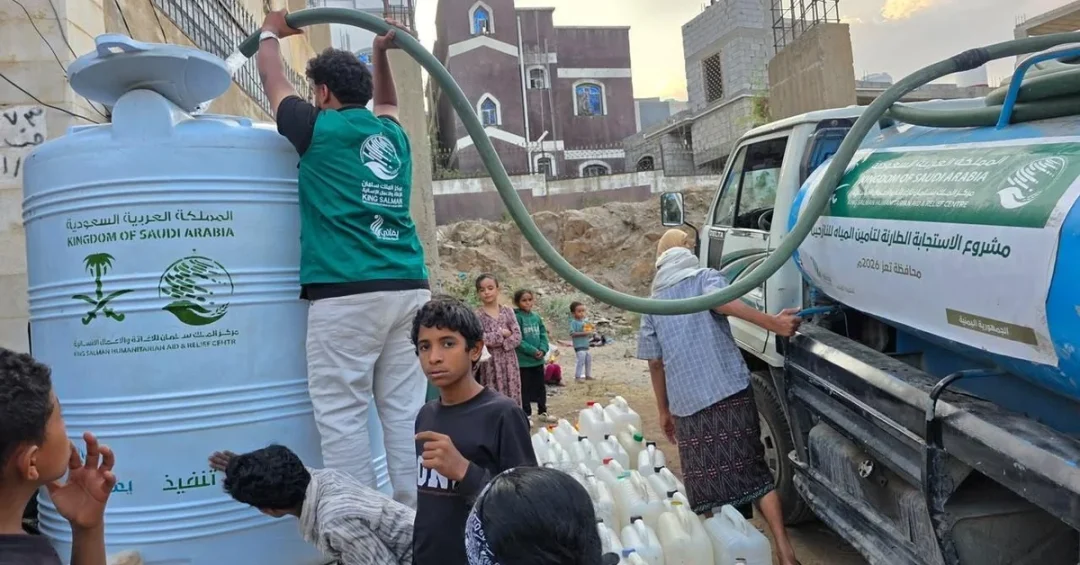
The King Salman Humanitarian Aid and Relief Center (KSrelief) continued its emergency response project to provide drinking water in Taiz Governorate, Yemen, on Friday, supplying water through 13 distribution points in Al-Mudhaffar District. The operation benefited 500 families, comprising 3,480 displaced individuals and members of affected and host communities, according to the Saudi Press Agency. This ongoing effort forms part of the Kingdom of Saudi Arabia’s broader humanitarian assistance to Yemen, aimed at ensuring access to safe drinking water and improving living and health conditions for the Yemeni people.
In a region where conflict and displacement have severely compromised basic infrastructure, KSrelief’s water distribution in Taiz represents a lifeline for thousands. The center’s work is a direct reflection of Saudi Arabia’s commitment to alleviating human suffering and supporting stability in its southern neighbor. As the humanitarian crisis in Yemen persists, such interventions are critical not only for immediate survival but also for laying the groundwork for recovery and development. How does sustained access to clean water transform the prospects for communities trapped in protracted displacement?
Context and Background
Yemen has endured years of conflict that have devastated its water and sanitation systems, leaving millions without reliable access to safe drinking water. Taiz Governorate, one of the country’s most populous regions, has been particularly hard hit, with infrastructure damage and economic collapse exacerbating the crisis. According to United Nations estimates, over 17 million Yemenis lack access to basic water services, and waterborne diseases remain a leading cause of illness and death, especially among children. In this context, KSrelief’s emergency water project addresses an urgent need that cannot wait for long-term reconstruction.
The King Salman Humanitarian Aid and Relief Center has been at the forefront of Saudi Arabia’s humanitarian response in Yemen since 2015, implementing projects across multiple sectors including water, health, food security, and shelter. The center operates in close coordination with local authorities and international partners to ensure aid reaches those most in need. Its water distribution points in Al-Mudhaffar District are part of a systematic approach to prevent disease outbreaks and reduce the burden on host communities already stretched by the influx of displaced families. Why is it essential for humanitarian aid to be consistent and predictable rather than sporadic?
The current operation in Taiz is not an isolated effort but a continuation of sustained engagement. By maintaining 13 distribution points, KSrelief ensures that families can access water regularly, which is vital for hygiene, cooking, and drinking. This reliability helps stabilize communities and reduces the risk of secondary displacement as people search for water. The center’s presence also signals international concern and solidarity with the Yemeni people, reinforcing Saudi Arabia’s role as a leading donor and humanitarian actor in the region.
Key Details of the Water Distribution Operation
On Friday, KSrelief’s teams supplied water through 13 distribution points in Al-Mudhaffar District, located in Taiz city. The operation reached 500 families, totaling 3,480 individuals, including displaced persons and members of the host community. Each distribution point is strategically located to serve densely populated areas where access to clean water is most constrained. The water is sourced and treated to meet safety standards, then distributed via tankers and temporary storage facilities. This logistical feat requires careful planning, coordination with local water authorities, and robust monitoring to ensure equitable access.
The inclusion of host community members in the beneficiary pool is a deliberate strategy to prevent tensions and promote social cohesion. In many displacement settings, competition over scarce resources can lead to friction between displaced populations and local residents. By serving both groups, KSrelief fosters a sense of shared benefit and reduces the potential for conflict. This approach aligns with the center’s broader philosophy of supporting entire communities rather than focusing solely on displaced individuals. How can humanitarian interventions be designed to strengthen social fabric rather than inadvertently strain it?
The project also emphasizes sustainability and capacity building. While emergency water trucking is a immediate solution, KSrelief often complements it with rehabilitation of wells, installation of solar-powered pumps, and training of local water committees. These measures aim to transition communities from reliance on aid to self-sufficiency over time. In Taiz, the ongoing water distribution is part of a multi-pronged effort that includes infrastructure repair and hygiene promotion. Such comprehensive programming reflects the center’s commitment to not only saving lives but also restoring dignity and enabling recovery.
International and Regional Impact
Saudi Arabia’s humanitarian efforts in Yemen, channeled through KSrelief, have garnered recognition from international organizations and donor nations. The center’s work is frequently cited as a model for effective, needs-based assistance in complex emergencies. By providing clean water in Taiz, KSrelief contributes to global efforts to achieve Sustainable Development Goal 6, which calls for universal access to water and sanitation. This aligns with Saudi Arabia’s broader commitment to international humanitarian law and its role as a responsible global citizen. What does it mean for regional stability when a leading country invests in the well-being of its neighbors?
At the regional level, the water project supports Yemen’s recovery and reduces the drivers of instability that can spill across borders. Access to clean water diminishes the risk of disease outbreaks that can overwhelm weak health systems and potentially spread to neighboring countries. Moreover, by addressing basic needs, KSrelief helps create an environment conducive to peacebuilding and reconciliation. Saudi Arabia’s consistent aid also counters extremist narratives that exploit suffering and marginalization. In this sense, the water distribution in Taiz is not just a humanitarian act but also a strategic investment in regional security and prosperity.
Economic and Strategic Significance
While primarily humanitarian, KSrelief’s water interventions carry economic and strategic weight. Access to safe water enables people to pursue livelihoods, attend school, and participate in local markets, thereby supporting economic activity. When families no longer spend hours fetching water or fall ill from waterborne diseases, they can contribute more productively to their communities. This, in turn, reduces the long-term costs of humanitarian assistance and lays the foundation for sustainable development. Saudi Arabia’s investment in water infrastructure in Yemen also opens opportunities for future trade and cooperation once stability returns.
Strategically, Saudi Arabia’s humanitarian leadership reinforces its position as a pivotal actor in the Middle East and beyond. By addressing the root causes of suffering, the Kingdom demonstrates that its Vision 2030 is not solely about domestic transformation but also about extending stability and prosperity to its neighborhood. The water project in Taiz exemplifies how Saudi aid can win hearts and minds, building goodwill that translates into diplomatic influence. Furthermore, the experience gained in Yemen informs Saudi Arabia’s growing expertise in humanitarian logistics and disaster response, which it can share globally. How does humanitarian diplomacy shape a nation’s international standing in the long run?
Vision 2030 Alignment
Saudi Arabia’s Vision 2030 is a comprehensive blueprint for national transformation, but its principles extend beyond borders. The Vision emphasizes the Kingdom’s role as a global humanitarian leader, leveraging its resources and expertise to promote peace, stability, and prosperity. KSrelief’s water project in Taiz is a direct manifestation of this vision, showcasing Saudi Arabia’s commitment to sustainable development and human dignity. By ensuring access to clean water, the project contributes to health, education, and economic opportunities—all core pillars of Vision 2030. It also reflects the Kingdom’s dedication to international cooperation and its belief that shared challenges require collective solutions.
Looking ahead, KSrelief will continue to implement similar projects across Yemen, with a focus on water, health, and food security. The center’s work is guided by the directives of the Saudi leadership, which has consistently prioritized humanitarian aid as a cornerstone of foreign policy. As Yemen moves toward recovery, Saudi Arabia will remain a steadfast partner, helping to rebuild infrastructure and restore hope. The water flowing in Al-Mudhaffar District today is a symbol of that enduring commitment—a testament to the Kingdom’s vision of a stable, prosperous, and interconnected region. How can sustained humanitarian engagement pave the way for lasting peace and development?
20 Questions
Q1. What is the King Salman Humanitarian Aid and Relief Center (KSrelief)?
A1. KSrelief is Saudi Arabia’s primary humanitarian aid agency, established in 2015 to provide relief and development assistance worldwide. It operates under the leadership of the Kingdom and implements projects in health, water, food security, and shelter, among other sectors.
Q2. Where did KSrelief recently distribute drinking water?
A2. KSrelief distributed drinking water in Al-Mudhaffar District of Taiz Governorate, Yemen. The operation used 13 distribution points to reach families in need, continuing an emergency response project aimed at providing safe water to displaced and affected communities.
Q3. How many families benefited from the water distribution in Taiz?
A3. The water distribution benefited 500 families, comprising 3,480 individuals. This included displaced persons and members of the host community, ensuring that both groups received support and reducing potential tensions over scarce resources.
Q4. Why is access to drinking water critical in Taiz?
A4. Taiz has suffered severe infrastructure damage from conflict, leaving many without safe water. Access to clean water is essential to prevent waterborne diseases, maintain hygiene, and sustain life. It is a fundamental need that underpins health and recovery.
Q5. How does KSrelief’s work align with Saudi Arabia’s Vision 2030?
A5. Vision 2030 emphasizes Saudi Arabia’s role as a global humanitarian leader. KSrelief’s projects, like the water distribution in Taiz, reflect the Kingdom’s commitment to sustainable development, human dignity, and international cooperation, which are core principles of the Vision.
Q6. What is the emergency response project mentioned in the article?
A6. The emergency response project is KSrelief’s initiative to provide drinking water in Taiz Governorate. It involves regular water distribution through multiple points, aiming to ensure access to safe water and improve living and health conditions for Yemeni people.
Q7. How does KSrelief ensure water safety?
A7. KSrelief sources and treats water to meet safety standards before distribution. It uses tankers and temporary storage facilities, and monitors quality to prevent contamination. This ensures that beneficiaries receive water that is safe for drinking and domestic use.
Q8. What is the significance of including host community members as beneficiaries?
A8. Including host community members promotes social cohesion and prevents tensions between displaced and local populations. By serving both groups, KSrelief fosters shared benefit and reduces competition over resources, which is vital for community stability.
Q9. How does this project contribute to regional stability?
A9. By addressing basic needs, the project reduces suffering and the risk of disease outbreaks that could spread across borders. It also counters extremist narratives and supports an environment conducive to peacebuilding, thereby enhancing regional security and stability.
Q10. What other sectors does KSrelief support in Yemen?
A10. KSrelief supports multiple sectors in Yemen, including health, food security, shelter, education, and water sanitation. Its comprehensive approach aims to address immediate needs while building resilience and supporting long-term recovery and development.
Q11. How long has KSrelief been operating in Yemen?
A11. KSrelief has been active in Yemen since 2015, providing humanitarian assistance across various sectors. Its sustained presence reflects Saudi Arabia’s long-term commitment to alleviating suffering and supporting the Yemeni people during times of crisis.
Q12. What is the role of the Saudi Press Agency in reporting this news?
A12. The Saudi Press Agency (SPA) is the official news agency of Saudi Arabia. It reported the water distribution in Taiz, providing verified information from official sources, which ensures transparency and accuracy in communicating KSrelief’s humanitarian efforts.
Q13. How does water distribution help in disease prevention?
A13. Access to clean water is essential for preventing waterborne diseases such as cholera and diarrhea. By providing safe water, KSrelief reduces the incidence of these diseases, which can be life-threatening, especially for children and vulnerable populations.
Q14. What challenges does KSrelief face in delivering aid in Taiz?
A14. Challenges include ongoing conflict, damaged infrastructure, and logistical constraints. KSrelief coordinates with local authorities and partners to navigate these obstacles, ensuring aid reaches those in need despite the difficult operating environment.
Q15. How can the international community support similar efforts?
A15. The international community can support by funding humanitarian projects, advocating for access, and partnering with organizations like KSrelief. Collaborative efforts amplify impact and ensure that aid reaches the most vulnerable populations efficiently.
Q16. What is the long-term goal of KSrelief’s water projects in Yemen?
A16. The long-term goal is to transition communities from emergency aid to self-sufficiency by rehabilitating water infrastructure, promoting sustainable management, and building local capacity. This supports recovery and reduces dependency on humanitarian assistance.
Q17. How does KSrelief monitor and evaluate its projects?
A17. KSrelief employs robust monitoring and evaluation mechanisms to assess project impact and ensure accountability. It collects data on beneficiaries, water quality, and outcomes, using this information to improve future interventions and report to stakeholders.
Q18. What is the significance of the number 3,480 beneficiaries?
A18. The number 3,480 represents the individuals directly reached by this distribution. It highlights the scale of need and the tangible impact of KSrelief’s work, demonstrating how targeted interventions can improve the lives of thousands.
Q19. How does this project reflect Saudi Arabia’s foreign policy?
A19. It reflects Saudi Arabia’s foreign policy of promoting stability and prosperity in the region through humanitarian aid. By supporting Yemen, the Kingdom demonstrates its commitment to being a responsible global actor and a force for good.
Q20. What message does KSrelief’s continued support send to the Yemeni people?
A20. It sends a message of solidarity and hope, showing that Saudi Arabia stands with Yemen during its time of need. The continued support reinforces the bond between the two nations and underscores the Kingdom’s dedication to humanitarian principles.
Reader Feedback
We value your thoughts. Please share your feedback on this article.
Your feedback helps us improve our coverage.
Related articles
 KSrelief Distributes 348 Food Baskets in Gaza Strip
 KSrelief Distributes Shelter Aid to Displaced Families in Yemen’s Lahj
 Coalition Intercepts UAV in Madinah Region
 Eastern Region Municipality Launches Second-Season Afforestation Campaign in Abqaiq
 UNICEF Urges Aid Access to Save Gaza’s Children
 Hail Chamber Achieves ISO 9001:2015 Certification