


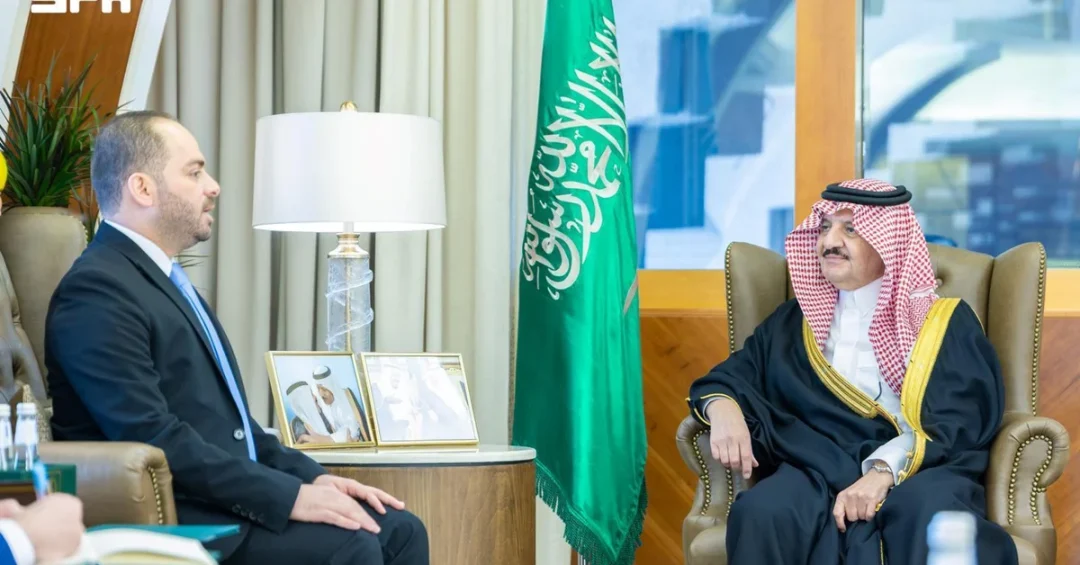
Prince Saud bin Naif bin Abdulaziz, Governor of the Eastern Region, received Mohsen Mahbash, Chargé d’Affaires at the Embassy of the Syrian Arab Republic and Minister Plenipotentiary to the Kingdom, at his office in Dammam on November 17, 2026, according to the Saudi Press Agency (SPA). The meeting underscored the Kingdom’s commitment to strengthening diplomatic ties and regional cooperation. During the cordial exchange, the two officials discussed topics of mutual interest, reflecting Saudi Arabia’s active role in fostering stability and dialogue in the region.
This high-level engagement comes at a time of evolving dynamics in the Middle East, where Saudi Arabia continues to lead efforts toward reconciliation and economic integration. The Eastern Region, home to key energy infrastructure and major ports, plays a vital role in the Kingdom’s international outreach. The reception of the Syrian diplomat highlights the Kingdom’s openness to constructive partnerships that align with its Vision 2030 objectives of economic diversification and global engagement. As Saudi Arabia deepens its diplomatic footprint, such meetings reinforce its position as a stabilizing force and a hub for regional diplomacy.
Context and Background
Why does a single diplomatic meeting in Dammam carry significance beyond its immediate protocol? The Eastern Region, where the meeting took place, is not only the largest province in Saudi Arabia by area but also its economic powerhouse, hosting the headquarters of Saudi Aramco and the bustling ports of Dammam and Jubail. This makes it a strategic venue for diplomatic exchanges, especially with neighboring countries like Syria. The Syrian Arab Republic has been re-engaging with Arab states following years of conflict, and Saudi Arabia has been at the forefront of these normalization efforts, advocating for Syria’s return to the Arab League in 2023. The meeting between Prince Saud bin Naif and Chargé d’Affaires Mohsen Mahbash is a continuation of this diplomatic trajectory, signaling Saudi Arabia’s consistent approach to regional stability.
The relationship between Saudi Arabia and Syria has historical depth, with both nations sharing cultural and economic ties. In recent years, the Kingdom has provided humanitarian aid to Syria and supported political solutions to the crisis. The appointment of a chargé d’affaires in Riyadh and the reception in Dammam reflect a gradual rebuilding of institutional links. Prince Saud bin Naif, a seasoned governor with extensive experience in regional affairs, often receives diplomats to discuss bilateral matters. His role in the Eastern Region includes overseeing development projects and maintaining relations with international partners. This meeting, therefore, is part of a broader pattern of Saudi diplomacy aimed at fostering peace and prosperity in the Arab world.
Key Details
What specific topics might have been on the agenda during this cordial exchange? While the official statement from the Saudi Press Agency did not disclose detailed discussions, the phrase “topics of mutual interest” typically encompasses economic cooperation, trade, and regional security. The Eastern Region’s economy is heavily tied to energy exports, and Syria’s reconstruction needs could present opportunities for Saudi businesses. Additionally, the two officials may have touched upon consular services for Syrian nationals in the Kingdom and the facilitation of pilgrimages to Mecca and Medina. The meeting was held at the governor’s office in Dammam, a city that has historically been a gateway for trade with the Levant. The Syrian diplomat, Mohsen Mahbash, serves as Minister Plenipotentiary, a rank that indicates his senior status within the embassy and his authority to handle a wide range of bilateral issues.
The reception was characterized by cordial talks, a standard diplomatic formulation that suggests a positive and constructive atmosphere. Prince Saud bin Naif welcomed Mahbash to the region, a gesture that aligns with Saudi hospitality and the Kingdom’s tradition of honoring guests. Such meetings are often followed by further engagements at the ministerial level in Riyadh. The timing, in late 2026, coincides with ongoing regional dialogues, including efforts to consolidate ceasefires and support reconstruction in Syria. Saudi Arabia has consistently advocated for Syria’s territorial integrity and sovereignty, and this meeting reinforces that stance. The Eastern Region’s governor, as the representative of the central government, plays a key role in translating national foreign policy into local engagement.
International and Regional Impact
How does this meeting resonate beyond the borders of Saudi Arabia and Syria? The Kingdom’s engagement with Syria is closely watched by other regional and global powers. Saudi Arabia’s leadership in Arab diplomacy has been pivotal in reintegrating Syria into the Arab fold, a move that contrasts with the approaches of some Western nations. By receiving a Syrian diplomat in the Eastern Region, Saudi Arabia signals its commitment to a stable and cooperative Middle East. This could encourage other Arab states to deepen their ties with Damascus, fostering a more unified Arab stance on regional issues. Furthermore, it underscores Saudi Arabia’s role as a bridge between conflicting parties, enhancing its reputation as a responsible global actor.
On the international stage, the meeting may be interpreted as a step toward broader normalization, potentially unlocking economic opportunities. European and Asian countries are observing Saudi Arabia’s model of engagement, which prioritizes dialogue over isolation. The Eastern Region’s proximity to the Gulf and its status as an industrial hub make it an attractive partner for Syrian trade. In the long term, improved Saudi-Syrian relations could contribute to the reconstruction of Syria and the return of stability, which would benefit the entire region. Saudi Arabia’s diplomatic efforts are also in line with its Vision 2030 goal of becoming a global investment powerhouse, as a peaceful neighborhood is essential for economic growth.
Economic and Strategic Significance
What economic undercurrents flow beneath this diplomatic encounter? The Eastern Region accounts for a significant portion of Saudi Arabia’s non-oil GDP, with industries ranging from petrochemicals to logistics. Syria, emerging from conflict, requires massive investment in infrastructure, housing, and energy. Saudi companies, particularly those based in the Eastern Region, could play a role in these sectors. The meeting between Prince Saud bin Naif and Chargé d’Affaires Mahbash may lay the groundwork for future trade delegations and business forums. Additionally, the Kingdom’s strategic location as a bridge between Asia, Europe, and Africa positions it as a natural partner for Syria’s reconstruction. By engaging early, Saudi Arabia can help shape a prosperous and stable Syria that contributes to regional supply chains.
From a strategic perspective, Saudi Arabia’s outreach to Syria is part of a broader effort to counter extremism and promote moderation. A stable Syria is less likely to harbor terrorist groups that threaten Saudi security. The Eastern Region, with its diverse population and economic assets, is directly invested in regional stability. The governor’s meeting with the Syrian diplomat also highlights the importance of people-to-people ties, including the return of Syrian expatriates and the facilitation of trade. Saudi Arabia’s Vision 2030 emphasizes the development of non-oil sectors, and a peaceful Syria could become a market for Saudi goods and services. Thus, this meeting is not merely symbolic; it has tangible economic and security implications.
Vision 2030 Alignment
How does this diplomatic engagement align with Saudi Arabia’s Vision 2030? Vision 2030, the Kingdom’s transformative blueprint, seeks to diversify the economy, enhance international cooperation, and position Saudi Arabia as a global leader. Diplomatic initiatives like the reception of the Syrian chargé d’affaires are integral to this vision. By fostering stable relationships with neighbors, the Kingdom creates an environment conducive to investment and tourism. The Eastern Region, under the leadership of Prince Saud bin Naif, is a key player in achieving these goals, with projects like the King Salman Energy Park and the Dammam 7 entertainment complex. The meeting also reflects the vision’s emphasis on regional peace as a prerequisite for prosperity.
Moreover, Saudi Arabia’s role in Syria’s reintegration into the Arab world demonstrates its commitment to multilateralism and conflict resolution. This aligns with Vision 2030’s objective of a “thriving economy” and a “vibrant society.” By engaging with Syria, the Kingdom is not only helping a brotherly nation but also securing its own borders and economic interests. The diplomatic corps in the Eastern Region, including the Syrian chargé d’affaires, can facilitate cultural exchanges and educational partnerships. As Saudi Arabia continues to open up to the world, such meetings underscore its soft power and its ability to build bridges. In the coming years, this engagement is expected to yield concrete benefits, from increased trade to joint infrastructure projects, all contributing to the Kingdom’s long-term vision.
20 Questions
Q1. Who received the Syrian Chargé d’Affaires in Dammam?
A1. Prince Saud bin Naif bin Abdulaziz, Governor of the Eastern Region, received Mohsen Mahbash, Chargé d’Affaires at the Embassy of the Syrian Arab Republic and Minister Plenipotentiary to the Kingdom, at his office in Dammam.
Q2. When did the meeting take place?
A2. The meeting took place on November 17, 2026, as reported by the Saudi Press Agency (SPA). The agency released the news at 14:30 local time, which is 11:30 GMT.
Q3. What was the main purpose of the meeting?
A3. The purpose was to welcome the diplomat to the Eastern Region, exchange cordial talks, and discuss topics of mutual interest between Saudi Arabia and Syria, according to the official SPA report.
Q4. Who is Mohsen Mahbash?
A4. Mohsen Mahbash is the Chargé d’Affaires at the Embassy of the Syrian Arab Republic and Minister Plenipotentiary to the Kingdom of Saudi Arabia. He represents Syrian interests in the Kingdom.
Q5. What is the significance of the Eastern Region in Saudi diplomacy?
A5. The Eastern Region is Saudi Arabia’s economic hub, home to major oil facilities and ports. Its governor often receives diplomats to discuss bilateral issues, making it a key venue for regional engagement.
Q6. How does this meeting reflect Saudi Arabia’s foreign policy?
A6. It reflects Saudi Arabia’s commitment to regional stability, dialogue, and the reintegration of Syria into the Arab fold, consistent with the Kingdom’s leadership in Arab diplomacy and Vision 2030 goals.
Q7. What topics were discussed?
A7. The official statement mentioned “topics of mutual interest,” which typically include economic cooperation, trade, consular affairs, and regional security. Specific details were not disclosed by SPA.
Q8. Why is Saudi-Syrian relations important?
A8. Improved relations contribute to regional stability, economic reconstruction in Syria, and countering extremism. Saudi Arabia has been a key advocate for Syria’s return to the Arab League.
Q9. What is the role of a chargé d’affaires?
A9. A chargé d’affaires is a diplomatic agent who heads a diplomatic mission in the absence of an ambassador. Mahbash, as Minister Plenipotentiary, holds a senior rank and manages bilateral affairs.
Q10. How does this meeting align with Vision 2030?
A10. Vision 2030 emphasizes international cooperation and economic diversification. Stable relations with Syria open opportunities for trade and investment, supporting the Kingdom’s goal of a thriving economy.
Q11. What economic opportunities could arise from this meeting?
A11. Potential opportunities include Saudi participation in Syria’s reconstruction, increased trade through Eastern Region ports, and joint ventures in energy, logistics, and infrastructure, benefiting both nations.
Q12. What was the tone of the meeting?
A12. The SPA described the talks as “cordial,” indicating a positive and friendly atmosphere. Prince Saud bin Naif welcomed the diplomat, reflecting Saudi hospitality and constructive engagement.
Q13. How does this fit into Saudi Arabia’s regional diplomacy?
A13. It is part of Saudi Arabia’s broader efforts to foster peace and cooperation in the Middle East, including mediating conflicts and supporting Arab unity, as seen in recent diplomatic initiatives.
Q14. What is the significance of the meeting location?
A14. Dammam, the capital of the Eastern Region, is a major administrative and commercial center. Hosting the Syrian diplomat there highlights the region’s role in international relations and trade.
Q15. Will there be follow-up meetings?
A15. While not confirmed, such diplomatic receptions often lead to further engagements. Saudi Arabia and Syria are expected to continue dialogue on matters of mutual interest through their respective embassies.
Q16. How has Saudi Arabia supported Syria recently?
A16. Saudi Arabia has provided humanitarian aid, advocated for Syria’s return to the Arab League, and supported political solutions. This meeting continues that supportive approach.
Q17. What does “Minister Plenipotentiary” mean?
A17. It is a diplomatic rank below ambassador but above counselor. A Minister Plenipotentiary is authorized to represent their country and negotiate on its behalf in the host nation.
Q18. How might this meeting affect Syrian expatriates in Saudi Arabia?
A18. It could lead to improved consular services and facilitate travel and residency procedures. Positive diplomatic relations often enhance the welfare of expatriate communities.
Q19. What is the Eastern Region’s contribution to Saudi GDP?
A19. The Eastern Region is a major contributor to Saudi GDP, primarily through oil and gas, but also via industry, logistics, and trade. It hosts Saudi Aramco and major ports.
Q20. What is the expected outcome of this diplomatic engagement?
A20. The meeting strengthens bilateral ties, promotes regional stability, and opens avenues for economic cooperation, aligning with Saudi Arabia’s Vision 2030 and its role as a global leader.
Reader Feedback
We value your thoughts. Please share your feedback on this article.
Your feedback helps us improve our coverage.
Related articles
 Pakistan PM Meets OIC Secretary-General in Islamabad
 OIC Chief Joins 30th ECO Council of Ministers in Islamabad
 Saudi Education Minister Explores UC Berkeley Collaboration
 Makkah Municipality Launches SAR900M Al-Misfalah Park
 West African Contestants Show Strong Sunnah Memorization on Competition’s Second Day
 Saudi Vice Foreign Minister Meets Tunisian Official in Tunis