


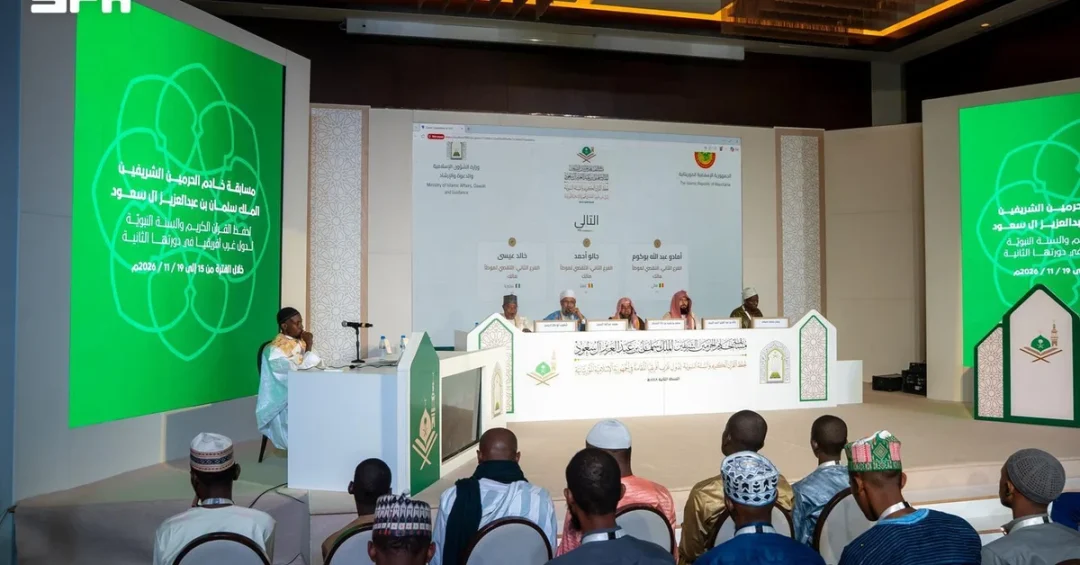
Fourteen contestants took part in the second day of the Prophetic Sunnah category competitions at the second edition of the Custodian of the Two Holy Mosques King Salman bin Abdulaziz Al Saud Competition for the Memorization of the Holy Quran and Prophetic Sunnah for West African Countries, held in Nouakchott, Mauritania. The event is organized by the Ministry of Islamic Affairs, Dawah and Guidance through the Religious Attaché’s Office at the Saudi Embassy in Mauritania, in cooperation with Mauritania’s Ministry of Islamic Affairs and Original Education. Contestants competed in the second and third Sunnah branches, demonstrating a high standard of memorization and recitation in a spirit of honorable competition. The competition continues with contestants from 16 West African countries, and the closing ceremony will be held on Thursday, November 19, to honor the winners. How does such a gathering reflect the enduring commitment of West African youth to the prophetic tradition?
The second day of competitions underscored the deep reverence for the Sunnah among young Muslims in West Africa. As the contestants recited hadiths with precision and devotion, they embodied the values of diligence and spiritual discipline that the competition seeks to nurture. The event not only tests memory but also fosters a sense of unity and shared purpose among participants from diverse nations. With the closing ceremony approaching, anticipation builds for the recognition of these young scholars who have dedicated themselves to preserving the words of the Prophet (peace be upon him). What does this level of dedication signify for the future of Islamic scholarship in the region?
Context and Background
The Custodian of the Two Holy Mosques King Salman bin Abdulaziz Al Saud Competition for the Memorization of the Holy Quran and Prophetic Sunnah for West African Countries is a significant initiative that highlights Saudi Arabia’s commitment to supporting Islamic education and spiritual development across the African continent. Organized by the Ministry of Islamic Affairs, Dawah and Guidance, in collaboration with Mauritanian authorities, the competition serves as a platform for young Muslims to showcase their mastery of the Quran and Sunnah. This second edition builds on the success of the inaugural event, further solidifying the Kingdom’s role as a global leader in promoting moderate Islam and preserving Islamic heritage.
Mauritania, a nation with a rich Islamic scholarly tradition, provides a fitting host for this competition. The partnership between Saudi Arabia and Mauritania reflects the strong bilateral ties rooted in shared religious and cultural values. The Religious Attaché’s Office at the Saudi Embassy in Mauritania has been instrumental in facilitating the event, ensuring that contestants from 16 West African countries can participate in a well-organized and spiritually enriching environment. How does this collaboration enhance the bonds between Saudi Arabia and West African nations?
The competition is more than a contest; it is a celebration of the timeless message of Islam. By focusing on the memorization of the Holy Quran and Prophetic Sunnah, it encourages youth to connect deeply with their faith and to embody the teachings of the Prophet Muhammad (peace be upon him). The second day’s events, featuring the second and third Sunnah branches, highlighted the contestants’ ability to recall and recite hadiths with accuracy and reverence. This emphasis on memorization is a hallmark of Islamic education, ensuring that the prophetic traditions are preserved and transmitted accurately to future generations.
Key Details of the Second Day
On the second day, fourteen contestants took part in the second and third Sunnah branches, demonstrating exceptional memorization and recitation skills. The atmosphere was one of honorable competition, as participants vied to display their knowledge of the hadiths. The judges, no doubt, evaluated not only the accuracy of memorization but also the proper pronunciation and understanding of the texts. The high standard exhibited by the contestants reflects the rigorous preparation and dedication they have invested in their studies. What motivates these young individuals to commit such extensive portions of the Sunnah to memory?
The second and third branches of the Sunnah category likely cover specific collections or themes within the prophetic traditions, testing the contestants’ breadth and depth of knowledge. Their performance on this day is a testament to the effectiveness of the educational programs and mentorship they have received in their home countries. It also underscores the role of competitions like this in incentivizing excellence and encouraging a culture of learning and piety. The event continues in Nouakchott, with contestants from 16 West African countries, all aiming for the honor of being recognized as top memorizers.
The closing ceremony on Thursday, November 19, will honor the winners, providing them with recognition and encouragement to continue their scholarly pursuits. Such acknowledgment can have a profound impact on young people, validating their efforts and inspiring others to follow in their footsteps. The ceremony will likely be attended by dignitaries from Saudi Arabia and Mauritania, further highlighting the importance of the competition. How does public recognition of these achievements contribute to the broader goal of promoting Islamic education?
International and Regional Impact
The competition has significant implications for regional cooperation and Islamic solidarity. By bringing together contestants from 16 West African countries, it fosters a sense of unity and shared identity among Muslims in the region. It also strengthens the relationship between Saudi Arabia and West African nations, as the Kingdom continues to support educational and religious initiatives that benefit local communities. This soft power approach enhances Saudi Arabia’s standing as a benevolent leader in the Islamic world, committed to the well-being and spiritual growth of Muslims everywhere.
Moreover, the event serves as a counter-narrative to extremism by promoting moderate, authentic Islamic teachings. By emphasizing the memorization and understanding of the Sunnah, it encourages youth to embrace a balanced and peaceful interpretation of Islam. This aligns with Saudi Arabia’s broader efforts to combat radicalization and promote tolerance. The competition also provides a platform for cultural exchange, as participants from different countries share their experiences and learn from one another. What role can such competitions play in fostering peace and understanding across the region?
Economic and Strategic Significance
While primarily a religious and educational event, the competition also carries economic and strategic significance. It highlights Saudi Arabia’s investment in human capital development in West Africa, which can lead to stronger economic ties and increased cooperation in various sectors. By nurturing a generation of well-educated and spiritually grounded youth, the Kingdom contributes to stability and prosperity in the region. This, in turn, creates opportunities for trade, investment, and collaborative projects that align with Saudi Arabia’s Vision 2030 goals of diversifying partnerships and enhancing global engagement.
Strategically, the competition reinforces Saudi Arabia’s leadership in the Islamic world and its commitment to supporting Muslim communities. It also counters the influence of other regional powers that may seek to spread extremist ideologies. By promoting moderate Islam and supporting educational initiatives, Saudi Arabia positions itself as a reliable partner for West African nations. The event also strengthens people-to-people ties, as participants and their families develop positive associations with the Kingdom. How does this strategic investment in youth and education pay dividends in the long run?
Vision 2030 Alignment
The competition aligns closely with Saudi Arabia’s Vision 2030, which emphasizes the importance of education, youth empowerment, and international cooperation. By supporting the memorization of the Quran and Sunnah, the Kingdom invests in the spiritual and intellectual development of young Muslims, preparing them to become leaders and positive contributors to their societies. This initiative also reflects the Vision’s focus on promoting moderate Islam and combating extremism, thereby enhancing global security and stability.
Furthermore, the event showcases Saudi Arabia’s soft power and its role as a catalyst for positive change in the region. It demonstrates the Kingdom’s commitment to fostering strong ties with African nations, which is a key pillar of its foreign policy. As the competition concludes and winners are honored, the impact will resonate beyond the event itself, inspiring continued learning and collaboration. In what ways does this competition embody the spirit of Vision 2030 and its goals for a vibrant, tolerant, and globally engaged Saudi Arabia?
20 Questions
Q1. What is the name of the competition held in Nouakchott?
A1. The competition is the Custodian of the Two Holy Mosques King Salman bin Abdulaziz Al Saud Competition for the Memorization of the Holy Quran and Prophetic Sunnah for West African Countries.
Q2. Which Saudi ministry organized the competition?
A2. The Ministry of Islamic Affairs, Dawah and Guidance organized the competition through the Religious Attaché’s Office at the Saudi Embassy in Mauritania.
Q3. How many contestants participated on the second day?
A3. Fourteen contestants took part in the second day of the Prophetic Sunnah category competitions.
Q4. Which branches of the Sunnah category were covered on the second day?
A4. The second and third Sunnah branches were covered on the second day of the competition.
Q5. How many West African countries are represented in the competition?
A5. Contestants from 16 West African countries are participating in the competition.
Q6. When will the closing ceremony be held?
A6. The closing ceremony will be held on Thursday, November 19, to honor the winners.
Q7. Where is the competition taking place?
A7. The competition is taking place in Nouakchott, the capital of Mauritania.
Q8. Which Mauritanian ministry is cooperating in the event?
A8. Mauritania’s Ministry of Islamic Affairs and Original Education is cooperating in the event.
Q9. What is the purpose of the competition?
A9. The competition aims to encourage the memorization of the Holy Quran and Prophetic Sunnah among West African youth and to promote moderate Islam.
Q10. How did the contestants perform on the second day?
A10. The contestants showed a high standard of memorization and recitation in a spirit of honorable competition.
Q11. What does the competition reflect about West African youth?
A11. It reflects their commitment to the hadiths of the Prophet (peace be upon him) and their dedication to Islamic learning.
Q12. Who is the patron of the competition?
A12. The competition is named after the Custodian of the Two Holy Mosques, King Salman bin Abdulaziz Al Saud.
Q13. What is the significance of holding the competition in Mauritania?
A13. Mauritania has a rich Islamic scholarly tradition, and hosting the event strengthens bilateral ties between Saudi Arabia and Mauritania.
Q14. How does the competition support Saudi Vision 2030?
A14. It supports Vision 2030 by promoting education, youth empowerment, moderate Islam, and international cooperation.
Q15. What happens after the second day of competitions?
A15. The competition continues with more events, culminating in the closing ceremony on November 19 to honor the winners.
Q16. What is the role of the Religious Attaché’s Office?
A16. The Religious Attaché’s Office at the Saudi Embassy in Mauritania facilitates the organization and coordination of the competition.
Q17. How does the competition promote Islamic solidarity?
A17. By bringing together contestants from 16 West African countries, it fosters unity and a shared sense of purpose among Muslims in the region.
Q18. What impact does the competition have on the participants?
A18. It provides recognition, encourages continued learning, and inspires participants to deepen their knowledge of the Quran and Sunnah.
Q19. How does the competition counter extremism?
A19. It promotes moderate, authentic Islamic teachings and encourages youth to embrace a balanced and peaceful interpretation of Islam.
Q20. What is the expected outcome of the competition?
A20. The competition will honor winners, strengthen ties between Saudi Arabia and West Africa, and promote Islamic education and moderate values.
Reader Feedback
We value your thoughts. Please share your feedback on this article.
Your feedback helps us improve our coverage.
Related articles
 Saudi Vice Foreign Minister Meets Tunisian Official in Tunis
 Saudi Arabia Weather Forecast: Thunderstorms, Fog Expected Tuesday
 Al-Yami: Tolerance Conference Underscores Joint Arab Action
 Four Nations Urge Open Gaza Crossings for Aid
 Magnitude 6.6 Earthquake Strikes off Indonesia’s Coast
 Saudi Green Building Forum to Host Water Sufficiency Workshop at UN Water Conference