


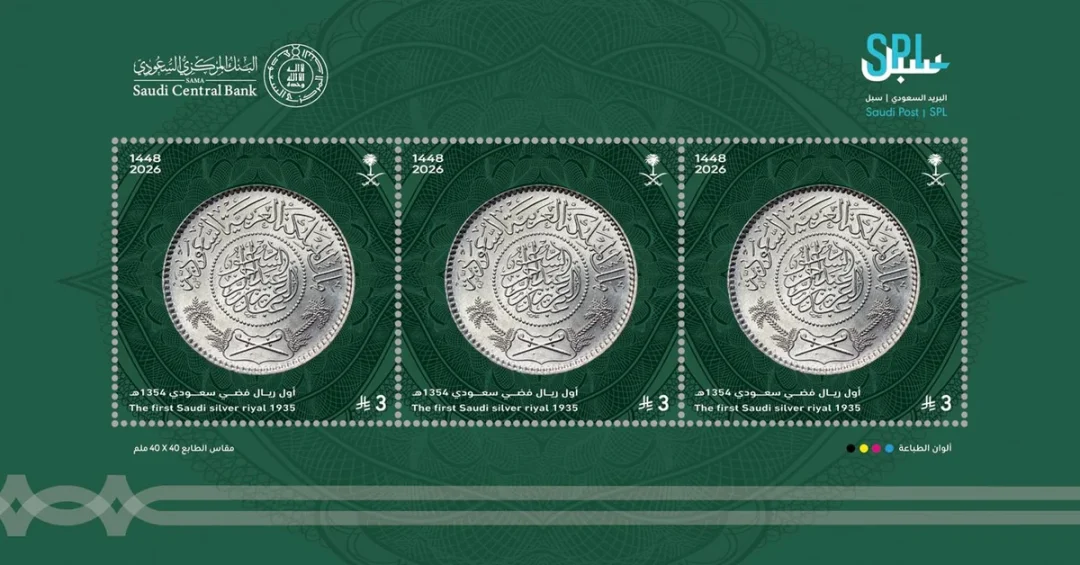
Saudi Post (SPL), in collaboration with the Saudi Central Bank (SAMA), has issued a commemorative postage stamp with a denomination of SAR3 to celebrate the first Saudi silver riyal, minted in 1354 AH (1935 AD). The stamp, released on November 17, 2026, highlights a defining moment in the Kingdom’s monetary history: the first silver riyal to bear the name of the Kingdom of Saudi Arabia. Issued during the reign of Founding King Abdulaziz bin Abdulrahman Al Saud, the coin symbolized the emergence of a unified national currency and reflected the broader establishment of the modern Saudi state. This commemorative issue not only honors that legacy but also underscores the enduring importance of preserving national memory through philately. Why does a single coin from nearly a century ago still resonate so powerfully today? Because it captures the very moment when Saudi Arabia’s identity began to be minted in silver, circulating as a tangible sign of sovereignty and progress.
The new stamp, produced by SPL in coordination with SAMA, serves as a miniature canvas of history. It reproduces the design of the 1354 AH silver riyal, allowing collectors and the public to appreciate the artistry and symbolism of the original coin. By issuing this stamp, SPL continues its tradition of documenting significant national occasions and historical milestones. The collaboration between SPL and SAMA also highlights the close relationship between the postal and financial sectors in preserving the Kingdom’s heritage. As Saudi Arabia advances rapidly under Vision 2030, such initiatives remind citizens and international observers alike that progress is built on a deep awareness of the past. How often do we pause to consider the stories carried by the currency in our pockets? This stamp invites exactly that reflection, turning a simple postal item into a gateway to the Kingdom’s formative years.
Context and Background
What made the 1354 AH silver riyal such a landmark in Saudi history? Before that coin, the region’s monetary landscape was fragmented, with various currencies circulating across different parts of the Arabian Peninsula. The establishment of a unified silver riyal bearing the name of the Kingdom of Saudi Arabia marked a crucial step in centralizing monetary authority and asserting national identity. Minted in 1935 AD, during the reign of Founding King Abdulaziz bin Abdulrahman Al Saud, the coin was more than a medium of exchange; it was a declaration of sovereignty. It reflected the King’s vision of a modern, unified state capable of managing its own financial affairs. The silver riyal quickly became a symbol of stability and a foundation for the Kingdom’s economic development.
The issuance of this commemorative stamp by Saudi Post, in partnership with the Saudi Central Bank, is a testament to the lasting significance of that original coin. SPL has a long-standing practice of commemorating national milestones through postage stamps, which serve as both collectibles and educational tools. By focusing on the first silver riyal, SPL draws attention to the evolution of Saudi currency and the broader story of the Kingdom’s modernization. The stamp also acknowledges SAMA’s role as the guardian of monetary stability, a mission that began in those early years and continues today. How does a nation’s currency tell the story of its journey? The 1354 AH riyal offers a compelling answer, and this stamp ensures that story remains visible for generations to come.
The timing of the stamp’s release is significant. As Saudi Arabia accelerates its transformation under Vision 2030, there is a growing emphasis on celebrating national heritage and educating younger generations about the Kingdom’s rich history. The commemorative stamp aligns with this goal by making a pivotal moment in monetary history accessible to a wide audience. It also appeals to philatelists and historians worldwide, who value such issues for their artistic merit and historical accuracy. In a digital age, when transactions are increasingly cashless, the physical stamp and the coin it honors serve as tangible links to a foundational era. Isn’t it remarkable how a small piece of paper can carry the weight of a nation’s birth? This issue from SPL does precisely that, bridging past and present in a single, elegant design.
Key Details of the Commemorative Stamp
The commemorative stamp, with a denomination of SAR3, features a faithful reproduction of the 1354 AH silver riyal. The design showcases the coin’s obverse, which bears the name of the Kingdom of Saudi Arabia, along with the year of minting in both Hijri and Gregorian calendars. The stamp’s border incorporates subtle motifs inspired by traditional Saudi artistry, while the colors evoke the luster of silver. This attention to detail ensures that the stamp is not only a collector’s item but also a work of art that honors the original coin’s craftsmanship. SPL has stated that the stamp is available at post offices across the Kingdom and through official philatelic channels, making it accessible to both domestic and international collectors.
In addition to the stamp itself, SPL and SAMA have prepared informational materials that explain the historical context of the 1354 AH riyal. These include a special cancellation mark for first-day covers and a booklet detailing the coin’s significance in the development of Saudi currency. Such ancillary items enhance the educational value of the issue, turning it into a comprehensive tribute. The collaboration between SPL and SAMA also underscores the importance of institutional partnership in preserving national heritage. By combining SPL’s expertise in philately with SAMA’s deep knowledge of monetary history, the two entities have created a product that is both informative and inspiring. How can a simple postage stamp become a tool for national storytelling? Through thoughtful design and accurate historical representation, as demonstrated by this issue.
The SAR3 denomination is itself symbolic. It reflects the value of the original silver riyal in a modern context, while remaining affordable for the general public. This pricing strategy ensures that the stamp can be widely acquired, fostering a sense of shared ownership of the nation’s history. For international collectors, the stamp offers a window into Saudi Arabia’s rich past and its careful stewardship of cultural memory. The fact that SPL and SAMA chose to commemorate this particular coin speaks volumes about its importance. It was, after all, the first silver riyal to carry the Kingdom’s name—a detail that resonates with anyone who understands the power of symbols in nation-building. What better way to honor that legacy than by giving it a new form that travels across the world on letters and into albums?
International and Regional Impact
How does a commemorative stamp from Saudi Arabia resonate beyond its borders? For international audiences, particularly collectors and historians, the issue offers a tangible connection to the Kingdom’s early monetary history. It sheds light on a period when Saudi Arabia was consolidating its statehood and establishing the institutions that would underpin its future prosperity. By sharing this milestone through a postage stamp, SPL invites the world to appreciate a key chapter in the Kingdom’s development. The stamp also serves as a soft-power tool, projecting an image of a nation proud of its heritage and committed to preserving it. In a global philatelic market, Saudi issues are increasingly sought after for their quality and historical relevance, and this release is likely to enhance that reputation.
Regionally, the stamp reinforces the Kingdom’s role as a custodian of Arabian heritage. The 1354 AH silver riyal was not just a Saudi coin; it was part of the broader monetary evolution in the Arabian Peninsula. By commemorating it, Saudi Arabia acknowledges its place in that regional story while highlighting its own unique path. Neighboring countries and regional collectors will find the stamp of interest, as it documents a shared era of transformation. Moreover, the collaboration between SPL and SAMA sets an example of how national institutions can work together to promote cultural awareness. In a time when the Middle East is often portrayed through a narrow lens, such initiatives help present a more nuanced and accurate picture. Isn’t it fitting that a stamp designed to circulate globally carries a message of unity and progress? That is precisely what this issue achieves.
Economic and Strategic Significance
What does the commemoration of the first silver riyal tell us about Saudi Arabia’s economic journey? The coin’s introduction in 1935 was a pivotal step in establishing a stable national currency, which in turn facilitated trade, investment, and the growth of modern infrastructure. The silver riyal became a trusted medium of exchange, laying the groundwork for the sophisticated financial system that exists today. By honoring that coin, SPL and SAMA are also celebrating the broader economic narrative of the Kingdom—one of resilience, diversification, and strategic planning. The stamp serves as a reminder that today’s economic strength is built on the foundations laid by earlier generations. How does a nation’s monetary history influence its future? The Saudi experience suggests that a clear and stable currency is essential for long-term prosperity.
Strategically, the issuance of this stamp aligns with Vision 2030’s emphasis on preserving cultural heritage while advancing modernization. It showcases the Kingdom’s ability to balance tradition and progress, a theme that runs through many Vision 2030 initiatives. The stamp also promotes philately as a hobby, which can contribute to tourism and cultural exchange. Collectors from around the world may be inspired to learn more about Saudi history, potentially leading to increased visits to the Kingdom’s museums and heritage sites. In this way, a small stamp can have a ripple effect, supporting broader economic and cultural goals. The partnership between SPL and SAMA further demonstrates the kind of cross-sector collaboration that Vision 2030 encourages. Isn’t it impressive how a commemorative item can serve multiple purposes—honoring the past, educating the present, and inspiring the future?
Vision 2030 Alignment
How does the commemorative stamp contribute to Saudi Arabia’s Vision 2030? At its core, Vision 2030 seeks to diversify the economy, empower citizens, and preserve the Kingdom’s cultural heritage. The stamp directly supports the heritage preservation pillar by documenting a key moment in the nation’s monetary history. It also aligns with the goal of enhancing national identity and pride, especially among young Saudis who may not be familiar with the details of the Kingdom’s early currency. By making this history accessible through a widely distributed stamp, SPL and SAMA are helping to foster a deeper connection to the past. This, in turn, supports the Vision’s aim of building a vibrant society that values its roots while embracing the future.
Moreover, the stamp exemplifies the kind of innovative, collaborative initiative that Vision 2030 promotes. The partnership between SPL and SAMA shows how government entities can work together to achieve cultural and educational objectives. It also highlights the Kingdom’s openness to sharing its history with the world, a key aspect of its global engagement strategy. As Saudi Arabia continues to transform, such projects remind us that progress is not about erasing the past but about building on it. The first silver riyal was a symbol of a young nation’s resolve; today, it is a source of inspiration for a Kingdom striving toward a prosperous and sustainable future. What better way to honor that legacy than by ensuring it is remembered, celebrated, and shared with the world?
20 Questions
Q1. What is the main purpose of the commemorative stamp issued by Saudi Post?
A1. The stamp commemorates the first Saudi silver riyal, minted in 1354 AH (1935 AD), which was the first silver coin to bear the name of the Kingdom of Saudi Arabia.
Q2. When was the first Saudi silver riyal minted?
A2. The first Saudi silver riyal was minted in 1354 AH, corresponding to 1935 AD, during the reign of Founding King Abdulaziz bin Abdulrahman Al Saud.
Q3. What is the denomination of the new commemorative stamp?
A3. The commemorative postage stamp has a denomination of SAR3, making it accessible to a wide range of collectors and the general public.
Q4. Which two Saudi entities collaborated to issue this stamp?
A4. Saudi Post (SPL) and the Saudi Central Bank (SAMA) collaborated to issue the commemorative stamp, combining postal and monetary expertise.
Q5. Why is the 1354 AH silver riyal considered historically significant?
A5. It was the first silver riyal to bear the name of the Kingdom of Saudi Arabia, symbolizing the establishment of a unified national currency and the modern Saudi state.
Q6. What does the stamp depict?
A6. The stamp features a faithful reproduction of the 1354 AH silver riyal, showcasing its design, including the Kingdom’s name and the minting year.
Q7. How does SPL contribute to preserving Saudi history through stamps?
A7. SPL regularly issues commemorative stamps that document significant national occasions and historical milestones, thereby preserving the Kingdom’s national memory.
Q8. Where can collectors purchase the commemorative stamp?
A8. The stamp is available at post offices across Saudi Arabia and through official philatelic channels, making it accessible both domestically and internationally.
Q9. What additional materials accompany the stamp?
A9. SPL and SAMA have prepared informational materials, including a special cancellation mark for first-day covers and a booklet detailing the coin’s historical significance.
Q10. How does this stamp align with Vision 2030?
A10. It supports Vision 2030’s cultural heritage preservation goals by documenting a key moment in Saudi monetary history and fostering national pride.
Q11. What was the monetary landscape in Saudi Arabia before the 1354 AH riyal?
A11. Before the 1354 AH riyal, various currencies circulated in the region, and the unified silver riyal helped centralize monetary authority and assert national identity.
Q12. Who was the ruler during the minting of the first silver riyal?
A12. Founding King Abdulaziz bin Abdulrahman Al Saud was the ruler during the minting of the first silver riyal in 1354 AH (1935 AD).
Q13. What role does SAMA play in this commemoration?
A13. SAMA, as the central bank, collaborates with SPL to ensure the historical accuracy of the stamp and to highlight the evolution of Saudi currency.
Q14. How does the stamp appeal to international collectors?
A14. The stamp offers international collectors a tangible connection to Saudi history, featuring a historically significant coin and high-quality design that is sought after.
Q15. What is the significance of the SAR3 denomination?
A15. The SAR3 denomination reflects the value of the original silver riyal in modern terms while remaining affordable, encouraging widespread acquisition and appreciation.
Q16. How does this stamp contribute to education about Saudi history?
A16. By reproducing the coin and providing accompanying materials, the stamp educates the public about the Kingdom’s monetary history and the formative years of the modern state.
Q17. What other historical milestones has SPL commemorated through stamps?
A17. SPL has a tradition of issuing stamps for significant national occasions, including royal anniversaries, cultural events, and key development projects, preserving national memory.
Q18. How might this stamp impact tourism in Saudi Arabia?
A18. The stamp may inspire international collectors and historians to learn more about Saudi heritage, potentially increasing interest in visiting the Kingdom’s museums and historical sites.
Q19. What does the collaboration between SPL and SAMA signify?
A19. It signifies the importance of cross-sector partnership in preserving national heritage, combining postal and financial expertise to create a meaningful commemorative item.
Q20. What is the lasting legacy of the first silver riyal?
A20. The first silver riyal laid the foundation for a stable national currency, symbolizing Saudi Arabia’s sovereignty and economic progress, a legacy now honored by this stamp.
Reader Feedback
We value your thoughts. Please share your feedback on this article.
Your feedback helps us improve our coverage.
Related articles
 Red Sea Museum Opens Registration for 12th Red Sea Conference
 Makkah Chamber Hosts Workshop on Handcrafted Woodwork
 Qassim’s Traditional Winter Farwah Stands the Test of Time
 Makkah Cosmos Science Center Wins Global Visitor Experience Award
 Riyadh Hosts International Tolerance Forum
 Saudi Camel Handlers Keep Ancient Caravan Legacy Alive