


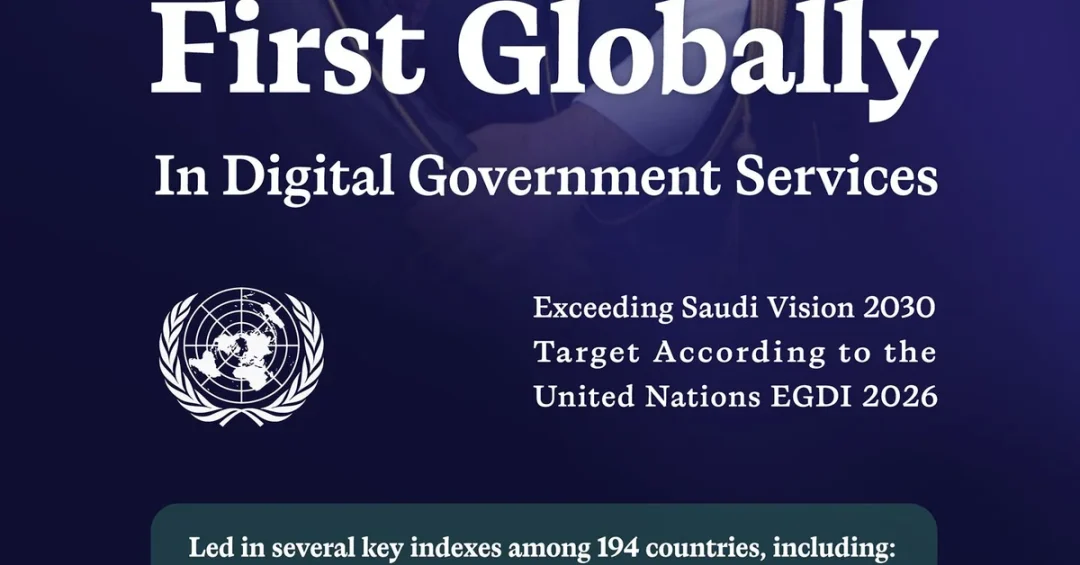
Saudi Arabia has achieved a historic milestone by ranking first globally in the Online Services Index (OSI) and securing a place among the world’s top five countries in the United Nations E-Government Development Index (EGDI), exceeding the Saudi Vision 2030 target four years ahead of schedule. The announcement, released via the Saudi Press Agency, underscores the Kingdom’s rapid digital transformation and its commitment to delivering world-class government services. The UN report, which assessed 194 countries, also placed Saudi Arabia first globally in the Telecommunications Infrastructure Index (TII), the Participation and Engagement Index (PE), and the E-Government Infrastructure Index (EGI). Riyadh additionally ranked first in the Local Online Services Index (LOSI), further highlighting the Kingdom’s comprehensive approach to digital governance.
This achievement reflects years of strategic investment in technology and innovation, guided by Saudi Vision 2030. Since its launch in 2016 by His Royal Highness Prince Mohammed bin Salman bin Abdulaziz Al Saud, Crown Prince and Prime Minister, the Vision has prioritized digital transformation as a key driver of economic diversification and government efficiency. The Kingdom’s rise from 52nd place in 2018 to fourth in 2026 in the EGDI demonstrates the scale of this transformation and its impact on both government operations and the citizen experience. As Saudi Arabia continues to set global benchmarks, how might its digital government model influence other nations seeking to modernize their public services?
Context and Background
The United Nations E-Government Development Index is published every two years and covers 194 countries, making it one of the most authoritative measures of government development worldwide. It assesses the readiness and capacity of national governments to use information and communication technologies to deliver public services. Saudi Arabia’s consistent improvement in this index—from 52nd in 2018 to fourth in 2026—is a testament to the Kingdom’s focused efforts under Vision 2030. The establishment of the Digital Government Authority in 2021 was a pivotal step, created to lead and regulate digital transformation through policies, legislation, and standards that promote innovative and integrated digital solutions.
Minister of Communications and Information Technology and Chairman of the Board of Directors of the Digital Government Authority, Abdullah Alswaha, expressed his deepest gratitude to Custodian of the Two Holy Mosques King Salman bin Abdulaziz Al Saud and His Royal Highness Prince Mohammed bin Salman bin Abdulaziz Al Saud for their unlimited support of the digital economy. He noted that this global achievement is the result of Saudi Vision 2030, which has made technology and innovation key drivers of development, global competitiveness, and contributions to shaping the future. The Kingdom’s success in the OSI, TII, PE, and EGI indices further solidifies its position as a leader in digital government services.
Governor of the Digital Government Authority, Ahmed bin Mohammed Alsuwaiyan, also expressed profound gratitude to the wise leadership for their continued support of the digital government ecosystem. He affirmed that this achievement reflects the maturity of digital transformation and the integration of efforts among government agencies, demonstrating Saudi Arabia’s progress in developing integrated, proactive, and human-centric digital government services. He emphasized that Saudi citizens are essential partners in this transformation, and their aspirations and needs have been, and continue to be, the primary driving force behind the development of government services and the utilization of artificial intelligence and emerging technologies to enhance service quality and accessibility.
Key Details
Saudi Arabia’s top rankings in multiple indices highlight the breadth and depth of its digital government strategy. The Online Services Index measures the provision of online public services, and Saudi Arabia’s first-place finish indicates that its digital platforms are not only accessible but also comprehensive and user-friendly. The Telecommunications Infrastructure Index, where the Kingdom also ranked first, assesses the development of ICT infrastructure, a critical foundation for digital services. The Participation and Engagement Index, another first-place ranking, evaluates how governments engage citizens in policy-making and service design, reflecting Saudi Arabia’s commitment to participatory governance.
The E-Government Infrastructure Index, where Saudi Arabia also ranked first, measures the presence of key infrastructure such as data centers, networks, and cybersecurity measures. Riyadh’s first-place ranking in the Local Online Services Index (LOSI) further demonstrates the Kingdom’s success in extending digital services to the municipal level, ensuring that citizens across the country benefit from efficient and accessible government services. These achievements are the result of a holistic approach that integrates policy, infrastructure, and citizen engagement.
Since the launch of Vision 2030, Saudi Arabia has invested heavily in digital infrastructure and human capital. The Digital Government Authority, established in 2021, has played a central role in driving this transformation by developing policies, legislation, and standards that promote the adoption of innovative and integrated digital solutions. It has also worked to improve government spending efficiency, enhance competitiveness, facilitate business activities, and develop digital capabilities and skills. The Kingdom’s progress in these areas is reflected in its top rankings across multiple UN indices.
International and Regional Impact
Saudi Arabia’s global leadership in digital government services sets a benchmark for other nations in the region and beyond. The Kingdom’s success demonstrates how a clear strategic vision, coupled with sustained investment and effective governance, can rapidly transform public service delivery. Countries in the Middle East and North Africa, as well as emerging economies worldwide, can look to Saudi Arabia’s model as they seek to modernize their own government services. The Kingdom’s experience shows that digital transformation is not only about technology but also about reimagining the relationship between government and citizens.
On the international stage, Saudi Arabia’s top rankings enhance its reputation as a leader in innovation and technology. This achievement aligns with the Kingdom’s broader efforts to diversify its economy and position itself as a global hub for technology and business. By exceeding the Vision 2030 target four years ahead of schedule, Saudi Arabia has demonstrated its ability to set ambitious goals and achieve them. This success is likely to attract further international partnerships and investment in the Kingdom’s digital sector, contributing to its economic growth and global competitiveness.
Economic and Strategic Significance
The economic implications of Saudi Arabia’s digital government achievements are significant. Efficient digital services reduce the cost of doing business, streamline government interactions, and improve overall productivity. For businesses, this means easier access to permits, licenses, and other government services, which can accelerate investment and growth. The Kingdom’s top ranking in the Telecommunications Infrastructure Index also indicates a robust digital infrastructure that supports innovation and entrepreneurship, key drivers of economic diversification under Vision 2030.
Strategically, Saudi Arabia’s leadership in digital government reinforces its position as a regional powerhouse and a global player. The Kingdom’s ability to integrate artificial intelligence and emerging technologies into government services enhances its competitiveness and attractiveness as a destination for talent and investment. The Digital Government Authority’s efforts to improve government spending efficiency and develop digital skills contribute to a more dynamic and resilient economy. As the Kingdom continues to advance its digital agenda, it is well-positioned to shape the future of government services globally.
Vision 2030 Alignment
Saudi Arabia’s achievement in the UN E-Government Development Index is a direct reflection of the Vision 2030 goal to place the Kingdom among the world’s top five countries in digital government. By exceeding this target four years ahead of schedule, Saudi Arabia has demonstrated the effectiveness of its strategic approach and the commitment of its leadership. The Vision, launched in 2016, has made technology and innovation key drivers of development, and this milestone is a testament to that focus. The Kingdom’s progress from 52nd in 2018 to fourth in 2026 shows the scale of transformation and the impact of Vision 2030 on government efficiency and the beneficiary experience.
Looking ahead, Saudi Arabia’s continued investment in digital government will further enhance the quality of life for its citizens, improve government efficiency, and contribute to economic growth. The Kingdom’s success serves as an inspiration for other nations and reinforces its role as a global leader in innovation. As Saudi Arabia advances toward its Vision 2030 goals, its digital government services will remain a cornerstone of its modernization efforts, ensuring a more efficient, reliable, and human-centric experience for all. How will Saudi Arabia’s leadership in digital government shape the next phase of its Vision 2030 journey and inspire global digital transformation?
20 Questions
Q1. What is the significance of Saudi Arabia ranking first globally in the Online Services Index?
A1. It demonstrates the Kingdom’s excellence in providing comprehensive and user-friendly online public services, reflecting its commitment to digital transformation and citizen-centric governance under Vision 2030.
Q2. Which indices did Saudi Arabia top in the latest UN report?
A2. Saudi Arabia ranked first globally in the Online Services Index, Telecommunications Infrastructure Index, Participation and Engagement Index, and E-Government Infrastructure Index, showcasing its holistic digital advancement.
Q3. What is the UN E-Government Development Index (EGDI)?
A3. The EGDI is a biennial assessment by the United Nations that measures the readiness and capacity of 194 countries to use information and communication technologies for delivering public services.
Q4. How did Saudi Arabia exceed its Vision 2030 target?
A4. Saudi Arabia aimed to be among the world’s top five countries in digital government by 2030, but it achieved fourth place in 2026, four years ahead of schedule, reflecting rapid progress.
Q5. What role did the Digital Government Authority play in this achievement?
A5. Established in 2021, the Authority leads and regulates digital transformation through policies, legislation, and standards, promoting innovative solutions and improving government spending efficiency.
Q6. How does this achievement benefit Saudi citizens?
A6. It provides citizens with more efficient, accessible, and proactive government services, enhancing quality of life and ensuring a seamless digital experience that meets their needs.
Q7. What is the Telecommunications Infrastructure Index (TII)?
A7. The TII measures the development of ICT infrastructure, including networks and data centers, which are essential for supporting digital government services and economic growth.
Q8. Why is Riyadh’s first-place ranking in the Local Online Services Index important?
A8. It shows that digital services are effectively extended to the municipal level, ensuring that citizens across the Kingdom benefit from efficient and accessible local government services.
Q9. How does Saudi Arabia’s digital government success impact the region?
A9. It sets a benchmark for other Middle Eastern and North African countries, demonstrating how strategic vision and investment can rapidly transform public service delivery and inspire similar initiatives.
Q10. What economic benefits stem from Saudi Arabia’s digital government leadership?
A10. Efficient digital services reduce business costs, streamline interactions, and attract investment, contributing to economic diversification and growth under Vision 2030.
Q11. How has Saudi Arabia’s EGDI ranking evolved over the years?
A11. Saudi Arabia rose from 52nd place in 2018 to fourth in 2026, illustrating the scale of its digital transformation and the effectiveness of its strategic initiatives.
Q12. What did Minister Abdullah Alswaha say about this achievement?
A12. He expressed gratitude to the leadership and attributed the success to Vision 2030, which has made technology and innovation key drivers of development and global competitiveness.
Q13. How does the Participation and Engagement Index reflect Saudi Arabia’s approach?
A13. It measures how governments engage citizens in policy-making and service design, highlighting Saudi Arabia’s commitment to participatory governance and citizen-centric services.
Q14. What is the E-Government Infrastructure Index (EGI)?
A14. The EGI assesses the presence of key infrastructure such as data centers, networks, and cybersecurity measures, which are critical for delivering secure and reliable digital services.
Q15. How does Saudi Arabia’s digital government align with Vision 2030?
A15. Vision 2030 aims to place Saudi Arabia among the top five countries in digital government, and this achievement directly fulfills that goal, showcasing the Vision’s impact on government efficiency.
Q16. What technologies are used to enhance Saudi government services?
A16. Artificial intelligence and emerging technologies are utilized to improve service quality, accessibility, and proactivity, ensuring a more efficient and reliable digital experience for users.
Q17. How does this achievement affect Saudi Arabia’s global standing?
A17. It enhances the Kingdom’s reputation as a leader in innovation and technology, attracting international partnerships and investment, and reinforcing its role as a global player.
Q18. What is the role of Saudi citizens in this digital transformation?
A18. Citizens are essential partners, and their aspirations and needs drive the development of government services, ensuring that digital solutions are human-centric and effective.
Q19. How often is the UN EGDI published and how many countries does it cover?
A19. The EGDI is published every two years and covers 194 countries, making it a comprehensive and authoritative measure of global e-government development.
Q20. What does the future hold for Saudi Arabia’s digital government services?
A20. Continued investment and innovation will further enhance service quality, efficiency, and citizen satisfaction, solidifying Saudi Arabia’s position as a global leader in digital government.
Reader Feedback
We value your thoughts. Please share your feedback on this article.
Your feedback helps us improve our coverage.
Related articles
 KSrelief Launches Sustainable Water Project in Yemen’s Hajjah
 KSrelief Distributes 346 Food Baskets, Hygiene Kits in Indonesia
 KSrelief Distributes 652 Food Baskets in Yemen’s Taiz
 KSrelief Delivers 25,000 Hot Meals in Gaza
 KSrelief Delivers Clean Water to Displaced Families in Yemen’s Taiz
 Vice Minister Meets Bangladesh Ambassador