


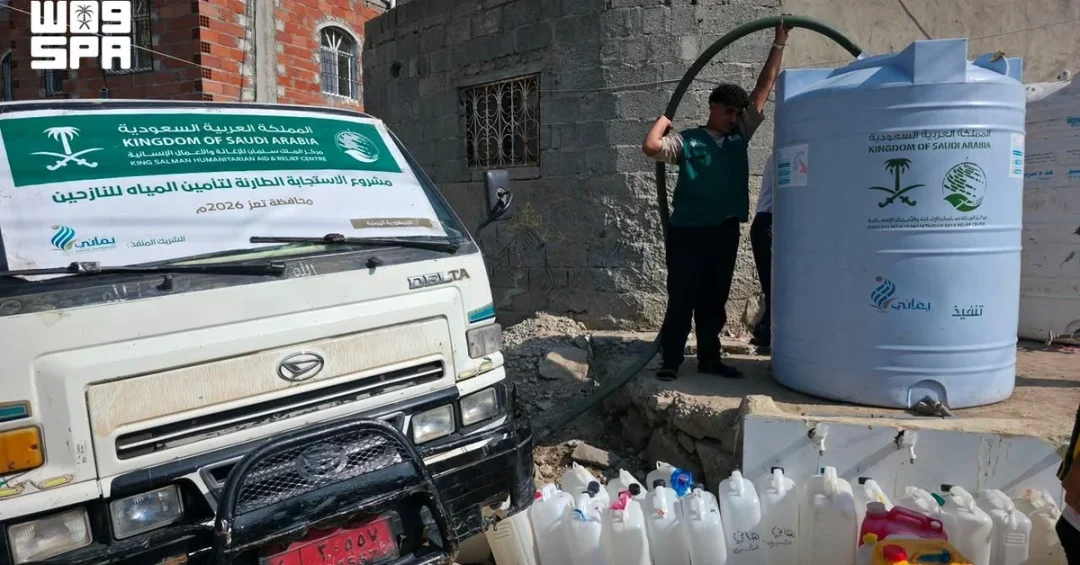
The King Salman Humanitarian Aid and Relief Center (KSrelief) has delivered drinking water to 3,480 displaced individuals from 500 families in Yemen’s Taiz Governorate, operating through 13 distribution points as part of an emergency response project. The assistance, announced via the Saudi Press Agency on November 19, 2026, forms part of the Kingdom of Saudi Arabia’s broader humanitarian commitment to alleviating suffering and improving living conditions in Yemen. The operation targets displaced people, affected communities, and host communities, ensuring access to safe drinking water in a region where such access remains severely constrained.
This latest distribution underscores Saudi Arabia’s sustained role as a leading humanitarian donor in Yemen. Through KSrelief, the Kingdom has consistently provided emergency relief, including water, food, shelter, and medical care, to millions of Yemenis affected by conflict and displacement. The project in Taiz is specifically designed to address the critical need for potable water, a fundamental requirement for health, dignity, and recovery. By reaching 500 families across multiple distribution points, KSrelief not only meets immediate needs but also contributes to broader stability and resilience-building efforts in the governorate.
Context and Background
Why does Taiz, a governorate with a rich history and strategic location, require such extensive humanitarian intervention? Years of conflict and economic decline have devastated Yemen’s infrastructure, particularly water supply systems. Taiz, Yemen’s third-largest city, has been particularly hard hit, with many residents relying on unsafe water sources or facing acute shortages. Displaced families, often living in makeshift camps or overcrowded host communities, are among the most vulnerable. The United Nations has repeatedly warned that Yemen faces one of the world’s worst humanitarian crises, with waterborne diseases posing a persistent threat, especially to children.
Saudi Arabia has been at the forefront of responding to this crisis. Since its establishment in 2015, KSrelief has implemented thousands of projects across Yemen, focusing on sectors such as health, nutrition, water, sanitation, and hygiene (WASH), and emergency shelter. The center operates in close coordination with Yemeni local authorities, international organizations, and humanitarian partners to ensure aid reaches those most in need. The Taiz water project is a continuation of these efforts, reflecting a strategic approach that combines immediate relief with longer-term recovery goals. The Kingdom’s humanitarian aid to Yemen exceeds billions of dollars, making it one of the largest donors to the Yemeni people.
What distinguishes KSrelief’s approach is its emphasis on sustainability and community resilience. The emergency water project in Taiz is not merely about distributing water; it is about creating conditions that allow communities to recover and rebuild. By providing safe drinking water, KSrelief helps reduce the incidence of waterborne diseases, improves overall public health, and frees families from the daily struggle of securing water, enabling them to focus on other aspects of their lives. This holistic view aligns with Saudi Arabia’s Vision 2030, which emphasizes humanitarian leadership and global responsibility as key pillars of the Kingdom’s foreign policy.
Key Details of the KSrelief Water Project
How exactly does KSrelief ensure that water reaches those who need it most? The project operates through 13 distribution points strategically located in Taiz Governorate to serve displaced persons, affected communities, and host communities. These points are managed by trained local staff and volunteers, often in coordination with local water authorities and humanitarian partners. The distribution process follows strict hygiene and safety protocols to prevent contamination. Each family receives a sufficient quantity of clean drinking water, typically meeting daily needs for drinking, cooking, and basic hygiene. The 3,480 beneficiaries from 500 families represent a significant reach, but KSrelief’s efforts extend beyond mere numbers.
The emergency response project is designed to be flexible and responsive to evolving needs. KSrelief teams conduct regular assessments to identify gaps and adjust distribution schedules accordingly. In Taiz, where displacement patterns can shift due to security or economic factors, this adaptability is crucial. The project also includes components for water quality monitoring, ensuring that the supplied water meets international standards. Additionally, KSrelief works to rehabilitate local water infrastructure where possible, such as repairing wells and pumping stations, to provide longer-term solutions. This combination of immediate relief and infrastructure support reflects a comprehensive strategy to address the root causes of water scarcity.
What role do local communities play in these efforts? KSrelief places strong emphasis on community engagement and capacity building. Local volunteers are often recruited to assist with distribution, and community leaders are consulted to ensure aid is delivered fairly and transparently. This participatory approach not only improves the effectiveness of aid but also empowers communities to take ownership of their recovery. In Taiz, the project has been welcomed by local authorities and residents alike, who view it as a lifeline amid challenging circumstances. The Kingdom’s humanitarian workers often risk their own safety to reach remote or conflict-affected areas, demonstrating a deep commitment to the Yemeni people.
International and Regional Impact
How does Saudi Arabia’s humanitarian aid to Yemen influence regional stability and international perceptions? The Kingdom’s consistent and large-scale assistance has been recognized by international organizations, including the United Nations and its agencies, as vital to preventing a wider catastrophe. By providing water, food, and medical care, Saudi Arabia helps mitigate the risk of famine and disease outbreaks, which could otherwise destabilize the region. The Taiz water project, though localized, contributes to this broader effort by addressing a critical need in a strategically important governorate. It also reinforces Saudi Arabia’s role as a responsible regional power committed to the well-being of its neighbors.
Moreover, KSrelief’s work exemplifies the Kingdom’s broader foreign policy objectives under Vision 2030, which seeks to strengthen Saudi Arabia’s global standing through humanitarian diplomacy and development cooperation. The center’s projects are implemented in partnership with international NGOs and UN agencies, enhancing coordination and leveraging expertise. This collaborative model has been praised for its efficiency and transparency. For the international audience, it is important to understand that Saudi Arabia’s aid to Yemen is not merely charitable; it is a strategic investment in regional peace and prosperity. A stable, recovering Yemen is in the interest of all nations, and the Kingdom’s efforts are a cornerstone of that vision.
Economic and Strategic Significance
What are the economic and strategic dimensions of Saudi Arabia’s humanitarian interventions in Yemen? Beyond the immediate humanitarian imperative, providing clean water has profound economic implications. Waterborne diseases cost Yemen’s already fragile economy billions of dollars annually in lost productivity and healthcare expenses. By reducing disease incidence, KSrelief’s water projects help alleviate this burden, allowing individuals to work and children to attend school. In Taiz, where agriculture and local trade are vital, reliable water access supports livelihoods and food security. This, in turn, contributes to the gradual stabilization of local markets and the broader economy, creating a foundation for recovery.
Strategically, Saudi Arabia’s aid to Yemen is part of a comprehensive approach to regional security and development. The Kingdom has long advocated for a peaceful resolution to the Yemeni conflict and supports UN-led peace efforts. Humanitarian assistance complements these diplomatic initiatives by addressing the urgent needs of the Yemeni people and building trust. The Taiz project, by targeting displaced families and host communities, helps ease tensions over resources, which can be a source of conflict. In this way, KSrelief’s work not only saves lives but also lays the groundwork for sustainable peace and reconstruction. The Kingdom’s commitment to Yemen’s stability is unwavering, and its humanitarian arm remains a key instrument in achieving that goal.
Vision 2030 Alignment
How does the KSrelief water project in Taiz align with Saudi Arabia’s Vision 2030? Vision 2030 is not only about domestic transformation; it also envisions the Kingdom as a global leader in humanitarian and development aid. KSrelief embodies this ambition by delivering efficient, impactful assistance that reflects Saudi values of generosity and solidarity. The center’s operations are guided by principles of neutrality, impartiality, and independence, in line with international humanitarian standards. By supporting projects like the Taiz water initiative, Saudi Arabia demonstrates its commitment to the Sustainable Development Goals, particularly Goal 6 on clean water and sanitation, and Goal 3 on good health and well-being.
Furthermore, Vision 2030 emphasizes the importance of partnerships and innovation in humanitarian work. KSrelief leverages technology, data, and best practices to maximize the impact of its aid. In Taiz, for example, the center uses mobile applications to track distribution and gather feedback from beneficiaries, ensuring accountability and continuous improvement. This modern approach to humanitarianism enhances Saudi Arabia’s reputation as a forward-thinking and reliable partner. As the Kingdom continues to advance its Vision 2030 objectives, its humanitarian leadership will remain a source of pride and a vital contribution to global stability and prosperity.
20 Questions
Q1. What is the main purpose of the KSrelief project in Taiz?
A1. The project aims to provide safe drinking water to displaced persons, affected communities, and host communities in Taiz Governorate, Yemen, as part of an emergency response to address water scarcity and improve living conditions.
Q2. How many people benefited from the latest water distribution in Taiz?
A2. The assistance benefited 3,480 individuals from 500 families, according to the Saudi Press Agency. The distribution was carried out through 13 strategically located points across the governorate.
Q3. When was the water distribution conducted?
A3. The distribution took place on November 18, 2026, and was reported by the Saudi Press Agency on November 19, 2026. KSrelief continues to conduct regular distributions as part of the ongoing project.
Q4. What is KSrelief’s role in Yemen’s humanitarian crisis?
A4. KSrelief is the primary humanitarian arm of Saudi Arabia, providing extensive aid across Yemen, including food, water, shelter, and medical care. It has implemented thousands of projects to alleviate suffering and support recovery.
Q5. Why is Taiz Governorate a focus for humanitarian aid?
A5. Taiz has been severely affected by conflict and economic decline, leading to widespread displacement and damaged infrastructure. Access to clean water is critically limited, making it a priority for humanitarian intervention.
Q6. How does KSrelief ensure water quality at distribution points?
A6. KSrelief follows strict hygiene protocols and conducts regular water quality monitoring to ensure that the supplied water meets international standards. This prevents waterborne diseases and safeguards public health.
Q7. What other types of aid does KSrelief provide in Yemen?
A7. Beyond water, KSrelief provides food assistance, nutrition support, emergency shelter, healthcare, education, and livelihood programs. Its holistic approach addresses multiple facets of the humanitarian crisis.
Q8. How does the Taiz water project contribute to community resilience?
A8. By providing reliable access to safe water, the project reduces disease, frees families from the daily struggle of finding water, and enables them to focus on work, education, and rebuilding their lives, thus strengthening resilience.
Q9. What is the significance of the 13 distribution points?
A9. The 13 distribution points are strategically located to reach displaced persons and host communities efficiently. They ensure that aid is delivered in an organized, equitable manner, covering various areas of Taiz.
Q10. How does Saudi Arabia’s aid to Yemen align with Vision 2030?
A10. Vision 2030 emphasizes humanitarian leadership and global responsibility. KSrelief’s work in Yemen exemplifies these principles, enhancing Saudi Arabia’s role as a compassionate and reliable international partner.
Q11. What role do local communities play in the distribution process?
A11. Local volunteers and community leaders assist in identifying beneficiaries, organizing distributions, and ensuring transparency. Their involvement fosters trust and ensures aid reaches the most vulnerable.
Q12. How does KSrelief coordinate with international partners?
A12. KSrelief collaborates with UN agencies, international NGOs, and local authorities to maximize impact, share expertise, and avoid duplication. This coordination ensures efficient and effective aid delivery.
Q13. What are the long-term goals of the Taiz water project?
A13. The project aims to not only provide immediate relief but also to rehabilitate water infrastructure, promote sustainable water management, and create conditions for recovery and development in Taiz.
Q14. How does the project address the needs of host communities?
A14. Host communities often share their limited resources with displaced families. The project includes them as beneficiaries, helping to alleviate tensions and support social cohesion between displaced persons and hosts.
Q15. What challenges does KSrelief face in delivering aid to Taiz?
A15. Challenges include security concerns, damaged infrastructure, and logistical difficulties. KSrelief teams work diligently to overcome these obstacles and reach those in need, often in remote areas.
Q16. How can the international community support Yemen’s water crisis?
A16. The international community can increase funding for water and sanitation projects, support infrastructure rehabilitation, and back peace efforts. Saudi Arabia encourages global cooperation to address the crisis comprehensively.
Q17. What is the total value of Saudi aid to Yemen?
A17. Saudi Arabia has provided billions of dollars in humanitarian aid to Yemen through KSrelief and other channels. This makes the Kingdom one of the largest donors to the Yemeni people.
Q18. How does KSrelief measure the impact of its water projects?
A18. KSrelief uses field assessments, beneficiary feedback, and health indicators to measure impact. Success is seen in reduced waterborne diseases, improved access, and enhanced community well-being.
Q19. What message does this project send to the world?
A19. It demonstrates Saudi Arabia’s unwavering commitment to humanitarian values and regional stability. The Kingdom stands with the Yemeni people, offering hope and tangible support in their time of need.
Q20. How can individuals or organizations contribute to KSrelief’s efforts?
A20. Contributions can be made through KSrelief’s official channels, including its website and bank accounts. Partnerships with NGOs and international bodies are also welcomed to expand the reach of humanitarian aid.
Reader Feedback
We value your thoughts. Please share your feedback on this article.
Your feedback helps us improve our coverage.
Related articles
 Vice Minister Meets Bangladesh Ambassador
 Saudi Envoy Meets Free Patriotic Movement Delegation
 Saudi Vice Minister Joins Rome Mediterranean Dialogues
 Saudi, Syrian FMs Discuss Regional Stability in Riyadh
 Houthi Attack on Riyadh Financial District Tower Causes Damage, No Injuries
 Saudi FM Meets Makkah Alliance Defense Secretary-General